
American Pachuco: The Legend of Luis Valdez
10/6/2026 | 1h 31m 1sVideo has Closed Captions
Discover filmmaker and playwright Luis Valdez, a founding figure of the Chicano Movement.
Follow the legacy of filmmaker and playwright Luis Valdez. A founding figure of the Chicano Movement, Valdez is best known for his play Zoot Suit, the Ritchie Valens biopic La Bamba and the theatre company El Teatro Campesino.
Problems playing video? | Closed Captioning Feedback
Problems playing video? | Closed Captioning Feedback
Support for American Masters is provided by AARP, The Rosalind P. Walter Foundation, Thea Petschek Iervolino Foundation, Burton P. and Judith B. Resnick Foundation, The Philip and Janice Levin Foundation,...
Support provided by:

American Pachuco: The Legend of Luis Valdez
10/6/2026 | 1h 31m 1sVideo has Closed Captions
Follow the legacy of filmmaker and playwright Luis Valdez. A founding figure of the Chicano Movement, Valdez is best known for his play Zoot Suit, the Ritchie Valens biopic La Bamba and the theatre company El Teatro Campesino.
Problems playing video? | Closed Captioning Feedback
Where to Watch American Masters
American Masters is available to stream on pbs.org and the PBS app.
Buy Now
A front row seat to the creative process
How do today’s masters create their art? Each episode an artist reveals how they brought their creative work to life. Hear from artists across disciplines, like comedian Chris Fleming, actor Greg Kinnear, sports journalist Taylor Rooks, and more on our video podcast "American Masters: Creative Spark."Providing Support for PBS.org
Learn Moreabout PBS online sponsorship♪♪ ♪♪ [Big band swing plays faintly] [Dog barking in the distance] [Swing music continues, echoing and dreamlike] ♪ [Music softens] Narrator: Ladies and gentlemen.
It has come to my attention that some of you don't know the story of Luis Valdez.
The man is a living legend.
He wrote the script for a whole generation of theater and film for our people.
[Laughs] Who am I?
Don't sweat it, ese.
We'll get acquainted soon enough.
All that you need to know for now is that I'm The Pachuco, and I'm your guide to this story.
But it ain't my story.
[Haunting tones playing] It's his.
So, kick back, relax, and ask yourself, why don't I know the legend of Luis Valdez?
[Music crescendos, fades] [Projector whirs and clicks] [Slow drumbeat playing] Olmos: What makes Luis Valdez Luis Valdez is Luis Valdez.
There's never been anybody like him.
Ever.
[Laughs] Ronstadt: He's a director.
He's a writer.
But I think of him as a "brujo," a witch man, a magician.
Marin: This was heavy political theater told with a sense of humor.
$15,000 for a mere Mexican?
Sancho: Mexican?
What are you talking about, lady?
This is a Mexican-American.
You want that word, you pay for it!
Dolores Huerta: Luis Valdez could be described as a social arsonist.
[People yelling] Putting people on fire, getting people motivated, and getting them to light up.
Man: Chicano... Men: Power!
Man: Chicano... Men: Power!
Man: Chicano... Men: Power!
Words mean a lot.
Weigh the facts and enjoy the pretense.
Valdez's rebellion is through words.
Luis Valdez is the Shakespeare of Chicano theater.
[Drumbeat rises] [Upbeat music playing, cheering] Luis Valdez attracted a whole new audience to the theater with the success of "Zoot Suit."
Hackford: Luis wrote and directed "La Bamba."
♪ Bamba la Bamba ♪ Which still is the most successful Latino film ever made.
He has this voice.
It's like a lion's roar.
It goes right into you.
It's like Moses bringing the tablet down from the mountain.
[Drumbeat rises] Luis Valdez: My works speak for themselves.
They just happen to speak for an awful lot of other people.
We are human beings.
We laugh and cry like everybody else.
And you know what?
We make America strong because we are America.
[Drumbeat steady] [Music ends] [Subdued music playing] ♪ I was born in a farm labor camp in Delano, California.
My parents were born in Arizona.
They were farm workers.
At 6 years old, I joined my folks in the fields picking tomatoes, picking cotton, whatever there was to be picked.
We seemed to be beasts of burden.
[Subdued music continues] Oftentimes, they wouldn't get paid.
They had to work from sunup to sundown.
There were no bathrooms in the fields for the workers, no drinking water.
It was literally slave labor.
Luis: Farmworkers lived from hand to mouth.
Sometimes, if you don't work today, it means you won't eat today.
I lived that.
I lived that in my family.
We were 10 siblings.
Frank was the firstborn.
He was handsome, he was intelligent, and he was my hero.
He didn't want to be a farm worker for damn sure.
He wanted to do something with his life.
Socorro Valdez: Luis and Frank got the best of both my parents early.
It wasn't that they themselves were extremely educated, but they promoted the promise of better things in the kids.
[Cheerful kids' voices] Luis: So we went to a country school where we were the only Mexicans in the school.
[Lively music] My mother got a brown paper bag, made some egg tacos, and this is what I took to lunch.
Other kids had sandwiches and apples, so I had to eat my tacos like a wino, you know, drink this wine out of a bottle, kind of ashamed.
This brown little paper bag, that was my prized possession.
I would fold it and take it back to my mother.
One day my little brown paper bag was all ripped up and floating in a basin of water.
The teacher, she pulled out a piece of the bag, dipped it into some white paste, and put it on a mold.
And the mold was a face.
It was a monkey!
And she says, "It's for a play."
And so, I forgave her about the bag.
And I auditioned the next Monday for my first role, and I got it.
I was gonna be a monkey.
[Music stops, primate calls and barks] I couldn't wait for opening night, man.
I was ready.
Children: Ra, ra, ra, ra, ra!
[Tender music] Luis: The week of the show, my mother said, "We're leaving the camp tomorrow."
I said, "But, Mom, the show's on Friday."
She says, "I know, "but there's nothing we can do.
We're being evicted."
And as we were leaving in the morning and I saw the old school receding into the fog.
Being on the road, being virtually homeless, going from crop to crop and from camp to camp, I felt this hole opening up in my chest.
It... It could've destroyed me.
But I began to pour scripts and poems and screenplays into that hole.
It became the hungry mouth of my creativity.
Children: [Laughing] Danny Valdez: Where we lived, the labor camps, my brother Luis, he would perform and put on these shows.
The kids would all gather around to see the puppets that he'd made.
He had this need to bring people joy.
And in a labor camp, nothing is more refreshing than a puppet show.
[Laughs] It was magic to see that happen.
[Dreamy, echoing laughter] The incredible thing was, I had these two brothers, Frank and Luis, who were very intellectual, and they were the brains of the family.
[Chime rings, echoes] Narrator: Pues, órale, let your Pachuco friend fill you in.
Luis's older brother, Frank, carried his own pain from all those years of being pushed around, never really feeling like he belonged anywhere.
And he began to think that education was the way to climb the ladder, ese.
The brothers decided to take on the biggest challenge they could imagine: college.
[School bell rings] Luis: Frank decided to become a math and physics major.
I was the second one right behind him.
We were going to be engineers, but I got tired of people asking if I could speak English.
[Spirited music playing] One of my motivations for studying English as a major was that I wanted to be absolutely in control of the language.
As they say in Spanish, "Dominar el inglés."
To dominate English.
Now, that term kind of appealed to me because I could dominate the insecurities of my life.
I could dominate racism.
Maybe what the world needed were more playwrights of my background.
Frank said, "You're crazy.
"You can't make any money off of writing plays."
And I said, "I don't care about the money.
"I just want to do this."
Frank thought, "Here's my younger brother.
"We're gonna come and make an impact "in the scientific, mathematical world."
And then Luis shot the wad and went the other way.
Luis: I launched my first full-length play, "The Shrunken Head of Pancho Villa," an absurdist comedy.
[Spirited music continues] My older brother was a character in it.
I was a character in it, my sisters.
It was really an attempt for me to make sense of the 1950s with my family.
Why were we still poor in a moment of great prosperity in America?
When I went to go see "The Shrunken Head," I was blown away.
I was taken by the idea, the fact that he had put our reality on the stage.
We live in the land of opportunity, a land where anybody can start at the bottom, even in the fields, and become a rich man before he can say... [Shrieking] [Shrieks] Narrator: [Cackles] "The Shrunken Head of Pancho Villa."
It ain't just jokes, ese.
Luis was starting to see something real.
Our stories, our pain, our laughter, they belonged on that stage same as anybody's.
If he could write them true, maybe we don't have to walk with our heads down no more.
Maybe we finally belong here, on the stage of America.
[Ominous laughter builds, then fades to chill funk jazz] Luis: San Francisco was one of my formative influences in the 1950s.
Man: Pantalone, don't do anything hasty.
Luis: So, I joined the San Francisco Mime Troupe.
I'd never seen a piece of theater that opened up a social question with so much fun and so provocatively.
We get richer, and you get screwed.
Audience: [Laughs] Luis: You combine that with the marijuana in the air, the LSD, the music, and opposing the war in Vietnam.
It was a cultural revolution that was taking place.
[Music continues] In the middle of all of this, my father showed me a newspaper.
♪ It had photographs of the grape workers who were on strike.
And I said, "Where's this coming from?"
He says, "From Delano," where I was born.
Man: ¡Viva la huelga!
People: ¡Viva!
Man: ¡Viva la causa!
People: ¡Huelga, huelga, huelga!
[Music continues, strikers cheering] We are your brothers and sisters over here.
Come out!
Come on out!
Woman: ¡Estos patrones no los necesitan a ustedes como nosotros los necesitamos ahorita!
[Yelling, sirens] Luis: The farmworkers had a really formidable opposition in the agribusiness structure of California.
[Pensive music playing] I don't think any of these places really speak of prosperity or security of any sort.
Thousands and thousands of people are living like this.
It's unfair.
It's an injustice when you think about it.
It's unbearable when you have to live through it.
[Forlorn music playing] Protestors: ¡Huelga, huelga, huelga!
Luis: To ask farm workers to stop today and fight for a better cause and a union contract tomorrow when they've got hungry children at home to feed, it's perfectly understandable that they didn't want to stop work.
They don't know who you are.
Farmworker: I am just a working man.
Come on out, brothers.
We are waiting for you.
Luis: So, I pitched Dolores Huerta an idea.
I said, "I have an idea of a theater "of, by, and for farmworkers."
Delano could be the place where this could get done.
You have a striking workforce.
You have people that are trying to express themselves.
Dolores: Luis came up and he asked me, "Do you think that they would like "to have a theater group in Delano?"
To take away that fear that the farmworkers might have about joining the strike.
The idea of a workers' theater is a little bit off the wall.
I was talking about theater in the middle of a strike.
So I tried to explain this in an activist kind of way that we could use signs, music, masks, chants, and that this would become elements that would activate a picket line.
I love theater.
So I told Luis, "Could you come down with a caravan?"
Luis: So then, I went full circle.
Go back to my roots, to go back to Delano.
There was a feeling of destiny, that I was meant to do this.
All: ¡Huelga, huelga, huelga!
¡Huelga, huelga!
Chávez: Venga.
Venga.
Oiga, compañero.
Luis: And I kept becoming more and more interested in who this guy César Chávez was.
Narrator: Hold on, ese.
Let me tell you who César Chávez was.
He was one of the founders of the farmworkers' movement alongside Dolores Huerta and Larry Itliong.
[Solemn music playing] We thought César was one of us, we held him up as a saint, but history would tell a different story down the line.
Dolores welcomed the farmworker theater with open arms.
But César... he was a king to these people.
Held the reigns tight.
Luis had to get through to him.
Luis: He had a big ego under the humility, actually.
I was reluctant to talk to César about it because I didn't want him to take me as a fool.
You know, I'm coming in, talking about doing theater.
He's got this grape strike happening.
[Crowd cheering] His response was, "OK, I like your ideas," he says, "They're fine.
"But I want you to know that there's no money, "there are no actors, there's no theater, "there isn't even any time to rehearse.
"We're on the picket line night and day.
"Do you still want to do it?"
"Absolutely, César.
What an opportunity."
[Laughs] One of the first plays in Delano was this thing called "Death is Not a Scab."
It was an intellectual-pessimism, college-educated Luis coming in, trying to do something for farm workers, and it turned out to be a disaster.
They wanted hope.
They wanted laughter.
They wanted strength.
And so, we learned how to improvise everything.
That was a much better approach.
Well, the point is... is to take the rancher and to put him on the stage so that other people can see what he's like.
Only we'll do the acting.
[Laughter] You see?
There's a way to get back at them, and that's to make fun of them on the stage where everybody can see.
Hello, Jack.
How are you?
Let's talk English, eh?
Por favor.
Now we're in America.
Let's talk English, eh?
Man: Sí, por favor.
Actor: No, no.
You'll never work for me again.
You'll never work for me.
Audience: [Laughs] You'll never work for me again.
I know you.
But let me talk.
I know what's good for you.
I know what's good for all of you people.
That's what I want to tell you right now.
That there is no strike Man: ¡Huelga!
[Applause] Ready?
2, 3.
Go!
[Exciting strike music] ♪ Yo soy Chicano, tengo color ♪ ♪ Americano, pero con honor ♪ Luis: Some wonderful performers started to join the Teatro.
And of course, Danny, my younger brother, was one of our original cast members.
The magic was incredible.
[Cheering] It felt like a Mexican Revolution.
Because we still claim... we still claim that there are reds and agitators.
Audience: [Boos] No, no.
Hold on... Audience: [Boos continue] Hold on.
Among you Mexicans.
[Boos and yells rise] [Laughter] Socorro: When I was still in junior high, my parents took us.
There was no theater.
We were out in the fields, and there were so many people!
In the midst of all the pain and the midst of all the struggle, to hear that many people laughing, that was incredible to me.
[Laughter continues] Danny: We felt very strong about our identity.
We were a theater company.
We were The Farmworkers' Theater.
♪ Defiendo a mi raza ♪ ♪ Con mucho valor ♪ [Song ends with a flourish and gritos] It's like you're running through the jungle, and you hear the Beatles for the first time.
Well, I don't care if it's the jungle.
These Beatles can play.
[Fast music playing] ♪ Luis: In one of my most popular pieces, the worker and the boss exchange identities.
The worker grabs what used to be the boss and the boss starts to complain saying, "I need help!
I'm going on strike!
"¡Huelga!
¡Huelga!"
Man: ¡Huelga!
¡Huelga!
Luis' theater can be very folkloric, and it can be very sophisticated at the same time because we're capable of both.
Audience: [Cheering] My favorite word that we use as a definition of our aesthetic is called "rasquachi" or "rasquachismo."
Narrator: Say it with me now.
Ras-qua-chi.
"Funky."
"Run down."
"Put together with spit and glue."
Some times, more spit than glue.
But if you do it with pride, it's rasquachi, ese.
Audience: [Laughs] Danny: Our costumes were what we could find, whatever we had.
Our characterizations were cardboard signs with a name written in the front.
That's rasquachismo.
That's rasquachi.
But it's also very powerful in the sense that it's so funky that nothing can undermine you.
Rasquachismo is a powerful force.
[Lively music playing, people laughing] Demonstrators: [Sing in unison in indistinct Spanish] Dolores: We had been on strike for several months.
The support that we were depending on, and the resources were kind of dying down.
And so we had to do something to draw the attention of the world.
So we decided on a march, and the march was gonna be from Delano to Sacramento.
[Powerful Latin fusion beat playing] ♪ [Music softens] Luis: It became an event such as the Valley had never seen before.
Danny: The Teatro performed in every city that the march went into.
We became the number one thing to draw people to the movement.
Jorge Huerta: They stopped in towns where the Teatro would perform songs, if not Actos, giving these people hope.
[Powerful Latin fusion beat, demonstrators chanting] Dolores: By the time we got to Sacramento, there were 10,000 people.
♪ Luis: On Easter Sunday of 1966, we won our first union contract.
It was an elation you couldn't believe.
[Mariachis play to enthusiastic cheers] [Boisterous cheers] Luis: That was a moment of arrival.
We had finally proven that it could be done.
It all made tremendous sense to me.
I was born here to do something with the talents that God had given me, as meager and as humble as they were.
As rasquachi as they were, I could still do something to make life better for all those around me.
[Chanting] [Song ends] [Traffic rushes] Narrator: So they won the first-ever union contract for farm workers in America.
But that was with just one grower in California.
[Singing in Spanish] ♪ Peleando por esta huelga ♪ Narrator: The union went nationwide, boycotting every grocery chain selling scab grapes.
♪ El picket sign, el picket sign ♪ ♪ Lo llevo por todo el día ♪ Luis: Our first national tour was all about dramatizing that struggle for people that would never know it directly.
It set us up to go into a whole different phase of our evolution.
Narrator: But the boycott became too big, and the union was stretched too thin.
[Ballad playing on acoustic guitar] Luis: There was a lot of criticism that Teatro wasn't doing enough, we were wasting our time.
♪ [Laughter] Narrator: César needed muscle on the picket line, not actors on the stage.
He told Luis to drop the Teatro, cold.
Danny: César was very adamant about putting everybody to work on the boycott.
He said, "Stop performing, leave the Teatro alone, "and be organizers."
But it broke our hearts.
Why can't we be who we are?
Luis: I said, "The only thing I can do "is pull the Teatro from the union."
And César was a little surprised.
He says, "Well, what are you gonna do?"
I said, "Go independent, I guess.
"I have no choice."
So we had no recourse but to move out.
[Indistinct conversations] [Ballad continues playing] Danny: The original idea of creating a Farmworker's Theater company was done, so we left with that heartache.
[Plane whistles] Luis: My older brother was going in the opposite direction.
Frank graduated and went to work as an engineer at Vandenberg Air Force Base.
Man: Vandenberg Air Force Base.
Luis: I wrote a poem, actually, where I talk about my brother as a missile-making Mexican, you know.
[Triumphant music playing] One of the first things that Frank did when he got his new job, he bought himself a Porsche.
And then he married a lovely woman, and she was Irish American.
And on their honeymoon, he went back to our hometown to introduce his wife, but also to show them his Porsche.
[Chuckles] He was doing a victory tour.
At the time, I didn't know where my next meal was coming from, but he's living the American Dream.
Frank said, "I couldn't believe that you went back there.
"You went back."
In some ways he felt that I was over here on the sidelines playing with my toys while he was dealing with the real world.
He's living his own life and I'm living mine.
Socorro: For Luis, it was very much a crisis in that he was separated from the closest sibling.
Losing Frank to another direction.
And he would've loved having his older brother Frank with him.
♪ [Plane rumbles] Danny: When we left the Union, we had to start all over again as a theater company.
We were on this little farm worker town, Del Rey, California.
Luis: Well, we set up a show, and nobody came.
It turned out that the campesinos that we were addressing now didn't have time for us.
[Ominous music playing] Danny: And in the middle of that, the country was in the Vietnam War.
Luis: A disproportionate number of Chicanos were serving in Vietnam.
The minorities were available as cannon fodder.
Before, we couldn't talk about Vietnam.
It would put the union in a very bad place.
But our politics was changing.
Luis: We were no longer limited to just working on the grape strike, so we began to evolve new pieces.
Protestors: Stop the war in Vietnam!
Bring our boys home!
Stop the war in Vietnam!
Bring...!
Esparza: When I first saw Luis and the Teatro, it blew me away.
I was struck by the fact that I had never seen Chicano Latino characters.
Actors: [Speaking indistinct Spanish] Esparza: And that was, like, a mind-bending experience.
It just opened up a whole new world for me.
[Solemn ballad on harmonica] Death: This is Johnny, el soldado raso.
He is leaving for Vietnam in the morning.
Luis: We put together a piece called "Soldado Razo."
It was much more serious, much more dramatic.
It's really the story of a soldier that's going off to war.
Death: [Gives a high, bright grito Mexicano] Esparza: It's narrated by Death.
And he'd come out and say, "Ay, ay, ay, ay, ay!
"Don't be afraid.
Come on.
"I'm not here to take anybody today.
"I'm here to tell you a story "about how Johnny gets drafted "and how the enemy "are people that look like himself, "and he starts to have questions "about what they're doing there."
And then, in the midst of one poignant scene, La Muerte shoots him.
[Gunshot] Woman: [Screams] [All sounds fade] Esparza: We went to El Paso, Texas.
They were proponents of the war.
The audience was heckling us.
"Boo!
Get out of here, communists!"
By the ending of the show, total silence.
["Taps" playing] The effect on audiences was truly amazing.
And they were no longer belligerent.
They got it.
Luis: It went over like hot tamales, man.
We really scored with this piece.
This was now Chicano theater.
Man: A!
All: A!
Man: B!
All: B!
Man: ¡Sí, chingón!
All: ¡Sí, chingón!
Luis: We started to perform on college campuses, and they inevitably would come up at the end of the performance and say, "How can we become part of this?"
So we began to recruit right off the campus.
Luis began to recognize the importance of addressing those college-age kids that were starting to identify with the word "Chicano."
Man: Chicano!
All: Power!
Man: Chicano!
All: Power!
Man: Chicano!
All: Power!
Man: Chicano!
All: Power!
Luis: "Chicano", like the word "El Pachuco," like the word "zoot suit," you know, it's of mysterious origin.
Nobody seems to really know where it came from.
The term "Chicano" originally started out as an insult from Mexicans to other Mexicans living in this country.
They were something else.
They were something smaller.
They were Chicos, Chicanos, you know, little satellite Mexicans.
[Folkloric music playing] Narrator: Word on the street is it goes back to how the Indigenous would say "Mexicano."
"Mechicano."
'Til some vato shortened it to "Chicano."
[Chuckles delightedly] The word started carrying some heavy weight.
It meant pride, ese.
Not Mexican, not American, but something in between that belonged to us.
A word that held everything we were and everything we were fighting to be.
I am Chicano.
[Echoing] Yo soy Chicano.
Chicano!
Chicano!
Chicano!
[Song ends on a flourish] ♪ Por eso los grandes amores de muchos colores ♪ Luis: There was a sense of growth coming out of the farm workers' movement into the Chicano movement.
[Mellow music playing] But in my personal life, I was a single person.
I didn't have a long-term girlfriend.
[Cheerful conversations and laughter] And so, one time after the show, this group of 5 lovely Chicanas came up to us backstage to talk.
One of them was Lupe Trujillo.
She ended up coming to visit us in Del Rey in our new theater, and out of that came her participation in Teatro Campesino.
In 1969, when we did our first international tour in France, we needed her as an actor, and it was on that trip to Paris that we became a romantic couple.
And it was like everything that a love story can be.
It was love.
[Laughs] What can I say?
Um... What he created, what we all created with him, was something that I believed in.
[Cheering] So he could always move a crowd.
All: ¡Arriba!
Lupe: Obviously, he moved me.
[Music continues] Luis: When we got married, it was on a pyramid.
We created a theatrical set.
It wasn't even a Catholic ceremony.
Lupe: It was a theatrical performance on a stage.
[Laughs] Luis: Half of her family left after the ceremony because they thought that she had been kidnapped by a cult.
Lupe: I felt like I was ready to join the circus.
There's one important thing is that he'd be American.
Man: American?
And I'm still here with the circus today.
[Saloon-style jazzy flourish] ♪ Danny: The show kept running, and people were actually paying money to see the Teatro.
And pretty soon it turned into theaters.
Audience: [Cheering] I liked the circus.
[Laughs] Luis said, "I will give you some different parts to play."
Like any kid sister, I think I said, "Well, you got to ask Mom."
[Laughs] Luis: She was a powerful performer.
Socorro: Did you like the United States?
Luis: With my sister Socorro, we evolved some of our most iconic pieces.
Aztec and Mayan mythology became part of our work.
Also, the Day of the Dead imagery, la calavera.
Garza: The work that Luis Valdez does in Teatro Campesino sets the stage.
It's a release of creative talent, and that well is what we drink from.
It's only water from the well of the people, and it should be given back to them in a cup of beauty.
And in drinking, understand themselves.
[Cheering] We published the first books of Actos, the first records of Chicano music, the first film, the first video shows, the first national broadcast.
The reason that all these firsts happened is because we were there first.
That's all.
We arrived at these shores when there was nothing else.
["Nothing From Nothing" playing] ♪ [Music glitches out] One of the first pieces that we developed on television was a play called "Los Vendidos," "The Sellouts."
I'm Honest Sancho, and this is my shop.
Más antes, I used to be a labor contractor.
Now I'm a businessman.
Qué suave, ¿no?
And he is selling various kinds of Mexicans.
Buyer: We're looking for a Mexican-type model for our administration.
Sancho: Well, you came to the right place, señorita.
These are automatons.
That's the pretense, you know?
We have Honest Sancho selling these used Mexicans.
And so, she goes through the litany of several types.
Sancho: Listen to this.
[Clicking] ¡Viva Villa!
Buyer: That's awfully loud.
Oh, well, he's got a volume control.
[High-pitched] ¡Viva Villa!
They dressed me up like a very middle-class, educated person.
It even drove the message in deeper about this assimilation.
This "sellout" is the word "vendido."
Buyer: It's true we need Mexicans such as these, but it's more important that he be American.
Sancho: American?
Buyer: Yes.
Mexican, but American?
Buyer: That's correct.
Sancho: Introducing our Mexican-American... [Hums melody to "Stars and Stripes"] [Clicking] Buyer: Oh.
Oh, my goodness.
Where have you been hiding this one?
Sancho: He just arrived on the plane this morning.
She marches out, thrilled that she's got this Mexican-American.
Sancho: Bye, señorita!
Socorro: And then, in a moment's time, the Honest Sancho's character runs out of power.
The twist is he's the robot.
and those guys, the other characters that are there, they are the real people.
How much did she end up paying?
15,000 bucks!
That ain't bad!
Luis: This was now dealing with issues of identity, cultural as well as racial and political identity.
Because the objective of this little shop was to create enough Mexican-Americans that would be bought and sold within the system to integrate the whole of American society to go and infiltrate and become part of American Society.
Man: Listen, according to the map, we've got Chicanos infiltrating every major urban center in the U.S.
Man 2: All right!
Man: Look at this.
Los Angeles, San Francisco... Luis: The idea of that show came from my older brother.
Frank was looking for his happiness in terms of the values that America has always espoused.
But at the same time, he would tell you how much racism there was on this military base and that he was having troubles because he was brown.
I come before you tonight as a Mexican American, to tell you of the problems of the Mexican.
He needs to think American.
[Bangs podium] American.
[Bangs podium] American.
[Bangs podium] American.
American.
American.
American.
American.
God bless America!
God bless America!
God bless America!
Buyer: Oh, my!
He's patriotic, too.
Sancho: He loves that word.
Let me just make a little minor adjustment.
Socorro: Do I think Frank wanted to assimilate?
Well, yeah, because that was really the only available option.
And it wasn't even an option, man, it was a pie-in-the-sky dream, you know?
Those that made efforts never got very far.
And he said, "No, it never worked.
"It never worked.
I tried everything," he told me.
"I tried everything to fit in."
Luis: He had trouble sizing up himself with his past, you know?
The sense that he had been a farm worker just like me.
He didn't want to deal with that at all.
He cancelled that out.
But no one can do that.
You got to acknowledge your past.
You got to acknowledge your roots.
Socorro: It's easy to point a finger and say, "Ah, those guys were sellouts, vendidos."
But I think if you... you're human about it, you see the person underneath trying to find a way to break free from some of the things that all of us want to break free from: the cages that are being put on because they're Mexican or because they're poor.
In this case, we were both.
[Modern traditional Mexican fusion music playing] ♪ Luis: The Chicano Moratorium was the largest gathering of Chicanos in the history of the united States.
We marched for 5 miles.
[Indistinct voice on speaker] [Grito mexicano] The Chicano Moratorium was about the deaths in Vietnam, so we were protesting the death of so many veterans.
So we brought our calavera band to the march.
[Music playing] I had made contact with an L.A.
newsman, a journalist called Rubén Salazar, who was writing articles on Chicanos in the L.A.
Times.
The Mexican-American or the Chicano is not an immigrant to this part of the country.
We've always been here.
[Indistinct chanting] Luis: So we made a date to get together there at the Moratorium, and I was going to be interviewed.
And we went to the beginning of the march and I saw Rubén Salazar with his camera crews, And we said hello and he said he was looking forward to our interview.
And then we went on the march.
America had never seen Mexican-Americans march to these numbers, so it was a joyous event.
[Indistinct cries] But the first thing we noticed is that the LAPD were all amassing at one end of the park, and they looked like Roman legions.
They had their shields, they had their helmets, they had their clubs.
[Indistinct cries] We were on the stage, getting ready to sing to the crowd, and suddenly someone threw a smoke bomb.
It was a flare that came out from the police group and landed in the middle of the park.
And a Chicano ran out there and tossed it back at the cops.
And then a barrage, like missiles, of these smoke bombs came out, into the middle, and this time they reached the crowd.
[Explosions, screaming] [Explosion] So, some people confronted the cops and the cops then started to attack.
They ran forward with clubs and started to club people.
[Indistinct screaming] People were screaming and yelling as the cops attacked, and it was open warfare in Laguna Park.
And the riots then began.
[Sirens blare] [Gun fires] East L.A.
was in flames.
[Cacophony continues] I saw a young woman hit in the head.
Knocked down.
People were screaming and running, and there was a mass arrest taking place by several police officers with shotguns.
Trujillo: It was horrifying.
It was dangerous.
We were just trying to get to safety because we didn't know at any time that a bullet could pass and hit us.
Luis: Rubén Salazar ducked into a local bar called the Silver Dollar, and one of the L.A.
cops came and fired a flare into the bar, and it hit him in the head and killed him.
[Distant police sirens] Narrator: The death of Rubén Salazar hit our people hard.
The road ahead wasn't going to be easy, ese.
And for Luis, he began to wonder if he needed a new path forward.
Luis: For us at the Teatro Campesino, the bitterness and the anger and the disillusionment that the end of the '60s brought really made it necessary for us to find a permanent home.
Lupe and I came to San Juan Bautista, and we fell in love with it immediately.
In 1973, we were hosting Peter Brook and his International Centre for Theatre Research.
Hackford: Peter Brook is a big deal.
At the time, probably the most famous theater director worldwide.
He'd done revolutionary theater.
So, Danny... You know, Danny Valdez, my friend, he invites me up to go to San Juan Bautista, and I'm gonna go because I want to see Peter Brook.
These two, they're meeting.
They were doing a thing called the Conference of the Birds.
[Birdlike squawks and squeals sound] It was pretty far out.
[Squawks and calls continue] [Steady tones on harmonica] Esparza: Up until this time, people described us that we weren't really theater.
We were alternative theater.
We were outside the norm.
And I know it bothered Luis.
Luis: We'd been in the Chicano movement for years, but there was never enough time to really focus on the aesthetic of art and politics.
[Ethereal, haunting music playing] This interaction with Peter Brook really solidified that expression.
King: 3, two... Jester: [Nervous chuckle] Audience: [Laughs] King: [Cackles] Luis: It gave us a perspective about life in the theater that we had never had.
It made everyone extremely more serious about the work that we were doing.
What has brought this group into existence and the roots of the Chicano movement is the reality of what you can hold in the heart, and the reality of what you can hold in the soul.
One reality.
Esparza: Luis had come to a decision, that it was time to tell our story to a much bigger audience.
To create something more substantial for the mainstream of America.
And that was the gestation of the beginning of "Zoot Suit."
Narrator: Hold up.
Let me tell you what it meant to wear a zoot suit.
You had to be a pachuco.
Pachucos were street cats with style.
Young americanos, children of farm workers who hit the city.
We were the first to declare "aquí estamos," we are here.
With nothing but style and pride.
The zoot suit, those wide-brimmed lids, those threads that flowed like water.
This was our armor, our identity, our way of claiming our place on the stage when America wanted us invisible.
[Dark, lumbering jazz playing] Danny: The whole Pachuco myth was related directly to zoot suiters and the riot that took place in Los Angeles.
It was something Mexicanos never talked about.
Narrator: It all started with the Sleepy Lagoon murder in 1942.
Some vato in L.A.
got dropped in a street fight.
Nobody knew who did it.
The newspapers, they turned the whole city against us.
Then came the law.
They arrested more than 600 brown kids off the street for nothing.
Anyone wearing a zoot suit was a target.
Then they dragged our carnales through a rigged trial.
America was at war overseas, but we became the enemy at home.
[Streetcar bell dings] Then came the riots.
Navy boys started hunting our people in the streets like dogs.
[Flashbulb pops] I still see their faces, carnal.
Our zoot suits went from being our pride to bullseyes on our backs.
[Police whistle blows, men yelling] Luis: The really outrageous thing that happened is that these sailors and soldiers took it upon themselves to strip the Pachucos of their clothes.
To me, that means that these Pachucos are being stripped of their American identity.
[Distant siren, traffic hums] Portillo: At that time, when we were doing "Zoot Suit" in the '70s, the Chicano presence in film, television, theater was very minimal.
[Cartoon sings Cielito Lindo] Portillo: We were still in the era of Frito Bandito.
[Cartoon sings] ♪ Frito Bandito ♪ Portillo: Funny with a big hat.
And that's just racism.
Luis: So, I decided to attack the stereotype directly in "Zoot Suit".
I wanted someone who had the power to be able to stand tall.
And I decided to convey that sensibility into the character of El Pachuco.
[Funk music] It had to have a raconteur, you know, that could tell the story.
And so, I evolved El Pachuco as the major storyteller.
And we had to really dig to find an actor that could embody what I was after.
I wanted someone who was larger than life.
Danny was holding auditions, and this guy wandered in.
But Danny saw him in the hallway, and he said, "Are you here for the auditions for 'Zoot Suit'?"
He said, "What audition?"
[Flashbulb pops] It's amazing.
He comes in with his Humphrey Bogart face.
The style, the way he stood up.
He had the presence that we needed.
Olmos: I walked in as the character, and I didn't smile.
I didn't say hello.
I just looked at them.
[Upbeat percussion in the background] "¿Qué me ves?"
You looking at me?
You know me, or do you wanna know me?
[Big band "Zoot Suit" theme music] ♪ Esparza: He made the role his.
El Pachuco was a quadruple threat in that not only did he have to sing, act, and dance at the topnotch level, but his ability to go from English to Spanish to Caló, he had it!
It was fate.
Luis: In "Zoot Suit" I made a statement right at the get.
The Pachuco comes out, and he starts talking in the Pachuco patois.
It's a mishmash.
[Typewriter keys clacking] It's based on Caló, which is street slang in Mexico City.
Olmos: And it was a language that was understood by some, but no one understood all of it unless you were truly a Pachuco.
Because it was... [Bang] [Reciting lines in Caló] Que le voy a echar mis trapos.
¿Sabe qué?
Estas garras me las planté porque nos vamos a dejarnos caer en un place.
Cómo se me hace que eres puro verdolaga.
Tú eres puro... square, ese.
[Snap, bang] El Pachuco: Get up and escape, Henry.
Leave reality behind.
[in Caló/Spanish] Con tus buenas garras cual chamberlain.
Narrator: So now you know me, carnal.
Luis created me on the page to take control of the story.
I was the master of ceremonies.
I moved between worlds.
I could snap my fingers and stop time cold.
Two more Mexicans killing each other.
Narrator: Nobody had ever put a Pachuco like me, center stage, with this kind of power.
El Pachuco: Everybody's looking at you, ese.
Narrator: I wasn't just another character in somebody else's story.
I was the one telling it like it is.
[Snap, bang] Luis knew what he was doing, carnal.
He gave me the voice that our people needed to hear.
[Eerie music] Luis: I gave the Pachuco his reign.
This kind of quality made him a superhero in some ways, made him a magical being that could control the storytelling and the pace of the play.
Man on movie: In the American way of life.
El Pachuco: Perdón, señor.
Narrator: He became my stand-in for the power to tell the story in the way that I wanted to tell it.
El Pachuco: Pues, don't take the [bleep] play so seriously, Jesus.
[Audience laughs, echoing eerily] It's puro vacilón, ese.
Watcha.
[Big band music, dancers cheering] Luis: Then, of course, there's the gang itself.
But my brother Daniel ended up doing Henry Reyna, the so-called leader of the gang.
[Keys clack, door squeals open] [Door slams] Narrator: Henry Leyvas was a Pachuco with too much self-worth, so they tagged him as the ringleader.
[Flashbulb pops] He was exonerated years later, but that didn't matter to the courtroom trying to pin down a brown face.
Danny: I felt his pain, and he was a young Chicano trying to find himself.
[Military march plays over a big band tune] He was a victim, and he was being singled out.
It's the injustice, that's what drives him.
[Jazz number plays in the film] What I've tried to express through Henry was his struggle with just being allowed to be a human being, be an American.
[Camera shutter clicks] Esparza: When we did the first reading, which was phenomenal, everyone realized there was something to be had there.
Portillo: Some of us were trained, some of us were not.
All of us were making theater.
It was heaven.
I mean, you just keep looking to have experiences like that where you're really at the beginning of something, but you know it's special.
Chorus: ♪ Vamos a bailar el swing, hey!
♪ Luis: The initial run, the first two weeks that we did completely sold out before I had even finished the play.
I could feel the pressure.
We could all feel the blood pressure in Los Angeles.
Esparza: People started lining up at 6, 7:00 A.M.
first day tickets went on sale, and the line went completely around the block.
[Engines rumble] Chorus: ♪ Cuando voy al vacilón ♪ ♪ Y me meto a un salón ♪ Ronstadt: We all dressed up in '40s clothes.
We got some guys that had lowrider cars.
We cruised down Sunset.
I just never had seen anything like that.
It was like coming home, to me.
[Engines roar, paper rips] Olmos: The first time I walked out on the stage and slit the newspaper, and I stood there and saw them erupt, it was like a standing ovation just watching, looking as those people stood up and cheered.
I mean, right there.
[Kiss] Punto.
You're speaking my language.
We're talking to each other.
"Zoot Suit" at the Mark Taper Forum begins to break a consciousness and begins to reveal that there's a wider audience.
I went to go see the show, and I was just speechless.
To see yourself on stage, being portrayed, owning who you were.
I mean, I think I'm getting emotional now, but... I never experienced that before.
[Rousing applause, cheers] Portillo: It wasn't just a standing ovation.
It wasn't just we did a good job.
It was a statement about belonging.
Those of us on the stage knew that.
Luis: We had sold out the run before we opened.
1,200 seats.
People coming from all over, but especially from East Los Angeles, to see a play in Hollywood that reflected them as no play had ever reflected them before.
My heart's still beating.
It was fantastic.
My dad was a Pachuco, and, you know, it's a lot of cultural significance in this play.
And, well, it depicts something that actually happened.
Mom and dad, when they were young, they were like Chucos and Chucas.
And the reason why I'm dressed like this, because it's my mom's suit, you know.
For the very first time, Latinos were going to the theater and actually paying money for tickets to go see a play about Pachucos.
It was our "Rocky Horror Picture Show," man, because the audience started coming dressed in the costumes.
Some of them wore costumes better than ours.
I mean, it was... It was an incredible response that took place.
Órale.
That's the beauty of Luis's work.
Somos familia.
Somos Mexicanos.
Somos Chicanos.
[Camera flashes] Olmos: And to this day, it was the most iconic moment in theatrical history for the Latino people in the United States of America.
[Camera flashes] Valdez: There has never been any other production in L.A.
that has run a play, original play, for that length of time.
They even bought the building, the Aquarius Theater, in order to house "Zoot Suit".
It had sold-out audience all the way through until they went to New York.
Well, if the audience in New York is just half as enthusiastic as it has been on the West Coast, "Zoot Suit" will be Broadway's next smash hit.
El Pachuco: Pues, órale.
[Big band music starts in the play] Danny: The Shubert Organization came to see us and said, "We wanna bring this show to Broadway."
It was like, okay.
Okay.
[Delighted laugh] Let's do it.
[Upbeat freeform jazz plays] ♪ Portillo: It was earth-shattering.
It was a dream come true.
Luis: I had never dreamed about going to New York.
New York is a long way, almost all the way to Europe... [Chuckles] ...in some ways, in Chicano eyes.
As it turns out, we went to the Winter Garden.
It was a grand old lady.
All the major classics were at the Winter Garden theater.
Major stars had played on that stage.
So it was a little intimidating to me.
[Broadcast glitch] Narrator: Hey.
Let me tell you a little secret, carnal.
This was all very intimidating to this vato.
[Chuckles] [Camera flashes] Luis: It felt like we had landed on the moon.
Olmos: We came in guns blazing, man.
I mean, it was just like full-scale.
The zoot suiter, el Pachuco, was everywhere.
[Freeform jazz continues] Danny: The uncertainty was this was a Chicano play.
Who in the hell is going to understand Chicano reality in New York?
I did this interview with The New York Times prior to the opening, and they said, you know, "You're the first Chicano play on Broadway."
I said, "Yeah?"
"Yes."
He said, "I hope it all goes for you, "but this town will eat you alive."
[Jazz ends] Luis: I kind of had this feeling before we opened.
We were into dress rehearsals, and we were having some technical problems with the lighting, some pauses and some glitches, and we were waiting.
And so, I began to get a little nervous, you know, because we were into our final rehearsals, you know, before we opened.
I was suddenly consumed with a fear of my own mortality.
And I began to lose breath.
I began to say, "I gotta get out there and walk."
And so, I left the rehearsal.
[Labored breaths, city commotion] I walked out of the Winter Garden, and I walked out into Times Square.
The traffic, the sounds, the lights.
[Lights pulse, crackle] It was too much.
It was an anxiety attack of major proportions.
[Unsettling droning] I had, then, a premonition.
I said, "We're gonna crash."
[Unnerving hum of traffic] And the only way that I could catch my breath was by walking around the rim of Times Square.
[Deep electrical buzz, city commotion] [Commotion slowly settles] Being with the Teatro Campesino, that I could do.
Trying to play the Broadway musical game was being out of reality.
[Upbeat big band music] ♪ Opening night, it's a wonderful madness.
You know, the flashbulbs and the taxis arriving, the limousines.
You know, it's New York.
My God, it's a Broadway opening.
I'd never dreamed that I would be there.
Never happened to a Chicano on this level before.
Reporter: Luis Valdez and Mrs.
Valdez.
♪ [Bright, energetic jazz plays in the show] [Flashbulb pops, jazz continues] Danny: Our biggest worry was, is it gonna relate?
Is the audience going to relate?
Are they gonna get it?
[Jazz fades] They got it.
[Flashbulb crackles] I remember hugging my brother and saying, "Brother, we did it."
We were both out of our shoes, man.
And I turned to the corner off to the side, and there's Mick Jagger standing in the wings.
And he's going, "Yeah."
[Laughs] And I'm going, "Wow, this is not real."
We jump in the limousines, all the cars.
The whole cast is taken to Sardi's.
200 reporters waiting for us.
And we step out of the car, and flashes going on.
And he says, "You guys are wonderful."
You know, "I think it's better than 'Grease.'"
Boom!
[Cheers erupt] Flash, flash, flash, flash.
It was amazing, man.
We had champagne dinners for everybody.
And all these celebrities, Andy Warhol, they were all sitting there with us, waiting for the reviews to come out, because the New York Times is right next door.
[Music fades] It literally comes off the printers.
Drama critics in New York are the gatekeepers.
They tell the American public who is admittable and who is not.
Danny: So we're all sitting there, everybody's all excited, and there's a huddle taking place in the corner.
And it didn't look good.
Out of the 9 major newspapers, we were bombed in 8 of them, that it was the worst play they'd ever seen.
[Haunting drone] And then it just got quiet as one paper after another just treated us so badly.
"What is street theater doing on the stage of Broadway?"
[Melancholy music on solo piano] [Pen underlines text] Olmos: It was brutal, and it crushed, it crushed the play.
The experience that Luis had at that moment was deadly, and it was tragic, like drowning his child.
It didn't make any sense.
I mean, how could you deny the 1,700 people standing on their feet throwing flowers?
I mean, it was amazing.
It was an amazing opening.
Those critics weren't criticizing the play as much as they were criticizing the act, that the Pachuco stood there and looked at them and said, "Hey, ¿qué pues?"
One of the critics had said, you know, that you have to forgive the playwright because he... English is not his primary language.
It was idiotic.
It was childish.
And so, it offended me.
Admittedly, it was probably my fault because I didn't have subtitles, you know, on the stage.
I went with the full blast Caló, expecting people to be reasonable enough to let it ride the way they had in Los Angeles.
[Melancholy music on solo piano] They didn't understand the Chicano experience at all.
[Melancholy music on solo piano] The tragedy was for the United States of America, for American theater.
[Melancholy music layers over traffic and horns honking] ♪ [Birds singing as music softens] [Wistful music on acoustic guitar] Lupe: He needed to come back home after New York.
And he needed a sense of reality.
His life was here.
♪ Luis: I put a sign on the wall that said "California".
I was back home in California and I was gonna restructure my life.
[Music fades into howling wind] [Ravens and coyotes call out as wind whips] [Wind and coyote calls fade] [Pensive music, river water burbling] One night, I had this dream that I had gone to a prison where all the inmates were dead.
[Pensive music continues] I was ushered into the visiting room, and a guard ushered in Henry Leyvas and sat down and stared at me face to face.
And I was looking into his eyes.
He was looking into me.
And then he smiled, and he said, "I like what you did with my play."
And then I woke up.
And that was the review, the only review that I really wanted.
I was giving myself permission to tell my story as an American.
Sailor: He dropped the shiv!
Get him.
[Music from the film echoes as sailors begin to yell] Luis: There is a moment at the high point of "Zoot Suit" where the Pachuco allows himself to be stripped by American sailors, and he is naked except for a loincloth.
El Pachuco: [Sobs] Luis: The critics wanted to strip me naked.
They wanted to leave me on the street, the way the people that beat up Pachucos left those kids way back in 1943.
[Haunting drones and buzzes echoing] And he stands up, rising to his full height.
And what he is, is a native of America in all of his Aztec, Mayan beauty and power, and he recedes into the shadows, having revealed that even if we're naked, they cannot take our dignity away.
[Tense, pulsing music] Narrator: Chicanos, we identify with our indigenous roots.
[Mesoamerican flute and drum distorts then smooths] We are what the conquest left behind.
[Pre-Hispanic music from Mesoamerica, flute and drums] We were here for tens of thousands of years, carnal.
Then, when the conquistadores strutted in swords swinging, disease spreading, they took our women, created the raza mestiza, mixed blood from total domination.
Then the gabachos rolled through with their manifest destiny.
[Horse neighs] They were packing heat, hombre.
[Gunfire, horses galloping] Their border jumped us before we ever jumped it.
[Crash, bang, fighting commotion] So how are you gonna find yourself when you're split right down the middle?
That's our struggle.
I'm both the conqueror and the conquered.
Been here forever, but just showed up yesterday.
[Solemn music] So how do I make a place for myself in America?
[Echoing protestors' chants over solemn music] [Solemn music and echoing voices continue] [Echoing footsteps] Luis: We're responsible for ourselves.
You have to become your own authority.
Give yourself a chance.
It's never too late.
But it takes a lot of love to be able to accept it and make you whole.
[Solemn music continues] [Music fades] Danny: The New York experience left an imprint on me.
We'd touched the top of the mountain.
It's no wonder that I came away thinking about doing Ritchie Valens' story.
[Thrilling music] [Motorcycle revs] Luis: The history of La Bamba goes back to "Zoot Suit".
Opening night of "Zoot Suit" at the Winter Garden theater, we're full of ourselves.
Here we are on Broadway, and we're saying, okay, we've done the '40s.
We're gonna have to come back and do the '50s.
How can we do that?
At that moment, we heard music coming from down below in the street.
We looked out the window, and there was a mariachi band down on the street playing up toward the window.
They were serenading us.
And I certainly recognized the tune that they were playing, and Danny recognized it too.
And there's a mariachi playing La Bamba.
And they both said, "Okay, this is it.
"We have to do something with Ritchie Valens."
[Upbeat rock] ♪ Well, well, now, now, baby ♪ ♪ Let's just go all night long ♪ ♪ Well, on and on... ♪ Narrator: Luis wanted to tell the story of Ritchie Valens, a young vato from the San Fernando Valley who started in the fields.
Valens: ♪ Come on, baby Just rock, rock, rock... ♪ Narrator: His real name was Ricardo Valenzuela.
Like Luis, he carried Yaquí blood in his veins.
[Upbeat '50s rock plays] Ritchie was the new sound.
Not the jazz we Pachucos danced to, but rock and roll.
Different threads, different beats.
The same swagger we always had.
[Audience cheers] This teenage carnal broke through every wall they put up.
But right as his star began to rise... [Echoing metallic thud] ...a plane crash took him down.
Alongside rock 'n' roller Buddy Holly and The Big Bopper.
[Wind whistles] This became known as "The Day the Music Died."
Young Ricardo faded into the shadows.
Luis and Danny knew what they had to do: bring Ritchie back and make America see that their rock and roll hero was a Chicano.
[Tender music plays] The whole family had relocated after Ritchie's death.
The mother was distraught.
She wanted to get away from the grief and the memory.
She took us in and I asked us what we were trying to do.
And then she said, "You have any money?".
She was very direct.
And I said, "No, but we can get some."
"What we need is... is the story."
And so what happened there is we went directly to Danny's manager, who was Taylor Hackford.
Hackford: Luis wrote it in pretty record time.
He turned in the script.
And, you know, when you worked in film, and you worked with screenwriters most of the time, it's bad... It's tough.
And when Luis Valdez turned in his first draft of "La Bamba", I looked at it and went, "Man, are we lucky!"
Because he was turning this experience of his life, all the things he'd wanted to say about Chicano culture, in those pages.
And it was great.
Luis: When we set out to cast La Bamba, my focus was Ritchie Valens.
We needed to find a star.
I had an idea of who I wanted, but was not able immediately to find him.
[TV static] ♪ Wop bop a loo bop a lop bam boom ♪ ♪ Tutti frutti, oh rutti!
♪ ♪ Tutti frutti, oh rutti!
♪ All right.
Just do it.
Do something with it, all right?
[Light picking and sliding] [Light picking, no amplification] Good enough.
Got it.
Luis: We saw hundreds.
We saw 600 young men.
[Men singing Valens' music] Bob Morales, Ritchie Valens' brother, was a lot easier to find.
Morales: Little Ritchie with the light skin, green eyes.
Or All-American Steve sure knew how to pick, and he didn't want no Indian like me around.
Luis: Esai was perfect.
His mother said, "You found Bob How could you find Bob?
"He looks exactly like Bob."
That was a lucky, lucky find for us.
Hackford: And Luis said, "I'm just not finding "the right people for Ritchie."
So we opened it up.
Woman: Can you give us a profile each way?
Phillips: In the early '80s and being an actor of color, I used to keep a red bandanna and a switchblade in my... in my car for auditions 'cause 9 times out of 10 it was gonna be a gang member, you know?
And, you know, I'd go into the audition and tie it on and go, "I'll cut you, man".
And I walk in, and right there on the wall just outside of Luis Valdez's office is a headshot, and it's John Stamos.
Reader: You're such a dreamer, man.
Stamos: Hey, my dreams are pure rock and roll, man.
Pure rock and roll.
Phillips: And I go, "Oh, I don't have "a snowball's chance in hell at this role."
But I thought, "I'm a kid from Texas with big dreams, "and I will do anything to get there.
"I am Ritchie."
Yeah, I'm gonna be a star 'cause stars don't fall out of the sky, right?
Do they?
[Laughs] Luis: The fact is that with Lou, you could see Ritchie's heart through his eyes.
[Men laugh playfully] Luis: And then I read him with Esai Morales.
We began to see, "Okay, here are two possible brothers."
"This is a good combination."
The big question mark, though, that remained in the air, was whether Lou Diamond Phillips could pass as a Latino.
So it turns out he's half-Filipino, that his mother was this little brown woman, you know, from the Philippines.
And his dad was an American sailor.
And it seemed to me, "Okay, he's fusion."
The real Ritchie Valens, he's very light skinned, but his cheekbones are the Yaquí exponent.
And you can tell his face has indigenous features.
So, he was a product of racial fusion, and it turns out that so was Lou Diamond Phillips.
So despite the fact that he was not a Chicano, he could play a Chicano.
Phillips: Luis grabs a chair, and he pulls it up right in front of me.
And he says... [Deep voice] "Lou, how would you like to play Ritchie Valens?"
['50s rock plays] Tears!
[Laughs] And then it was like getting shot out of a cannon.
[Electric guitar riff] ♪ Well, come on, let's go, let's go ♪ Luis: When you're trying to tell a story in which the protagonist, the hero, dies, how can you tell this story without making it a bummer?
I went for the music.
1, 2, 3, 4!
♪ All my love, all of my kissing ♪ ♪ You don't know what you've been missing ♪ ♪ Oh, boy ♪ ♪ When you're with me, oh, boy ♪ ♪ The world can see that you ♪ Luis: I figured, okay, Ritchie is known basically for 3 hits, you know, that he recorded one right after the other.
"Come On, Let's Go."
♪ Come on, let's go and do it again ♪ "Donna."
♪ Oh, Donna ♪ And "La Bamba."
[Cheers and applause fill the space] ♪ Para bailar la Bamba ♪ ♪ Para bailar la Bamba, se necesita ♪ Hackford: Columbia's not gonna give us a lot of money.
It was, are you kidding?
For a studio picture?
Low budget.
Luis: That has to be that full extension, okay?
And also, rather than down... Luis: What's interesting from this perspective is that Hollywood has not had that many Chicano directors.
Esparza: We're on location, and the producers and the stars, everybody gets a mobile home.
They didn't have one for Luis.
It just so happened that we had one.
I brought it to the set.
They go, "What the hell?
Who's that?
"We're not paying for that."
I said, "You're not having to.
"It's not yours.
It's mine.
It's for Luis."
That would be his office.
Luis: I was getting no respect, and I was having to deal with racist jokes, even from my crew.
So I had to put a stop to that.
I said, you know, "I don't appreciate "some of these off-color jokes about Mexicans.
"It's not funny to me."
A director has to claim his set.
A director has to claim his movie.
There I am, a short brown man in Hollywood directing a Hollywood film, and I had to earn the respect that I eventually got from the crew.
So I had to really come forward with a sense of authority that Chicanos do not normally have.
[Sweet music, actors laughing joyfully] Ritchie: Bob, watch it!
My guitar, man.
Bob: Ah, sorry, dude.
Luis: No one would say anything negative about Ritchie.
He loved his mother.
He bought her a house.
He was a good kid.
And Bob said, "Yeah, well, I had a few run-ins with him."
I said, "Tell me more."
And so, out of Bob, I began to see the struggle of the brothers: older brother, younger brother.
And I recognized the pattern.
I saw myself and Frank in them.
[Light bulb pops] Phillips: Bob takes Ritchie to Mexico and introduces him to a shaman.
It seems foreign to Ritchie because he's not as connected to it as Bob is.
Bob takes his chicanoness ethnicity and he wears it very proudly like a patch on his vest.
Shaman: La víbora es la vida.
Una víbora que sale de su propio cuerpo viejo.
Como un sueño.
Ritchie: What's he saying?
Bob: He says life is a snake.
A snake crawling out of his own dead skin.
Like a dream.
Phillips: Ritchie is trying to attain that, that American Dream through a channel that is widely accepted.
Bob is saying, "Okay, listen, you're becoming this.
"You're becoming a rock star, all this other good stuff.
"These things are happening to you, "but you need to go back to the source, "because that is one of the things "that will sustain you "when the industry attempts to change you."
[La Bamba played on strings] Ritchie: La Bamba.
♪ Para bailar la Bamba ♪ ♪ Para bailar la Bamba se necesita una poca de gracia ♪ ♪ Una poca de gracia y otra cosita ♪ ♪ Y arriba, y arriba ♪ ♪ Ay arriba, y arriba, y arriba ♪ ♪ Yo no soy marinero ♪ ♪ Yo no soy marinero ♪ When they got older, there was a confrontation.
I suppose Ritchie had to claim his own turf.
He had to claim his own identity as I did.
I had to claim that from my older brother.
Bob: Don't you walk out on me!
[Punch lands, Bob grunts, thuds on the sofa] [Both growl] Don't you ever talk to me like this!
It's really a classic case of two brothers that are confronted by the contradictions of their country.
[Motorcycle purrs, tender music plays] Danny: We were uncovering something that had been covered up for 30 years that we tried to heal, and it never really healed.
That sense of loss was so strong.
We were dealing with something that was raw.
It was real.
MC: The newest rock 'n' roll sensation, Ritchie Valens!
[Audience cheers and applauds] Luis: And the most important thing was we wanted the audience to feel what Connie felt when she lost Ritchie, the day the music died.
[Music echoes, haunting] That was the context of this whole movie.
There is so much division.
There is so much of an attempt to limit what the American Dream is and who it is for.
Buddy Holly: Hey, Ritchie, relax, man.
Everything's cool.
[Plane engine hums] Besides, the sky belongs to the stars, right?
[Engine roars] Luis: He wasn't quite an icon until he died.
But the moment that he was gone, he was there forever, and everybody could then identify with Ritchie.
[La Bamba plays] The day that we screened "La Bamba" for the execs at Columbia Studios, they were all happy, man.
They were all beaming.
You know, it was like seeing money signs on the screen.
They knew that it was going to hit.
Reporter: "La Bamba" mania has hit the Southland.
Danny: "La Bamba" changed a lot of lives, where it wasn't limited to the ethnicity of who we are.
Something very special that involved everyone.
Hackford: We made over $50 million in the United States with ""La Bamba."
It still is the most successful Latino film ever made.
The sound of music across America this summer is the Latin beat of La Bamba.
Reporter 1: His is an archetypal American success story.
Reporter: 2: Very good performances under the fresh and vigorous direction of Luis Valdez.
[Reporters continue, overlapping] Little Richard: This movie will touch your soul.
It will make your bladder splatter add your knees freeze and your liver quiver.
[All laugh] Esparza: And then when we got Los Lobos to remake the song, and it hits Number One.
Radio DJ: The new Number One song in the USA is La Bamba.
[Fans cheering] And we're just laughing, and... [Laughs] We had arrived.
Reporter: A rock 'n' roll fairytale... Olmos: "La Bamba" became, and is, the centerpiece of who we are as a culture in film form.
Real film form.
Dolores: I remember when I saw "La Bamba," and we were all so nervous, because we knew it was Luis's movie.
[Laughs] I thought it was a great movie, it's a classic movie.
Like all of his work.
Danny: I look at "La Bamba" not only as a film, but an undoing of a great injustice, that family could now rest knowing that the whole world loved their brother.
And it showed.
Luis: People speak about the American Dream, but you have to be awake, in some cases, to really appreciate the American Dream.
I have no doubt that "La Bamba" changed the way that America saw Chicanos.
♪ Bamba, Bamba ♪ [Song ends, cheers explode] [Cheers fade to grass rustling in the breeze] [Soulful music] Luis: I got so used over the years of not having contact with my older brother that it became a way of life.
Frank and I were finally able to make contact on a personal level after a few years, once he had his divorce.
He wanted to talk about life.
He wanted to talk about our struggles and about his feelings.
And we had probably our first serious conversations in years at that time.
Frank: [Speaking indistinctly] Luis: After I left Maths and Physics... Frank: Yes?
Luis: My old reaction as a Chicano was really a personal reaction to you as an older brother.
I was all confused kind of at those, in those days, in a sense that I wanted to get away from my own ethnic background, uh, for a... for a lot of reasons, primarily being brainwashed in those days.
Like, we weren't allowed to eat tortillas in the school and that sort of thing.
The danger of selling yourself out, selling your culture out, it's wrong.
It was very wrong.
Whenever I see, like, Luis's plays, they mean a little bit more to me, because what Luis has done is dramatize facets of our life that, uh, well, that are very real to us, you know?
Characters, for example, uncles.
Even I was characterized in one of them.
In one of the sketch, yeah.
"The Shrunken Head" and also "Los Vendidos", remember?
I recall, I recall that first time and, uh, wow, that really drove the point home, I'm telling you.
And then he goes on to say, "But I finally understood "it was because it was about love and family."
When he said that, I knew at that moment.
I said, "They... they... they... they came back together."
[Tender music continues] Luis: In the final analysis, Frank and I were very, very close.
We slept in the same bed.
We used to take baths in the same tub when we were little.
If Frank was still around, I would tell him, "The simplicity, man.
"Go for the root.
That's where the juice is."
[Tender music continues, boys laugh in the distance] [Music fades to many overlapping conversations] Luis: Okay, here we go.
Sound, roll 'em.
Vamos.
[Laughter] Interviewer: The iconic film "La Bamba," did you think when you made it that you were gonna create this legacy?
Luis: You can't make a film unless your heart is in it.
And I was very proud to be able to tell the story for other generations to come.
[Music pulses, conversations build] As a Chicano, I'm still in the fight.
I'm 84 years old now, but I might as well be 24.
I'm still going.
Emperor: ¡Viva Mexico!
[He laughs as others heckle] Oh!
Oh, my.
They're throwing prickly pears.
Let's go.
[Valdez laughs] Phillips: If we had the support back then that we had today, this man would've won an Oscar.
Narrator: Luis had been spending decades with that typewriter, working from that little mission town in California.
He keeps laying down the truth about what makes this country tick.
Not just that Chicanos belong in America, but the real truth, carnal.
America is Chicano.
♪ Para bailar la Bamba, se necesita ♪ Host: The 2015 National Medal of Arts to Luis Valdez for bringing Chicano culture to American drama.
[Applause, light cheers] Luis: We have been here, and we have contributed, having fought in every single war since the Revolutionary War.
What we don't have is enough people telling those stories.
Stories that reaffirm our humanity and reaffirm our presence in America.
[Applause, cheers] We are America, and we need to continue to do what we do, whether it's on a flatbed truck, in a community center, on Broadway, and on the sound stages of Hollywood.
You can do it, raza!
You can do it, people!
¡Pa'lante!
¡Adelante!
¡Arriba y arriba!
[Cheers continue as music pulses] Narrator: And that's the perfect place to end this story.
[Church bell tolls] And me?
I'm the spirit that shows up when my people need reminding who we are.
Don't sweat it, ese.
I'll be back when you need me, carnal.
You'll see.
Órale pues.
[Whip cracks, horse whinnies] [Typewriter keys clacking] [Upbeat funk music plays] Chicano Batman: ♪ Nobody likes you ♪ ♪ Nobody cares ♪ ♪ Nobody wants you ♪ ♪ Nobody cares ♪ ♪ To extend a greeting aid ♪ ♪ Connecting lands ♪ ♪ Life is just a jaded game to them ♪ ♪ They won't give it a chance ♪ ♪ But you know what I know ♪ ♪ That the galaxies are all around us ♪ ♪ And life will flow on ♪ ♪ As long as the grass grows and the water runs ♪ ♪ And while I'm here on Earth ♪ ♪ I'll rejoice in it's worth ♪ ♪ Because freedom is free ♪ Hey, al alba!
Están watchando.
I'm sorry.
Honest Sancho's is closed.
¡Buenas noches!
[Laughter] [Mexican music playing] [Music stops] [Tape running] [Turning switch off]
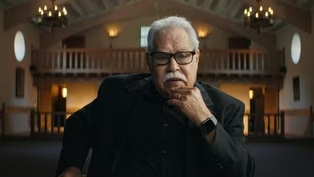
American Pachuco: The Legend of Luis Valdez
Video has Closed Captions
Discover filmmaker and playwright Luis Valdez, a founding figure of the Chicano Movement. (2m 10s)
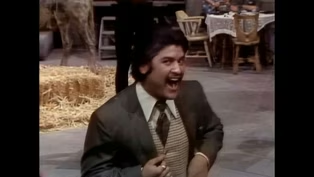
Luis Valdez's play commented on identity and assimilation
Video has Closed Captions
Luis Valdez's play, "Los Vendidos," or the sellouts, was a commentary on assimilation and identity. (3m 6s)
Providing Support for PBS.org
Learn Moreabout PBS online sponsorship












Support for PBS provided by:
Support for American Masters is provided by AARP, The Rosalind P. Walter Foundation, Thea Petschek Iervolino Foundation, Burton P. and Judith B. Resnick Foundation, The Philip and Janice Levin Foundation,...