
Women Of WWII: More Untold Stories
Episode 2 | 58m 39sVideo has Closed Captions
Explore more never-before-seen stories of the greatest secret weapon of World War II — women.
Explore even more never-before-seen stories of the greatest secret weapon of World War II — women. They broke codes and split atoms, gathered the news, crossed frontlines and even rescued children from the Nazis, creating an enduring legacy that serves as a guiding light. Discover more about the history and experience of the women who lived through the turbulent wartime era.
Problems playing video? | Closed Captioning Feedback
Problems playing video? | Closed Captioning Feedback
Women Of WWII: More Untold Stories
Episode 2 | 58m 39sVideo has Closed Captions
Explore even more never-before-seen stories of the greatest secret weapon of World War II — women. They broke codes and split atoms, gathered the news, crossed frontlines and even rescued children from the Nazis, creating an enduring legacy that serves as a guiding light. Discover more about the history and experience of the women who lived through the turbulent wartime era.
Problems playing video? | Closed Captioning Feedback
Where to Watch Women of World War II: The Untold Stories
Women of World War II: The Untold Stories is available to stream on pbs.org and the PBS app.
Buy Now
Providing Support for PBS.org
Learn Moreabout PBS online sponsorship(dramatic music) - [Narrator] We've uncovered more stories from the women of World War II.
- [Schaffer] My mother was in Normandy six weeks after D-Day.
(soft dramatic music) And because of her high school knowledge of French, she was really able to converse with the civilians.
(soft dramatic music) - [Narrator] These women stood up and stood out.
(swoosh) - [Katz] A group of Dutch women helped save 600 Jewish children.
It gave people hope.
It gave families the possibility... a light in a very dark time, to think that potentially their child could be saved.
(dramatic music fades) - When you're pioneering, you do a lot of things that, that are not normal.
(music crescendos) - [Kelly] You had almost all women, 22,000, running these big machines, trying to separate out tiny amounts of this fissile uranium to produce enough for a bomb.
(explosion) (explosion fades) (mysterious music starts) - [Fisher] People asked me where I was, I was in New Mexico.
"What was your husband doing there?"
(mysterious music) He's busy.
I didn't like what was going on and the secrecy.
(mysterious music) (soft desert wind) So there was a lot to be frightened about.
(mysterious music crescendos) - [Yellin] What surprised me about the women of World War II is how much strength and courage and valor they had.
(inspiring music) (truck drives by) No one believed that women could serve in the military.
(inspiring music) No one believed that women could work in factories.
- [Interviewer] Isn't this pretty hot for you, Miss Spillane?
- Well, I hear it gets kind of hot around the kitchen stove, too.
- [Yellin] And so every woman that stepped into all these pioneering roles had to do it with no role models.
(upbeat music) - [Narrator] Women did much more than get up every day and keep the machine of America running as riveters and factory workers.
(upbeat music) They traversed battlefields, worked in laboratories as scientists, protected the coasts, and even reported from the front lines.
(upbeat music) - [Buckley] It was the greatest generation for everybody.
They knew what they were fighting about.
They knew what they were fighting for.
They knew how good they were.
They had to be so good to get where they were.
And they were just extraordinary women.
(upbeat music) And the women had great morale because it was a war that had to be fought.
It wasn't a political war, it was a human war.
(upbeat music) - [Bradley] My mother was an extraordinary leader in the fight for freedom.
That she was very proud to be a part of.
I think she and all the women who served with her can be recognized for their contributions.
(whoosh) I think it's an untold part of history.
(xylophone crescendo) (upbeat music fades) (soft violins) - [Narrator] As the growing conflict of World War II unfolded across the globe, it upended everyday life in the United States.
- That's a period in history that people didn't think anything about.
We come to work and then we did our job like the men did during the war.
(meditative music) There was a lot of homes really broken up during the war with the situation.
(piano music) - [Narrator] As thousands of women entered the workforce, new challenges adjusting to wartime arose, including how to manage childcare.
- [Soskin] The childcare, child development centers for the women who went in the Rosies did a tremendous job for everybody.
There was also a heroic generation of African Americans because they came and brought with them this tremendous tradition of collective parenting that kept them together.
(piano music) - [Elder] I rented a room and I boarded my son out at a place about five blocks from where I lived that took care of children because where I lived, they didn't allow children.
And then I visited on the weekends.
(piano music) I thought I had to make a living.
So that's what kept me going.
(upbeat music starts) (soft street noise) - [Narrator] Trying to maintain a semblance of normalcy, women attempted to stay connected.
Letters were the dominant form of communication.
- [Howell] My going into the service stimulated my sister to write letters because she never would write a letter.
When I went in, she was very faithful and always wrote me a letter every week, as did my mother and it was great.
- [Helm-Frazier] Imagine not hearing from home, not knowing what's going on.
That can be nerve-racking.
No mail, low morale.
(whimsical piano trill) - [Boschitsch] Letter writing was daily.
Whenever they had time to write, they would write.
Of course it was beautiful, but it was, it was also storytelling.
- [Archival Narrator] You answer the best gift the folks back home can give you: a letter.
(melodic piano) - [Narrator] Even though the war separated families, letters sustained relationships.
(music fades) The war would unexpectedly bring people together as well.
(romantic piano) - [Dan Rothermel] I was home on leave from the Mediterranean after being over there about two years.
A mutual friend in- invited us for dinner and Jean was there sitting across from me and I thought,"This beautiful gal, how lucky can I be?"
(laughs) (romantic music continues) She was committed to the Red Cross.
She knows the sailor's life and I know what she did and in every way she did as much as I did.
(romantic music builds) There was always the chance that I would meet her if she was in the Pacific.
As it turned out... (romantic music builds) I met her four times.
(upbeat music swells) - [Jean Rothermel] Dan's ship had come in.
It was a, uh, small repair ship going to the Pacific.
(upbeat music) - [Dan Rothermel] Lo and behold, before we got into the harbor the signal light started blinking, and our signalman called off the message that had been sent by Jean to the ship!
That she was in Guam and I should look her up the moment we tied up.
(upbeat music) - [Jean Rothermel] I got a call from the Red Cross office saying that Dan, with whom I was in love, was- uh, had arrived on his ship, and wanted to know where I was.
(upbeat music) - [Dan Rothermel] I might have said something like, "You know, I think this is it.
Shall we get married when the war's over?"
- That was it.
- It was about that way.
- [Jean] It was something... ...like, it was casual.
- It was really very simple, because we... (music crescendoes) we knew it should be.
(Dan chuckles) (gentle music resolves and fades) (upbeat music slowly fades up) - [Narrator] As the war escalated, the US government realized they needed women to be part of the military effort.
For the first time in history, they allowed women to volunteer for the military in 1942.
By 1944, women made up 85% of personnel on duty at Marine Corps headquarters with more than 23,000 women reservists serving during the war.
The Navy created the Women Accepted for Volunteer Emergency Service, or WAVES.
Recruitment for the WAVES focused on patriotism, while emphasizing the academic training facilities, and uniforms from French designer, Mainbocher.
- [Buckley] The first black WAVE was a friend of the family, and her name was Lieutenant Harriet Pickens, and I was in love with her white uniform.
I thought... I just hope the war lasts long enough, so that I can grow up and be a WAVE.
You had to be better than anybody else to get to be anything in the military if you were black.
For men and women.
That's why they were so extraordinary.
(music resolves and fades) - [Archival Narrator] Training the Army Way, to do jobs the Army Way, now begins.
- [Narrator] More than 150,000 women served in non-combat roles in the Women's Army Corps, or WAC.
They performed a variety of jobs: clerical work, drivers, mechanics, almost anything that could help free up men for combat.
- [Schaffer] My mother served as a WAC, (bell dings) Women's Army Corps.
I think she was very determined that she was gonna do something that used her skills.
She was also very determined that she was gonna do what she could do to help the war effort.
She said she never regretted joining the Army.
It was the best experience of her life.
And she was just happy to be there to help.
(upbeat music) - [Bradley] My mother felt that she wanted to do all she could to be of service.
She applied with a vengeance.
Those were her words exactly.
- [Narrator] Admission to the first officer training class was rigorous.
Of the 35,000 women who applied, only 440 were accepted.
Isabel Kane was one of those women.
- [Centrella] Isabel was in the first class of the WACs and was able to, as part of that, be- move on up to the role of captain within six months after graduating.
- [Narrator] Another standout in the first class was Charity Adams, the first Black woman to graduate as an officer.
She was put in charge of the Six Triple Eight, the all-female, predominantly African American unit that was soon en route to England to help the war effort.
- [Helm-Frazier] When the first wave of women left out of the port of New York, and they were coming across the Atlantic, and German U-boats were chasing them, Charity Adams was there.
(soft violins) The unit also was always on show, because everybody had heard about this battalion of all-Black females commanded by Major Charity Adams.
(soft violins) - [Narrator] Captain Kane knew the WACs' unique place in history, even then.
Writing a letter to her family, she quoted a speech from WAC director, Oveta Culp Hobby.
- [Bradley] "Without any introduction, Director Hobby took the center stage, and slowly passed her eyes over the assembled group.
It was as though she was looking at each of us personally.
Then she said, 'This is a most inspiring sight.
You have a debt to democracy.
A date with destiny.
Never forget for one moment, that you are the first women to serve in the United States Army, the first example in American history of free women fighting for freedom.'"
(violins fade) (upbeat music) - [Narrator] The Coast Guard established the SPARs and more than 10,000 women volunteered for service.
The United States had problems on the Atlantic Coast with German U-boats, and during the first part of 1942, those U-boats were blasting our merchant shipping, and we were at a loss.
There was this huge need for women.
(fast-tempo music) - [Narrator] The SPARs recruited from across the country, even in places far from the coastline.
In Oklahoma, the recruits were called the "Sooner Squadron."
Many of these SPARs were indigenous women.
- [Vojvodich] Lula Mae O'Bannon was of Choctaw descent, and she was part of the Sooner Squadron.
- [Boschitsch] My mother had never seen any water of significance, except the creek down the street.
You would be able to see the world and get out of Oklahoma.
My mother wasn't dramatic.
This was a pivotal point in her life, and she didn't convey it as a pivotal point.
It was just, "Ho, hum, this is something that I did.
We went to the recruitment; we signed up."
Although she was very proud of being a Choctaw, that kind of was intertwined with patriotism.
It wasn't like "I'm a Choctaw first, and then I'm in the Coast Guard."
It was just woven together.
(soft inspiring music) I wish more people knew that the SPARS existed.
- I just knew her as grandma.
I didn't know her as this multifaceted woman with a vast array of experiences, an eclectic background and friendships.
She could have easily had done a safer route, but she felt so proud of her heritage and, um, her education and her faith and strength to do everything.
(music swells) - [Narrator] The Women Air Force Service Pilots also had unprecedented strength, but some of these women took an unusual path toward serving their country.
(soft music) - I had always wanted to fly from the time I was a little girl.
My father bought me a ride.
At that time, it was $8 to rent a plane for an hour.
(plane engine) And, "You can take my daughter up and convince her she doesn't want to fly."
(plane swooping) Well, it didn't work.
So there that dream was, and when I saw that WASP on the front of LIFE magazine, I was a goner.
When we broke the women flying as flyers, we also opened the door for women in the military to become mechanics, loadmasters, every phase!
So we didn't just open the door for pilots.
(inspiring music fades) (meditative music starts) - [Narrator] Their contribution to history and the bonds they forged together endured.
- It's a complete sisterhood of, of spontaneous people.
(meditative music) - [Goodrum] It is such a delight to see each other again and reminisce about those unusual days of our lives.
- [Veal] We had a wonderful time and a wonderful group of gals.
I think it's the most wonderful experience I ever had, being in the WASPs.
(upbeat music fades) (fast violins begin) - [Narrator] The women who worked on the home front, the Rosie the Riveters, remain an inspiration to this day.
Honoring their legacy, an all-women crew of welders have teamed up to restore the Red Oak Victory ship, built, in part, by the Rosies in 1944.
(metal sanding sounds) Docked in the Richmond, California bayfront, it is a reminder of what these women accomplished.
- [Ross] We all had that same feeling of, oh my goodness, look at this, look at what we're doing together.
(metal sanding sounds) I would definitely consider myself a modern day Rosie.
(music fades) - [Gipson] I loved being a Rosie because my mother always taught me, if you can't help somebody, don't hinder them.
And I thought I could help them by coming here and learning how to build ships, airplanes... I knew it was something bigger, but I just, I loved what I was doing to help the people in general.
(inspirational music) (welding) (inspirational music) (metal sanding) - [Ross] We're all standing on their shoulders.
When we go into our careers, and we remember if they could do it, we can do it too.
My great-grandmother, Helen, was working down here at the Kaiser shipyard during that time.
I only wish that my grandmother was still here to see me today, because she would be really proud.
(welding sounds) (soft inspirational music) - [Gibson] On Fridays, I'm now volunteering my time to talk to the people that come to the Rosie the Riveter Homefront National Park, because many people don't know what it was like during the war.
And they don't know about the discrimination against women and how it still continues.
It's kind of paying back.
- [Graves] The challenges the Rosies faced continue to be challenges we're trying to address today.
It's one of the reasons why I continue to stay involved with Rosie the Riveter Park.
It has so much relevance to the way we live now.
- [Soskin] The mission of the National Parks was to tell the nation's stories through structures.
And I found myself wondering, "Well, how my story could be told?"
The fact that I'm able to be participating in recapturing the story is an incredible privilege.
- [Berry] The Rosies showed us that individuals can make a profound difference for the collective good.
Their work embodied the promise that everyone has something to contribute and that society flourishes when barriers fall away and doors open up.
It's part of what this park preserves.
This message and this work is now ours to carry on, carry it forward!
(audience applauding) (orchestral music swells and resolves) (gentle piano music) - [Centrella] I've picked up various books of World War II and, you know, there's never any mention to speak of, of the women in them.
- [Narrator] Telling the story of the women of World War II now wouldn't be complete without the women that told the stories then, often from the front lines as a groundbreaking generation of correspondents.
They traversed Europe and the Pacific, chronicling the war as only they could, expanding the boundaries of who could report the news and how.
- In the 1940s, journalism, written journalism, was the prime medium for communicating what was going on in the war to the general public.
All correspondents felt the importance of being on the spot, getting the stories so that every detail of the war could be updated.
(jazzy music) - I got my big break, which was to be a "copy boy" on the Washington Daily News.
They had these empty slots, because they had been drafting the young men and they didn't think you could cover certain stories.
They got used to it, though.
(jazzy music) You run for coffee (teletype machine) you hear the bells on the teletype machine.
(sound of teletype machine) (newsroom ambience) We would get the list of casualties (piano music) (distant phone ringing) for the Washington area in the newsroom.
Sometimes the reporter would be informing the family of the deaths even before the Pentagon could get to them.
(piano music) - This was a time when women were told, "You can't do this, you can't be a photojournalist."
- [Mackrell] When the Americans entered the war, a few women journalists did begin to get official accreditation as war journalists, but their job was only meant to be writing what were called the soft stories, which were about women's involvement in the war, about the work done in hospitals, about how families were coping under rationing.
(piano music) - [Rinehart] They were actually barred by military code from being on the front lines, and yet they all said, "No, I have an important voice.
I have something important to contribute and nothing is gonna stop me from getting there."
- [Mackrell] Once those women got themselves into uniform, they began to find ways of ducking and diving between the regulations and actually getting themselves to where the action was.
(suspenseful music) - [Narrator] Virginia Cowles was reporting in London in 1940.
Frustrated that official channels weren't allowing her to get anywhere near the fighting, she decided to make her own way to Paris.
- [Mackrell] When she arrived, she was one of the very few journalists who were in position to report on that dreadful moment where the Germans were so close that everybody was desperate to get out of the city.
She reported on the fact that as those refugees trailed towards what they hoped would be safety, the German planes strafed the cars, they strafed the pedestrians.
She had just gone straight into the heart of danger.
For her, it was the moral urgency of bearing witness to what was happening to Europe.
That counted far and above her own well-being.
(suspenseful music resolves) - [Narrator] Sigrid Schultz was the Chicago Tribune's Berlin Bureau chief, well-placed to report on the rise of Nazism.
- [Mackrell] She was very adept at using the fact that she was one of the very few women amongst the press corps to, for instance, flirt with Goebbels and begin to wheedle information from him about the- the rise of the Nazi party.
She was also astoundingly courageous and she pushed and pushed and pushed against the limits of censorship that were imposed on foreign correspondents in describing the progressive victimization of Jews and political dissidents.
She reported on the first of the concentration camps.
(pensive music) - [Narrator] Meanwhile, in the Pacific theater of operations, Dickey Chapelle was a pioneering female war journalist.
But in order for her to bear witness to the combat, the military required that she go where women already were... on board a hospital ship.
(ocean sounds) - [Rinehart] Waves of Marines were coming aboard with all kinds of injuries.
She spent weeks just listening to their stories and talking about what they were afraid of, what had happened to them, who saved them, who didn't, what their fears were about going home.
(canon fire) And she was the only woman to bear witness to this.
(ocean spray) I am always struck by the story she tells when she was at a field hospital in Okinawa that came under fire.
And there was a young man who was suffering from severe combat fatigue, or PTSD, and Dickey followed him.
And she both covered and wrote about with such grace and dignity, (emotional music builds) his challenges: what he was going through, but also his valor and bravery.
(soft music) Dickey understood it wasn't generals who were actually shaping the consequences and the outcomes of the war.
It was the men on the ground fighting and the women who were supporting them.
(soft music) The female journalists in World War II proved to the world that they could do it.
That they had a voice, they had a story to tell, and that they were capable of going into combat zones, of bearing witness to what was happening and to telling the story for the world to see.
(pensive music fades) (soft foreboding music) - [Narrator] The Manhattan Project was the top secret venture by the United States and its allies to harness the power of the atom as the United States aimed to create a nuclear bomb.
(tense music intensifies) - [Kelly] Trying to create such a weapon is a rather large miracle.
(piano music) It was started in Manhattan.
They then realized to do the production sites, they needed to find new land.
(sustained synth note) - [Kiernan] There were three key sites: Oak Ridge in Tennessee, Los Alamos in New Mexico, and Hanford in Washington.
(soft synth music) Oak Ridge went from not existing... to having roughly 80,000 people living there using more electricity than New York City and one of the largest bus systems in the country.
(soft synth music) And it wasn't on a map.
(synth music intensifies) - [Kelly] They needed a lot of employees.
One of the three plants required 22,000 people.
And because it was the middle of World War II, most of the able-bodied men were off fighting, so they had a lot of newly graduated high school girls who were running the so-called calutrons, these big magnetic and electric machines to separate the uranium isotopes.
(contemplative synth music) - [Kiernan] And then you had thousands and thousands that were just keeping the entire place running.
(soft synth music) - [Kelly] It was mainly clerical jobs, secretarial jobs, working in the mess.
(soft synth music) - [Narrator] Some African American women, like Carolyn Parker, found work as scientists on the Manhattan Project.
In Oak Ridge, other African American women jumped at the chance for the improved economic opportunities the project offered.
(soft synth music) - [Kiernan] Katie was a black woman and heard how good the pay was.
Construction or domestic or janitorial were the only jobs that black workers were allowed to have at Oak Ridge.
But the pay was twice what she was able to get living in Auburn, Tennessee, so they came to Oak Ridge.
(soft synth music) - [Narrator] In the hierarchy of the Manhattan Project, Oak Ridge and Hanford were providing fuel for Los Alamos in New Mexico, where all of the elements came together.
But the secrecy of the project kept the residents in the dark.
- [Phyllis Fisher] All I knew is we were told we were going somewhere and that we'd know where we were when we got there.
- [Narrator] Starting a town like Los Alamos, almost from scratch, entailed challenges for the women there.
- [Fisher] We had sandstorms coming right into the house.
The windows didn't quite fit.
It was not comfortable living like we were used to.
And we had a walk to our house that would sink into the mud.
It was just a couple wooden boards we'd have to balance on.
And we had a little toddler, he'd fall off it and end up in the mud.
(cymbal crescendo) (low hum) - [Narrator] As the women who worked at the Manhattan Project sites quickly discovered, secrecy was paramount.
To ensure this, they were not told of the ultimate goal.
(suspenseful music) - [Kiernan] You work in this plant, and your job is to sit on this stool and turn knobs.
You know, if this needle goes to the left, you turn the knob to the right.
Needle goes to the right, you turn the knob to the left.
That's your job, that's all.
- [Lee] We didn't know that we were working on the atomic bomb, except for the physicists.
Ahhh, we thought they were doing chemical warfare.
(soft music) - [Kelly] The men couldn't share why they came back after 17 hours at the laboratory, looking very tired and, and chagrined.
"What's wrong, honey?"
"Well, I can't tell you."
It was a strain on marriages.
(soft music) - [Leon Fisher] There was nothing I could tell Phyllis.
Uh, I couldn't, uh... I couldn't talk to her about anything about the nature of the work.
(suspenseful music builds) - [Phyllis Fisher] I was expecting, and we were thinking of names for baby, and I was getting silly and thinking "Cowboy Fisher," I don't know how many other things.
And finally, I said, well, how about, and I don't know how I picked up the word "uranium," because I wasn't one of the scientists or anything, but I said, well, how about, I was saying "Uranium Fisher," and Leon kind of heard... "uranium fission"... was the big secret of the place.
(tense music) - [Leon Fisher] It just was a rule that was not to be broken, so I really got very upset about that.
(low rumbling explosion) - [Phyllis Fisher] And he put his hand over my mouth, and he said, "You've got to be quiet, you can't say that."
We were the only people in our house, and I said, "Well- wha- this is just crazy."
And he said, "Well, somebody could be coming by our house and hear it."
(tense music builds) That's the only time I had any idea what was going on up at Los Alamos.
(contemplative music) (low hum) - [Narrator] Some of the women did have an idea of what was happening on the Manhattan Project.
- [Kelly] Leona Woods Marshall Libby, she was the top woman physicist on the Manhattan Project at 23.
She went to Hanford, and she became Enrico Fermi's right-hand man slash woman.
He relied on her, she stood next to him, as he ran the first atomic reaction.
(soft violin music) - [Narrator] Women were also leading scientific research in other ways.
- [Kelly] Floy Agnes Lee was a very remarkable woman.
She got a job at Los Alamos, working in hematology, that is, drawing blood and analyzing it.
- [Lee] It all involved looking at, uh, cells that, uh, had been irradiated.
I was able to see deeper into the effects of radiation on chromosomes.
(pensive piano music) - [Narrator] For the few women who understood what they were working on, the moral weight was heavy.
In 1945, scientists signed the Szilárd petition to stop the use of the atomic bomb.
- [Kelly] General Groves, when he got it on its way to the president, he stamped it with a top-secret stamp and put it in his safe.
(suspenseful music) President Truman never saw it.
And after the war, Leo Szilárd said, "The biggest weapon that has come out of this war is not the atomic bomb.
It's a secrecy stamp."
(explosion) - [Kiernan] The way that the majority of people, not just in Oak Ridge, but throughout the Manhattan Project learned about what the project entailed was when the first bomb was detonated over Hiroshima.
(distant explosion) - [Phyllis Fisher] We were getting congratulatory letters from all over.
"You saved American lives and ended the war, and everything was going to be all right because of that."
(tense synth music) It was pretty shocking to know that you could kill so many people with one bomb.
(tense synth music) And it was a whole new level of what wars were going to be like in the future.
(eerie synth music) (cheering parade) - [Kiernan] Then the war ends, and for an awful lot of these folks, the men were coming back from overseas and were given their jobs back.
(cheering parade) What happened in Oak Ridge was a little different because these women hadn't taken anyone's jobs.
Those jobs didn't exist before.
(soft contemplative music) I would hear women who came here when they were young, you know, "I didn't know anything, why would you want to talk to me?"
And just decades of devaluing their role in this entire enterprise because, you know, they weren't the scientists, they weren't the person in charge, they weren't the "important people."
(soft violin music) But they were the important people.
This entire project does not happen without these people.
(music fades) - [Narrator] While some women helped unlock the power of the atom, others unlocked enemy secrets.
- [Mundy] US intelligence at the start of World War II was almost non-existent.
(naval battle sounds) (explosions) The Japanese surprise attack on Pearl Harbor was a catastrophic intelligence failure.
(piano music) (distant explosions) The ability to divine enemy intentions, to anticipate enemy attacks, to outmaneuver the enemy, the United States had to build that ability, really, almost from scratch.
(fast-paced music) - [Narrator] The US government built code-breaking facilities near Washington, D.C.
where thousands of secretly recruited women worked around the clock.
- [Mundy] Bright, adventurous, unencumbered, young women were being recruited like they had never been recruited before in American history.
More than half of our US code-breaking force was female.
(music fades) There were certain stereotypical beliefs about women at that time, and there was the belief that women were going to be very patient and very diligent.
(fast-paced violin music) But one of the fears about women is that women were gossips, that women couldn't keep a secret.
And so that was kind of a mark against them.
They had to prove that they real could keep a secret.
- [Mendez] A lot of the women that worked back then, it was undercover work.
It was not to be talked about.
It was not to be publicly ack- acknowledged.
(tense building music) - [Mundy] When the Navy housed the women in barracks, it would move them around from room to room so they wouldn't develop close friendships with roommates because they didn't want them even gossiping to each other about what they were working on.
And in fact, the women took the secrecy part of this so seriously to the point that they were afraid they would talk in their sleep.
(tense music resolves) (soft orchestral music) - [Parsons] My roommate was in the Japanese section, and we never talked about it.
We could talk about people and things we did with people, but we never talked about anything, and that, as they said, was the best-kept secret going.
(contemplative music) - [Mundy] Even if they couldn't necessarily talk about their work to each other, they could have a lot of fun together.
- [Howell] I met some wonderful people and made some wonderful friends Played tennis, went horseback riding, enjoyed my time off.
The hardest part, I think, was working around the clock.
(music crescendo) (uptempo music starts) - [Narrator] Early in the war, Nazi U-boats patrolled the Atlantic, sinking merchant ships within sight of the Eastern seaboard.
- [Parsons] Our group on the U-boats was called SHARK.
That was our department.
And if we didn't get this broken our ships from the States, by the thousands, they just, it was, it was, they were helpless.
They were just caught in this trap.
- [Mendez] Germans were so convinced that no one could read their communications that they were very cavalier about what they would say in the communications.
(fast-paced music) - [Mundy] When we, the Allies were trying to build machines that were big enough and fast enough to break that SHARK system, there was a very top-secret project to build what were called bombe machines.
And they secretly brought Navy WAVES to Dayton, Ohio, to the National Cash Register Company to solder.
A lot of these women had grown up on farms, and they were very self-reliant.
- [Parsons] The same message came every night.
It was very short, and it always came at the same time from the same place.
Everybody knows that you always use a dummy word first.
You don't go right into the message right away, but they forgot to use the dummy word, and that was part of their downfall, because from then on, we had the traffic broken every day till the end of the war.
(upbeat music) - [Mendez] I think the women got a taste of success and a taste of adventure.
It's empowering to be able to go out and do the kinds of things that they did.
A lot of women's careers were formed then.
- [Howell] I think we did a lot, but we didn't realize that we were really doing a lot, helping.
(bell ding) - [Mendez] I think it lit a fire in the belly of a lot of women, and I think the men must have been a little amazed at what they had started.
(orchestral music) - [Narrator] Honoring what they started and did, the Library of Congress held a ceremony to pay homage to the pioneering Code Girls, as they were called.
(applause) - [Nye] Jackie Jenkins.
Boy, I'm sorry, you guys.
(chokes up) I'm not that sorry, doggone it.
Okay.
(inhales) (soft crowd laughter) She was a heck of a lady.
Jackie Jenkins, later known as my mother, was a naval officer.
Her many contributions to winning the war are very well known, of course... Actually, I'm kidding.
Nobody knows what she did!
(audience laughter) We must all take a few moments today to thank the women, the Code Girls, for their service.
Their legacy inspires us all.
And we owe the Code Girls so much.
(music fades) - [Mundy] Fewer people realize that a lot of the brain work that was done during World War II was also done by women.
World War II was this terrible, terrifying moment in history when we really didn't know which side was going to win.
But it was this wonderful moment also when women were not only recruited into fields that they never would have been considered for before the war, but competed for.
(music swells) So, World War II proves, if proof were needed, the importance of inclusion.
(gentle music) - [Kiernan] With history in general, it is told in a very top-down fashion.
We see great moments in history through those who were in charge.
There are thousands and thousands of people who contribute to these moments.
A lot of them are women.
We need to cast a wider net when we talk about how these events unfolded.
(meditative music) - [Narrator] The wider net of World War II history includes the women of the Red Cross.
Working as volunteers, they embarked on unprecedented and dangerous adventures.
Many supported the war effort near the front lines as Clubmobile workers.
- [Urrea] My mother was Phyllis McLaughlin.
She joined the Clubmobile Corps at the Red Cross and served all over Europe.
What they ended up calling "Donut Dollies."
The whole donut thing was not even secondary far down the line of what they really did.
The women who joined the Red Cross, as my mother did, were not nurses.
The Red Cross girls had the responsibility of the morale of the troops.
If you think about a general, he also has that responsibility.
Before they ever crossed oceans, the Red Cross volunteers trained to drive and maintain the two-and-a-half ton Clubmobile trucks they would steer across war-torn Europe.
- [Jean Rothermel] I was trained at the American University in Washington, D.C., with a lot of other women, and we had some on-base experience.
I felt completely accepted by the servicemen and important to them.
(heroic music) In a very short time, we were on our way to the Pacific.
(heroic music) - [Urrea] A regular day in the Clubmobile corps, they would drive all day, they would park, and they would set up, and they'd start making donuts and coffee.
And they had loudspeakers and a record player.
- [Jean Rothermel] I do remember that one of the big things we did was listen to the stories of the sailors and look at the pictures of their wives and their children.
And of course, I'm a people-person, so that wasn't hard for me to do.
(heroic music) - [Urrea] They were supposed to be sister, mother, auntie, and girlfriend.
So they were trained to play cards and lose every game.
So soldiers would feel good.
They understood how much it would mean to see the embodiment of home and family.
(orchestral music fades) (truck engines) - [Narrator] Through bomb-scarred roads, the hardships they faced drew the Clubmobile women closer.
What began as shared service, became something deeper.
- [Yellin] The Red Cross girls were the ones closest to the front lines, and in many cases on the front lines, and they were killed.
We talk a lot about men and their war buddies.
Well, Jean was one of my mom's war buddies.
- [Jean Rothermel] It's hard to explain to somebody why everybody became friends so quickly, but it was necessary.
We had- we needed each other and we needed somebody to confide in and to be close to.
(soft music) - [Narrator] Phyllis McLaughlin also made fast friends in the Clubmobile with a woman named Jill Pitts.
- [Urrea] They just formed this sisterhood.
They had to bathe out of an army helmet.
They were under siege, they were shot at.
Their friendship was so amazing, so intense while they were together.
They did everything, everything imaginable.
And they did their job, which was to, you know, help our boys win the war.
(piano arpeggio resolves) (truck driving) (upbeat music) - [Narrator] As the US involvement in the European theater of operations escalated, the WACs were called in to help.
They were stationed in the United Kingdom, preparing for what was a rumored attack on the French coastline.
(upbeat music) 8,000 served in the European theater of operations.
My mother was one of those 8,000.
- [Centrella] My aunt Isabel went to England in April of 1944 and she was being slowly pulled into the meetings for the plans for going to Normandy at that time.
- [Schaffer] During the preparation for D-Day, my mother had absolutely no idea what was going on, because I think they just had everybody doing different parts.
(dramatic music) - [Narrator] In Washington, D.C.
offices, far from the front lines in Europe, young women untangled complex naval codes necessary for the Allies' plan for the invasion.
(suspenseful music) - [Mundy] It was a young woman named Genevieve Grotjan who, one afternoon, saw a pattern... that nobody else had been able to see.
Based on the pattern she had recognized, they were able to build a replica of the machine that the Japanese diplomats were using.
We were able to break every diplomatic message that the Japanese diplomats sent, so that when the D-Day landing was being planned, they knew that Normandy would be a better place to invade than Calais.
- [Narrator] The U.S.
military called on the code-breaking women in Arlington Hall to do more.
They asked them to create the communications of a fictional attack on the French coastline using dummy traffic.
- [Mundy] The creation of dummy traffic is one way to trick the enemy.
Create an invisible army that doesn't actually exist but seems to be communicating.
It was a group of WACs, actually, who were trained to do that.
They created radio communications traffic that was taking place in a different part of England to persuade the Germans that the invasion was gonna happen in the Calais area.
(music fades) (distant radio chatter) - [Narrator] As planning for the invasion progressed, another group of women mobilized toward the front lines of D-Day... war correspondents.
- [Mackrell] There were 550 journalists and photographers who had been given places to accompany the armada across the channel, and they were all men.
Martha Gellhorn took herself down to one of the southern ports and had managed to persuade the guards that she was simply going to be talking to some of the nurses before they set sail and then she would come back off the ship.
Of course she didn't.
She found a toilet and locked herself in.
When she came up on board, she wrote she had never seen anything so extraordinary.
(orchestral music) It was like a naval traffic jam that extended as far as the eye could see.
(contemplative music) All of the male journalists were not yet allowed to land on shore, so Martha scooped almost every male journalist by the fact that she went ashore with those medical teams and spent 24 hours on Omaha Beach.
The account she managed to publish was extraordinary, vivid, both in its description of being in the middle of the fighting.
She said, "While I was there, it was as if nothing else had happened or would ever happen."
(soft music) - [Narrator] Six weeks after D-Day, WACs stepped on to the beaches of Normandy and into history.
They provided communications, mapmaking and administrative support for the liberation of Europe.
- [Schaffer] Because of her high school knowledge of French, my mother was really able to converse with the civilians to learn about their conditions that they suffered essentially in Normandy.
(soft music) - [Centrella] My aunt was selected to be the one to lead the unit to Normandy.
When my aunt writes about getting, landing, on the beach.
Excuse me, it makes me emotional just talking about it.
It was all calm.
They could see tents and they could see so many remnants left from the beach.
They could see so much of the destruction for D-Day was still there.
You know, they couldn't even talk.
They just looked and, and took it all in.
(upbeat music) It was just amazing for these women to experience what this was like being the first women there and the soldiers and what they'd been through already.
And to see them, it was very touching.
(inspiring music) All she could tell her family was, "I've waited two years for the trip of all trips."
That's what I think touches me the most, that someone has that kind of experience.
(inspiring music resolves) (mysterious violin music) - [Narrator] Women were also recruited into espionage.
With intelligence as vital as ammunition, these female spies were valued for their ability to thrive under the radar.
(violin music) Women are sometimes spectacularly successful because they're women.
Not in spite of being women, but because they're women.
It can be a strength.
Amy Elizabeth Thorpe, also known as Betty Pack, became involved in wartime intelligence operations.
Her code name was... Cynthia.
- [Mendez] Cynthia was quite the femme fatale.
She was a seductress, par excellence.
She was told that what was needed were the French naval codes.
They were at the French Embassy here in Washington.
They were in the code clerk's office.
They were in his safe inside of a cipher lock, inside of a room that was also secured.
- [Narrator] To enact her plan, Cynthia kindled affections with the French ambassador's attaché.
- [Mendez] Cynthia and the attaché would go to the French Embassy.
They'd take a bottle of champagne, and they were setting up a pattern that the security guard would become comfortable with.
(champagne pouring) On the night in question, they go in, they have the champagne.
It looked like they were having a romantic evening.
Cynthia said, "Something's wrong."
She said, "Quick, take off your clothes," to the attaché.
And she disrobed and took off her clothes.
And the clothes had no sooner dropped to the floor than the door opens and a flashlight comes on and sweeps the room.
And it was the security guard.
(mysterious piano notes) Well, he was mortified.
(guitar strum) He never interrupted them again.
(sound of safe dial) They imported a safecracker.
They let him in the window.
Eventually, they got the safe open.
They passed the French codes out the window.
They staggered out of the French Embassy in each other's arms, the security guard waving them off.
And they had the French naval codes.
(mysterious piano) - [Narrator] Among the network of women who served as spies during World War II... Josephine Baker was an unlikely operative.
- [Mendez] The Josephine Baker that you always think of is the exotic dancer, this beautiful black woman in kind of outrageous and skimpy costumes.
(jazzy music) (applause) Paris just fell in love with Josephine Baker, and she fell in love back.
And so she became a French citizen.
(jazzy music turns suspenseful) Josephine Baker left Paris in 1940 and said she would never return to Paris as long as the Germans occupied it.
And it was then that she went to work for the Second Bureau of French Military Intelligence.
And she worked against the Germans.
And what she did is she had a lot of classified information that she needed to get out of the country.
They wrote it down in invisible ink in her sheet music.
They hid it in her clothes.
The head of French intelligence was traveling with her on a fake passport that said he was her dance instructor.
They crossed out of France and they went into Spain heading for neutral Portugal and got all of this information out.
No one had whatever it would take to really search her, frisk her, to even touch her.
So she was quite a heroine.
(soft music) - [Narrator] Also working in secret, other women in Europe fought the Nazis.
In the Netherlands, these Dutch women aligned against the occupation and joined the resistance.
Women like Hannie Schaft.
(inspiring music) - [Poldermans] She saw that her Jewish friends, they were not allowed to go into any kind of public areas.
She would go to bars and swimming pools, steal identification papers and have them forged by the Amsterdam resistance.
So she could directly help her friends.
(suspenseful music) Then she wanted to do more.
She wanted to join the armed resistance.
(suspenseful music) - [Narrator] Like Hannie, Truus and Freddie Oversteegen joined loosely formed groups in the resistance called cells.
- [Poldermans] Truus Oversteegen and Freddie Oversteegen would carry out acts of sabotage with the Council of Resistance, setting fire to a German shed where they had all their, their military stuff, or they would blow up freight trains.
(explosions) When she was very old, her eyes would sparkle, really, when she would talk about that.
(mysterious music) - [Narrator] The Nazis did not expect women to be involved in armed resistance, which gave them an advantage.
- [Poldermans] Truus could apply heavy makeup and go out there and flirt in order to coax information out of high ranking SS officers.
She would talk to the officer and then under the disguise of a romantic stroll, she would lure them into the woods and shoot the SS officer.
(gun fires) I remember Truus saying that there was no alternative.
You couldn't say, "Hey, Mister, what you're doing is wrong," and send them to jail, because there was no functioning judicial system, no functioning police systems.
(mysterious music) They never regretted what they did, but that doesn't mean that it wasn't weighing very heavily on them.
I mean, they were traumatized for life, because they did take lives.
(flute music) - [Narrator] Many women got involved because they saw atrocities... and wanted to do something.
- [Poldermans] Restrictions became stricter and stricter.
There was a plan to move all the Jewish people to a specific ghetto in Amsterdam and then have them deported to concentration camps.
- [Katz] There was a theater where the Nazis rounded up all of the Jews, and then they annexed this daycare across the street.
People were being taken off to the death camps and children were being separated from their families, and they put all the children in that daycare.
One by one, over the span of just under a year, a group of women and men, but mostly women, helped save 600 Jewish children during World War II in Amsterdam.
(soft suspenseful music) They smuggled out these children to various families in the countryside; foster families who were willing to take them in.
- [Narrator] One of the women working with this resistance cell was Hester van Lennep.
- [Baracs] I was young when I discovered that my mom and dad had played a good role in the resistance movement.
They risked their lives.
But my mom would not brag about it, not at all.
She found it quite normal that she had stood up for people that had been persecuted.
- [Katz] Hester van Lennep ran a skincare clinic in Amsterdam, and through word of mouth, people started hearing that she could help get children to the countryside to safety.
- [Baracs] The women could pretend much easier that they were moms or grandmoms or aunts or sisters from the children that they took in the trains towards families.
(gentle music) - [Narrator] Hester and her friend, Pauline van Waasdijk, ran their operation from a stately canal house.
They saved about 80 children, placing them with foster families working with the resistance.
(soft cymbal crash) - [Katz] One particular child came to them and was just so beautiful.
(fast violins) (baby cries) - [Brown] I was born on June 2nd, 1943.
Shortly after I was born, my parents were rounded up, as was my brother.
(fast violins) About three weeks of age, I came into the hands of two workers of the resistance.
(fast violins) They both fell in love with this child, and they both separately wanted to keep that little girl.
They ended up flipping a coin to decide who was going to keep that baby.
(suspenseful music) - [Brown] Pauline won the coin toss and was able then to take me.
(xylophone music) She had to have courage to go to her parents and claim this child illegitimately, because that was very shameful in those days.
And she kept that myth alive until the end of the war.
(xylophone music) What I remember the most was that she loved me.
(soft music) - [Narrator] After the war, Marijke was able to emigrate to America, where she became a naturalized citizen.
But she owes much to Pauline and Hester and their work with the Dutch resistance.
They really were important, and of course I wouldn't be alive without them, so, and I am, and I had a good life.
(meditative music) - [Poldermans] Women of the resistance never saw themselves as heroines.
Believing in something is one thing, but really acting upon it, especially under such horrible uh, circumstances, I think is very remarkable and admirable.
(music crescendoes and fades) (upbeat music) - [Narrator] Saving lives, changing the world.
These women defied expectations and made a difference for the generations to come.
- [Centrella] I was at a speaking engagement about my aunt, and a woman came up afterwards, and she said, "I want you to know that we stood on your aunt's shoulders."
They needed to be the best of the best in the country, because that was the only way this was going to succeed.
My aunt was recently inducted in March of this year into the Army Women's Foundation's Hall of Fame.
(upbeat music) - Thank you for honoring Major Isabel Kane Bradley today, and for ensuring her story and the stories of the women who served alongside her continue to be told.
(applause) - [Yellin] So really look at your mother, grandmother as a main player, not as a support system for your father or grandfather, and really ask questions from that place, and I think you'll be surprised how much you find.
(upbeat music) - [Boschitsch] I feel like the younger generation is able to now put a- paint a picture and speak louder for the ones that have been here before.
(upbeat music) - [Narrator] As more untold stories come to light, they stand as a reminder that the way we see the past shapes our future; a future that continues on the path pioneered by the women of World War II.
(music fades) [inspiring music] [music fades]
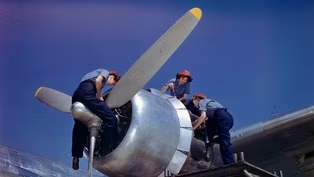
Video has Closed Captions
Preview: Ep2 | 30s | Explore more never-before-seen stories of the greatest secret weapon of World War II — women. (30s)
Providing Support for PBS.org
Learn Moreabout PBS online sponsorship










Support for PBS provided by: