
Bella! This Woman's Place Is in the House
3/17/2026 | 1h 40m 12sVideo has Audio Description
Follow the meteoric rise of firebrand politician and activist Bella Abzug.
Follow the meteoric rise of firebrand politician and activist Bella Abzug. Considered one of the first feminists to be elected to Congress, her commitment to women’s rights and progressive causes upended the status quo in Washington.
See all videos with Audio DescriptionADProblems playing video? | Closed Captioning Feedback
Problems playing video? | Closed Captioning Feedback
Support for American Masters is provided by the Corporation for Public Broadcasting, AARP, Rosalind P. Walter Foundation, Judith and Burton Resnick, Blanche and Hayward Cirker Charitable Lead Annuity Trust, Koo...
Support provided by:

Bella! This Woman's Place Is in the House
3/17/2026 | 1h 40m 12sVideo has Audio Description
Follow the meteoric rise of firebrand politician and activist Bella Abzug. Considered one of the first feminists to be elected to Congress, her commitment to women’s rights and progressive causes upended the status quo in Washington.
See all videos with Audio DescriptionADProblems playing video? | Closed Captioning Feedback
How to Watch American Masters
American Masters is available to stream on pbs.org and the free PBS App, available on iPhone, Apple TV, Android TV, Android smartphones, Amazon Fire TV, Amazon Fire Tablet, Roku, Samsung Smart TV, and Vizio.
Buy Now
A front row seat to the creative process
How do today’s masters create their art? Each episode an artist reveals how they brought their creative work to life. Hear from artists across disciplines, like actor Joseph Gordon-Levitt, singer-songwriter Jewel, author Min Jin Lee, and more on our podcast "American Masters: Creative Spark."Providing Support for PBS.org
Learn Moreabout PBS online sponsorship♪♪ ♪♪ ♪♪ ♪♪ -I feel very good waves.
-Good vibrations?
-The people have been very responsive.
I've been up and down the district and run into many people who, uh, indicate that they've been voting for me, and I hope that's a good omen of the end of the day.
-Well, you're going in to vote now.
Who are you voting for?
-[ Laughs ] Don't you know we have a secret ballot?
[ Chuckles ] ♪♪ -Bella, look up after you sign.
[ Indistinct conversations ] Right here, Bella.
-176.
-Couple more.
[ Camera shutter clicking ] ♪♪ -On her way out, you can get a shot of her.
-Coming out.
Right.
Okay.
♪♪ -Bella.
Right here, Bella.
Do it again.
-Mrs.
Abzug, could I ask you, were you axed -- were you axed just because, as you mentioned before, you're a woman and junior, or was it also because you're outspoken and relentless?
-I think it's because I have fought for women's rights, that I have made it clear that women are not going to be invisible in government, that we are not gonna have just 11 women out of the House of Representatives of 435.
-She came out and screamed about what was going on with women.
It really upset the white male power structure, who was being frightened by women coming in and taking over their power.
That didn't stop Bella.
-Are you suggesting to me that all of your files are -- of the CIA are presently in the possession of the FBI?
Because you just stated -- and I want you to know what you stated... -I refuse to have you say we are arbitrarily acting in this regard, Madame Chairman.
That's not fair.
-She was called all kinds of names.
She was loathed and definitely hated.
-I'm here in the New York delegation with Bella Abzug and her famous hat.
Do you ever take that off?
-Taking all those barbs and even worse from men who should have known better, a real organized effort to create a -- a monster who's not liked.
-Bella's loud.
She's abrasive.
I think she hurts more than she helps.
-Could I, uh, have your name, please?
-Bella Abzug.
-He says he hates everybody.
I mean, President Carter, Mayor Beame, Walter Cronkite, Bella Abzug, Mr.
Abzug.
-I was bold because of Bella.
Bella and those other congresswomen, they spoke up, they spoke out, they organized, they challenged, and I felt capable to do that and a responsibility to do it.
-It's because of the killing of the spirit and the meaning and the belief of American democracy that I do impeach the President of the United States.
-And she talked about the issues that mattered to me -- women's rights, gay rights, civil rights, nuclear disarmament, protecting the environment, ending the war in Vietnam.
-Good evening, my fellow Americans.
-They must let the president know that he is not their president until he does end the war, and that they will not be accomplices to his fraudulent election in which millions of Americans were duped into believing that the war would be over and our prisoners home by Christmas.
-Bella was a battler.
Bella came very naturally to the style that she displayed during her political career.
She also knew how to play the inside political game.
But Bella inspired me because she never lost sight of who she was fighting for.
-We shall have a beginning in 1972 of a new majority of the women in this country, of the young people in this country, of the Blacks and the Puerto Ricans and the Asians and other minorities in this country.
-♪ I'm gonna show you what a woman can do ♪ ♪ Ooh, ooh, ooh, ooh ♪ -Bella's attitude -- "Mm!
We will get this done."
I think that's what they needed.
That's what they desperately wanted.
And she went with the hat and took off the gloves.
-I just described to you how I've been fighting for childcare systems for the many working women in this city and in this district.
I've just described to you how I've been fighting for Social Security benefits and increases for the elderly in this city.
So if that isn't stewardship, I'd like to know what the hell is.
-Walking in the street with Bella, people would be yelling, "Give 'em hell, Bella," and stopping to talk about rent problems and war problems.
-Under the hat, there was a lot of brain tissue.
She could speak extemporaneously on anything... at the drop of a hat.
-I beg of you, organize.
Let's make this political power structure ours.
It doesn't belong to those white male elitists.
Let's get into it.
It belongs to us.
That's what the Constitution has dictated.
We're gonna make it work.
Good night.
[ Cheers and applause ] -The president, rejecting her advice and her, fired her.
-Did you call the president a little blank?
[ Laughter ] You know, that's been reported.
-I would never say "little."
-Uh... [ Laughter, applause ] -She was just too real.
-She was just too early.
-She knew that she wasn't there just for Bella and her generation, that she was there to make sure that the doors were open for what came next.
-♪ Woman can do ♪ ♪ 'Cause I've got a passion, let me shine it on you ♪ ♪ Let me, let me ♪ ♪ Let me shine it on you ♪ ♪ I'm gonna show you what a woman can do ♪ ♪ Oh, yeah ♪ [ Theme music plays ] ♪♪ [ Applause ] -We're beginning to examine, what is our democracy, what are our origins?
And as we examine it, we have to say, "Hey, there's something wrong."
And maybe we have inflation, maybe we have recession, maybe we have wars instead of peace because a whole part of the people are not involved in deciding what should happen to all other people.
-♪ Oh, oh, oh, oh-oh-oh ♪ ♪♪ ♪ Oh, oh, oh ♪ ♪ Oh, oh-oh-oh ♪ -In the '50s after the war, there was this whole cocoon approach to living, that one could withdraw into one's prosperity of having children, materialism, of having a happy life.
And women were in the home largely.
-You have the PTA, and -- and you make your own ketchup and -- -The PTA and home-bottled ketchup -- That is it.
And it's not very fulfilling.
-Expected then was, you would, uh, go to college, get a job, get married, and have children, and that would be your life.
Bella went to law school.
I mean, that was defying all kinds of customs and expected behavior.
-I made it clear that I was gonna be a lawyer and I was gonna practice law, and Martin was a very strong supporter.
We argued all of these things out before I got married, that I was hoping to have children and that I was hoping he would be a partner in all of this.
And I went to work after I recovered from my Cesarean.
I set up my own practice in the Nelson Towers on 34th Street and 7th Avenue.
And so I never felt that I couldn't have it all.
-She was always organizing -- for integration, Women Strike for Peace, against the McCarthy hearings.
You're on the phone, you're in the streets.
My mother was always doing that, and that is on top of being a lawyer.
-My mother was very consistent in what she did, well-thought-out, very committed.
And there were a lot of people that used to come to our house and gather around these issues.
Progressive movements that she was involved with, or even created some of those.
Women Strike for Peace was central to my -- It was the beginning for my mother.
♪♪ -Women Strike for Peace was her training ground for running for office.
I don't think she could have run for office without Women Strike for Peace.
-More than 50,000 women all over the country answered a call sent out by a handful of housewives in Washington, D.C.
-Dagmar Wilson was an artist.
She used to illustrate children's books.
And she gathered a group of women together to talk about the United States of America testing atomic bombs, dropping them on American soil, and spewing radioactivity.
The bombs would explode, the cows came to eat the grass, and we used to feed our babies cow milk.
Barry Commoner was a scientist, and he asked us to send him baby teeth because baby teeth under examination would show the presence of strontium 90, and he indeed found strontium 90.
That's all we needed, and we never stopped.
-I realized then that somehow or other everything else I was doing was minuscule compared to the potential of this nuclear threat.
-When she got involved with Women Strike for Peace, I saw that she was even more engaged in social justice outside the house with these women -- mothers, like my mother was.
But they became politicized.
-What I was interested in getting -- to use this issue in legislative political terms so that they could actually influence a change of policy.
You have whatever demonstrative action you want.
At the same time, we go visit members of Congress, members of the House, members of the Senate, and whatever leadership we can see in the White House.
-She taught me how to be an activist.
That -- I use that word because that was a big thing.
Be an activist.
Don't stay home and do nothing.
Do something.
She wanted all of us to take responsibility, and it was really the right thing to do.
And I think that the president understood that, too.
♪♪ -History is made again in an historic room of the White House as leading members of the Congress and the administration gather for the signing of the momentous Nuclear-Test-Ban Treaty.
-And when he was signing it in the White House, we Women Strike for Peace were standing at the White House gate sort of as a witness to his signing.
-And they became a very well-organized national anti-war group and a real sisterhood.
And I think it was a predecessor for the second wave of the feminist movement.
We grew up in Mount Vernon, New York, a suburban community about 30 minutes outside of New York City, one of the first bedroom communities that was truly an integrated community.
And I went to a very integrated public school.
My parents were very much involved in the school integration movement, which was really being tested in Mount Vernon.
-Over the last year and a half, nothing but harassment after harassment.
They call and they say, "This is death calling," or something like that.
-When Malcolm X was killed, she was a widow with four kids and about to have a fifth.
There was this committee that was formed by Sidney Poitier and Ossie Davis and Ruby.
They were looking for a house for her, and she saw my house, and she fell in love with it.
When my neighbors found out I was selling the house to her, it was my Black neighbors that called me in outrage.
And so they had this picture of meetings and violence.
And I said, "Are you folks crazy?
This woman has four kids.
She's trying to get a graduate degree in nursing school.
You think she's gonna conduct meetings?
I mean, you're outta your heads."
-So we sold the house to the Shabazzes, and they continued to own that house for many years.
And my mother and father wanted to really try to help her.
-We were sort of brought up with the philosophy that if there was discrimination or poverty among other groups, that it was not enough to seek a way out of poverty or a way out of discrimination for ourselves, but for others.
And that's essentially a very Judaic concept, coming out of Isaiah.
My parents were immigrants, but they came to this country when they were very young.
My mother was 13, 10.
Who knows?
My father was a butcher.
And he had this meat market on 9th Avenue in what we call the Old Hell's Kitchen.
And he put up this sign at the end of World War I as sort of his philosophy of life, which was the "Live & Let Live Meat Market."
♪♪ My mother and father had the tremendous foresight to give birth to me in the year that women got the vote, and they sort of set the destiny.
♪♪ -I first met Bella, I think, when we were marching outside the Pentagon.
And she had organized a trip.
Lots of women from New York to Washington.
-McNamara was then defense secretary, and he locked the Pentagon doors, and women took off their shoes and banged their heels on the Pentagon doors.
[ Explosions ] ♪♪ -Bella had pieces of a illegal bomb of some sort that we were not supposed to be using in Vietnam, but we were.
[ Chuckling ] And so she was holding them up.
I was afraid of her, too.
I had never, ever, ever in my life seen someone who did not come to the public as a lady.
-Also, for a lot of us women, most of our lives, we were told to shut up and sit down.
And it was very encouraging for us to be with a woman who was saying to us, "Speak up."
♪♪ -♪ Lindsay is gonna see to it ♪ ♪ Crimes are up, jobs are down ♪ ♪ We need someone who cares for the town ♪ -Bella and I decided we would try to have candidates say whether they were opposed to the Vietnam War or not, and that would be the basis of support for the liberal anti-war groups that were forming.
-Ronnie Eldridge called me and said, "We gotta help Lindsay."
I said, "Look, I'm not helping.
I'm tired of supporting men who don't do what they're supposed to do.
I'm really disillusioned.
It's too hard."
I did it finally.
And I developed a major campaign called "New York Spends More on War than on New York."
-New Yorkers send $3 billion every year into the war and another $6 billion into the war machine.
-All right, Bella.
-After he was elected, he said, "Well, what would you like to do?"
I said, "What would I like to do?
I'd like to continue this activist group."
He said, "Don't you want to be housing commissioner?
Wouldn't you want to be a judge?"
I said, "I only want to do this one thing.
I'll think about it, but I-I don't see what it is you're talking about."
So right after that, I went to Martinique with Martin.
So I was pretty upset about it.
And then he said to me, "Why don't you run yourself?
You're always so critical of everybody else.
Why don't you run for office?"
And I said, "You know, you have an idea.
It's not a bad idea."
And it was down there that I said to myself, "[Bleep] damn it, I think it's overdue.
I will run."
And I said to Martin, "I'm gonna run.
He said, "What?"
I said, "I'm gonna run myself."
♪♪ ♪♪ -Bella was an event, a perpetual rolling social event, you know, to be with her walking in the street.
She took everybody seriously.
So she'd listen to people.
If a doorman or a taxi driver said something she disagreed with, she would argue with them 'cause she really cared.
-My friend gave me a pin, which I have, called Abzug-lutely because her name was so unfamiliar that they had a kind of strategy.
-Bella, as far as I know, invented the slogan "A woman's place is in the House."
-This woman's place is in the House... The House of Representatives."
-Bella was one of the original shopping bag people.
You couldn't give those away fast enough at the subway stops.
We had very good lighting pole signs.
They had one word, "Abzug," and it would go A-B-Z-U-G.
And -- And occasionally we'd get the question of, "Who is Guzba?"
-We all got right behind her.
There was no question.
We just said, "What can we do?"
-Talk about the fact that I think that the country's asleep and that they're being hornswoggled.
Create a depression which is gonna make Hoover look like a baby.
-I used to go to the library and read a bunch of newspapers, including the New York papers.
And when Bella first ran, it was considered such a unicorn event.
There just weren't that many women running.
She was blunt, she was candid.
She was poking the beast, saying whatever it is she felt that she needed to say.
-I'm talking for these people 'cause I'm gonna represent them.
You talk about Congress of the United States.
You can't go to Congress and expect to have a mayor with programs to fight drugs as long as you support Nixon's dirty war.
[ Indistinct shouting ] -Len Farbstein was the Congressman at the time, and he was just a blur to me, an old white man.
But she brought color into a black-and-white movie.
-He was not incensed that there was going to be a challenge.
He was used to it.
Farbstein had come really close to losing three or four times.
-And the district was kind of a J-shaped district -- Lower East Side against the Village and the West Side.
-So her strategy was work the streets of Greenwich Village, where she lived -- she lived at number 37 Bank Street -- and cut into the Farbstein lead on the Lower East Side by stressing some things about her that are not usually in the lead in describing Bella -- her roots as a proud, observant, and quite learned Jew.
[ Man singing in Hebrew ] ♪♪ -My grandfather had a big influence on me, and he was Orthodox, and I loved celebrations.
And I went to Hebrew school.
He would be very proud of the fact that I could read Hebrew and so on, and he would show me off to all his cronies.
But the minute the services started, I was placed in a segregated area because women and men are separated behind what we call a mechitza, which is a curtain.
[ Man singing in Hebrew ] My father died when we were pretty young, when I was 13.
And I said Kaddish for him.
It was only done by the boy child.
They looked askance at me for doing that.
Nobody embraced me.
No one said, "How wonderful," or helped me.
I sort of stood there by myself, isolated.
It wasn't rationalized even.
It was something I just did instinctively.
And it was in those early days behind the curtain that I probably first got my ideas of feminism.
♪♪ As a kid, I was a left-wing Labor Zionist in the Hashomer Hatzair.
I used to go into the subways collecting money for what was known as the Jewish National Fund.
So in between subway stops, I used to make speeches -- what Zionism was, the fact people were struggling to create a homeland, and so on, with my little blue box, telling them why people had to contribute.
♪♪ Hi.
How are you?
Didn't you go to Columbia Law School with me?
-She concentrated a lot of time and effort in the Lower East Side projects and so was able to counter the Farbstein Jewish connection with her own Jewish connection.
-The biggest event of that first campaign was the day that the Abzug campaign hired a flatbed truck and went down Broadway with Barbra Streisand.
-I wanted her to get elected because we desperately needed her voice.
So I went out with her on this truck, and she would introduce me and hand me the mic.
I have no idea what I said, but I do know we campaigned on the Lower East Side.
She'd laugh, and she'd joke, and she'd speak Yiddish to the Jewish men and the women who gathered around our truck.
Here we were, two Jewish women, Bella from the Bronx and Barbra from Brooklyn.
-There's always affinity in the gay community to having Barbra Streisand hanging out with you, and Liz Taylor, and Shirley MacLaine, and Lily Tomlin, Marlo Thomas.
The glitz and the glamour was part of the excitement of knowing Bella, and their respect for her were akin to our admiration and our respect for her.
It was right after Stonewall.
Bella certainly recognized that we were a constituency that could be very helpful to her.
We were being told, many of us for the first time, by a major public person that we were worthwhile and we were loved and we were entitled to what everybody else had.
To all of us young kids, Bella represented the mother that we all wished we had.
-Barbra Streisand tried to buy a co-op in New York.
The co-op board turned her down 'cause she was in show business.
That was their reason.
So she defiantly bought a townhouse on the Upper East Side, and the first thing she did with it -- and it turned out the last -- was to have a big fundraiser for Bella Abzug.
-I just wrote out an invitation on my stationery and said, "There will be stars and -- stars of stage and screen and radio, drinks, canapés, but no furniture," 'cause there was no furniture.
Campaign volunteers nicknamed Bella Boosters.
Balabustas were people who could take care of the house well.
Housewives.
And, uh, this was Bella Boosters who came over to help me clean up this house.
I was scrubbing the floor.
Everybody was helping.
And I think we charged $25 a head.
And people kept asking Harry Belafonte, who was there, and me for autographs.
So we started selling those, as well.
It was fun.
It was actually the only party I ever had in that house because I ended up not moving into it.
-And she won them over enough in the primary in 1970.
But then she did have a general election.
♪♪ -Join us in the combat zone, "The Barry Farber Show."
-Barry Farber was the Republican and Liberal candidate.
He was persistent, and he had that platform of the radio show.
-Barry Farber, who was a talk show host -- I was a writer who was on his show many times -- was very slick and very smooth, but he was pretty lacking in conscience during this campaign.
He said anything.
We're familiar with that now.
We were not familiar with that then.
So when he lashed out and accused Bella of being anti-Israel, it was really a low blow.
-She may have been hurt.
I'm sorry.
The litmus test at that time was, will you vote for jets for Israel, modern jet aircraft to strengthen the Israeli Air Force?
Believe me, compared to what we could have used and in today's climate would've used, Bella got off very easy.
-Bella and I had parallel feelings both as Jews and as Zionists, which was a very important thing because on the left that gets very complicated.
[ Explosions ] You had to deal with the nuances of an Israel that was gaining muscularity at a time when we're too close to the Holocaust and Israel should be behaving better.
Bella and I were critical of the government of Israel when we felt it was betraying the values as declared in the Declaration of Independence.
And we were also proud Zionists who supported a Jewish state.
-How'd you get into all of this?
-How did I get into all of this?
Well, I have a wife who is a political activist, and I suppose that's how I got into all of this.
Indirectly, sort of.
I only hope that the constituents will deserve her.
♪♪ -The campaign did not have a lot of money.
It was not a self-financed campaign.
"Broadway for Bella" was an amazing night at the Madison Square Garden.
The major Broadway shows came in and did a piece from their show.
[ Laughter ] -On election night, I remember, oh, I was in a cab on my way to her campaign headquarters down in the Village.
I was with Pete Hamill, a reporter who was covering the race.
And we heard over the radio that Bella had lost.
Oh, we were crushed, really.
But... magically and wonderfully, by the time we got there, we walked in, more results had come in, and Bella had won!
Can you imagine?
We were stunned and relieved and so happy.
[ Cheers and applause ] -It was quite an exciting time.
And I remember Bella's mother speaking and saying, "I knew she'd be a success.
I never had to nag her to do her homework."
♪♪ ♪♪ -♪ She's not just another woman ♪ ♪ She's not ♪ ♪ No, no ♪ ♪ She's not just another woman ♪ ♪ She's not, no, no ♪ -Bella Abzug is one of the most colorful political people to come along in a long time.
She'll shortly be hitting Washington like a ton of bricks, I expect.
Will you welcome please Bella Abzug?
[ Applause ] -Would you welcome please Bella Abzug?
-Oh, gosh.
-♪ She's not just another woman ♪ ♪ She's not ♪ ♪ No, no ♪ ♪ She's not just another woman ♪ -She was sworn in on the House side and then went down to a rally on the Mall, where the Women Strike for Peacers all came down.
She had a big party.
-On the steps of the Capitol, Shirley Chisholm and Bella had a counter-inauguration.
She called to end that war on the plane ride down.
That was her mission.
-People for peace, I'm very happy to see all of you here today, and your being here is an indication that all over this country, we do have a chance to set the date and to withdraw our troops from Indochina within this year and by July 4, 1971.
[ Cheers and applause ] -She even was in a reception line in the White House.
She hated Richard Nixon.
She didn't want to go to anything that he had anything to do with, but she did so that she could get into the line and say to him, "You need to end that war, Mr.
President."
-When we stood on the receiving line, I said, "Mr.
President, I want you to know that my constituents are very unhappy with the fact that the war in Vietnam is continuing."
He was very startled and tried to move me on very quickly.
His hand stiffened up.
And you know how you're on the receiving line?
He tried to move me on.
And Mrs.
Nixon, I could see out of the corner of my eye, was equally horrified.
But, I mean, that's what I'm supposed to do -- tell the president what my constituents feel.
That's why they elected me, you see?
-Yeah.
-And finally he got me over to Mrs.
Nixon with sweat on everybody's head and so on, and she said, "Oh, there you are, you and your cute little bonnet."
-[ Laughing ] Oh.
[ Laughter ] -When she got to Washington, it was an explosion.
I was so excited about being elected myself.
But I think it's safe to say that Bella Abzug came there with a sledgehammer.
-There was an air of excitement of the old guard being challenged by these younger revolutionary people coming up.
-Ron Dellums was there.
I was there.
Bella was not the most popular person in the House of Representatives.
And the establishment was not ready for me, much less Bella.
-It was Ron Dellums who put the Pentagon Papers into the Congressional Record, which caused a great stir.
They worked together all the time.
I mean, they had like interests, and they were supportive of the same sorts of things.
-All the women who were elected were pretty strong.
I think the presence of women was very important.
And that's something women fought for.
The presence gives both men and women the idea that women deserve to be at the table.
-Bella was exactly the kind of person they didn't want in Congress.
And there hadn't been anybody like that.
Particularly offensive to them both as males and as Southerners.
You see the crumbling of this old system.
But there were still people like Carl Albert, the speaker, who was a short man and fairly soft-spoken and not telegenic at all.
And here's this brassy woman that comes in and is good on television.
News stories would be about her and not about them.
And not that they wanted the stories about themselves -- They just wanted to be in the background with the power.
And she comes in and challenges them publicly.
-People would stand on both sides as you entered the chamber, whips telling you how to vote.
Sometimes they would get up and say, "Bella's for this."
That was a signal to vote against it.
-"Yeah, well, what is it?"
"I don't know.
Bella Abzug's supporting it."
And that's the way some of my colleagues would know whether they were going yes or no.
-Mr.
Speaker, the President of the United States.
[ Cheers and applause ] -It was against the rules to wear a hat on the floor.
And, of course, there hadn't been that many women.
And so the issue hadn't come up in a long time.
And it's the job of the doorkeeper to enforce those rules.
Fishbait made his whole career being at the center of things.
He put on this Southern persona, and he asked Bella to take her hat off, and -- and she refused to do it.
And the -- the legend at least is that she said, "[Bleep] you."
-It was in all kinds of papers and stories.
Never true.
She was very respectful of Congress and would never have done that.
But when they couldn't get her on an issue, they would go after her for unfair things like that.
-And so there were those forces working against her, but she was unstoppable.
-When I went to Congress, it was a difficult time, but we moved, we organized.
People felt they had, in fact, their own lives.
When I was a kid growing up after the Depression, we never could dream that we wouldn't participate in influencing the course of government.
♪♪ ♪♪ -♪ Of all the boys I've known, and I've known some ♪ ♪ Until I first met you, I was lonesome ♪ ♪ And when you came in sight, dear, my heart grew light ♪ ♪ And this old world seemed new to me ♪ -When I was getting out of college, which was Hunter College, I wrote a letter to Harvard Law School, and Harvard said, "We're sorry but we don't accept women."
Well, I was outraged.
I always had a decent sense of outrage.
And so I turned to my mother.
In those days, there was no women's movement, so you turned to your mother, and my mother said, "What do you want to go to Harvard for anyhow?
It's far away."
See, I lived in the Bronx.
"You haven't got the car fare anyhow.
Why don't you go to Columbia Law School?
It's not too far, I hear they take women, and it only cost 5 cents on the subway."
And so I did all of that, and I became an advocate of low-cost public mass transportation.
But I also became a lawyer.
And I immediately went out and got a job, and I would go out for the firm and say, "How do you do?
I'm Bella Abzug, and I'm from the law firm of such and such."
And the answer would always be, "Fine.
Please sit down."
And I would sit and wait, and nothing much would happen.
So I would repeat.
And they said, "Yes, yes, we know, but we're waiting for the lawyer."
So I had an identity crisis, and in those days, professional women wore hats.
-Who says I can't?
You're a newspaper man.
-That's why I'm quitting.
I want to go someplace where I can be a woman.
-So I put on a pair of gloves and a hat.
And whenever I appeared anywhere, they then knew I was there for business.
Of course, I've since taken off the gloves, but I grew to like wearing hats, and that was merely my way of being me.
-♪ Every morning, every evening ♪ ♪ Ain't we got fun?
♪ ♪ Not much money, oh, but, honey ♪ ♪ Ain't we got fun?
♪ -Yehudi Menuhin was playing at this violin concert for the Russian war relief.
Intermission, there's this guy and two other guys who keep eyeing us up and down, up and down, up and down.
And he kept writing me these long letters and sending me books.
He sent me Sholokhov's volumes.
And then he arranged, 'cause he knew I liked music, for me to go to this great concert with him.
That was the beginning.
-♪ Still we have fun ♪ -When he was in college, they were on bad times.
It was the Depression.
So they took him out of college, and they developed this enormous business, ladies' blouses and sportswear, Abetta Blouse -- A-B-E-T-T-A -- Abetta Blouse Company.
And while he was in the blouse business, he had two novels published.
And then he found that he had to write a lot of trash.
So he went into the stock market, which he'd always been pretty good at.
I was going out with Martin for about two years, and he came up to his parents, and he said, "I'm getting married."
And she said, "To whom?"
And he said, "To Bella."
She said, "To Bella?
But she's a lawyer."
His father said, "Well, what did you want him to marry -- a pot?"
-Are you a member of the Communist Party, or have you ever been a member of the Communist Party?
-It's unfortunate and tragic that I have to teach this committee the basic principles of Americanism.
[ Gavel banging ] -That's not the question!
-As a lawyer, I was involved during the McCarthy period in the witch-hunt, defending people's constitutional rights.
-During the McCarthy period, my parents were called down to 26 Federal Plaza and interrogated for two days running about Bella and Martin.
Martin because in the '30s I think he was a member of the Communist Party or a fellow traveler or some nonsense.
And Bella because she was active in the civil rights movement.
All perfectly legitimate, but at that time, a red flag.
And as a consequence, my father and my mother were very frightened that my dad was gonna lose his security clearance and lose his job.
My dad moved the family out to California to frankly distance ourselves from Bella and Martin.
-I was also very involved in the '50s in the South, where justice for Blacks was very hard to come by, fighting for the right of Negroes to be on juries, fair trials.
I was involved in some very famous cases.
-Time is rapidly running out for Willie McGee.
And down here, right below us, they are opening the truck, getting it all set, ready to turn it on.
-My grandfather, Willie McGee, was accused of raping a white woman.
From what I understand, it was an affair.
An adulterous affair 'cause he was married, she was married.
And unfortunately they got caught.
My grandfather, I was always told -- very, very handsome debonair, charismatic.
He had too much confidence, and they used to tell him, "You need to bring that down."
-This was a trial that was very typical of the South at the time -- lightning trial, all-white, all-male jury.
First verdict of guilty was presented in 2 1/2 minutes.
-In those days, Blacks got the death penalty if they were convicted of rape.
So I worked on an appeal to show that there was systematic exclusion of Blacks from the jury.
United States Supreme Court.
And we won the case, and therefore his conviction was reversed.
The Civil Rights Congress said to me, "You'll have to go down there and get him a lawyer."
I said, "What, are you crazy?
I don't even know the first thing about Mississippi."
-The Civil Rights Congress was, I would say, a radical version of the NAACP at that time.
These were lawyers who were politically progressive, often on the left, some were Communists.
Bella Abzug had been dealing with being potentially labeled as a Communist all the way since her time in Hunter College.
She had many friends who were Communists.
Her husband had been in the Young Communist League.
But she herself was not a Communist.
-I resisted for a while, and then finally I said, "Well, the poor man's gonna get reindicted and not have a lawyer.
I'll see what I can do."
And I went to Mississippi.
The first thing I did was go to see Dixon Pyles.
He was a decent guy.
He was a labor lawyer.
"This whole town in Jackson is talking about the fact that some white young woman lawyer has arrived to help Willie McGee.
I mean, I don't know that it'll be safe for you to be here."
I went to my hotel, they said they had no reservation.
So I started going from hotel to hotel to hotel.
And every place said they had no reservation.
So the word was out.
Then one guy who was driving me finally said, "I know a place, but it's far from town, and I'm prepared to take you there."
And I said to myself, "This is serious.
I better not go anywhere near this."
I said, "Just take me to the bus station."
And I sat down and figured I'd spend the night in the bus station and then go to court in the morning.
They had a public bath, and I arrived in court fresh as a daisy.
Coleman, who was the attorney general, was, like, stunned when he saw me.
I said, "Well, I'm here, and I want you to know that I'm gonna be here, and that if this happens again, I'm gonna report you to the U.S.
attorney general."
-I can't imagine what he was thinking.
This young, beautiful woman coming to the courthouse to defend him and be challenged by all these name-callings and "nigger lovers" and all those things.
-They constantly were writing terrible things about this case and about me.
"When we execute Willie McGee, we have to execute his white woman lawyer at the same time."
-Not only that -- In the midst of doing this, she's carrying a child, and she loses the child.
She could have just said, "That's it.
I'm not doing this anymore."
-There was so much pressure on her, she kept having miscarriages.
And my father was just flipping out and pleading with my mom to come home.
-We appealed to every court.
We had two clemency hearings.
We appealed to the president.
We went to the Supreme Court five times.
We got a stay of execution finally.
I mean, really, it was whirlwind.
-Towards the end of the case, Bella Abzug and her colleague John Coe wrote to President Harry Truman, asked him to lean on Governor Fielding Wright to provide clemency to Willie McGee.
It was a very poignant letter to the president.
They wrote, "Our own national security is inextricably bound up in the security and well-being of all people and all countries.
We cannot deny the significance of our civil rights record as an issue in world affairs.
We dare not preach freedom abroad and tolerate its absence at home."
So they were very clearly saying that this is a human rights violation.
African-American men are essentially lynched in the courts through this mechanism of rape law, and it doesn't help our case in the Cold War against the Soviet Union.
This didn't move the president in any capacity.
I believe it was because of the Communist connection to this case.
-We note that there's a boy over here in a tree climbing ever higher into the branches.
I say, it looks like he's going to see it.
He's up there in that tree looking into the window.
-My grandfather was electrocuted in a courthouse in Mississippi -- Jones County Courthouse.
They came out with picnics, and they had their children out there.
-And I could hear on the phone blood-curdling screams of delight when he was executed.
-And that last surge was the final 2,000 volts of electricity that meant the end of the life of Willie McGee.
-And we're still seeing the same racism, the same thing happen.
It's a gentleman selling cigarettes on the street, a young man with a water gun, a young lady in a store, a young lady getting out of her car, saying, "I know my rights."
End up in a jail, hung.
It's the same thing.
So, yeah, this story needs to be told.
♪♪ ♪♪ [ Applause ] ♪♪ ♪♪ -I, a first-term freshman Congresswoman, on the seniority line, will probably not reach it until about four years from now.
People come up to me in the street and say, "Bella, I can't even go into that store to buy a piece of food."
I myself have supported a $6,500 annual income for all human beings.
The president has not responded to the peace proposals that the other side have offered to give us back the prisoners of war if we would but set a date.
-It was pretty notoriously a hard place to work 'cause she was so, you know, tyrannical and difficult and famously abusive verbally with her staff and much of a screamer and a charmer and alternating screaming and charming.
-It wasn't a matter of ego, and, believe me, she had an ego the size of Montana.
-It was hard for some people to understand that or to work with that.
It probably was not always an advantage or always understood.
-She would push you so far that you -- You know, she would call me at midnight and tell me that, um, there was something wrong in the apartment.
And I would say, "But I'm not your super.
I can't do it," having just left probably at 9:30.
But I still respected every single thing that she tried to do.
She couldn't get it done quickly enough.
-She'd very much hit the ground running in terms of anti-war activity on the floor and -- and in the Congress, trying very hard to get on the Armed Services Committee, without success.
She was trying very hard to compel the leadership, which didn't want to deal with it, to bring up amendments for floor votes and get the Democratic majority to support them.
-She and George McGovern in the Senate were the first two people to stand on the floor of Congress and say Vietnam was wrong and an illegal war.
-There was a vote one night on an "end the war in Vietnam" resolution.
We lost.
It came up many times, and kept losing.
And this particular night, we were going down on the escalator, and coming up on the other side on the escalator was Carl Albert.
And he leaned over and said, "Better luck, Bella.
Maybe next time."
And she looked at him, and she said, "With all due respect, sir, [bleep] you."
And as we went down the elevator, I said, "I think I just lost my parking space."
[ Laughs ] It wasn't a joke to her.
None of it was.
-♪ Whoa-oh-oh, oh-oh ♪ ♪ Oh-oh, oh-oh ♪ ♪ Whoa-oh, oh-oh-oh ♪ ♪ Whoa-oh-oh-oh ♪ -The 1971 Spring Peace Offensive filled a few days more than three weeks.
It began with no great expectations of success or impact.
But it moved, sometimes in a furious rush of events.
-♪ Oh-oh-oh, whoa-oh-oh-oh ♪ -The idea was to shut down the city, at least for that day.
And it was pretty -- We planned it.
-...a political coalition of young people, of women, of minorities, and Blacks who are determined to make America work for all of its people instead of for the Pentagon and the industrialists who profit from war.
[ Cheers and applause ] -After the Congressman finished, the arrests began.
-Police were suddenly wearing helmets and had metal shields and the place stank of tear gas.
-The demonstration turned chaotic very quickly.
The police were rounding up lots and lots of demonstrators and taking them down to RFK Stadium.
And Bella, God bless her, wanted to see what was happening in RFK Stadium personally.
-But she couldn't get close enough on the ground.
They had restricted traffic flow in that area.
At that time, I was doing traffic reports in the helicopter for the local radio station.
So her AA, Esther Newberg, was a good friend of mine.
-I suggested that Captain Dan should take her up in the helicopter to see what was going on from above.
-30 minutes later, Bella was at the airport.
She looked at the helicopter, she says, "That is what I'm gonna fly in?"
-It had no real floor.
It had something masquerading as a floor, but it was glass.
It was fun if you had no difficulty with height.
It was a horrible thing to go up in.
-I took off, and I guess we were about 75 to 100 feet in the air, and Bella says, "Oh, no, no.
Take me back."
-And I remember watching this.
The helicopter went up, and it got to the top, and it came down, and Bella got out.
-And I said, "What's -- What's the problem?"
She said, "I'm afraid."
I said, "You're not gonna do it?"
She said, "Well, let me think.
Give me a couple of minutes.
Give me a couple of minutes."
I said, "Okay, take your time."
And she said, "Okay, let's do it again."
And I said, "Bella, this time, you either go, or I bring you back, and that's it."
She said, "We're gonna go."
♪♪ -Whoo!
[ Indistinct shouting ] -I got down low as I could and just circled.
There was no water, no toilet facilities.
She was furious.
-Hey!
-Hey!
[ Crowd cheering ] -...and Representative Abzug.
-[ Laughs ] -I came to find out what's happening and what I can do to expedite... -Raise hell, Bella!
-All my constituents.
[ Laughter ] What did you do -- get yourself arrested?
[ Laughter ] -I don't think she was only brave because she flew in a helicopter.
I think she was brave about the things she did in Congress.
-This piece of legislation introduced today means nothing.
The people have to live.
People have a fundamental right to eat.
-What did she change?
She brought the fact that Congress was patriarchal to its core, written into the architecture and also in the culture of Congress.
-She actually is the one to integrate the congressional pool because it was only -- When my mother was first elected, it was closed to women.
And my mother went in there and said, "No more.
We're gonna integrate this pool."
Some of the guys said, "Well, we swim without a bathing suit."
And my mother would say, "Yeah, well, you're gonna have to start wearing one because I'm swimming in this pool."
-The childcare act that she and Shirley Chisholm were really at the forefront for.
-A long-overdue, comprehensive child development program, which is going to provide a full range of health, education, and social services to be available as a matter of right to all children.
The billions of dollars that are going into the illegal and immoral war in Indochina must immediately be redirected for the future of our children, which means the future of this country.
[ Beep ] -Yeah?
-Mr.
President.
Mr.
Ehrlichman.
-Yeah.
-There you are.
-They fought really hard for it, and they got a bill passed, but Nixon vetoed it.
And that was really upsetting 'cause that was one of the platform issues of women's rights and equality.
-You have to always feel that you're gonna be able to do something.
Most people come to the House with great intentions.
Many.
But when they realize all the bureaucracy and all the rules and all the control in the hands of a few people.
The committee chairmen come from the rural areas.
They're re-elected time and time again.
So it's hard for us urban Congressmen and Congresswomen to get change made.
-So where she got her successes was in the Public Works Committee.
Every street cut in the world, in the United States certainly, ought to have her name on it.
That was an amendment that she got through on the Public Works Bill.
-Public Works being quite valuable in terms of trying to get money for transportation in New York, especially mass transit.
-She designed this brilliant trade-in provision in a transportation bill that would allow any municipality to trade highway funding for mass transportation funding.
They would get the same federal funding, and they could use it as they wished for other transportation needs.
Bella was a great legislator.
People forget that, unfortunately.
She knew how to create legislation that would appeal to all sections of the country.
-What's happening here?
Are they, whoever they are -- Are they trying to do something to you?
-Well, we've gotten reports that the, uh, district that I represent, the 19th Congressional District, is about to be dismembered into three parts.
The state legislature, in the back rooms, Republicans and Democrats, are deciding not the fate of the politician who represents the district, but the right of the people to be represented.
-Are the Albany politicians going to get away with it?
-I don't think so.
I hope not.
-After the 1970 census, New York had to lose some districts.
So districts were combined.
People thought this was a good opportunity to pit two annoying progressives against each other so one would lose.
Suddenly the Lower East Side was taken away and moved to Staten Island.
And the new district was Greenwich Village and a thin strip of the West Side going all the way into the Bronx.
2/3 of this new district had been represented over the years by a liberal icon named William Fitts Ryan.
-Well, Bill Ryan was never a favorite of mine to begin with.
And they were so different.
I mean, Bill Ryan was quiet, he was very stiff-necked.
He didn't exude any warmth.
-Inevitably that meant a primary between these two liberal icons.
It was the ugliest fight among people of similar political sensibilities and beliefs in the history of New York City.
-Good morning.
-Good morning.
-Many call her Bellicose or Belligerent Bella.
-Hi, Bella.
-Lots of people are unhappy with Bella for challenging Ryan.
And that's a campaign issue.
-Oh.
-And we knew he was dying.
That was the other frustrating part about that.
Everybody knew he was sick, but they wouldn't admit it.
-Elect a man named Bill Ryan and we're here to help.
That's the fight I shall continue as I have in the past.
Thank you very much.
[ Cheers and applause ] -I'm not running against Bill.
I'm running to represent the people.
The people desperately need representation.
People need change.
No congressional seat belongs to anyone.
It belongs only to the people.
-I was 12 years old, and I had this relative who I admired.
And so I was very excited to be running a block ahead, giving out the shopping bags.
My mother, by the way, who loved Bella, was really in a rock and a hard place because she came into politics through the Reform movement supporting Bill Ryan.
And I remember Bella coming into the headquarters, obviously upset with my mother.
And she looked at me and said, "You have no family.
I'm the only family you have left."
And I ran home.
My mother looked at me as I opened the door and said, "How was your day?"
I think I looked at her and said, "I hate you."
And I came and slammed the door, and she was like, "Okay, you gotta calm down in this campaign," you know?
♪♪ -Bella was the first elected official that we took out to Fire Island, and we took her to the Grove, and she spent the day dancing with the drag queens.
We took her to some pool parties to raise money for her.
And I don't even think Bella was used to seeing so many gay people.
And then we told Bella we were taking her out that night.
Bella didn't know where she was going other than the fact that Jim Owles and I were taking her out to campaign.
So there's Bella Abzug walking down the narrow stairs of the Ansonia building into the basement, where The Continental Baths were.
And there's Martin behind her carrying her shopping bags.
And Bella looks up, and she sees hundreds of men wearing towels, big gigantic pool.
So Bella gets up on the stage, and she says, "If I knew I was coming, I wouldn't have dressed for the occasion."
And she gave this rip-roaring speech, and after she spoke, people threw their towels onstage.
So she's standing there in front of hundreds of nude men.
It was just glorious.
It was spectacular.
She loved it.
So it was Bette Midler and Bella who made The Continental Baths famous.
-Some 50 election districts show that Congressman Ryan has 5,551 votes.
His opponent, Bella Abzug, has 2,915.
And not quite a 2-1 lead.
-I started to see the election results, and it wasn't good news.
And I was stunned.
I just never thought that she would lose that congressional seat.
-From the beginning, we had to fight that double standard which was applied against me... not just because I'm a woman, although I believe that was a subconscious reason -- But because I am a woman who.
A woman who was really out to shake up the establishment.
Establishments have a way of holding on to their power.
-She asks me to come to Washington to help her close up the office.
-And then unfortunately a few months later, the Congressman passed away, and that's when this convention happened.
-And Bella was nominated, but his widow decided to run on the Liberal Party ticket.
I don't know how Priscilla Ryan could make that decision.
It was greedy in a way.
-Let's look at two or three House races in New York City, the 20th District, a race of interest not only here, but nationally.
And the winner is... Bella Abzug.
She'll be back.
She, of course, is a very strong liberal, a women's libber, and some members of Congress are gonna be very unhappy that Bella Abzug is back.
-Right hand, Bella.
Do it again.
♪♪ -All of the founders of the women's political movement are here -- Gloria Steinem, Betty Friedan, Shirley Chisholm, and Bella Abzug.
-One group, which has banded together to increase its power in the area of civil rights, is the National Women's Political Caucus.
-This is the first national political assemblage of women to be held in 100 years.
It is nonpartisan.
-Bella had invited me to stay overnight 'cause we were working on something.
And I said to her, "Bella, you know, of all the times I've been accused of going home with a member of Congress, you're the only case in which it's true."
And she said, "Shh."
[ Laughs ] -Mrs.
Schlafly can have the chivalry.
[ Laughter ] We'll take the equal pay and the equal opportunity.
[ Cheers and applause ] -She herself often said that she didn't really come into her feminism, didn't really get it fully, until she was in office, and then women began writing to her because she was clearly a fighter and assumed she was a fighter on this, as well.
And the more she thought about it, the more she was.
-I remember talking to her about how I had to get my husband's signature for a credit card that -- I-I mean, that I wanted at Bloomingdale's.
I had to get my husband's signature.
Yeah, I had a job.
I was vice president of a publishing company.
-I got married in 1975, and I was actually making more money than my husband practicing law.
He was the attorney general of Arkansas.
I could not get a credit card in my own name.
-If you went to the bank to get a loan, you had to supply a baby letter, saying that you were never gonna have a baby during the period of the loan.
In many cases, you had to have your husband's permission start a business, and he did not have to have his wife's permission to do the same.
-When my husband died, all my cards had been Mrs.
Lawrence Eldridge.
Bella actually was able to pass legislation that allowed women to have their own credit.
-The Equal Credit Opportunity Act was the first effort to clear up those problems.
And also, it blasted a lot of myths.
When you think of it, it seems so almost strange that that would have to be passed into law.
-You know, we always talk about helping people survive, helping people succeed.
And then there's Bella Abzug, who was there to transform, and that's what she did with that legislation.
-Women fought for their own credit, so American Express had to give in.
So carry an American Express card as a symbol of women's right to credit.
[ Cheers and applause ] -She introduced a bill that made it okay for the government to use "Ms.," M-S, as a form of address, so women didn't have to be identified by their marital status.
-In another groundbreaking effort, she introduced the first national gay and lesbian rights bill.
Bella was way ahead of the curve, and the rest of the world had to catch up.
-What's the fight?
-Gay rights!
-What's the solution?
-Revolution!
-What's the fight?
-Gay rights!
-What's the solution?
-Revolution!
-What's the fight?
-New York City, we say no.
Gay oppression has got to go.
New York City, we say no.
Gay oppression has got to go.
-More and more people now realize that there's no such thing as isolated rights.
That when you don't have full rights for everybody, then your rights can be affected, too.
-Your stand on gay rights is quite strong.
-That is correct.
-How do you deal with that?
-I first introduced the legislation, there was a lot of shock in the Congress.
How would you like to be prevented from having a job because somebody doesn't agree with what you think, let alone with how you act?
-She sponsored the first bill prohibiting discrimination against gays and lesbians in employment.
We had legislation prohibiting discrimination in employment on a basis of race, gender, religion, and national origin.
And Bella wanted to add on a base of sexual orientation.
-What we did is we were very smart.
There was a major competition between Bella Abzug and Ed Koch.
So we played off that.
And what we did is, "Bella, Ed said yes."
Ed Koch is introduced.
"Ed, Bella said yes.
Bella isn't."
They both co-authored the nation's first gay rights bill.
And that was a very bold step.
-There were very few people who supported them -- very small number.
I was very pleased to sponsor that.
But you can see that people felt politically, it could be damaging.
Gay rights?
There was no such thing.
-The gay rights bill, I think, she just introduced that it really went nowhere.
I mean, it was as much symbolic -- It was the first one ever introduced.
There was a press release and some news, and that was it.
-Did it come easy with Bella?
Not always.
She would forget to include the gay community when she gave her litany, and she would be punished.
"What about the gay?"
"Oh."
But Bella wound up being a very strong public advocate for us.
-She was so totally prepared, so insistent on total preparation.
I had to write testimony about the Equal Credit Act that she was gonna deliver.
I felt like I was doing my dissertation orals.
You could not get away with a cursory answer to a question that she asked because she demanded it of herself, which is why the leadership asked her to be a whip.
-She became a favorite of Tip O'Neill, the epitome of the good old boy male network in the Congress.
So she knew how to play different roles.
-She mostly got her information from Mim, Mim Kelber, who was her research person, writer.
I mean, Bella would have a great idea, and Mim put in words, you know, "I want this and I don't want that, and I think this is horrible."
-One had been president of their class, and the other one was editor of the newspapers.
So Mimi at the typewriter, or later at the computer.
She was the great speech writer, although Bella would certainly put her finishing touches on it.
She wrote the documents, but she was shy.
It's as if she knew that was her megaphone.
-In the fall of 1973, after my freshman year in college, decided, uh, I wanted to get some work experience in the real world, and I went to Washington, literally went door to door with my not-very-long résumé.
And when I got to Bella's office, I talked to people who said, "We could use you."
And as an 18-year-old, uh, I had an extraordinary opportunity.
First, I was working for a legend.
I worked on things ranging from drafting an amendment to what became our current pension laws, mobility of women in and out of the workforce.
There was a war in the Middle East, the Yom Kippur War.
I wrote speeches on those issues.
Impeachment was going on that year.
♪♪ -There are reports tonight that President Nixon has ordered Attorney General Elliot Richardson to fire the special Watergate prosecutor Archibald Cox.
-Those who have called for a specific act of illegality, uh, warning impeachment, now have that act.
They have a court decision which says that the firing was illegal.
That constitutes obstruction of justice.
-She took it very seriously.
-I think we filed an impeachment bill Monday morning.
You know, that was kind of the last straw for a lot of people.
-This is our country.
This is our constitution.
The institutions of this country belong to us, the American people, and we want the president to be impeached.
[ Cheering ] -Therefore, I shall resign the presidency, effective at noon tomorrow.
Vice President Ford will be sworn in as president at that hour in this office.
-Richard Nixon may have made a deal on the pardon with Gerald Ford before nominating him to the vice presidency.
If Richard Nixon made Ford's elevation to vice president, conditional upon the promise of a pardon, then conceivably, Mr.
Ford could be charged with accepting a bribe, which is an impeachable offense.
-The suspicion was that they had some kind of deal that Nixon would resign in exchange for a pardon.
The circumstances of the pardon were quite unusual.
Gerald Ford gave Nixon all of his papers, tapes, everything else.
He could take all the evidence, everything out of the White House, and Congress had to put a stop to that.
But she introduced a resolution of inquiry, which is a very esoteric kind of procedure, actually prompted President Ford -- he appeared before our subcommittee to talk about the pardon.
That never would've happened without the resolution of inquiry.
So Bella's knowledge of that parliamentary procedure prompted a historical appearance by the President of the United States.
Unfortunately, we never got the full answers that we wanted.
So questions remain today.
♪♪ ♪♪ -Why should you have a listing of names?
Of people who were civilians?
-In her third term, she got the subcommittee of government information and individual rights, had jurisdiction over the Freedom of Information Act, the Privacy Act, what became under her leadership the Government and the Sunshine Act.
-CIA Chief William Colby went before the House Individual Rights subcommittee today.
-The CIA director named no names, but Representative Bella Abzug did -- her own.
There's a CIA file on her.
Colby gave it to her, but Mrs.
Abzug is furious.
-Mrs.
Abzug said her CIA file dated back to 1953 and included reports on her anti-war activities and Vietnamese contacts.
Colby said he had begun to destroy irrelevant files and conceded some material in them was not appropriate.
But Mrs.
Abzug wasn't satisfied.
-Are you suggesting that my file revealed anything concerning my activity that was improper?
-No, I am not.
I'm saying that if I gave you certain of the material -- -Then it therefore must have invaded my privacy.
Did it not?
-No.
I -- I do not think it necessarily invaded your privacy.
I think it was collected incidentally in our coverage of some foreign subject.
-Once we cave in, in this society, on the rights of the individual, then we have caved in in this society.
Making believe that they're legitimate activities by some super agency, super snoopers, the FBI and the CIA.
I just can't see how you can continue when you say you're not gonna do it anymore, but yet you are gonna do it.
-No, I said I am not going to do the questionable ones.
-We thought everything we said on the phone was being tapped, we really did.
I mean, we weren't sure, but we operated that way.
-Well, I thought we'd all be killed somehow.
Um, there was a lot of conversation about it, as you can imagine, but we all believed the things she believed.
-Eight members of the United States Congress left Saigon today after seven days of trying to find out for themselves whether South Vietnam and Cambodia should have more military and economic assistance.
At least two of the congressmen say they may change their minds as a result of the trip.
-She went to Vietnam at the invitation of Henry Kissinger and Gerald Ford in an effort to try to persuade key members of Congress that it was okay to continue funding of the war, that we were winding down, that good things would eventually happen and we'd have to prevent the bloodbath.
She knew that her presence was being used, but I should have had more faith in Bella, because she wasn't gonna be co-opted in that way.
-And our credibility is to bring the peace that we promised and not to continue a military operation which is creating misery among children and women.
And our military appropriations, if we further them, will increase that misery for the people.
-We came in in the Watergate uh, class, and I hate that term, "Watergate," because our elections were much more about the war in Vietnam.
-The class of '74 is very often misrepresented as just a bunch of troublemakers -- very young, inexperienced.
So there were 93 overall new members.
There were 76 new Democrats.
49 had picked up Republican seats.
It was a very significant change in the composition of Congress.
Also, it pumped the Democrats up to 291 votes.
So they were pretty close to a veto override.
Bella Abzug is the one who looks at this group coming in and says, "The reinforcements have arrived."
Uh, she knows, as does everyone else, the nature of the game has changed now and that the liberals are in control.
And in April, Bob Carr, a freshman from Michigan, offers a resolution to end funding for the war.
-When it came time to offering the resolution before the caucus, they were happy to put me to the front.
She knew that there was a certain amount of toxicity to her name being associated with something that had to have broad support.
In an institution where people loved to claim credit, Bella was clearly about the goal rather than who could claim credit for it.
-When the war was over, she would say -- her mother would come out and say, "My daughter ended the war.
My daughter, Bella, ended the war."
-It seems to me she could have had the congressional seat forever, but that was not who Bella was.
♪♪ [ Cheers and applause ] ♪♪ -There is not even one woman among the 100 US senators.
People of both sexes and all parties can and do feel the injustice of that.
Now they can change it.
Now they can vote to bring the Senate into the real world of men and women.
[ Applause ] -She did like to be first.
She did like to be the first to win something -- not only to win, but to win something different.
But I was afraid she would lose everything.
-I actually was one of the people that didn't want her to run for the Senate.
I was worried, and she was so powerful.
I think she was voted the third most influential voice in the House.
To give that up for something that wasn't sure.
-I don't remember Bella ever sharing doubts or concerns about anything.
She would just say, "What's wrong with you?
You gotta get yourself up.
You gotta be ready for this.
You gotta get in there and fight."
-I think Martin thought she should be president, and I think so did she.
So she was gonna do this.
I'm not sure I fully understood how difficult it was going to be.
-♪ Let's all unite around Bella ♪ ♪ She's the popular choice ♪ ♪ Give your ballot to Bella ♪ ♪ And give the people a voice ♪ -Bella and I and the late Maggi Peyton went to 60 of the 62 counties of New York State every weekend for almost two years.
Lots of small planes.
But she had to step on the wing of the plane to get into the plane, with her little spiked heels, carrying her hat bag.
She was a smash in Erie County, in western New York, in Niagara Falls, with the journalists at The Buffalo Evening News, The Rochester Democrat and Chronicle, The Syracuse Post Standard.
She went to Watertown.
She went to Jamestown.
We went to the New York State Fair at Syracuse.
She won a big panda with a bow and arrow.
It was a good shot, which was a scary thing to have discovered.
-I flew with her to some of her fundraisers and Joe and I would entertain before she came out and spoke.
Our neighbor next door said, "I hear Bella Abzug's coming."
And I said, "Yeah."
And he said, "Why didn't you invite me?"
And I said, "Because you're a Republican and, uh, we're trying to get big donations."
He said, "I'll give her a thousand dollars.
I think she's great."
-I couldn't campaign for her in New York because I was in Los Angeles.
So I did what I could.
I held a fundraiser for her in my backyard.
As I said that day, "Screw the Senate.
Bella for president."
-Even though two other very well-known progressives, Ramsey Clark and Paul O'Dwyer, were running, it looked like the left was Bella's.
That's when the New York State Democratic machine went into overdrive, defined a candidate who could give her a run for her money.
-[ Singing indistinctly ] -As soon as Patrick Moynihan came into the race, Bella said to me, "I'm not worried about Clark and I'm not worried about O'Dwyer.
My opponent is Patrick Moynihan."
And I remember thinking, "What is she talking about?
He's practically Republican."
He talked about benign neglect.
You could hardly understand the word he said because, you know... But she made one very big mistake the last weekend.
She said she would not commit to support whoever won the Democratic primary.
-What I did say was that I could not actively campaign for a person who was not yet renounced the policies of Nixon and Ford, whom he served and praised.
-Pat Moynihan's press secretary immediately put out a statement denouncing her as selfish and single-minded and disloyal.
-That's the kind of attitude which if you can't have it your way, it'll be no way.
There's gotta be a certain element of party loyalty.
-That and The New York Times are the two factors that brought her under going into that last week.
-John Oakes, editor of the editorial page, disagreeing with a New York Times editorial.
Why?
He didn't explain.
We called Oakes this evening.
He obviously doesn't buy Moynihan but wouldn't say whom he was for, declaring he'd stand on his letter.
-The editor of the paper, John Oakes, favored Bella, wanted to endorse Bella.
The publisher favored Moynihan.
It was my impression that Oakes had finally yielded to the publisher to the extent of saying, "Well, let's not endorse anybody since we can't agree."
-He was very deliberate in his decisions.
So something like the endorsement of Bella Abzug is nothing he would've done lightly.
His cousin was "Punch" Sulzberger, who was publisher at The Times and whom he reported to.
We were coming back from Martha's Vineyard and we had to catch the ferry and he went into a phone booth and he came back and I remember him telling me, vividly -- he never said it before or since, but he turned to me, and he said, "Johnny, I want you to remember this moment.
It's the moment when the publisher overruled the editor of The New York Times."
-I'll never forget his statement as publisher, you see, "But I want Moynihan to win."
And if it hadn't happened so very near the end of my career as editor, I really think I would've had to do a good deal more than write a letter about it.
-This could only happen to Bella Abzug -- first woman to run, first woman to get screwed over by The New York Times.
It was devastating.
I think she thought that she had it, uh, but that it was gonna be a close one.
Nobody could imagine how close.
-Daniel Patrick Moynihan has won the New York Democratic Senatorial primary by a whisker.
He got 36% of the vote to Congresswoman Bella Abzug's 35%.
-Well, I don't see it as that close.
I think it's a whopping 1%.
[ Laughter ] -And the House of Representatives, by the same vote, will lose one of its most colorful and controversial characters, Bella Abzug.
-It was terrible, a terrible time, and it was a sad reality when she had to concede that race.
-The Senate loss was probably the most painful for Bella and for all of us because it was so narrow and because it was so willful.
If a couple of privileged white guys had cared about the issues more than about their own participation, even though they were sure to lose anyway, if they'd had any sense of caring or humility, they would've got out, and she would've won.
-We talked this afternoon with Bella Abzug, who recently turned down a selection of subcabinet-level positions in the Carter administration and asked if she were really going to run for mayor of New York, as currently rumored.
-Bella called a meeting at her home on Bank Street with all the red furniture, and that was a meeting I will never forget.
Bella started by saying, "I'm thinking of running for mayor, and I can't do it without you so I want to know what you think."
And Mim spoke first and she said, "Bella, we are exhausted.
You may not be exhausted.
You can't do this.
One other person who ran her congressional office, Dora Friedman, echoed what Mim said.
"You can't.
There's no way."
And I'll never forget Bella's reaction.
She said, "How dare you," to both of them.
"There's no end to your disloyalty."
And she got up and stomped out of the room and sort of stomped around the apartment.
-[ Chuckling ] I don't know what I would call it.
You know, she -- she was strange sometimes.
-When she came down back to her seat at the head of the room, she made it pretty clear she was doing this, and she expected us to serve.
-After that, it became very difficult, because she really wanted to be back in public office, and that's what happens sometimes.
♪♪ -We need a fighter in city hall like we never needed one before.
Come on.
Let's make Bella the mayor.
-It was, uh, a difficult time in our city -- shortage of money, and seemingly that nobody else cared.
Not -- Not Bella.
She was gang-ho.
-The city has sunk into a fiscal morass and it's been taken over by the state.
Infrastructure had run down.
It was a mess.
It's unlikely that Mayor Beame can be reelected.
So it was Bella, Mario Cuomo, Percy Sutton, Herman Badillo, and there was Congressman Ed Koch, who had the least chance of prevailing.
-Morning, everybody.
I'm Ed Koch, running for mayor.
-He entered with like a 5% recognition level.
-I have more energy than any candidate I know in this race.
I'm good from top to bottom and every other part in between.
[ Laughter ] -Bella really saw it as her life's work.
If she is the first woman mayor of New York City, that is gonna make life so different for women all over the country and, really, all over the world.
-We had these young kids going out with her to help hand out literature when she was walking the streets.
We'd have to have three different shifts of these young people because they all got tired out so fast.
It seemed like she never slept.
I'd look at my wife and I'd say, "You know, we haven't been in a movie in months."
It's Saturday night.
We've come out of the movie at 11:15.
Of course, who's standing in front of the theater, handing out literature?
Bella Abzug.
She looks at me and says, "What the [bleep] are you doing here?
How dare you do this to me?"
♪♪ -We had a big party in July to celebrate Bella's 57th birthday.
Now, that was quite something because Studio 54 was the place to be.
-Bella's our mayor.
That's how I happened to be here.
We need her like nothing was ever needed before.
-♪ All for love ♪ ♪ Oh, yeah, baby, can't you see just what I do for love?
♪ ♪♪ ♪ Oh, yes, it's all for love ♪ ♪ 'Cause I cannot stop this feeling deep inside ♪ -I'm standing here in front of City Hall with former Congresswoman Stella Abzug, who has an announcement to make.
Stella?
-Emily, it's Bella.
Bella.
-Oh, you speak Italian.
How nice.
-Debate on public television the other night, someone threw a pie at Mayor Beame.
-Please, everyone.
Please sit down.
-And I swear this happened.
Beame was wiping it away in disgust, and Bella had a -- you know, some on her, and she went like this and looked at it and went... ♪♪ -Mayor Abraham Beame is in big trouble.
His principle opponent is the lady in the floppy hat.
-And one of the things you have to know about all the polls, they not only show that I'm leading, but they also show that, of all the candidates, only one person has been regarded by them as a leader.
[ Cheers and applause ] -It was a scary time, and the "Son of Sam" was on the front page of the newspaper, like, every day, and she had to comfort people who were fearful, and that's a big responsibility in itself.
[ People chanting, "Gay rights now!"
] -It was such a heartbreak what Anita Bryant did to us.
The night that she won, the gays assembled in Sheridan Square and marched over to Bank Street.
-That night, Martin Abzug remembers, on Bank Street in Greenwich Village, they were sleeping, and they heard the chant of, "Bella, Bella, Bella," and Martin said, "Bella, somebody's calling your name," and she said, "Martin, go back to sleep.
You're -- You're dreaming."
-So I was there with her and Martin, and the doorbell rang.
She was in her nightgown, and the guys came to the door and demanded that Bella come and march with them.
-And Bella was the exact person that the community needed to hear from.
They needed to hear from their mother.
-May I just say to you tonight that, as a straight person, I have always believed that gay people have as much right to the constitution as every other person.
[ Cheers and applause ] -The city was crumbling.
The Son of Sam was rampaging.
It was 105 degrees day after -- I mean, really 105 degrees, and then the heat just became too taxing on the system.
-3,176 people arrested.
132 policemen injured.
1,576 businesses looted or set on fire.
The blackout divided the town into two societies, separate and unequal.
-We disgraced ourselves.
The mayor did a lousy job.
There should have been a curfew in the riot areas.
-I thought to myself, "Koch is not gonna blame this on Bella, is he?"
And then it became clear that the "liberals," the most liberal people, and the African-Americans and the Latinos are gonna be blamed.
It crushed Bella's candidacy, and Koch's numbers just shot up as he denounced the outbreak.
-Her "give 'em hell" image, her greatest asset, is also her greatest liability.
Seeing her angry face and listening to that powerful voice every day for the next four years could well be the hidden issue of this campaign.
-In order to fight hard, you have to sometimes give hell.
You don't say that Nixon should be impeached and be the first one without having to be considered as having given hell.
You don't fight hard to end the war in Vietnam every single day that you're in the Congress and not be considered giving hell.
-We won Manhattan.
We lost the other four boroughs.
-I want you to keep on fighting because you are fighters and you are believers and the city needs us and we will make our contribution along the way, every single day.
Thank you very much.
-Today, Bella Abzug was at her headquarters picking up the pieces of a campaign that saw her slip from a front-runner to a loser.
She refused to talk about it with reporters, but according to the WCBS-TV, New York Times poll, her strong activist image was perceived as too extreme by city voters.
-We still haven't had a woman mayor of New York.
-[ Speaks indistinctly ] -Voters have an image in their mind of what those offices look like and who holds them.
So it is harder to overcome the doubts and the opposition to having a woman in those positions, and we just have to keep trying to get across the finish line.
-How do ya do?
Nice to know you.
-Hi.
-Don't forget to vote on Tuesday.
-Ed Koch beat her and left open his congressional seat on the Upper East Side, the so-called Silk Stocking District, and Bella thought, "I wonder if I could do this."
-Returns from yesterday's special election gave the victory to Republican William Green by some 1,200 votes.
-I know you're disappointed, and -- and I can't say -- [ Indistinct shouting ] And I can't say that I'm not disappointed, because I am.
-The desperation showed.
They saw her be overambitious, and then they saw her desperate.
-Yeah, a lot of people said, "Let's -- You know, Bella, slow down.
Let's take a moment.
Maybe we need to take a pause between campaigns," but she says, "I'm a politician.
I run for office.
That's what politicians do."
-I'm 57, I'm very healthy, I'm alive and kicking, and I expect to do a lot more kicking before it's all over.
And I kind of find it very sad that the press should be writing my political obituary.
-Bella, may you preside with the true spirit of what this gavel means to American women who are again on the move.
[ Cheers and applause ] -I thought it was brilliant of her to move out of being elected and continue to make a difference in the world, and she did.
-Let us make this conference the beginning of a stage in our quest for making democracy the thing it should've been 200 years ago.
We have that charge.
We will make that charge work.
This is the time that we will make women and men share equally in the greatness of America.
-This was huge.
This was something that Bella had envisioned, something that she created, and something that she made Jimmy Carter do.
[ Chuckles ] -♪ I'm every woman ♪ ♪ It's all in me ♪ ♪ Anything you want done, baby ♪ ♪ I'll do it naturally ♪ [ Cheers and applause ] ♪ I'm every woman ♪ ♪ It's all in me ♪ ♪ I can read your thoughts right now ♪ ♪ Every one from "A" to "Z" ♪ ♪ Whoa, whoa, whoa, whoa ♪ -It still is massively the most democratic populist representative process I've ever seen.
I still meet women who were there who say that it transformed their lives.
-The issue of childcare... -Meant that I can attend school... -Sweatshop work conditions with high health hazards.
-I am Assemblywoman Maxine Waters, delegate from the state of California.
Bella, working with Gloria Steinem and some others, had a plan.
It was not just a conference where they said, "Y'all come," and the plan was to come out with recommendations for the President of the United States to include women in a very serious and profound way.
-The minority women's resolution caused one of the most emotional times of this conference, as women of all races joined hands and cried and laughed and danced and sang when it passed.
-♪ Deep in my heart ♪ ♪ I do believe ♪ ♪ We shall overcome someday ♪ [ Cheers and applause ] -And the greatest tragedy of all was to see two former first ladies and the current wife of the President of the United States alongside of Abzug, approving of sexual perversion and the murder of young people in their mother's wombs.
What a disgrace!
-Phyllis Schlafly and Congressman Robert Dornan had a counter conference also in Houston.
Nobody was elected, you know.
[ Chuckles ] Was just a hostile conference there across town, but it got covered as if it were 50/50, which it was not.
-My friend and the great chairman, Bella Abzug.
[ Applause ] -So, there was a commission that came out of that.
-We were very excited to be nominated.
I though, "Great.
Bella's gonna be the leader of it, and we're gonna get a lot done."
ERA in our heads and gay rights and civil rights and women's rights and children's rights.
-It was not as if he was eager to embrace, uh, what we were all about.
He was uncomfortable, but he knew he had to at least respond to what was a growing and significant movement.
-We welcome very much and appreciate what you've done, but it's not enough.
[ Laughter and applause ] So anguished are we that we call upon you to work even harder with us, side by side, and to use every bit of power that you have and influence at your disposal to make final ratification of the Equal Rights Amendment a national priority.
-Well, its purpose was supposed to be to advise President Carter on women's issues.
We discussed the budget, which Carter didn't think was a woman's issue and it was like, "What are you talking about?
Every woman in America is keeping a budget, and if a budget is really just a symbol of your priorities, so why would it not be a woman's issue?"
-Bella Abzug arrived at the White House this afternoon in apparent good humor, and along with other members of the National Advisory Committee for Women met with Mr.
Carter to discuss the topics that women are interested in.
-We had a very good meeting with the president in which we presented our concerns.
And has been, I think, one of the few presidents that's made clear that that's a major goal.
-And when she made that glowing statement about the president, he had already determined to fire her.
And moments later, top aide Hamilton Jordan called her back inside the White House and proceeded to do just that.
-He fired Bella, and we all quit.
-As it turned out, it turned more people against Carter than against Bella.
He just misread the whole national situation.
-Activist women were among President Carter's strongest supporters in 1976.
Now it seems possible that the president could go into the 1980 convention minus one of his most vocal constituencies.
♪♪ ♪♪ -We salute and thank you for it.
-Michael Dukakis will pack the federal courts with ACLU radicals.
[ Crowd boos ] -We need you, and you've come through.
And now no more talk.
Enjoy yourselves.
-The irony is that she was more important in the years when she was active on the international scene because of the work she had done in the United Nations on behalf of women and poor people and for peace.
-My name is Bella Abzug.
I am one of the cochairs of the Women's Environment and Development Organization.
Let's get some more.
Pass it all around.
-She took on the U.N.
the same way she took on Congress.
She learned the way it worked.
-And she saw there was a need to connect American feminists to international feminists -- and one of the first to see that.
-Before Bella, women really didn't have a voice within the U.N.
structure.
Well, Bella used her personal presence to find a voice for all women to be able to impact on legislation.
-Have you all gotten copies of the principles proposed by the Women's Caucus?
-And she trained NGOs all around the world, through WEDO, Women's Environment and Development Organization, and made that a profoundly effective tool in terms of United Nations documents, the agreements, the pacts.
These become entrenched like constitutions and members' states sign on to those documents, and they're supposed to abide by them.
It makes an enormous difference in the lives of women.
-Her stage was global.
I had the privilege of being with her at the Earth Summit in Rio.
-A young woman arriving in New York to come to the United Nations and saying to me, "I am the Bella Abzug of Manchuria."
-We will now have not a woman only in the House, but a woman in the White House.
[ Cheers and applause ] -My name is Geraldine Ferraro.
[ Cheers and applause ] -We were at the Democratic Convention when Gerry was formally nominated.
Bella was next to me, and it was an excitement that she, too, reveled in, fought for, and then bitterly regretted when the ticket couldn't pull it off.
It was one of the few times I saw her emotional, uh, when it all didn't work out.
And yet she still popped back up and found a way to reemerge and she finally decides that she could run again for Congress in Westchester.
We had lived there on Mount Vernon for many years, so she felt connected.
Well, many people thought, "Come on.
You ran for mayor.
You ran for Senate.
Now you're going to Westchester?
I mean, what are you, district-hopping?"
But my father was there at her side at every turn.
-She has compassion, and she has what Roosevelt had, what John Kennedy had.
-There was, to some degree, I suspect, a desire to really restore her stature that she felt had been tarnished as a result of the treatment of the Carter administration.
She just said, "I'm not going to spend the end of my life just being involved as a celebrity," which she could have been.
I mean, you know, she could've just done talk shows.
-People who live in Westchester are almost entirely people that used to live in the city, and they did not want the city to follow them.
And they associated Bella with Greenwich Village and radicalism and marijuana.
-A three-ounce bag of marijuana would look like -- -I heard about this little trick of yours, and what this amounts to is bologna.
I have here a pound of bologna.
-She actually won the primary pretty easily.
But my father had a massive heart attack a couple days before she won it.
Devastating.
Devastating to us all.
-Oh, yeah, she blamed herself, that if she had been there, that she could have saved him, but I know she couldn't have saved him.
-I never saw her change as much as after Martin died.
-I shouldn't bring up, and I'm sorry to bring -- that your husband died recently.
-Yeah, he died in July, in the middle of the campaign.
-How do you keep going?
How long were you married?
-42 years.
-It must just... -Well, Martin was a unique man on this Earth, and he was my most ardent lover and supporter.
I am campaigning in between the tears.
-She was a different person, I'd say, after my father died and never -- Her personality sort of changed somewhat.
My sister and I, we always knew it was a very strong bond between them, really strong, but she was inconsolable, and I don't think she ever got back to the joy of life that she had when he was still alive.
-And he's laughing, probably at the fact that I'm taking life so seriously.
-Well, I hope you're laughing for a long time, because I wouldn't be sitting behind this desk if it wasn't for ladies like you.
May I just say that?
We'll be right back.
-She knew what she had to offer.
She knew she was being underused, and it just about killed her.
She saw morons being elected.
-In Beijing today, former President George Bush, who is on a private speaking tour, has been very public with his criticism of American policy towards China and about the women's conference in Beijing.
-Well, I feel somewhat sorry for the Chinese, having Bella Abzug running around, uh, China.
Bella Abzug was one who has always represented the extremes of the -- of the women's movement.
-She reveled in that editorial.
In Beijing, it is pouring rain all week, and I hear her yelling, and she's on a wheelchair, stuck in the mud.
She didn't have to, but she wanted to be there.
-And people everywhere, this I suggest to you is the purpose of our meeting.
You'll forgive me if I'm a bit hoarse.
I haven't been feeling that well.
-We literally took her off the floor of the U.N.
directly to the hospital to see her doctor at Columbia-Presbyterian, who said, "You have no options.
You have to have this operation tomorrow."
-She didn't really take care of herself at all.
She was, like, a head, not a body.
-When we were talking the last months in the hospital, there were so many things she was trying to reconcile.
She explored whether she should've left Congress to begin with.
She talked a lot about the girls, the cost to the girls.
And she finally admitted that she was scared, that it never occurred to her she wouldn't be back.
When she sat up on the gurney as they wheeled her into the hospital, and she turned around and she raised her fist.
6:00 in the morning.
She said, "I have to have 20 more years.
20 more years.
20 more years."
She kept repeating that to us.
She had a lot more she wanted to do, and they got through the surgery, but she lost the battle to an infection that she got while she was in the hospital.
A small group of us, including my aunt and some of her closest friends, sat through the night with her, sang all her favorite songs, you know, show tunes, people, folk songs, civil-rights songs, to help her transition and told her it's okay to let go.
-One of the founding mothers of the women's movement in this country is dead.
Bella, Bella Abzug, the passionate advocate in her trademark hats, died this morning from complications following heart surgery.
-One of the country's most colorful and determined political characters has died.
"I'm a very serious woman," she always said, "with a decent sense of outrage."
-She was 77.
She leaves behind a profound and colorful legacy.
-Bella Abzug was a picture of the United Nations to ensure that women are not confined to the kitchen table but are present at every table, the table that deals with economics, the table that deals and copes with globalization, the table where peace negotiations take place.
-She gave everything she had to all of us, as well.
And I think part of what we owe Bella is to give everything we can to what we believe in and what we care about, to wear the hat of an advocate, to wear it with pride, and to wear it every day.
-In show business, we have a way of expressing our appreciation for a great performance.
And there has been no greater, singular, one-of-a-kind performance that I know or Renee knows, so we would, at this moment, like everybody to give a rousing, loud, protracted standing ovation for Bella Abzug.
[ Cheers and applause ] ♪♪ -And the day that we had her funeral, the girls were at the cemetery, and I was told to go back and open the door and let the right people in.
-The doorbell rang.
I opened the door, and it was Koch.
He said, "You're either gonna let me in, or I'm gonna step over you."
As he entered, the refrigerator door opened, and all the sodas fell out.
You know, it was, like, spontaneous there.
I mean, it was Bella.
-At the feminist seder, there was always a chair just for Bella, so everyone was sitting on the floor on pillows, and Bella was on a chair, like a queen.
And after she died, we always have an empty chair with a hat on it.
-And we went from 12 to now on the democratic side, we've more than five times increased our number, and I'm very proud that our caucus is a majority of women, people of color, and LGBT.
All of us stand on their shoulders.
-I am honored today to announce my candidacy for the United States Senate from New York.
[ Cheers and applause ] Bella had exactly the right vision.
Uh, we should aim for 50/50 in everything, but we still don't have a big enough pipeline filled with enough women who are willing to run, willing to serve, and we have to have other women and men speaking out about the continuing pernicious effect of bias and discrimination and the double standard, which is a form of prejudice, so that we can clear the way for more women, particularly young women, to find their place in politics and government.
-I think her legacy is that she planted the seeds.
She planted the seeds for so many movements.
Young people coming up now, the Millennials, they may not know Bella's name, but they are living in Bella's footsteps, and the people who came after her watered the seeds, but they were Bella's seeds.
-Well, I'm sorry to say, I don't feel her legacy is secure.
I don't think enough people know about her.
Um, I asked my granddaughter, who's a freshman at Yale, I said, "I'm gonna be interviewed about Bella Abzug.
What do you know about Bella?"
She had never heard of her.
That hurt.
She's not being taught.
-We need to tell Bella's story because we need to have more examples for young women to aspire to so that little girl growing up in the Bronx who wants her voice heard and maybe starts making speeches in the subways like Bella did, she's gonna think, "Hey, there was this woman.
She was in Congress, her name was Bella Abzug, and I want to be just like her when I grow up."
-Until this country includes the rights of all people as a commitment, we don't have democracy.
I fought in my lifetime for Blacks.
I fought for women.
I fought for elderly people.
I fought for young people.
I fight for gay people because I fight for people.
And that this has got to be part and parcel of the agenda of human rights if we have to really fulfill what we believe to be the best democracy in the world.
♪♪ [ Camera shutter clicks ] ♪♪ -♪ Same old road ♪ ♪ I go down ♪ ♪ Could have stopped ♪ ♪ And turned around ♪ ♪ There's so many lessons that ♪ -3...2...1.
-♪ That I refuse to learn ♪ [ Cheers and applause ] ♪ There's something ♪ ♪ Deep inside of me ♪ ♪ That just has to burn ♪ ♪ I can feel defeated now ♪ ♪ I could be brokenhearted ♪ ♪ I could be finished long ♪ ♪ Before I'd even started ♪ ♪ But that would be too easy ♪ ♪ And I never take ♪ ♪ The easy way ♪ ♪ That would be too easy ♪ ♪ And I never take ♪ ♪ The easy wa-a-a-a-a-y ♪
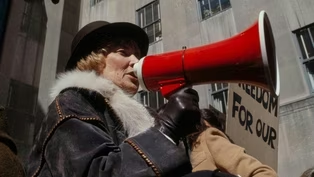
Bella! This Woman's Place Is in the House
Video has Closed Captions
Follow the meteoric rise of firebrand politician and activist Bella Abzug. (2m 41s)
Defining what's missing in our democracy
Video has Closed Captions
In 1975, Bella Abzug went on the "Dinah!" show and questioned what was missing in our democracy. (55s)
How Bella Abzug elevated feminist causes while in office
Video has Closed Captions
While in Congress, Bella Abzug elevated feminist causes, including women's financial independence. (2m 10s)
Providing Support for PBS.org
Learn Moreabout PBS online sponsorship











Support for PBS provided by:
Support for American Masters is provided by the Corporation for Public Broadcasting, AARP, Rosalind P. Walter Foundation, Judith and Burton Resnick, Blanche and Hayward Cirker Charitable Lead Annuity Trust, Koo...