
Prairies: Life in Motion
Episode 6 | 24m 58sVideo has Closed Captions
Nature’s rhythms; from fireflies flashing to cicadas emerging after years underground.
The prairies may look still, but everything here is in motion—by day and by night, above ground and below. Explorer Ariel Waldman follows nature’s rhythms from fireflies flashing at dusk and woodrats working in the dark to cicadas emerging after years underground. In the prairie, pollinators keep wildflowers blooming while ancient rocks shelter microorganisms and preserve echoes of vanished seas.
Problems playing video? | Closed Captioning Feedback
Problems playing video? | Closed Captioning Feedback
Prairies: Life in Motion
Episode 6 | 24m 58sVideo has Closed Captions
The prairies may look still, but everything here is in motion—by day and by night, above ground and below. Explorer Ariel Waldman follows nature’s rhythms from fireflies flashing at dusk and woodrats working in the dark to cicadas emerging after years underground. In the prairie, pollinators keep wildflowers blooming while ancient rocks shelter microorganisms and preserve echoes of vanished seas.
Problems playing video? | Closed Captioning Feedback
Where to Watch Life Unearthed with Ariel Waldman
Life Unearthed with Ariel Waldman is available to stream on pbs.org and the PBS app.
Providing Support for PBS.org
Learn Moreabout PBS online sponsorship[exciting piano and string music] There's a hidden world thriving in the heart of North America, a wilderness that is rarely seen.
I want to show you one of the most dynamic ecosystems on the entire planet, but it's one that's become virtually invisible to us: the prairies.
Here, grasses grow taller than people, sheltering a dazzling array of wildlife, all perfectly adapted to this flourishing habitat.
To truly see the prairies as the lush, jungle-like landscape that they are, you need to view them from a different perspective.
[grass rustling] I'm journeying deep into this remarkable ecosystem, cameras and microscopes in hand, to discover and document the incredible creatures and landscapes found here.
The prairies are a patchwork of connected habitats, from the grasslands to the woodlands, to the wetlands and even the terrain under my feet.
They all come together like a vibrant quilt.
Their rich mix of habitats is what makes them among the most vibrant ecosystems in North America, and well worth a closer look.
[serene synth music] At first glance, here in the prairies, it might seem like everything's still and serene, [starting engine] but look just a little bit longer, take a little bit of an extra moment and you'll see that life is actually in motion here.
Aboveground, underground, in the air, in the water.
Everything everywhere is constantly moving.
[upbeat synth music] Life on the prairies is part of a rhythm that follows the motion of Earth as we orbit a single star 93 million miles away.
As the sun crests the horizon, its first light ignites the land, and the air fills with a hum of wings.
Pollinators dart from bloom to bloom.
[bird calls] While birds take to the sky, their calls echoing across the open plains.
[turkey calls] Every creature here is moving, feeding, thriving.
Each part of a system set into motion thousands of years ago, when the last glaciers that covered much of North America began to retreat.
As the shadows grow long across the tall grass, the golden light deepens and the prairie prepares for the shift that comes with sunset.
When the sun finally slips beneath the horizon, a different world awakens.
A new cast emerges, stepping into the moonlight, ready to play their part under the canopy of night.
[evening insects whirring] It's just around sunset right now, and I'm waiting, eagerly to see fireflies.
I grew up with them in Kansas.
I called them lightning bugs and they just light up the sky, they're amazing to see.
If you haven't seen them, they're definitely worth a trip to try and find them.
They're typically in wooded, dark areas, and when they light up the sky, it's actually little chemical reactions happening inside of their bodies that they use to communicate to one another.
So I'm really interested to see what they have to say tonight.
[curious synth music] As night descended, there was little sign that anything was stirring.
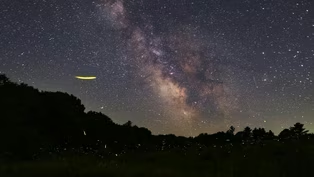
But as the last gasps of sunlight faded over the horizon, fireflies began emerging and lighting up the prairie.
So our patience paid off.
For a while I wasn't sure if we were going to see any 'cause we weren't seeing much.
But then slowly one or two lit up and then after that, the entire field lit up.
It was like a symphony of fireflies.
To witness fireflies is to watch a beautifully coordinated dance.
By using carefully controlled chemical reactions inside their bodies, they can attract one another in the hopes of mating.
The cadence and location of each of their flashes communicates their potential interest.
Using flashes of visible light to reach out and find one another, in an otherwise vast and camouflaged terrain, has turned out to be an ingenious adaptation.
It's also a communication technique that may prove to be universal.
For decades, researchers have been searching the radio spectrum for signs of intelligent extraterrestrial life beyond our solar system.
But researchers have also been looking out into the cosmos for flashes of visible light that could only be produced by technologically-advanced life.
If we ever detect a civilization beyond Earth, we may one day use the same strategy as fireflies to communicate across the cosmos.
Getting to see all of them communicating with one another and just actually getting to be out here and witness that is really special.
And so I think at this point, if they're communicating anything, they're probably telling us to shut off the light.
[light switch click] [coyotes howling] Before our small crew packed up for the evening, we decided to carefully hide a couple of small trail cams [thunder] to see who else was moving around the prairie at night.
[evening insects whirring] As the air cools and the prairie grows silent, a tiny architect emerges from the grasses.
[funny woodwind music] This eastern wood rat waits for the cover of darkness before venturing out, carefully gathering twigs and dried stems to build its nest.
The nest needs a lot of twigs.
This big one might just do the trick.
A little unwieldy, but no problem.
Out here, staying hidden is a matter of survival.
Moving by night helps the wood rat avoid the sharp eyes of hawks during the day.
But even in the dark, rats must plan their movements carefully to avoid nocturnal predators.
[suspenseful music] As the next dawn emerges, the wood rat is fast asleep, [calm orchestral music] safely hidden within its newly remodeled nest.
But if you watch closely, sometimes during the early daylight hours, you might just catch a faint rustle of movement and a flash of fur, of a rodent before it disappears back into the shadows.
With the sun overhead, I return to our firefly watching site, eager to explore this secluded prairie habitat in daylight.
[serene xylophone music and birds chirping] The prairies are a mosaic of different habitats and little ecosystems, each hosting their own distinctive forms of life and environmental conditions.
Woodlands and savannas like this one are different from forests.
The difference really has to do with the canopy.
In a forest, there's a dense canopy and you can't see any sunlight coming down to the ground.
But here, in a woodland and a savanna, you can actually see sunlight touch the ground, because the trees are only freckling the habitat.
And this is really key because that sunlight allows native grasses to flourish here.
The key to the dappled sunlight of prairie savannas has to do with the type of trees that can be found in them.
[birds chirping and woodpecker pecking] Oak and hickory trees are in this corner of the savanna, and oak trees, like this one, are adapted to fires, similar to prairie grasses.
It's those regular disturbances that actually help maintain the savanna and keep it a friendly place for a lot of the wildlife that call this place home.
Without fires, this would become a forest, and it would push out a lot of that wildlife that depend on this place in order to have a wonderful life.
The trees of the prairie savannas shape life not only in the open air, but also deep below, where their roots weave through the soil, supporting an entire hidden world.
It's a really exciting time to be here.
[cicadas whirring] I'm actually hovering over a cicada hole.
And these are really interesting because 17-year-cicadas have just emerged from underground.
They've spent 17 years of their lives entirely underground, sipping on the tree sap of tree roots and just waiting to emerge.
And right now, when they've emerged, is actually, for the first time in 221 years, they've overlapped with 13-year-cicadas, which have spent 13 years underground.
And because those are prime numbers, these two different cicada broods don't normally coincide.
But now, this year, they've coincided, and the result is a trillion cicadas across the entire U.S.
And so there's just so many cicadas out here.
And it's really exciting to see even just these ones that have spent 17 years underground finally emerging.
The emergence of cicadas is one of nature's great events.
Creatures that spend most of their lives out of sight, only to emerge in a sudden, synchronized explosion of sound and movement.
Their brief moment in the sun is a frantic rush, to shed their old skin, [cicada flying away] take flight, to mate, and to call out in a chorus that can be heard for miles.
[cicadas whirring and birds chirping] I love these little exoskeletons that really showcase the emergence of them going from their underground form to the aboveground form, where they're flying everywhere.
And they just leave behind these really cool shells that are just really fun to look at.
On the prairie, some lives unfold over a few short weeks.
Loud, fleeting, and full of motion.
But other stories move on a different timescale entirely.
Measured not in weeks or years, but in millions of years.
Written in stone and almost invisible to us.
[birds chirping] Hundreds of millions of years ago, this used to be a tropical beach near the equator.
It doesn't really look like a tropical beach today.
But we can still see the sand from that beach in the form of stone outcrops like these.
Over millions of years this sand got compacted under the weight of glaciers, and it was deep under the earth until eventually tectonic activity pushed it up out of the earth.
And now we can see it in these towering, beautiful stone outcrops.
And even just touching it, you can really feel the sand, the individual grains of sand from that ancient beach.
This ancient sandstone isn't just a remnant of North America's distant past.
It's also an active part of a living ecosystem.
Even now, its surface and cracks provide a micro-habitat for resilient lifeforms that have adapted in clever ways.
Tiny organisms use this ancient sand to protect themselves from the harsh UV rays that would otherwise dry them out.
Little pieces and bits of algae and bacteria actually embed themselves inside the rock, and we can actually see them.
If I just scratch off a little bit here with my fingernail.
[calm strings music] Because the sandstone is so porous, it allows in just enough sunlight so that the algae and bacteria can still photosynthesize.
But it protects them from the UV damage that they would otherwise get if they were left out in the sun.
It's remarkable to think that life can exist buried inside of a rock hidden away from sight.
But some rocks tell an even stranger story, not just as a home for life, but as the very remnants of life itself.
Formed from the skeletons of creatures that lived millions of years ago.
As I was walking around and looking at all this sandstone, I came across a rock that looks a little bit different.
I think it might be limestone, but what I'm going to do is actually test it by dropping a little bit of acid on it.
A mild acid, no stronger than lime juice.
But if this limestone, if it is limestone, reacts to this and starts bubbling, what it'll actually tell us is that this rock is the form of seashells that have been dissolved and compacted over time.
And this acid bubbling on it is reacting to those ancient seashells.
So let's try.
[fizzing] The fizzing proves the presence of calcium carbonate from the seashells of creatures that once occupied large stretches of what today are the tallgrass prairies.
Millions of years ago, coral reefs and shallow seas thrived here with symbiotic relationships, tiny life forms building vast underwater worlds.
Today, a different kind of life unfolds above these ancient rock beds.
A dynamic ecosystem of native plants, pollinators and migratory birds shape the modern prairie.
[bird calls] Each year when the weather warms, sandhill cranes can be seen in the prairies, drawn by the habitat's mix of wetlands and open grasslands.
Standing nearly five feet tall, [crane calls] they rely on the prairies for nesting and foraging, using their long bills to dig for insects and seeds.
But it's not only sustenance that the prairies provide.
They also leave a visible mark on the cranes themselves.
In the heat of summer, their normally gray plumage takes on a rusty hue.
By using the iron-rich mud of the prairies to preen themselves, they effectively dye their feathers, giving themselves a fresh summer look that helps them blend in with the sunbaked grasses.
[cranes calling] [insects and birds chriping, calm orchestral music] The tall grasses of the prairies share their home with a number of other iconic prairie plants, like this cone flower, which is just a hub for pollinators of all kinds.
Honeybees often get a lot of fandom and following, but here, just across these 4000 acres, there's 300 different species of native wild bees.
[serene harp music] Prairie bees come in many forms.
Unlike honeybees, most live alone, nesting out of sight in hollow stems, or even living underground.
Each playing a role in pollinating the wildflowers that keep the prairie thriving.
One of the most valuable pollinators native to North America is the bumblebee.
Bumblebees are key to the success of both prairie ecosystems and agriculture.
One of the secrets to their success lies in how they pollinate flowers.
By vibrating their entire body in tiny, rapid movements like a tuning fork, they can shake pollen out of flowers that other bees, such as the honeybee, can't access.
This is what's known as buzz pollination.
And without it, many prairie plants and everyday foods, like tomatoes and blueberries, would suffer.
While honeybees are important for agriculture, they aren't native to North America.
If not carefully managed, honeybees have the potential to crowd out native wild bees, competing for the same nectar and pollen, and putting pressure on already delicate ecosystems.
That's why protecting native pollinators is critical to the health and resilience of prairie habitats.
But bees are just part of the story.
The prairies are also home to an array of other pollinators.
From moths and butterflies, to wasps and even flies.
Each one plays a vital role in keeping this ecosystem blooming and balanced.
Each pollinator has their specialty.
Butterflies use their long, straw-like mouthparts to slurp up nectar.
Among the prairie grasses, they're one of the easier pollinators to spot.
Wasps, often mistaken for mere predators, also visit flowers and help transfer pollen as they search for nectar.
And flies, some disguised as bees, go about their work, visiting flowers and helping pollinate them along the way.
Together, they form a complex network that keeps the prairie in bloom.
It's so unbelievably gorgeous to be out here and just have the treat of getting to sit here.
There's a nice wind going across my skin, but I'm surrounded by colors of pink and purple and yellow and green, and I'm getting to see all the insects hop from plant to plant, which is really delightful.
I can also smell all of these different plants, and if I close my eyes and just sit for a moment.
I can hear the bees and the birds, all the different little creatures coming alive in this prairie.
[birds and insects chirping, woodpecker pecking] There's something quietly electric about experiencing the prairies.
Their strength and resilience lies within their diversity.
A patchwork of wetlands, grasslands and woodlands that come together to create one of the most biodiverse ecosystems on the continent.
[calm string music] These wide open spaces are bursting with life, if you just take the time to look.
And yet, even here, where life has adapted to a changing world, the signs of loss are hard to ignore.
In the last 50 years, numerous species of butterfly, bumblebee and grassland bird populations have fallen sharply, each by over 50 percent.
These aren't isolated declines.
They're part of a much larger story about how much space we leave for the wild.
The ubiquity of grass could give anyone a false sense of security about the future of grasslands.
But the reality is they're the most threatened and endangered ecosystem on the planet.
Tallgrass prairies once covered over 265,000 square miles across North America until just a couple centuries ago.
Today, it's estimated that less than 4 percent remain.
[hopeful synth music] But, when given the chance and the space, the prairie reawakens.
We've seen it happen.
Native plants coming back.
Monarchs fluttering over converted fields.
And microscopic animals reinhabiting restored soils.
Through studying the prairies tiniest microscopic wildlife, researchers have discovered that restored soils can regain the key components of healthy prairie ecosystems in just a few years, not decades, as once thought.
Efforts to restore prairie ecosystems have sprung up across the U.S.
over the last few decades, with promising results.
Organizations have invested in buying back land from agricultural farms to begin the important work of expanding corridors for native plants and wildlife.
So much of the natural history of the prairies is about nature giving room for different forms of life to flourish.
And that story and approach is similar in prairie restoration.
A number of approaches, such as restoring habitats, managing land use, the rematriation of lands to indigenous stewardship, and addressing greenhouse gas emissions, are being explored as part of broader efforts to support prairie ecosystems.
These measures can play a role in shaping environments that support native plants and animals, as well as reshaping our relationship with nature.
The first step is to recognize we can no longer afford for the prairies to be invisible to us.
[uplifting piano music]
Video has Closed Captions
Clip: Ep6 | 3m 2s | Fireflies are a captivating phenomenon to witness on the prairie. (3m 2s)
Video has Closed Captions
Preview: Ep6 | 30s | Nature’s rhythms; from fireflies flashing to cicadas emerging after years underground. (30s)
Providing Support for PBS.org
Learn Moreabout PBS online sponsorship New Episode
- Science and Nature

Explore scientific discoveries on television's most acclaimed science documentary series.
 New Episode
- Science and Nature

Capturing the splendor of the natural world, from the African plains to the Antarctic ice.

 New Episode








Support for PBS provided by: