
WETA Arts October 2026
Season 14 Episode 2 | 28m 8sVideo has Closed Captions
Sculptor Foon Sham and D.C. Preservation League Executive Director Rebecca Miller.
In October, WETA Arts puts a spotlight on internationally renowned local sculptor Foon Sham, known for creating large-scale sculptures depicting organic forms made of wood blocks. Also, host Felicia Curry explores the city with D.C. Preservation League Executive Director Rebecca Miller to learn about what D.C.'s architecture can reveal about its history.
Problems playing video? | Closed Captioning Feedback
Problems playing video? | Closed Captioning Feedback
WETA Arts is a local public television program presented by WETA
WETA Arts October 2026
Season 14 Episode 2 | 28m 8sVideo has Closed Captions
In October, WETA Arts puts a spotlight on internationally renowned local sculptor Foon Sham, known for creating large-scale sculptures depicting organic forms made of wood blocks. Also, host Felicia Curry explores the city with D.C. Preservation League Executive Director Rebecca Miller to learn about what D.C.'s architecture can reveal about its history.
Problems playing video? | Closed Captioning Feedback
Where to Watch WETA Arts
WETA Arts is available to stream on pbs.org and the PBS app.
Providing Support for PBS.org
Learn Moreabout PBS online sponsorship♪ Hi, everybody.
I'm Felicia Curry, and welcome to "WETA Arts," the place to discover what's going on in the creative and performing arts in and around D.C.
In this episode... sculptor Foon Sham finds his calling.
[Foon Speaking English] Woman: It's a spectacular building, yes.
Curry: And I meet with Rebecca Miller, Executive Director of the D.C.
Preservation League, to learn about what our city's architecture tells us about our history.
Historic preservation is really important to the people of the nation.
These stories coming up on "WETA Arts."
♪ Across the DMV, you can find striking, large-scale sculptures of forms depicting nature, made of woodblocks.
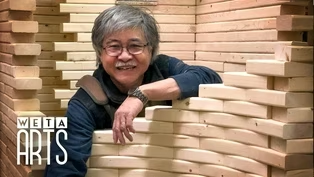
These works were created by sculptor Foon Sham, a local artist whose work has become a highly recognizable part of the regional landscape.
Yeah, I'm right there.
Curry: But this time, the creator of those massive works is instead showing small pieces.
♪ The Museum of Contemporary Art Arlington, MoCA for short, is about to open its Art After Hours event, and Foon is catching up with Kathy Freshley, who was the museum's Executive Director in the eighties, while he was an artist in residence.
Why did you become interested in doing this?
[Foon speaking English] After you burned it?
Yeah.
Curry: The exhibition, called "Material Matters," celebrates the museum's Artist-in-Residence Program's 50th anniversary by showcasing work from generations of former artists-in-residence.
Woman: In Foon's case, he was my first studio visit.
He was so enthusiastic about the wood, just the material.
I finally asked him, "Foon, why do you like wood so much?"
And he said, "Because trees are like people, "and no two are alike, "and you won't really know what they are "until you start to work with them, and then they tell you their story."
And I realized right then, like, that was the heart of the show.
[Speaking English] Curry: Foon was born in Macau, off the southern coast of China, and his family moved to Hong Kong when he was 10.
[Speaking English] Curry: While Foon Sham was discovering his true passion in California, in Northern Virginia, the stage was being set for his residency at the Museum of Contemporary Art Arlington, at the time called the Arlington Arts Center.
Arlington County in the early seventies was contemplating building a cultural center with studio space for dance, for visual artists.
The county decided not to do that.
Curry: This left the artists in a bind.
Coincidentally, a school on Wilson Boulevard near what would become Virginia Square Metro had recently closed.
Freshley: And they came to the county with a proposal that the county rent Maury school to the visual artists.
The county agreed, and in '76, they took over.
They wanted to paint and explore.
They didn't really want to run a gallery.
And that is how I got involved.
I never thought I would be an artist, but I loved that administrative helping role.
I joined the board.
Then they asked me to be president, and I had just finished my term as president in late '85, and I got a call from one of the board members saying, "Kathy, "we want you to be our executive director."
Foon came shortly thereafter.
Curry: After graduating from the California College of Arts and Crafts, Foon Sham went to graduate school at Virginia Commonwealth University in Richmond.
[Speaking English] Curry: One of the professors invited Foon to teach a design class, and other teaching gigs followed.
The portfolio he built helped him secure a residency at Arlington Art Center, whose mission was to support artists pursuing professional careers.
[Speaking English] Foon and I just developed a friendship, and I learned a tremendous amount about large-scale construction.
He's an artist, but he's also an engineer.
He's just brilliant in how he puts together these pieces.
Curry: She also started buying art from Foon and other artists in the region.
A selection from her collection is also being revealed at the museum's Art After Hours event.
The shape of this piece is extraordinary.
I just love this.
The way you view art in a gallery and the way you view it in your home is so different.
It's very thrilling and exciting for us, because it makes us see elements of the pieces that you walk by every day, and maybe not every day, you're paying deep attention to it.
You're just going about your life, and there it is.
Well, now you're looking, and you're seeing a little different.
I'm excited by that.
[Speaking English] Yeah.
It's nice because we get so many different people now, and everybody's really into the art, so... Arlington Arts Center was known for great exhibitions, but it didn't have visibility in the community.
Even when we rebranded in 2022, we never changed the mission.
It's always been that foundational point to connect community to contemporary art and artists.
So it was just a matter of signaling to the community that this was a place they could come inside.
Hi, how are you?
It's so good to see you.
Anchin: Art After Hours can bring in 400 people over the course of 3 hours to look at new shows, meet new people, and chat with the artists directly.
Our residents have their studios open to the public, so people can wander in and get to chat with them and see work in progress, as well as meet other artists in our region.
Curry: One of those artists in residence, Milan Warner, is a former student of Foon's.
I've been good.
[Speaking English] This is like paper crepe, just literally on some hot glue that I've nailed into the wall to create these organic forms.
[Foon speaking English] I'll see you soon.
Yeah, I'll see you soon.
Curry: Foon's work can now be found around the world, as well as across the DMV.
[Indistinct chatter] What I like about his work is it looks simple, but it's very complex, and the work has changed over the years.
But you can always tell that it's his work.
I think seeing the artist in person definitely helps ground me in that human connection of it.
Coming here is like it's an opportunity for us to see what our community is doing.
Jirón-Murphy: Foon Sham is a very special artist.
He has a very wide reach, and I think it's just his generosity as a person, and we're just so lucky that he's a part of this organization's history.
Curry: For more about Foon and his work, go to foonsham.com.
And for the latest Museum of Contemporary Art Arlington programs, go to mocaarlington.org.
Washington, D.C., like all cities, is always changing, and its varied architectural style provide a window into the city's rich history.
Rebecca Miller is dedicated to saving that history.
She's the Executive Director of the D.C.
Preservation League, whose mission is to preserve, protect, and enhance the historic and built environment of Washington, D.C.
I met her on 13th and Pennsylvania Northwest to learn how D.C.
's preservation movement got its start.
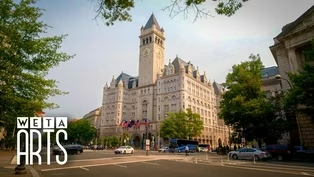
We're standing here in front of the Old Post Office building, which I know is the origin of your organization, started as Don't Tear It Down.
What was going on here in the 1970s that led the folks around to say we need to preserve this building in particular?
A lot of the historic buildings were tagged to be demolished.
The Old Post Office, being built in 1891, was not in the style of the Federal Triangle that you see behind me right now.
It's Richardsonian Romanesque, which is H.H.
Richardson, who did a lot of work up in the Northeast, and it's very instrumental to the skyline.
We had a big rally here in front of the Old Post Office building.
We marched from the National Trust for Historic Preservation's headquarters.
There was a lot of lobbying of Congress, and eventually we were able to save it.
Who were the people who were just passionate about wanting to save this particular building?
It was historians, it was the public, it was architects.
We had a whole coalition of individuals.
We had had the riots here in 1968.
This was the early seventies, and people were really wanting to stay here and see the city rebuilt.
Obviously, Old Post Office building, big win.
Are there any others around the city that are memorable for you?
Memorable for the organization, particularly is the Willard Hotel, which I think is really identifiable to the public.
We also have the Franklin School, which is now the Planet Word Museum up on Franklin Park, and that's a really successful one.
I think one of the biggest successes that we had, though, was the 1978 law called the District of Columbia Historic Landmark and Historic District Protection Act of 1978.
About 20-25% of the city is protected.
We've been talking so much about the Old Post Office building.
I would love to see it up close and personal.
Can we do that?
We should go take a look.
Let's do it.
♪ Curry: You all are in D.C.
proper.
Miller: We were in Wonder Bread before that.
It is also a nice historic building that we saved.
That you saved.
Yes, and it was really quite good.
Curry: Wow.
When you see it this close, it really is beautiful.
Miller: It's a spectacular building, yes.
The arches are emblematic of this type of Richardsonian Romanesque architecture.
And this particular tower is so interesting because it's 215 feet tall, and you wouldn't be able to build this today under our Height Act.
Curry: We've talked so much about this very large building.
I would love to see the projects you're working on that are in some of the smaller neighborhoods that are affecting the people who actually live in the city.
Should we go check one out?
Let's do it.
Curry: We head northeast to Shaw, a neighborhood named for Civil War Colonel Robert Gould Shaw.
So welcome to Shaw.
It's beautiful.
They have some wonderful architecture here.
Does a building or a house have to be a certain age for you all to take an interest in it?
Not particularly.
Under the D.C.
law, we actually don't have any type of age requirement, but enough time has had to have passed that there can be academic study and research of those particular neighborhoods or sites.
I think what's most interesting to our work right now is the diversification of our D.C.
inventory of historic sites to tell the fuller story of Washington, D.C.
We've been working on projects like African American architects and their major works, also women's suffrage, Latino history, and the Chinese community down in Chinatown.
So all of these are really important to telling the full story of Washington, D.C.
and making sure people understand that it's not just a federal city, but it is a community as a whole.
What are the tools at your disposal to actually challenge the changes that are being made?
We have the ability to file for landmark nominations and also a historic preservation review board that reviews major development projects.
New construction happens in historic districts all the time, and it goes through that review process so that it is compatible with its neighbors and the historic district as a whole.
You mentioned that Shaw is different than other historic neighborhoods in D.C.
Why is that?
Well, there are a lot of different architectural styles.
Let's go have a look.
Let's do it.
♪ Miller: This used to probably be a little corner store.
You can see the, like, little storefront.
Curry: Yes.
Isn't that adorable?
And then you have that infill row house, which was built in 2006, but it's compatible with the neighborhood.
If you hadn't just said it was 2006, I would have thought it was a historic building.
Well, it's really about the evolution because there are different ages of buildings here, and so we had a big boom in population after the Civil War, and people were now building in what was originally farmland.
We have a lot of building stock, such as right behind us, that was built in 1874 or even earlier.
We have to do a lot of research through fire insurance maps just to make sure that we understand the exact date.
Or you have buildings across the street with the bayfront row houses that were built a little bit later, 1883.
1968, of course, we had the riots here in Shaw after the death of Martin Luther King Jr., and the Shaw Historic District was established in 1999.
Which D.C.
neighborhoods would you say have changed the most since your organization was founded?
So many of them have changed, but there's one particular neighborhood that's had a dramatic change over the last 20 years.
I'd like to show it to you.
I'd love to see it.
Curry: From Shaw, we travel to Southeast, to St.
Elizabeths, named after a tract of land surveyed back in 1663.
Curry: Here we are at St.
Elizabeths.
Why is it such an important historic place?
St.
Elizabeths is a National Historic Landmark.
It was founded in 1852 by Dorothea Dix.
Dorothea Dix was a social reformer from New England, and she came down and worked with Charles Nichols, who was a local physician, to start the U.S.
Government Hospital for the Insane, and they convinced the federal government to give them a plot of land.
It originally started with a long, undulating building on the west campus and had several phases of development.
At one time, something like 15,000 people were on campus.
The federal government owned this facility up until the nineties.
Then the District government had it for a long time, and then they split the campuses.
The West Campus is across the street where the Department of Homeland Security has its consolidated headquarters.
The East Campus, though, is owned by the District government, and they're redeveloping it for mixed-use housing, also a practice facility for the Wizards, and lots of other different opportunities here in Ward 8.
You actually preserved this because of the landscape, as well.
The view sheds are very significant, so sight lines and experiencing the land.
On the West Campus where Homeland Security is, it was a planned therapeutic landscape.
Unfortunately, they did demolish 13 historic buildings.
What was the decision-making around that?
There was no decision-making from the part of the preservation community.
That's something that, generally speaking, would have been consulted on and resulted in some sort of mitigation measures that we haven't seen at this point.
The west side of the campus falls within the General Services Administration's portfolio, and that falls under Section 106 of the National Historic Preservation Act, which requires them to take into account the effect of any development on the historic character of the campus.
And under the D.C.
Historic Preservation Law, the goal is to benefit, does the public benefit outweigh the preservation loss?
I would love to take a walk around campus and see the state of some of the buildings right now.
Let's go check that out.
Let's do it.
♪ Curry: As we're walking by this building, clearly it's been renovated, but what are some of the things that architecturally lend itself to what it used to look like?
Well, these buildings have been greatly documented over the decades, and so it's very true to what it was historically.
You have the red tile roofs.
You have the stone over the entryways and the arches that you can see here.
There's plenty of buildings that look like this over here that are waiting for rehabilitation.
The campus has been under development since 2011, and we've had a pandemic during that time, a little slow down in construction right now.
There's no reason that you couldn't take this building and actually reuse it for a good purpose in the future.
This campus dates back to about 1850.
I would love to see sort of a broader idea of the city planning and the history of that in the city.
Is there somewhere we can go for that?
There's absolutely a plan for the city of Washington that we can show you.
Let's go.
Let's do it.
We make our way northwest to Arlington National Cemetery and the rooftop of the Military Women's Memorial.
Miller: We are at Arlington National Cemetery at the Women's Memorial.
Curry: Oh, my goodness.
This view is unbelievable.
It's pretty spectacular, isn't it?
You can see across Memorial Bridge to the Lincoln Memorial.
You can also see the skyline of Washington where you see the Old Post Office, the Washington Monument.
You can also see the Capitol Building.
So it's a really special view from here.
What makes this view different than maybe a view you might see in other major cities?
It is a designed city.
And Pierre L'Enfant, who was chosen to design the city by George Washington in 1791, wanted it to feel like an open space where you had radiating avenues, large public civic spaces, the hierarchy of government, where you have the connection of the Capitol Building to the White House.
So you have these view sheds all around the city that are very important to the L'Enfant plan.
When you talk about L'Enfant's plan, the next major vision for the city is the McMillan Plan.
How are these plans similar?
How are they different?
As the city grew through the 19th century, it kind of grew up just buildings going here and there.
The McMillan Commission decided to implement L'Enfant's vision for the city of Washington.
They started doing that in the early part of the 20th century, which continues today as we try and protect it.
This stretch, between Arlington National Cemetery and the Lincoln Memorial, what was the symbolism, do you think, of this stretch?
Well, it's very much laid out in the McMillan Plan to show the unity between the North and the South because that was an idea to have the country heal in the future.
Arlington National Cemetery wasn't here until after the Civil War.
It was the Lee family estate.
Lee was, of course, the commanding officer for the Confederacy, and Lincoln is the president who ended the Civil War.
So it's this intentional view to really symbolize that connection between these two individuals.
Curry: In 2025, the White House announced a different vision for this stretch with a triumphal arch in the circle between Lincoln Memorial and Arlington National Cemetery.
At 250 feet, it would be over twice the height of the Lincoln Memorial.
Curry: When we talk about possibly putting something at the center of this stretch, what is the public benefit of something like that?
What's the preservation loss of something like that?
There's a lot to lose at this point by putting a triumphal arch in the middle of Memorial Circle.
Not only would you lose the view shed, unless you were walking directly down the middle of Memorial Bridge, it would complicate so many types of different activities that take place here.
And you have more than 400,000 people who were buried here in Arlington National Cemetery.
It's supposed to be a solemn space.
It's not a place of victory and triumph, which is what this arch is meant to stand for.
As somebody whose father is buried at Arlington National Cemetery, that's not something that I am interested in, nor are the veterans who are suing to stop that memorial from going forward.
You started out as a grassroots organization.
What's the trajectory that you see for the D.C.
Preservation League moving into the future?
At this point in time, we are using lawsuits, which is something that we did initially because we didn't have the preservation laws in place.
We've always had a great working relationship with the federal government, and I hope in the future we'll return to that so that we can preserve these places together.
Historic preservation is really important to the people not only of the District of Columbia, but of the nation.
Rebecca, thank you so much for being on "WETA Arts."
It's been a pleasure.
Curry: The D.C.
Preservation League's website provides dozens of self-guided tours of D.C.
historic places and spaces.
Go to dcpreservation.org for details.
Here's a thought from American poet June Jordan.
Poetry is a political act because it involves telling the truth.
Thank you for watching "WETA Arts."
Be well, be creative, and enjoy the art all around you.
I'm Felicia Curry.
People may be concerned that they can't paint their house, which is not actually part of the regulations, or change their windows.
We try and be as flexible as possible, understanding that not everybody in the city has the same resources to manage their historic buildings.
I think when you see an exhibition, you're seeing your community, and that's pretty damn cool.
Announcer: For more about the artists and institutions featured in this episode, go to weta.org/arts.
D.C. Preservation League: 50 Years of Saving Washington's Architecture
Video has Closed Captions
Clip: S14 Ep2 | 13m 16s | Exploring historic preservation in Washington, D.C. (13m 16s)
Meet Foon Sham: The Artist Whose Sculptures Define the DC Region
Video has Closed Captions
Clip: S14 Ep2 | 12m 55s | Felicia Curry visits the Museum of Contemporary Art Arlington (12m 55s)
Preview: WETA Arts October 2026
Preview: S14 Ep2 | 30s | Sculptor Foon Sham and D.C. Preservation League Executive Director Rebecca Miller. (30s)
Providing Support for PBS.org
Learn Moreabout PBS online sponsorship New Episode
 New Episode
- Arts and Music

Innovative musicians from every genre perform live in the longest-running music series.


 New Episode




 New Episode
 New Episode

Support for PBS provided by:
WETA Arts is a local public television program presented by WETA