
Meet Foon Sham: The Artist Whose Sculptures Define the DC Region
Clip: Season 14 Episode 2 | 12m 55sVideo has Closed Captions
Felicia Curry visits the Museum of Contemporary Art Arlington
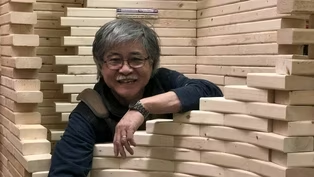
Across the D.C. region, you've probably seen Foon Sham's towering wood sculptures without knowing his name — but this time, the artist is going small. WETA Arts host Felicia Curry visits the Museum of Contemporary Art Arlington as it prepares for its Art After Hours event and the opening of "Material Matters," an exhibition celebrating 50 years of the museum's Artist-in-Residence Program.
Problems playing video? | Closed Captioning Feedback
Problems playing video? | Closed Captioning Feedback
WETA Arts is a local public television program presented by WETA
Meet Foon Sham: The Artist Whose Sculptures Define the DC Region
Clip: Season 14 Episode 2 | 12m 55sVideo has Closed Captions
Across the D.C. region, you've probably seen Foon Sham's towering wood sculptures without knowing his name — but this time, the artist is going small. WETA Arts host Felicia Curry visits the Museum of Contemporary Art Arlington as it prepares for its Art After Hours event and the opening of "Material Matters," an exhibition celebrating 50 years of the museum's Artist-in-Residence Program.
Problems playing video? | Closed Captioning Feedback
Where to Watch WETA Arts
WETA Arts is available to stream on pbs.org and the PBS app.
Providing Support for PBS.org
Learn Moreabout PBS online sponsorshipAcross the DMV, you can find striking, large-scale sculptures of forms depicting nature, made of woodblocks.
These works were created by sculptor Foon Sham, a local artist whose work has become a highly recognizable part of the regional landscape.
Yeah, I'm right there.
Curry: But this time, the creator of those massive works is instead showing small pieces.
♪ The Museum of Contemporary Art Arlington, MoCA for short, is about to open its Art After Hours event, and Foon is catching up with Kathy Freshley, who was the museum's Executive Director in the eighties, while he was an artist in residence.
Why did you become interested in doing this?
[Foon speaking English] After you burned it?
Yeah.
Curry: The exhibition, called "Material Matters," celebrates the museum's Artist-in-Residence Program's 50th anniversary by showcasing work from generations of former artists-in-residence.
Woman: In Foon's case, he was my first studio visit.
He was so enthusiastic about the wood, just the material.
I finally asked him, "Foon, why do you like wood so much?"
And he said, "Because trees are like people, "and no two are alike, "and you won't really know what they are "until you start to work with them, and then they tell you their story."
And I realized right then, like, that was the heart of the show.
[Speaking English] Curry: Foon was born in Macau, off the southern coast of China, and his family moved to Hong Kong when he was 10.
[Speaking English] Curry: While Foon Sham was discovering his true passion in California, in Northern Virginia, the stage was being set for his residency at the Museum of Contemporary Art Arlington, at the time called the Arlington Arts Center.
Arlington County in the early seventies was contemplating building a cultural center with studio space for dance, for visual artists.
The county decided not to do that.
Curry: This left the artists in a bind.
Coincidentally, a school on Wilson Boulevard near what would become Virginia Square Metro had recently closed.
Freshley: And they came to the county with a proposal that the county rent Maury school to the visual artists.
The county agreed, and in '76, they took over.
They wanted to paint and explore.
They didn't really want to run a gallery.
And that is how I got involved.
I never thought I would be an artist, but I loved that administrative helping role.
I joined the board.
Then they asked me to be president, and I had just finished my term as president in late '85, and I got a call from one of the board members saying, "Kathy, "we want you to be our executive director."
Foon came shortly thereafter.
Curry: After graduating from the California College of Arts and Crafts, Foon Sham went to graduate school at Virginia Commonwealth University in Richmond.
[Speaking English] Curry: One of the professors invited Foon to teach a design class, and other teaching gigs followed.
The portfolio he built helped him secure a residency at Arlington Art Center, whose mission was to support artists pursuing professional careers.
[Speaking English] Foon and I just developed a friendship, and I learned a tremendous amount about large-scale construction.
He's an artist, but he's also an engineer.
He's just brilliant in how he puts together these pieces.
Curry: She also started buying art from Foon and other artists in the region.
A selection from her collection is also being revealed at the museum's Art After Hours event.
The shape of this piece is extraordinary.
I just love this.
The way you view art in a gallery and the way you view it in your home is so different.
It's very thrilling and exciting for us, because it makes us see elements of the pieces that you walk by every day, and maybe not every day, you're paying deep attention to it.
You're just going about your life, and there it is.
Well, now you're looking, and you're seeing a little different.
I'm excited by that.
[Speaking English] Yeah.
It's nice because we get so many different people now, and everybody's really into the art, so... Arlington Arts Center was known for great exhibitions, but it didn't have visibility in the community.
Even when we rebranded in 2022, we never changed the mission.
It's always been that foundational point to connect community to contemporary art and artists.
So it was just a matter of signaling to the community that this was a place they could come inside.
Hi, how are you?
It's so good to see you.
Anchin: Art After Hours can bring in 400 people over the course of 3 hours to look at new shows, meet new people, and chat with the artists directly.
Our residents have their studios open to the public, so people can wander in and get to chat with them and see work in progress, as well as meet other artists in our region.
Curry: One of those artists in residence, Milan Warner, is a former student of Foon's.
I've been good.
[Speaking English] This is like paper crepe, just literally on some hot glue that I've nailed into the wall to create these organic forms.
[Foon speaking English] I'll see you soon.
Yeah, I'll see you soon.
Curry: Foon's work can now be found around the world, as well as across the DMV.
[Indistinct chatter] What I like about his work is it looks simple, but it's very complex, and the work has changed over the years.
But you can always tell that it's his work.
I think seeing the artist in person definitely helps ground me in that human connection of it.
Coming here is like it's an opportunity for us to see what our community is doing.
Jirón-Murphy: Foon Sham is a very special artist.
He has a very wide reach, and I think it's just his generosity as a person, and we're just so lucky that he's a part of this organization's history.
Curry: For more about Foon and his work, go to foonsham.com.
And for the latest Museum of Contemporary Art Arlington programs, go to mocaarlington.org.

D.C. Preservation League: 50 Years of Saving Washington's Architecture
Video has Closed Captions
Clip: S14 Ep2 | 13m 16s | Exploring historic preservation in Washington, D.C. (13m 16s)
Preview: WETA Arts October 2026
Preview: S14 Ep2 | 30s | Sculptor Foon Sham and D.C. Preservation League Executive Director Rebecca Miller. (30s)
Providing Support for PBS.org
Learn Moreabout PBS online sponsorship New Episode
 New Episode
- Arts and Music

Innovative musicians from every genre perform live in the longest-running music series.


 New Episode






 New Episode
 New Episode

Support for PBS provided by:
WETA Arts is a local public television program presented by WETA