
Realms of the Real
Season 12 Episode 2 | 54m 39sVideo has Audio Description
A group of international artists push everyday materials into the fantastical, absurd and sublime.
Viewers travel from a banana plantation in Reykjavik, Iceland, to a former Agfa photographic film factory in Berlin to Argentina’s “Lithium Triangle” with featured artists Njideka Akunyili Crosby, Ragnar Kjartansson, Candice Lin and Tomás Saraceno.
See all videos with Audio DescriptionADProblems playing video? | Closed Captioning Feedback
Problems playing video? | Closed Captioning Feedback
Realms of the Real
Season 12 Episode 2 | 54m 39sVideo has Audio Description
Viewers travel from a banana plantation in Reykjavik, Iceland, to a former Agfa photographic film factory in Berlin to Argentina’s “Lithium Triangle” with featured artists Njideka Akunyili Crosby, Ragnar Kjartansson, Candice Lin and Tomás Saraceno.
See all videos with Audio DescriptionADProblems playing video? | Closed Captioning Feedback
How to Watch ART21
ART21 is available to stream on pbs.org and the free PBS App, available on iPhone, Apple TV, Android TV, Android smartphones, Amazon Fire TV, Amazon Fire Tablet, Roku, Samsung Smart TV, and Vizio.
Buy Now
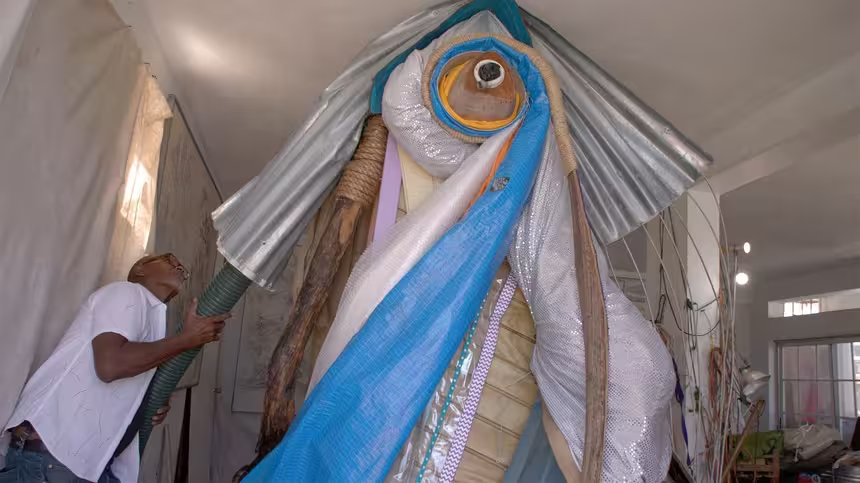
Everyday Icons
Learn more about the artists featured in "Everyday Icons," see discussion questions, a glossary, and more.Providing Support for PBS.org
Learn Moreabout PBS online sponsorship♪soft uplifting music♪ ♪soft uplifting music♪ [string instrument tuning in distance] [gull caws] [tuning continues] [man] Okay, on one, two, three.
One...two...three!
Okay.
Now down a little bit.
Down.
[Ragnar VO] For me, visual art basically just means... It's almost like a word for freedom.
♪organ playing♪ That you can do whatever you want and you can call it "visual art."
It was like a brilliant thing that was kind of given to us at the beginning of the 20th century by people like Marcel Duchamp.
It really feels like the ultimate freedom profession.
♪soft curious music♪ I'm Ragnar Kjartansson, and I am a visual artist living in Iceland.
[indistinct chatter] [man] It's so nice, the tree.
The tree is fantastic.
[Ragnar] It's really cool, the tree.
Especially when you're... ♪♪♪ [Ragnar VO] For me, being an artist is a way to live life, creating moments.
Moment is so important.
Very similar to, like, a children's play.
-[man] Rolling!
-[woman] Rolling!
[Ragnar VO] You meet your friends and you play, and you, like... you try to create a situation that's magical.
[both singing] ♪Far out♪ ♪At the end of history♪ ♪I will wait for you♪ ♪Hoping you will come♪ ♪I cannot keep my dreams straight♪ ♪I cannot keep my dreams straight♪ ♪I cannot keep♪ ♪My dreams straight♪ [Markús VO] For an artist like Ragnar, art is a part of his life from the beginning.
He's just a vehicle for something that needs to be explored, and that he can go to whatever length that will take him.
♪soft uplifting string music♪ As they row from Kambar towards the village, Olafur is overwhelmed by the future waiting.
Everything is possible.
♪♪♪ [Markús VO] It's all about art as a way of expressing yourself... [dog barking] to better understand humanity, and better understand your emotions.
[both singing] ♪By the stream, by the stream♪ ♪My love♪ ♪My love♪ ♪♪♪ [Markús VO] Just to find your way in the world.
[all singing] ♪Oh, babe♪ ♪No tomorrow♪ ♪Oh, babe...♪ [Ragnar VO] Iceland plays a huge role in kind of what I am as an artist.
It's a really specific, strange place, because it's up north kind of by the end of the world.
Iceland was just, like, a sheep farming community until the mid-20th century.
And then, suddenly, like... city life started happening.
So, I remember in the generation of my grandparents -- my grandfather was a sculptor -- but they had just both moved from the countryside to Reykjavík... to basically create culture.
It was almost make-believe -- you know, like, "Let's do this."
My mom, she went to acting school in England.
That's lovely, darling.
[Ragnar, in mock English accent] Oh, lovely!
-Yes, yes, yes, yes.
-Ah!
[laughs] [Ragnar VO] She was in class with Judi Dench, and James Fox, and all these really great actors, but she never, ever had the idea in her head that she should stay in England and pursue a career there, because, like, you just had to go back to this island to... create culture.
So, that's also maybe a part of this feeling of make-believe: nobody's, like, a real cultural person.
You're just kind of... [chuckles] We're just, like, pretending this is, like, a real European place.
♪quirky ethereal music♪ [Gudrún] He was studying at the... art school in Iceland, and then he made this painting for me.
[Ragnar] My great religious painting.
[Gudrún] Aha!
Yes.
That's how it is.
[Ragnar] The birth of Jesus.
Yeah, it's the Holy birth.
[laughs] [spitting] [Ragnar VO] So, that's a piece that started in art school.
[spitting] [interviewer VO] How did it feel?
How did it feel?
[Gudrún] To spit on him?
-Marvelous!
-[laughs] Yes.
[Ragnar VO] And then I decided this rule that we should film it every five years.
[spitting] I just really like this idea of repetition that it creates a mantra -- creates something religious.
[spitting] It just becomes... mystical.
It just becomes like a religious experience.
I started out as an artist, like, I was in a band.
We had this band called Trabant, which was an electro-clash, flamboyant pop group.
We got a record deal.
We did, like, what's called the "toilet tour" of England.
Then I thought to go to art school -- like, all European bands come from art school.
And so, I went to art school, and I learned about performance art and, of course, conceptual art and feminist art.
♪melancholy music playing♪ [singing] ♪Sorrow conquers♪ ♪Happiness...♪ [Ragnar VO] I make all kinds of works, but sometimes, there's these themes that come again and again in my works -- like, "Let's do a musical piece."
[singing] ♪Once again♪ ♪I fall into♪ ♪My feminine ways...♪ [Ragnar VO] The video work allows you to make music that is, like, out of the music world.
I just like the idea of the singing painting -- to visualize music.
[singing continues] ♪My feminine ways...♪ [Ragnar VO] I very much like the situation you create when you do pieces -- like, "Let's go put some gear in this place and play it there."
And it's almost always just this... mundane absurdity.
The magical and the mundane in conversation.
[singing] ♪As if I'm the only one who's cruel...♪ [all singing] ♪The weight of the world♪ ♪The weight of the world♪ ♪The weight of the world♪ ♪Is love...♪ [Markús VO] Performance is, for Ragnar, a key element to maneuver in the world and to approach his art-making.
♪tender strings♪ And I guess that comes from his theatrical background, but it also has to do with his interest in pretense -- that there is a way of moving around in the world where you try things out and you pretend to do something.
And that sort of becomes a performance, in a way.
♪rollicking bluesy rock music♪ He pretends to be a painter, he pretends to be an actor, he pretends to be a country musician.
♪♪♪ You could say that he's performing his way through life, but it's just a way of exploring.
There's nothing false about it, it's just a method -- it's a very sincere method.
[Ragnar VO] Growing up in this kind of milieu of, you know, art, I became sort of fascinated by this kind of idea of the Bohemian artist.
And then, when I got invited to do the Iceland Pavilion in Venice [Bienniale], I think I was 32 at the time, which was, like, pretty young to get that gig.
♪soft curious music♪ But, Jesus, how am I gonna put... "This is my art" inside some palazzo by the Grand Canal, you know?
So then, I just got this idea that it would be great to just turn it into a studio and to collaborate with a friend of mine, Páll Haukur Björnsson -- just to ask him to be in a... [chuckles] in a Speedo being the object, and I will be the painter, and we will just be in the situation for half a year, and kind of slowly deteriorate... everything.
It's hilarious -- like, I am... kind of the ultimate cliché in art history: I am a... [chuckles] white male wanting to be an oil-on-canvas painter and, you know, have a Bohemian life where I... [laughs] Yeah, I think through kind of learning about how to... have fun with that identity, and, uh... and also, like, use it as criticism.
There was kind of this wishful feeling that the end of masculinity.
I think a lot of my... kind of my artistic vision, this comes from Fluxus, and this idea of, like, art as a... kind of like a fluid happening.
♪♪♪ At the end of the Bienniale when there is no one there and it's... cold and miserable.
We were both going crazy from alcoholism and hysteria.
♪♪♪ Then, it was masterpiece.
♪acoustic guitar plucking♪ [both singing] ♪Oh, I've been♪ ♪A boy and a girl...♪ [Ragnar VO] This piece, which is called... "A Boy and a Girl and a Bush and a Bird and Fish and the Sea," it just comes from me and David went to the countryside, we were smoking pipe and playing guitar, and then we sort of started writing this song.
It felt so right in this crazy space: the greatest banana plantation in Europe.
And then, I just thought, "We should make a film in this space, just for the hell of it."
♪singing and guitar playing in videos♪ [Ragnar VO] All artistic decisions were almost a... a coincidence.
It's like a situational painting with music.
[indistinct chatter] It really takes a village -- community effort to do the piece.
Crazy lucky thing for me is to work with Lilja, who is just like a master producer.
Being soaked in Davíd's music, it's incredible.
♪curious delicate piano playing in video♪ In my life and kind of in the life of the artists around me, art and life is very mixed up.
There's also this kind of weird confidence.
They're like, "Yep, let's just do it... and hope for the best."
♪piano continues♪ Cut!
[cheers and applause] ♪soft curious music♪ [Candice VO] As a child, we'd go to a Chinese restaurant, and I'd see the chicken head on the plate, and I'd be really excited, and I'd want to, like, take it home so I could play with it and make something out of it.
And, usually, they'd be like, "No, why do you wanna do that?!
Don't do that!"
As an adult that's an artist, I finally get to... misuse things the way I wanted to, and create something of value out of that.
♪♪♪ I started doing sensorial installations to think about the porosity of the body.
The experience of the work is not primarily visual.
You might smell it or hear it before you actually see it.
It fills your body, as a viewer.
You almost feel like it's this thing that's in you.
And, hopefully, it stays with you and haunts you a little bit.
I'm Candice Lin, and I'm a visual artist.
I primarily work in sculptural installation.
I'm also an educator who teaches at UCLA.
[Candice] Cochineal is an insect, mainly in what's now Mexico and in Southern California.
The rest of Europe loved it because it was used as this new red dye that was much more vibrant.
[Candice VO] The part of my practice that's grounded in the real is the material -- the physical matter.
I often dive into the history of those materials.
[Candice] This is yellow ochre.
They kind of form in rock form.
Red clay was the first medicine in pill form.
[Candice VO] I've worked with porcelain, bone black pigment, indigo, cochineal, oak galls, silkworms, flesh-eating beetles, compost worms... -What else do I do?
-[man] Urine.
Oh, yeah, urine.
♪ethereal choral music♪ "A Hard White Body" is a series of work I did looking at the way that porcelain was valued by Europeans for being this kind of pure, white, impregnable, disdaining, hard, superior body.
So it's like this language of white supremacy built into their valuation of this material that was very much not coming from Europe.
"A Hard White Body" starts out as this unfired porcelain bedroom that's loosely based on James Baldwin's bedroom in 'Giovanni's Room,' and the description of the ship cabin that this woman, Jeanne Baret, the first woman crossdressing as a man to circumnavigate the globe.
Above it is a misting system.
I'm misting the porcelain to keep it from drying out.
And it's fed with distilled urine.
Over time, it did pool in certain areas and cave in some of the sculptures.
It even grew a little bit of mossy green mold on it.
And then, at the end of the exhibition, we needed to figure out a way for it to be transported to show again in Frankfurt, and so I cut it up and fired it in small fragments, which were reinstalled as islands.
♪curious ethereal music♪ And then the third iteration of it, when it went to Chicago, we flooded the gallery space with a foot of porcelain slip and water, and the distilled urine was slowly raising the water level like a flood.
All of the fragments of porcelain and the research and drawing materials became waterlogged and kind of ruined.
And I was thinking about how much caretaking and constant attention is required to keep these stories alive, and how easily that work is undone.
[Candice] Oh, honey!
I'm sorry!
It's okay.
You're hungry, huh?
I'm sorry, there's so many people here!
Yeah!
He doesn't like it.
[Candice VO] Roger is my... best friend.
No, wait, uh, Roger... [laughs] Roger is my cat.
He was a feral kitten, and I slowly lured him from the rosebush after his mom abandoned him.
When I'm petting him, I unconsciously go, "You're my favorite person!
You're my-- you're my favorite person!"
[silly voice] Poor guy... he's hungry.
♪delicate curious music♪ [Candice VO] From 2016 to 2019, the work I was making was more strictly research-based and tied to historical fact.
In 2019, I was working on a series called "Pigs and Poison" that looked at 19th-century indentured Chinese labor.
And a lot of that history is really grim and violent and was very heavy.
♪♪♪ As the pandemic happened, I needed to allow myself some room for the space of imagination as a way to get out of that heaviness.
So, I started to make these indigo textiles that had this story about cats.
♪uplifting ethereal music♪ It became this tent-like structure that people could go and lay on these painted rugs, and inside of it, there was an animation.
[cat in animation] Gray and white, not to be mistaken for me.
White and gray... [Candice VO] And then, outside of it, there was another video and other elements, so there was this whole narrative component.
♪♪♪ I didn't know how to talk about this new shift in the work, and it felt maybe frivolous at first.
But then, I realized that a lot of it was about relations and contact.
I think of realms in terms of world-building.
What is a realm?
The world or the kingdom you've created in the work.
I think a lot of that, for me, is taking the real or historical aspects, but then imagining what are the stories that are lost in the archives?
What are the things that can't be verified, but probably happened and are important stories to tell?
I use the speculative or fictional aspect of my work to allow those things to come to the surface.
"Seeping, Rotting, Resting, Weeping" was my first show I ever made that my mom liked.
It's a big show in that way.
♪soft pensive music♪ -[bees buzzing] -[indistinct chatter] -[Candice] Hi!
-Hi, Candice!
-How are you doing?
-[Candice] I like your haircut!
[indistinct chatter] [Candice VO] I always felt sure that I would never make any money with my art.
[laughs] So I never, uh... I think, in a way, that was a blessing -- not feeling like... my work was gonna make money.
I think the first few times there was interest, the museum, they would ask, "Well, how do we preserve this crumbling porcelain that's been urinated on?"
And I'd be like, "Oh, you don't!"
But that was never the priority for me; it was more about creating these experiences that live inside of people.
[Candice] So, you guys, um... wanna start painting the glaze on your pieces?
-[students] Yeah.
-[Candice] Okay.
[Candice VO] And teaching was always a way to have that freedom.
[woman] Is this thick or thin?
That, I reformulated... [Candice VO] And it's also a way that I keep my research alive.
[woman] Candice is, like... the most generous teacher I've ever had.
And she's, like, beyond a teacher to me, like, she... like, became a friend, and I think that's very special.
Candice is one of the most knowledgable persons I know.
And I think she's just, like-- she knows everything!
Yeah, I love how curious Candice is.
I feel like every time I talk to Candice, it's like going down a YouTube rabbit hole.
And she's like, "Oh, well, then that makes me think of this and..." I'm like, "Yeah!"
♪♪♪ "Night Stone" is a new sculptural installation that has sound, water, manganese.
On the one hand, there's the story of trade in Indonesia, trading with First Nation Australians for sea cucumber.
A lot of history always starts trade with when the Europeans started trading.
This is a very early moment of Asian trade that isn't being told.
The other part of the work is a speculative story from the perspective of the sea cucumber that is on a boat that capsizes.
The sea cucumber ingests manganese and breathe it in through their mouth anuses, and they become toxified by that.
It's interesting to me to imagine the perspective of non-human others as another form of marginal or unconsidered narrative, because the world is always organized around us.
When you decenter that, other things get revealed.
♪♪♪ [Candice VO] Okay, you guys ready?
Everybody ready?
Everybody's masks on?
♪♪♪ [Candice VO] The part I enjoy most about my practice is often the learning part.
[Candice] All right, get the-- get the dog.
[Candice VO] Both learning how a material reacts to the way I'm manipulating it, as well as learning about its history.
And when you're teaching, you get to actually stay with that beginning part: the excitement of what this thing can do.
[sizzle] My work, it's about a kind of instability.
[student] I like the shiny one!
I wanna do the shiny next.
[Candice VO] Things are changed and transformed over processes of heat or pressure or time, pointing out the fact that things are not as stable and categorizable and controllable.
It's a way to think about the way that we're always entangled with the environment, with the history that surrounds us, and that we're not discrete individuals.
[Candice] Looks good, guys!
[cheering] Yay!
[laughter] ♪minimal ethereal music♪ ♪sparse curious music♪ -[Tomás] ¿Como andas Claudia?
-Si.
¿Que tal Tomás?
Mira, estamos viendo los colores de Zip.
-So, ¿qué te pareces?
-¿Que es hermana?
¿Los nuevo tryouts?
-¿Y Jazmín?
-[Jazmín] Hola.
Que bien.
[Maristella VO] Tomás Saraceno es un gran artista que primero, tiene un gran imaginación que es capaz de reflejar en sus proyectos.
Y sobre todo, tienes la gran capacidad que es de el que es abrir nuevos horizontes de vida, construir otros caminos, valorizar novamente el pensamiento utópico, unir arte con utopía para poder construir otro mundo posible.
♪sparse ethereal music♪ Y el trabajo con la esfera de vidrio también.
Bien, ¿pero no había un tablero con todos los diferentes tipos?
[man] Ah, porque aquí se ve bien.
Lo sé, pero splicing es difícil.
Está hecho a mano, ¿no?
Eso no está tan mal.
This will be nice.
Because I know the... The bumblebee.
[chuckles] [Roland] Oh, yes, nice!
Yeah, the spider is there.
♪sparse ethereal music♪ ♪♪♪ ♪drumming♪ ♪airy ethereal music♪ ♪sparse ambient music with crackling♪ ♪♪♪ ♪♪♪ ♪sparse spacey music♪ [Claudia VO] El trabajo de Tomás me ha llevado a pensar diferente la forma de crear espacio.
Y tomar en cuenta que muchas veces, el espacio no es solo el construido si no que también el que ya nos rodea.
Cloud Cities en la Metropolitan Museum fue todo un año, año y medio planeamiento.
Casi dos años de hecho.
Tomás invento uno manera de poder andar por estas redes, transforma, moldea, evoluciona ideas de cómo crear espacio.
♪sparse curious music♪ ♪peaceful ethereal music♪ ♪♪♪ [Maristella VO] En general, las comunidades indígenas, las comunidades de pueblos originarios son muy desconfiadas.
Y esto es normal porque la Argentina son un país también muy racista y muy antiindígena.
Proyecto Aerocene, con el tiempo fue creando confianza con esas comunidades.
Que decía, “El agua vale más que el litio.” Había un interés común, que era la protección de las salinas, pero a más darle visibilidad al mensaje de los comunidades.
♪♪♪ [cheering] ♪soft curious music♪ So, this is, like, the... original drawing we were working from.
It just makes me not scared to change things around, because I know the original drawing is always there for us to refer back to.
This line to here.
[Njideka] My oldest child was upset that... [laughs] they didn't appear in a work, so they've been bugging me for a while, so I am making a piece with my oldest child in it.
It took a while to figure out exactly what I wanted, the point of view.
Finally got it, set it up, took a picture... [snap] And I have her wearing this star fabric, which is one of the iconic patterns from when I was growing up.
♪mellow uplifting music♪ [Njideka VO] The real in my work comes down to little everyday things -- the particular chair that is in the room, the rug, the doily, the things on the table.
I saw this quote.
Brenda Cooper, professor from South Africa, she wrote, "The massive weight of little things, little events, small solid possessions, and apparently insignificant happenings are what embed one in one's time and place.
♪♪♪ A visit to the supermarket, the bus ride to work, the tea break, the preparation of meals -- the list is infinite and the details may be minute, and yet, this is the fabric that comprises social lives and identities.
The dailyness of life becomes part of new realities."
♪♪♪ When I read that, it was such a... [gasp] "Oh my God, you're explaining this thing I know I'm interested in and I do!"
♪♪♪ My name is Njideka Akunyili Crosby, and I make works on paper that are a mix of painting, drawing, and printmaking.
The current work is a little bit of a challenge.
I don't know if it's going to work.
[chuckles] But today, I want to do, like, a mock-up to try to start figuring out what colors to use for the rug, but the rug is going to be transferred.
Okay.
[Njideka VO] It's this cacophony, it's really noisy, and I'm trying to... rein it in, I'm trying to control the noise.
[Njideka] Can you just do one section?
Just two pictures for testing.
[man] Okay.
[Njideka VO] But I still wanna keep the noise.
I want it to feel like, "Oh my God, this is a lot!
But, like, it's so amazing just how layered it is!"
There are these moments where it's just like a beautiful passage.
♪♪♪ The place where I grew up in Nigeria is Enugu.
It's a town in eastern Nigeria.
It was very homogenous.
Most people knew each other.
When I was young, I would just find a piece of charcoal outside and try to do a drawing of something I saw on the newspaper or a magazine that my dad bought.
So, drawing was something that I had always practiced, but I didn't take my first painting class 'til I went to the community college in Philadelphia.
-[slide advancing] -♪sparse curious music♪ This is a preparatory sketch I made in 2011.
We staged it, I took the pictures, my husband was draped over my legs.
These drawings were all made on transparent film.
A layout like this gives me a blueprint to work from.
[slide advancing] My husband is in a lot of my works because, in my dream world, I was going to finish with college and move back home.
But then, I met Justin at Swarthmore and we got married.
It became what rooted me in America.
[slide advancing] The title of this is "Ejuna na-aga, kp l nk lik ya."
[indistinct] means "When a snail moves, the snail drags its shell along," so just saying that when you move from place to place, you carry the things that matter to you.
♪♪♪ [Njideka VO] It's like the longer away you stay, the more you feel yourself drifting away from where you used to live.
"Third space" is a term I came across when I was in grad school and taking a postcolonial literature class.
This idea of third space -- a Venn diagram where "culture A" and "culture B" come together.
You know, this third space is dynamic, it's constantly changing.
♪♪♪ Because I used to go back home every year, I was watching it happen!
And I just felt like, "This is so fascinating!
If I can hint at what I'm seeing, that will be such exciting work."
[Nigerian commercial playing] [Njideka VO] As I'm making my work from my grandparents' generation to my generation, I'm looking for things that will act as markers for those different times.
So, when I'm thinking of Nigeria in the '80s and '90s, when I was then a child... [slide advancing] there are different things I think of -- television shows, popular songs... books is one I've been thinking about a lot.
[slide advancing] Every time I go back home, I go to market, I go to the library in our family house, and I'm trying to find these... books that everybody who went to primary school in Nigeria recognizes.
The illustrations in them were very formative for me, and the last time I was in Nigeria looking through my things, I found this!
So this is a painting that I did when I was in secondary school of a market that was not far from my house in Enugu.
I was always drawn to the imagery -- like, they were just so beautiful, they captured the life that I saw around me, that was very familiar to me.
You know, it's like, we wore school uniforms like this, I went to markets that looked like that.
[chuckles] I love having portals in the work.
The transfers -- the little images -- do it, but I like to play up on it.
And that's why I love having windows, framed stuff, televisions, CD covers, family pictures, posters on the wall.
Ways to create more openings.
♪peaceful upbeat music♪ So, "The Beautyful Ones" started off with my family because I was working a lot from my family pictures, so I did my oldest sister, my brother, and my other sister, and then I moved on to pictures that I took of kids when I went back to Nigeria.
♪sparse curious music♪ [slides advancing] I want the works to be rewarding beyond the first... the first look.
Having the multiple images, it complicates what I'm asking people to look at in a way I think is interesting.
I want you to take time to decipher!
At this point in the work, it's a combination of two different plant silhouettes -- Caribbean Almond, which is ubiquitous in Nigeria, and the Indian Rubber Plant.
The plants flatten but they also separate.
Like, trying to keep those different layers separate but still getting this unified-looking plant piece.
[slide advancing] ♪tender ambient music♪ But this is the plant I keep looking for.
It's called Green... Acalypha or something like that, but there's a better picture I want to work from.
I've never seen that plant outside Nigeria.
♪♪♪ [Njideka VO] Yes, I'm always constantly, like, trying to collect things.
[Njideka] Can you hold it up, please?
[Njideka VO] Will I use it in my work?
I don't know.
Maybe, maybe not.
But I just like... having them as I'm thinking about future things.
As wide as you can stretch.
Nice, nice!
I'm looking for plants.
That's why I'm kind of looking side to side.
♪tender curious music♪ So it's paintings, it's drawing, it's collage, it's printmaking, there are elements of photography in it.
And you see all those in it, but it's not... firmly in any one of those camps.
♪♪♪ After a while it became like, "Okay, I want to work in this tradition... but also, how do I bring myself into this tradition?
How do I use this tradition to talk about the things that excite me, Nigerian fashion?"
[laughs] It's hard to label, but that's intentional for me.
♪♪♪ ♪soft uplifting music♪ [woman VO ] 'Art in the Twenty-First Century' is available on Amazon Prime Video.
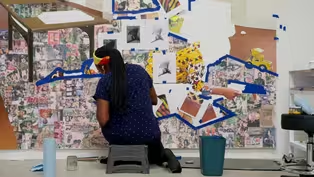
Episode 2 Preview | Realms of the Real
Video has Closed Captions
Preview: S12 Ep2 | 30s | A group of international artists push everyday materials into the fantastical, absurd and sublime. (30s)
Providing Support for PBS.org
Learn Moreabout PBS online sponsorship

- Arts and Music
The Best of the Joy of Painting with Bob Ross
A pop icon, Bob Ross offers soothing words of wisdom as he paints captivating landscapes.










Support for PBS provided by: