WPBS Weekly: Inside the Stories
October 13, 2026
10/13/2026 | 26m 9sVideo has Closed Captions
The Day of the Dead, Innovations with Biomethane, and more Revolutionary War Graves.
A celebration of life and remembrance - Dia de los Muertos is a fall tradition in Kingston, Ontario. Then, creating energy from cow manure - how one local farm is converting organic matter into natural gas. Also, several hundred Revolutionary War veterans helped settle Lewis and St. Lawrence counties. We visit several local cemeteries to find out more.
Problems playing video? | Closed Captioning Feedback
Problems playing video? | Closed Captioning Feedback
WPBS Weekly: Inside the Stories is a local public television program presented by WPBS
WPBS Weekly: Inside the Stories
October 13, 2026
10/13/2026 | 26m 9sVideo has Closed Captions
A celebration of life and remembrance - Dia de los Muertos is a fall tradition in Kingston, Ontario. Then, creating energy from cow manure - how one local farm is converting organic matter into natural gas. Also, several hundred Revolutionary War veterans helped settle Lewis and St. Lawrence counties. We visit several local cemeteries to find out more.
Problems playing video? | Closed Captioning Feedback
Where to Watch WPBS Weekly: Inside the Stories
WPBS Weekly: Inside the Stories is available to stream on pbs.org and the PBS app.
Providing Support for PBS.org
Learn Moreabout PBS online sponsorship- Tonight on WPBS Weekly Inside the Stories, a celebration of life and remembrance.
Dia de los Muertos is a fall tradition in Kingston, Ontario, and creating energy from cow manure, how one local farm is converting organic matter into natural gas.
Also, several hundred revolutionary war veterans helped settle Lewis and St.
Lawrence counties.
We visit a number of local cemeteries to find out more.
Your stories, your region coming up right now on WPBS Weekly, Inside the Stories.
- Funding for WPBS Weekly, Inside the Stories, is provided by the Statewide Community Re-Grants Program, a re-grant program of the New York State Council on the Arts with the support of the Office of the Governor and the New York State Legislature and administered by the St.
Lawrence County Arts Council.
Carthage Savings founded in 1888, offering VA, FHA, seasonal and rural development mortgage products, providing financial services to Northern New York from offices in Carthage, Clayton, Croghan, and Watertown.
Online at carthagesavings.com.
- Good Tuesday evening, everyone, and welcome to this edition of WPBS Weekly: Inside the Stories.
I'm Michael Riecke.
Remembrance is powerful.
When we speak the names of our loved ones and share their stories, we keep them close.
That is the heart of Dia de los Muertos, Day of the Dead, a time to reconnect, to reflect, and to feel surrounded by the people who shaped our lives, even if they are no longer physically with us.
Rooted in remembrance, family, and community, it's a tradition that continues to bring people together in Kingston, Ontario, and one that will be cherished for many years to come.
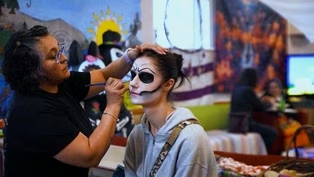
- For more than a decade, Kingston has come together each fall to honor a tradition that is thousands of years old, Dia de las Muertos, the day of the dead.
Here, far from its origins in Mexico, this celebration has grown into something beautiful, a gathering of family, friends, neighbors, and cultures, all united by remembrance and love.
- So it's been a, like a winding kind of like journey of where we are today, but essentially for Dia de los Muertos, it was about just gathering community and that open space of the first time.
Yeah, it was 10 years ago today at the Tet Center and over 900 people came.
900 people came.
It was a lot of people.
And it was a beautiful thing because the feedback was the people from all backgrounds and that warms my heart because ultimately some people don't even know where, where their heritage is and it's like just celebrating that they're here.
There's so many people hanging by threads, so many people in different parts of their life and it's just celebrating life in itself.
But I'm excited like moving forward as well of like different things and kind of more collaborations, community partners.
- Yessica's journey is woven into the fabric of this celebration, a reminder that traditions don't just arrive, they are carried, shaped, and shared by people who believe in keeping culture alive.
And here in Kingston, that belief has taken root.
- Day of the death is to remember that people have departed because we're, as you know, we're all made of energy and energy permeates through the world, especially this day.
It used to take two weeks before.
Day of the death was two weeks long and it was a good time.
You go to the cemeteries and that's where the party was.
I think wherever they are, they're looking after me.
Not just one day a day, but 365 and every moment I step, I take.
- In those memories and that sense of being cared for, we see that Dia de las Muertos truly represents diversity and unity, learning from one another.
The tree of life and the altar remind us that every path, every story and every heritage has a place here.
- It's about celebrating community, celebrating life.
And for me and my heart, it's not about the division, it's about the unity and it's about the embracing of the diversity, learning from each other in a good way because there's medicines from all around the world.
That's why a big theme is corn too, because corn, the squash, the beans, the concept of three sisters started in Mexico and it's about sharing in a good way.
And that's what today is with the community altar, that tree of life is like people add to the tree of life that's downstairs and it's like with lots of love and care, we put them away at the end of the event and then they come back next year.
So it just kind of keeps evolving, keeps growing.
So I'm just so excited for today.
Again, it's mainly a lot of family.
Sometimes I know some volunteers couldn't make it, but essentially it's like just show up, just be here, grateful for everybody that's here.
Every helping hand helps.
And yeah, because this isn't about one person.
It's about celebrating life, celebrating our loved ones.
Yeah, it's about embracing all people from all walks of life and just being grateful.
- Yessica's gratitude speaks to something at the heart of this celebration, the simple act of showing up.
When people gather here from different cultures, backgrounds, and experiences, they are doing more than attending an event.
They are honoring a lineage.
They're recognizing the people who came before them and acknowledging their traditions that carried families, communities, and whole nations forward.
- I feel honored to be invited here and I always like to welcome them here as well too because we as Haudenosaunee people have been welcoming newcomers for 500 years.
In the Haudenosaunee Sikh Nation Confederacy culture, we recognize our ancestors because we still are learning from them through spiritual ways of ceremony and prayer.
We still learn from them.
So we need to honor them, take time to honor them always because we are continuing the work that they were doing before colonization happened.
- In a world filled with mixed messages, celebrations like this bring us back to what matters, connection, spirit, and the energy that lives within all of us.
It's a space to remember, to learn and to feel grounded.
- I try to be the best I can.
It's difficult nowadays because so much media or the electronics, they feed stuff that you don't know what's true or not anymore.
So you got to go within you, the energy within you and the energy from your ancestors.
And this is one day that is that you recharge your energy.
Wherever they are, I think they come back, not just today, every day, but if you talk about them, it's like they were here.
- Remembrance is powerful, that when we speak about our loved ones, we keep them close.
That's what this day offers, a chance to reconnect, to recharge, to feel surrounded by the people who shaped us, even if they are no longer physically here.
It's a tradition rooted in connection and one that Yessica hopes will continue in Kingston for many, many years to come.
- It's not about me doing a whole bunch.
It's about the idea and I'm hoping whether I'm physically here or not next year, that it keeps going, that momentum and then I'll be a part of the celebration in a beautiful way and I have that in my heart whenever the drums are out and the singings, like I know it'll be echoed in community.
- For WPBS Weekly, I'm Gail Paquette.
- Dia De Los Muertos or Day of the Dead is usually celebrated in early November.
To find out more, you can visit their Facebook page.
Well, from the farms that feed our communities to the waste we throw away every day, a surprising source of renewable energy is hiding in plain sight.
It's called biomethane, a clean burning natural gas produced from organic materials like food scraps and manure.
Instead of allowing these materials to release harmful greenhouse gases into the atmosphere, they can be captured and transformed into a renewable fuel that heats homes, powers vehicles, and generates electricity.
This week we take a closer look at how one St.
Lawrence County farm is turning cow manure into energy.
- This is where the gas comes after it goes through the digester.
The two silver tanks are filled with a, a medium that cleans up the gas initially.
Hydrogen sulfide is one of the biggest impurities that we're trying to get rid of.
- John Greenwood started Greenwood Dairy Farm in 1978 with just 70 cows.
Now the farm is currently milking 1,600 cows with close to an additional 1,400 head of young stock.
With nearly 3,000 animals, the farm faced a challenge.
What to do with all that cow manure?
The best solution, install an anaerobic digester that uses that manure to create energy.
- So methane gas is, is a naturally occurring gas that comes off of decaying organic matter.
If you go out into a swamp at certain times of the year, you can actually see bubbles coming out of the swamp and that's, that's methane gas coming, coming from a swamp.
Cows and manure, any type of manure as it, as it decays creates gas and breaks down.
And so you'll, you'll naturally have methane gas being released from manure.
But we're enhancing that environment by creating anaerobic conditions in a digester, heating the manure up and, and agitating it to, to enhance the gas production so we can collect that gas in a controlled environment and, and use it.
We have to clean up the gas because it's got a lot of impurities in it so it's got to be cleaned up before it can be injected into the gas line.
The anaerobic digester is, is producing the gas, making the gas, and collecting it, which is in the tank you see behind me, that's actually a tank, in-ground tank with a cover over the top.
The inside of that, that dome is all filled up with the methane gas that then is going out and being cleaned up with cleanup equipment before it's injected into the line.
- The farm installed the first digester in 2014 to make electricity for their own use, and the excess electricity was sold to National Grid.
- And then the opportunity came to convert and put gas in the gas line and sell it as a transportation fuel actually to California to get the credits, and there was a lot of incentives to move that way.
And so in 2024, we went online injecting gas into the gas line.
Our farm is really a little bit small to be able to do this feasibly, but because we already had a digester and the gas line is right here it made it feasible for us to convert and do that.
- This is our controls for the RNG operation.
It shows everything from our manure coming into the digester the methane that's produced in the digester, the gas, going down to our upgrader, and obviously the upgrader purifies our gas and sends it into the pipeline.
So there's different screens.
This kind of shows the entire overview of the whole system.
Like this screen will show me how much manure I've been putting into the feeding to the digester.
This screen kind of shows our temperatures, mixers inside the digester, our hydraulic retention times, temperatures, pressures, our level height for the gas bag that's inside the digester is that height.
- For Greenwood Dairy Farm, installing an anaerobic digester helped create a circle of sustainability.
- I think click cleaning up your gas and making more power was intriguing.
At the same time, then we're also taking the manure that comes out of the digester, running it through separators, and taking those manure solids and using them for bedding, which allowed us to replace those manure solids in place of sawdust.
And so it, it kind of made a, made a loop.
So we're, we're feeding the cows with, with the crops that we grow, taking that manure, making electricity at the time, currently natural gas, taking the manure solids off that, making bedding.
The manure is still going back then onto the land to fertilize the crops we grow, so it's kind of a complete circle of utilizing the resources that the farm is producing.
- Maintenance and upkeep of the equipment and the digester, however, can be expensive and time-consuming.
- It's a relatively new technology, if you will.
And I think we're still kind of in, in the learning phase of, of making sure everything is working and is adjusted right, how it operates.
It can be a major, major expense and a, a draw on labor, but it can also has, has some benefits.
- Biomethane is a flexible and non-fossil fuel energy source.
It uses organic resources to produce energy and recover nutrients that enhance soil health and fertility.
Commercially available at many scales, it can create jobs in rural and disadvantaged communities.
- I think the benefit is that you're removing methane, and this is what the environmental advocates would say, you're removing methane from the environment and, and, and once it's, you know, used in a, a form like that, it's not released into the atmosphere, and so you're destroying it.
So that, that is probably the biggest environmental benefit is that you're actually destroying methane and not, not releasing it.
- More than 200 years after the American Revolutionary War, the people who fought for our nation's independence are still remembered in cemeteries across New York State.
Tonight, we visit a few of those grave sites in Lewis and St.
Lawrence counties.
Each grave has a story to tell, a story of courage, sacrifice, and the fight for a new nation.
- Here in the Old Level Cemetery, we have a couple of Revolutionary War soldiers buried here, one of which is Captain Isaac Perry.
Now, he was among some of the first settlers here in Lowville, though he mainly actually resided in the community of Stowe Square, which is where Stowe Square Cemetery is now.
He is most well known for having named the Tug Hill Plateau as he was one of the first to pioneer a trip up onto that part of the land and thus had the pleasure of naming it.
This is the second Revolutionary War soldier here in the Old Lauville Cemetery.
This is Captain Jonathan Rogers.
He was part of the original survey team that came up here and chose the site of Lauville for settlement, and he was part of the team in charge of building and navigating the flat bottom boat that came up the Black River and Mill Creek to bring the first families to actually settle here.
He ended up settling on a farm which encompassed land that housed the majority of what is now Lowville.
He also was Lowville's representative for the Freedom Right meeting in Freedom Rights Tavern that caused a petition for the creation of Lewis and Jefferson County from Oneida County in 1804.
Here in East State Street, we have another couple of Revolutionary War soldiers buried, including Levi Adams.
Now, Levi Adams served in the New York State militia during the Revolutionary War, and afterwards, he came to live here in Lowville.
He served as a New York State Senator from 1818 to 1822.
The second soldier buried in East State Street Cemetery is Isaac Clinton.
Now, he was a student of Yale when he volunteered for service in the Revolutionary War.
He's known to have been involved in several battles across the war, and afterwards he came to settle here in Lowville.
When he lived in Lowville, he was ordained as a pastor at the Presbyterian Church, and he was the first principal of Lowville Academy.
Here, we have a pair of Revolutionary War soldiers in the Lowville Rural Cemetery, one of which being Charles Davenport.
He served as the captain of the 17th regiment of the Albany County Militia under the command of Colonel William Bradford Whiting.
After the war, he ended up settling in Harrisburg.
Another Revolutionary War soldier buried in the rural cemetery is John Shull, who emigrated here from Germany in order to fight in the Revolutionary War.
After the war, he settled here in Lowville.
While we're not entirely sure, it's possible that John Shull was actually a Hessian mercenary who fought for the British and settled here after the war instead of going home.
Here in the Denmark Hillside Cemetery, we have Jacob Nash, who served as a private in Martha's Vineyard.
He is most well known for being one of the original minutemen.
- We're here at the Brick Chapel Cemetery in Canton, New York, where there are five Revolutionary War patriots buried.
We're at the grave of Eber Goodnew, and Eber is interesting because he was sent on April 19th, 1775 by his father to fill in for his older brother, Abner, and he was only 13 years old.
Because of his age of 13, he was assigned as a drummer boy.
He saw action at the Battles of Lexington and Concord and marched back to Boston, where he stayed through March of 1776 as part of the siege of Boston.
And some of his duties would have been digging trenches, guarding the supply depot, and even standing sentinel so that none of the British could break out.
In March of 1776, he went home and he stayed there working on his farm until the summer of 1777 when he was again called as a substitute for his father.
And this time he was enlisted into the Continental Army and he was at the Battle of Bemus Heights where a few days later, 10 days later, Bregoin surrendered and he was honorably discharged and went home.
At that point, he was only 15 years old.
We're here at the grave of Tubel Nash.
Tubel Nash answered the call to arms on April 19th, 1775 and joined Samuel Williams' Regiment of Minutemen.
He saw action at the Battle of Lexington in Concord and participated in the siege of Boston.
Later, he was at Fort Ticonderoga and was part of the Northern campaign, and he saw action at White Plains, New York.
We're at the grave of Samuel Leonard.
He was in the Massachusetts militia, and they were called to serve at the Siege of Boston in 1775.
Samuel was also part of Sullivan's expedition, which was to fight against the Iroquois who had aligned themselves with the British.
Samuel is interesting in that Samuel was a quartermaster, and Quartermaster Corps was the oldest of the logistical branch of the Continental Army.
General George Washington formed the Quartermaster Corps in 1775.
Samuel remained a quartermaster until he was honorably discharged in 1782.
We're here at the Old Brookside Cemetery in Waddington, New York at the grave of Edward Lawrence.
Edward Lawrence joined the Continental Army two weeks after the Battle of Lexington and Concord.
He was sent to Boston to help defend Boston against the British.
Later, he signed up, he volunteered to join Benedict Arnold in his 350-mile trek that took two months to walk through the wilderness of Maine into Quebec, where on December 31st, 1775, they attacked Quebec City.
This is the battle where Benedict Arnold was wounded, severely wounded, but unfortunately for Edward, he was taken as a prisoner of war.
He was captured and held until 1776 when he was paroled by then Governor Guy Carlton.
Part of his parole was that he would never take up the arms against British again.
However, seven months later, he reenlisted.
After he re-enlisted, he was sent to Saratoga where he witnessed the surrender of General Burgoin.
From there, he endured the hardships with George Washington at Valley Forge and later fought in the Battle of Monmouth.
Edward was honorably discharged in 1780 where he had risen to the rank of sergeant.
We're here at the Union Cemetery in Waddington, New York at the grave of Isaac Bartholomew.
At the age of 19, Isaac enlisted in Colonel Sheldon's Regiment of Dragoons and served with and under Benjamin Talmage.
Major Benjamin Talmage was a spy master and ran one of the most successful spy rings of the entire Revolutionary War.
He worked directly with George Washington.
The name of the spy ring was the Culper Spy Ring.
Isaac and several of the other regiments, Isaac's regiment in particular, would often patrol, do scouting, and many times were called upon to guard General Washington as he moved between battles and amongst his troops.
Isaac's regiment under Major Talmage was so good at scouting, patrolling, and gathering intelligence that George Washington himself called them the eyes and ears of the Continental Army.
When the United States entered the War of 1812, Isaac became the first commissioned officer in St.
Lawrence County.
He served in Benedict's regiment in the New York militia.
After the war, Benjamin returned to farming and became St.
Lawrence County's first highway superintendent.
We're here at the East Road Cemetery in Depoister, New York.
This is the grave of Zachariah Barber.
In 1781, when Zachariah was 16, he joined forces to defend Rhode Island during the Rhode Island alarm.
For the spring and summer of 1781, he would be called on short 10, 15 day tours of duty when the British were causing raids or he was called up to defend.
In August of 1781, he enlisted in the Continental Army and marched to West Point, where he remained until the end of the war under General Washington and was discharged in 1783.
After the war, he married Mary, and he and Mary had eight children.
They would move to Vermont and eventually here to St.
Lawrence County, following their oldest son, John, who was already here.
In 1859, on July 4th, Zachariah was honored as the last living Revolutionary War soldier in St.
Lawrence County.
The following spring, at the age of 95, Zachariah passed away and all the flags in St.
Lawrence County were flown at half staff to honor his service and his memory.
- That does it for this Tuesday night.
If you have a story idea you'd like us to explore, we would love to learn more.
All you need to do is send us an email at wpbsweekly@wpbstv.org and let's share it with the region.
That's it for tonight, everyone.
Join us next time for a fresh look inside The Stories.
Until then, take care.
- Funding for WPBS Weekly, Inside the Stories, is provided by the Statewide Community Re-Grants Program, a re-grant program of the New York State Council on the Arts with the support of the Office of the Governor and the New York State Legislature and administered by the St.
Lawrence County Arts Council.
Carthage Savings founded in 1888, offering VA, FHA, seasonal and rural development mortgage products, providing financial services to Northern New York from offices in Carthage, Clayton, Croghan, and Watertown.
Online at Carthagesavings.com.
- I tried to be the best I can.
It's difficult nowadays because so much media or the electronics, they feed stuff that you don't know what's true or not anymore.
So you got to go within you, the energy within you and the energy from your ancestors.
And this is one day that is that you recharge your energy.
 New
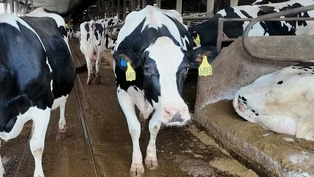
NewBiomethane: From Cow Manure to Clean Energy
Video has Closed Captions
Creating energy from cow manure - how one local farm is converting organic matter into natural gas. (5m 14s)
 New
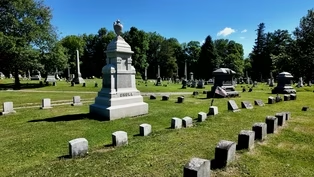
NewRevolutionary War Graves in Lewis and St. Lawrence Counties
Video has Closed Captions
Several hundred Revolutionary War veterans helped settle Lewis and St. Lawrence counties. (10m 13s)
Providing Support for PBS.org
Learn Moreabout PBS online sponsorship












Support for PBS provided by:
WPBS Weekly: Inside the Stories is a local public television program presented by WPBS