WPBS Weekly: Inside the Stories
Biomethane: From Cow Manure to Clean Energy
Clip: 10/13/2026 | 5m 14sVideo has Closed Captions
Creating energy from cow manure - how one local farm is converting organic matter into natural gas.
From the farms that feed our communities to the waste we throw away every day, a surprising source of renewable energy is hiding in plain sight. It's called biomethane - a clean-burning natural gas produced from organic materials like food scraps and manure. We take a closer look at how one St. Lawrence county farm is turning cow manure into energy.
Problems playing video? | Closed Captioning Feedback
Problems playing video? | Closed Captioning Feedback
WPBS Weekly: Inside the Stories is a local public television program presented by WPBS
WPBS Weekly: Inside the Stories
Biomethane: From Cow Manure to Clean Energy
Clip: 10/13/2026 | 5m 14sVideo has Closed Captions
From the farms that feed our communities to the waste we throw away every day, a surprising source of renewable energy is hiding in plain sight. It's called biomethane - a clean-burning natural gas produced from organic materials like food scraps and manure. We take a closer look at how one St. Lawrence county farm is turning cow manure into energy.
Problems playing video? | Closed Captioning Feedback
Where to Watch WPBS Weekly: Inside the Stories
WPBS Weekly: Inside the Stories is available to stream on pbs.org and the PBS app.
Providing Support for PBS.org
Learn Moreabout PBS online sponsorship- This is where the gas comes after it goes through the digester.
The two silver tanks are filled with a, a medium that cleans up the gas initially.
Hydrogen sulfide is one of the biggest impurities that we're trying to get rid of.
- John Greenwood started Greenwood Dairy Farm in 1978 with just 70 cows.
Now the farm is currently milking 1,600 cows with close to an additional 1,400 head of young stock.
With nearly 3,000 animals, the farm faced a challenge.
What to do with all that cow manure?
The best solution, install an anaerobic digester that uses that manure to create energy.
- So methane gas is, is a naturally occurring gas that comes off of decaying organic matter.
If you go out into a swamp at certain times of the year, you can actually see bubbles coming out of the swamp and that's, that's methane gas coming, coming from a swamp.
Cows and manure, any type of manure as it, as it decays creates gas and breaks down.
And so you'll, you'll naturally have methane gas being released from manure.
But we're enhancing that environment by creating anaerobic conditions in a digester, heating the manure up and, and agitating it to, to enhance the gas production so we can collect that gas in a controlled environment and, and use it.
We have to clean up the gas because it's got a lot of impurities in it so it's got to be cleaned up before it can be injected into the gas line.
The anaerobic digester is, is producing the gas, making the gas, and collecting it, which is in the tank you see behind me, that's actually a tank, in-ground tank with a cover over the top.
The inside of that, that dome is all filled up with the methane gas that then is going out and being cleaned up with cleanup equipment before it's injected into the line.
- The farm installed the first digester in 2014 to make electricity for their own use, and the excess electricity was sold to National Grid.
- And then the opportunity came to convert and put gas in the gas line and sell it as a transportation fuel actually to California to get the credits, and there was a lot of incentives to move that way.
And so in 2024, we went online injecting gas into the gas line.
Our farm is really a little bit small to be able to do this feasibly, but because we already had a digester and the gas line is right here it made it feasible for us to convert and do that.
- This is our controls for the RNG operation.
It shows everything from our manure coming into the digester the methane that's produced in the digester, the gas, going down to our upgrader, and obviously the upgrader purifies our gas and sends it into the pipeline.
So there's different screens.
This kind of shows the entire overview of the whole system.
Like this screen will show me how much manure I've been putting into the feeding to the digester.
This screen kind of shows our temperatures, mixers inside the digester, our hydraulic retention times, temperatures, pressures, our level height for the gas bag that's inside the digester is that height.
- For Greenwood Dairy Farm, installing an anaerobic digester helped create a circle of sustainability.
- I think click cleaning up your gas and making more power was intriguing.
At the same time, then we're also taking the manure that comes out of the digester, running it through separators, and taking those manure solids and using them for bedding, which allowed us to replace those manure solids in place of sawdust.
And so it, it kind of made a, made a loop.
So we're, we're feeding the cows with, with the crops that we grow, taking that manure, making electricity at the time, currently natural gas, taking the manure solids off that, making bedding.
The manure is still going back then onto the land to fertilize the crops we grow, so it's kind of a complete circle of utilizing the resources that the farm is producing.
- Maintenance and upkeep of the equipment and the digester, however, can be expensive and time-consuming.
- It's a relatively new technology, if you will.
And I think we're still kind of in, in the learning phase of, of making sure everything is working and is adjusted right, how it operates.
It can be a major, major expense and a, a draw on labor, but it can also has, has some benefits.
- Biomethane is a flexible and non-fossil fuel energy source.
It uses organic resources to produce energy and recover nutrients that enhance soil health and fertility.
Commercially available at many scales, it can create jobs in rural and disadvantaged communities.
- I think the benefit is that you're removing methane, and this is what the environmental advocates would say, you're removing methane from the environment and, and, and once it's, you know, used in a, a form like that, it's not released into the atmosphere, and so you're destroying it.
So that, that is probably the biggest environmental benefit is that you're actually destroying methane and not, not releasing it.

 New
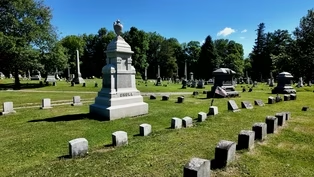
NewRevolutionary War Graves in Lewis and St. Lawrence Counties
Video has Closed Captions
Several hundred Revolutionary War veterans helped settle Lewis and St. Lawrence counties. (10m 13s)
Providing Support for PBS.org
Learn Moreabout PBS online sponsorship













Support for PBS provided by:
WPBS Weekly: Inside the Stories is a local public television program presented by WPBS