
Here and Now
Michael Wagner on Increasing AI Disinformation in Elections
Clip: Season 2500 Episode 2515 | 5m 18sVideo has Closed Captions
Michael Wagner on how artificial intelligence tools are affecting campaigns and elections.
UW-Madison journalism professor Michael Wagner considers how disinformation generated with artificial intelligence tools is affecting campaigns and elections as more voters engage with social media.
Problems playing video? | Closed Captioning Feedback
Problems playing video? | Closed Captioning Feedback
Here and Now is a local public television program presented by PBS Wisconsin
Here and Now
Michael Wagner on Increasing AI Disinformation in Elections
Clip: Season 2500 Episode 2515 | 5m 18sVideo has Closed Captions
UW-Madison journalism professor Michael Wagner considers how disinformation generated with artificial intelligence tools is affecting campaigns and elections as more voters engage with social media.
Problems playing video? | Closed Captioning Feedback
Where to Watch Here and Now
Here and Now is available to stream on pbs.org and the PBS app.
Providing Support for PBS.org
Learn Moreabout PBS online sponsorship>> And we're going to do it.
>> In the months and weeks ahead of the 2026 midterm elections.
Disinformation, including deep fake political ads, is rampant, new and easy to use.
Artificial intelligence tools can put real sounding words in candidates mouths, surrounded by manipulated video.
And the more lies and disinformation generated, the more chat bots scrape it and could repeat it back to users.
UW-Madison journalism professor Mike Wagner is an expert in the political media landscape.
And thanks for being here.
My pleasure.
So is this the wild, wild west of kind of AI generated disinformation?
Or or is that sensibility kind of overstated?
>> I think it is.
The Wild West on social media in many states, Wisconsin included a television ad or a radio ad that uses AI in a campaign ad has to disclose it.
But on social media, they generally really don't.
And so people can kind of do whatever they want, and there are already rules in place that hold social media companies harmless.
If phony false things are said on their platforms.
And so it really is a free for all.
>> So one candidate in a congressional race in Wisconsin sought a cease and desist order from their challenger over the use of AI generated ads.
So this is not theoretical anymore.
>> No.
Derrick Van Orden has not paid ads on his Facebook page that have an AI generated Rebecca Cooke saying things that she has not said and says that she would not say.
And so it looks like she's saying them.
She's called for a cease and desist.
I think the Van Orden campaign responded by creating an AI generated duck that was quacking, cease and desist.
And so I think they don't want to take the stuff down, but it's stuff that she has not said that they are pretending that, she said.
>> With increasing numbers of people getting their information on elections from social media, what role do changing consumption patterns play in the consumption of mis and disinformation?
>> It's so much easier to encounter it, and it's it's spreading from the world of politics into the world of entertainment.
Our own alum, Charlie Behrens, the famous comedian, is being there are ads going around on people's phones where it looks like he's endorsing a candidate in the governor's race, which he has not done and explicitly never does.
And so he, you know, people are this is happening in politics, but he's bleeding everywhere.
And we're getting the information on social media where we think we might be getting news.
We're getting it on our phones and text messages.
We're getting it from trusted sources sometimes.
And it's very hard to discern what's real.
>> What are the numbers of people getting information from social media versus traditional outlets?
>> So a fair number of people, you know, probably in the neighborhood of half, say they get some news from social media.
It kind of varies by platform and by age.
And so older people tend to use Facebook a little more for news.
Younger people tend to use TikTok a little more for news.
But you know, most folks still get their news from local television.
That's still number one.
And it's the most and it's the best source in terms of providing accurate information that's verified.
And then there are consequences if things aren't real.
Whereas on social media, there aren't consequences if things aren't real.
>> So with all this stuff out there, what is the best way for people to get make sure they're getting accurate information?
>> I think start with traditional sources of news where the place has a corrections policy, where reporters get in trouble if they report things that aren't true.
That's the place to start.
And when you're getting stuff in your social media feed that appears fantastical or really exciting, especially if it's a boy.
My, my, my candidate looks great and my opponent looks awful.
Maybe see if you can't find that same story, you know, from PBS Wisconsin or Wisconsin Public Radio or local newspapers, local television stations to see.
Are there other places that are corroborating this, or is it just something that's churning on social media?
>> Unless and until there are more regulations of AI, is it consumer beware?
>> It really is.
There's not much else that can be done.
Candidates can scream and holler if they believe that they're having AI generated images of them be be used, as is happening right here in Wisconsin in this election cycle.
But it's really up to us until there are regulations.
>> So how do fears of election fraud or how the Trump administration might respond to those fears create mistrust in institutions in the process?
>> A lot of our opinions are rooted in what the political leaders we trust most have to say.
That's how most of us learn about what's going on in the world.
And when they tell us over and over again, we can't trust the result of the election.
Especially if I lose.
It diminishes the overall trust we have in our system.
And then when things happen on election night and they aren't going our way, our minds are more likely to go to, I wonder if there's a conspiracy here.
I wonder if this isn't legitimate.
Instead of there's a process that's being observed by both sides and has been replicated and repeated for years.
In Wisconsin, where we have an incredible record of conducting free and fair elections.
>> What will you be looking for on Election Day?
>> I'll be looking for news organizations that do a legitimate job explaining the process, letting folks know that, you know, the early votes can't be opened until Election Day and counted.
So we get big ballot dumps in the middle of the night because we have to basically, by law, it's not a secret, nefarious thing that's happening.
So the more local news can tell us, here's what's happening and why, the better off we'll all be.
>> All right, Mike Wagner, thanks so much.
>> My pleasure.
>> Outside of the friendly
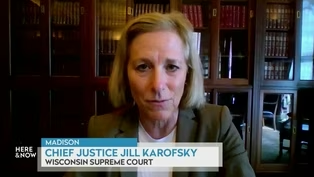 New
NewChief Justice Jill Karofsky on Temporary Restraining Orders
Video has Closed Captions
Clip: S2500 Ep2515 | 5m 58s | Jill Karofsky on filing for temporary restraining orders through an online system. (5m 58s)
 New
NewHere & Now opening for October 9, 2026
Video has Closed Captions
Clip: S2500 Ep2515 | 1m 6s | The introduction to the October 9, 2026 episode of Here & Now. (1m 6s)
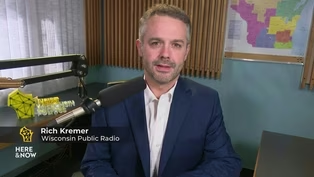 New
NewInside Wisconsin Politics: Crowley and Tiffany Attack Ads
Video has Closed Captions
Clip: S2500 Ep2515 | 4m 22s | Inside Wisconsin Politics on attack ads that campaigns for governor are airing. (4m 22s)
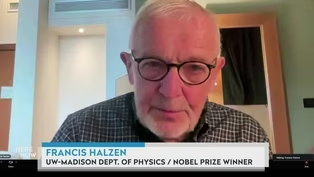 New
NewUW-Madison Professor Francis Halzen's Nobel Prize Reaction
Video has Closed Captions
Clip: S2500 Ep2515 | 2m 4s | Francis Halzen shared his reaction to being honored with the 2026 Nobel Prize for Physics. (2m 4s)
 New
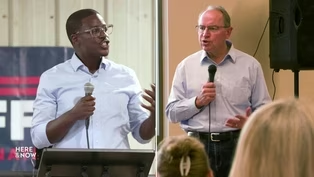
NewWisconsin Democrats, Republicans Center the Economy in 2026
Video has Closed Captions
Clip: S2500 Ep2515 | 7m 24s | Inflation, affordability and the economy are top priorities for Wisconsin voters. (7m 24s)
Providing Support for PBS.org
Learn Moreabout PBS online sponsorship New Episode
- News and Public Affairs

Top journalists deliver compelling original analysis of the hour's headlines.

- News and Public Affairs

FRONTLINE is investigative journalism that questions, explains and changes our world.
 New Episode
 New Episode
 New Episode
 New Episode
 New Episode
 New Episode


 New Episode
Support for PBS provided by:
Here and Now is a local public television program presented by PBS Wisconsin