WPBS Weekly: Inside the Stories
June 30, 2026
6/30/2026 | 28m 19sVideo has Closed Captions
Americas Tapestry, Skateboard Revival, and Author CJ Dotson
Visit the historic Van Schaick mansion in Cohoes, New York, to learn about America’s Tapestry – an AMERICA@250 project involving all thirteen original colonies. Then, we go Inside the Studio to talk with local author C.J. Dotson. Plus, skateboarding in Kingston, Ontario, isn’t just about tricks, it’s about freedom, expression, and the constant passing of knowledge from one generation to the next.
Problems playing video? | Closed Captioning Feedback
Problems playing video? | Closed Captioning Feedback
WPBS Weekly: Inside the Stories is a local public television program presented by WPBS
WPBS Weekly: Inside the Stories
June 30, 2026
6/30/2026 | 28m 19sVideo has Closed Captions
Visit the historic Van Schaick mansion in Cohoes, New York, to learn about America’s Tapestry – an AMERICA@250 project involving all thirteen original colonies. Then, we go Inside the Studio to talk with local author C.J. Dotson. Plus, skateboarding in Kingston, Ontario, isn’t just about tricks, it’s about freedom, expression, and the constant passing of knowledge from one generation to the next.
Problems playing video? | Closed Captioning Feedback
Where to Watch WPBS Weekly: Inside the Stories
WPBS Weekly: Inside the Stories is available to stream on pbs.org and the PBS app.
Providing Support for PBS.org
Learn Moreabout PBS online sponsorship- Tonight on WPBS Weekly, Inside the Stories.
New York State's contribution to America's Tapestry celebrating America's 250th anniversary.
And skateboarding isn't just about tricks, it's about freedom, expression, and the constant passing of knowledge from one generation to the next.
Also, we meet local author C.J.
Dotson to learn what inspires her as a writer.
Your stories, your region.
Coming up right now on WPBS Weekly, Inside the Stories.
- Funding for WPBS Weekly inside the stories is provided by a the Statewide Community Regrant program, a re-grant program of the New York State Council on the Arts, with the support of the office of the Governor and the New York State legislature, and administered by the St.
Lawrence County Arts Council, Carthage Savings, founded in 1888, offering VA FHA seasonal and world development mortgage products, providing financial services to Northern New York from offices in Carthage, Clayton Crohgan, and Watertown online at carthagesavings.com.
- Good Tuesday evening, everyone, and welcome to this edition of WPBS Weekly Inside the Stories.
I'm Michael Riecke.
2026 marks the 250th anniversary of the United States of America, and this summer celebrations are in full swing.
Our 13 original colonies are commemorating the milestone in a very special way.
These states have joined together to create a one of a kind tapestry production of the New York section.
Took over a year and was completed in May.
Take a look.
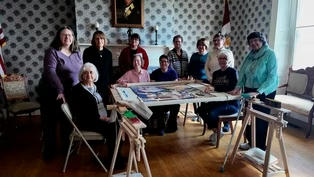
- So America's Tapestry is a project to Stitch 13 panels, one for each of the original 13 colonies, and we're hand embroidering those as well as some other techniques, and all of them will be displayed together as a traveling exhibit.
- Each of the 13 states was tasked with picking a story from their state that was not generally well known.
After some research, the New York group, headed by Jennifer Paperman, selected a design that picks the Birch Trials, an event that took place in 1783.
- So very early in the war, the British made an offer to enslaved black people.
You serve the British Crown.
At the end of the war, we will free you whether we win or lose.
It's now 1783.
The war is over and the British have to make good on that promise.
However, it's 1783.
It's not like we've got passports and record computerized records or even records - At the Birch trials held at Fraunces Tavern in New York City.
Enslaved black people could make their case for liberty.
They would have to prove their service to the British, but if they were successful, they would gain their freedom.
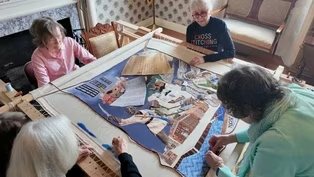
- In the upper left corner, we have the actual Birch trial, a enslaved black making his case.
Below that, and kind of from the right corner down, you have the documents from the British saying this is what's going to go happen.
And then through the middle you have what the, what a enslaved black person could have done.
So some of them might have actually fought for the British in what was known as the Ethiopian Regimen.
Some of them would've done things like, there's a woman pushing a wheelbarrow, she's helping to build the camp.
There's a man who's a cobbler making shoes for the soldiers.
If they were successful in making their their case, then their name would be put in something called the Book of Negroes.
The Book of Negroes was a list of all the people who had been freed.
They would also be given a document and then they could go down to New York Harbor and they would take a ship.
And so the last scene in our or vignette is a family, a husband, a wife, and a son on a boat headed to Nova Scotia.
The reason they were going to Nova Scotia is because the British lost, so they no longer had the colonies.
They still controlled Canada, so they could send them there.
The interesting thing about the Book of Negroes is to this day, black Canadians will use it for genealogy because it lists the name, the person's name, the date they left, and the ship they left for Canada on.
So it's, it's still relevant to this day.
- The design is based on an illustration by America's tapestry organizer, Stefan Romero.
Construction of the tapestry began in April, 2025 at the historic Van Schaick Mansion in Cohoes, New York.
The mansion built in 1753 and run by the Daughters of the American Revolution has its own connection to America's fight for freedom.
Strategy for the Battle of Saratoga in 1777 was planned at the mansion.
- The room that they've let us use has excellent lighting for the stitching that we're doing.
So we're stitching this on 32 count, which means 32 stitches to the inch.
So having good lighting is really important for us.
There are five techniques that our chapter sort of focuses on, and all five of those techniques are in here somewhere.
Those techniques are something called white work, which is kind of a misnomer.
White work is basically the color of the fabric and the color of the stitching are the same.
So that's what we're doing for the cobblestones in front of the buildings.
It hasn't been stitched down yet, but that's over here.
Black work is, is sort of a fill pattern.
So that would be the British officers, the American officer, the father and the son on the boat, the woman pushing the wheelbarrow.
Her shirt is done with black work.
There's another technique called needle work, or needle point, specifically the technique is bar jello.
And that's what was done for the harbor.
It's done in different shades of blue, so it really looks like the waves of the harbor.
We also have something called counted thread, where you actually count the threads and a couple of the buildings have been done using that technique.
And then the last one is something called surface embroidery, where you just kind of do it as you feel.
It's kind of the best way to describe that.
So like all of the men's hair has been done with French knots where somebody's just stoked, sewed them down.
And they haven't done any counting.
They've just said, ah, that looks about right.
We also have some appliques that were done where either they were printed on fabric or they were hand drawn on fabric.
And then the other thing we've done is some fabric painting.
So this panel is 35 inches by 45 inches, which is 1,575 square inches.
The reason that number is important is that it takes approximately an hour per square inch of stitching.
So we're looking at 1500 hours of stitching if we tried to stitch the background.
So by doing fabric paint, we were able to get large swaths done, and then we could focus on the stitching - For members of the New York Capitol District chapter of the Embroiders Guild of America.
The tapestry has truly been a labor of love.
When the opportunity to be involved arose, there was never any doubt they were eager to take part and lend their time, talent, and dedication to the project.
- When Stefan Romero reached out, when he first came up with the idea, he reached out to every single stitching group he could think of in New York State asking for somebody to take the lead on the New York panel.
The New York Capital District chapter of the EGA was one of those that was, that he reached out to.
And I was like, we have to be involved.
We absolutely have to be involved.
Put me down as the, as the project lead, I'll figure this out.
And I have very much relied on the other members of the chapter.
- All told over 1000 volunteers in 13 states have joined America's tapestry to embroider the 13 panels after its inaugural display at the College of William and Mary's Mascara Museum of Art in Virginia This summer, America's Tapestry will tour a number of other historic venues throughout the East coast for a multi-year traveling exhibition.
From November, 2027 through February, 2028.
It will be on display at the New York State Museum in Albany.
More information can be found at americastapestry.com - In a small Ontario arena, skateboarders from around the world rolled in.
But this wasn't just a freestyle competition, it was the heartbeat of something bigger.
A revival.
Skateboarding has grown into a universal language, spoken through movement, rhythm and connection.
And in Ontario, that shared language is being spoken louder than ever because skateboarding holds space for everyone.
It doesn't require uniforms or permission just aboard.
And the courage to roll forward - In a small Ontario arena, the world showed up on four wheels skaters from places like Chile and Argentina, join locals in nap knee to share tricks, stories, and the spirit of freestyle.
- This was above and beyond expectations.
The first person who signed up was Mile from Chile.
When I first announced the contest, first one, first day she signed up and I thought maybe she made a mistake.
So I had to send her a message like, you know, it's in Canada, right?
And she said, oh yeah, I'm coming.
There's a dedicated, committed group of freestylers.
- This was more than just a freestyle competition.
It was a sign of something bigger, a revival of a culture that never really left, but it's finally being seen again.
- It seems like every decade or so something happens that takes skateboarding to a new level.
And back in the day, it would've been someone like Kevin Harris or Rodney Mullen really blew up the freestyle scene.
You had sidewalk surfing, which was, you're just going down the street, you're not doing tricks, you're not going off of obstacles.
And then it evolved into, freestyle was the first trick based skateboarding.
As freestyle faded from popularity to people like Tony Hawk with Vert and Street became the more popular mode of skateboarding.
- Skateboarding didn't lose its roots, it branched out each style, carved its own path and pushed boundaries in new ways.
Today they all ride side by side.
Freestyle, Vert, Street, even Park and Longboard have become part of a shared language.
And now in Ontario, that language is being spoken more clearly than ever.
- What the OSA's mission is, is to put together the tools for communities, individuals, and policy makers to be able to do some of the things that in my town or other places that I have examined or taken a look at and and broken down why they have made work what they have.
I'd like to create the tools, which we've already started working on.
We already have tons of, tons of information and stuff between grants and processes and the conversations, the council members, things like that.
You know, we want to cut through the red tape for people before they ever get there with the scissors.
We're gonna make sure that the skate parks that were built but never had a tree planted, get some trees.
The ones that don't have a place to get a drink has a place to get a drink or a washroom or any number of things.
So it has infrastructure.
That's what we wanna do is reinvest in the physical infrastructure of skateboarding so that it can continue to flourish once again, the way that it used to.
- You don't always need sunshine to make skateboarding happen.
This arena, usually home to ice, can also be home to fire generated by passion, creativity, and community, whether on asphalt or arena floors, skateboarding finds its space.
- Ontario, Canada at the world needs a revival of skateboarding in the biggest way.
It deserves it.
It's something that holds space for everybody.
So I believe that as a whole, as a society, we can do something to hold space for it as a sport the same way we do for other sports.
And the fact that there is people here from such a wide range of this entire earth.
You know, we have people here from Chile, we have Rio de Janeiro, we have someone from Philadelphia.
I'm from Madox, small town Ontario.
You know, we have people from all over the world, every demographic, every age, man, woman, child.
It doesn't matter.
So the reality is, is that we, we just need to get us together.
You know, we gotta get, get this ball rolling again.
So we have opportunities - That unity is already taking shape across towns, across generations, and across every style of skating.
Its enduring presence was felt through one of its most respected voices who crossed the border to skate alongside the next generation, reminding us that even as skateboarding evolves, it's roots still run deep - For me.
I'm still competing, like I still compete on the world circuit and whatnot.
I've traveled all around the world doing what I love to do, but it's also about giving back.
So it's always been the older generation, giving it to the younger generation, the younger generation, taking it to the next level, and then they're passing it on the same, it's that, that constant evolution.
And what's interesting too is that we have a guy, Russ Howell, he's the first pro skateboarder.
He is in his seventies now, and he still skates.
He's a grandfather, right?
And he still skates.
And I'll tell you what I learned from watching his skating.
So I'm like a grom for him.
And then the guys who watch me, they're a grom for me.
And then anybody who watches them.
So it's like we can all learn from each other.
It's what's great about skateboarding is that I can have the same conversation with him, and he's older than my father was, right?
So he's older than my father, but me and him have the same level of talking.
What's also interesting too is that even internationally, we may not know the same language, but skateboarding has a universal language.
A kick flip is a kick flip in Canada as it is in us, as it is in Japan, as it is in Germany.
- What might have looked like just another skate event is something much more, it's the planting of seeds for kids, looking for a place to express themselves for adults who never stop skating for communities ready to build back, not just structurally, but socially.
In that language of skateboarding, everyone can find a voice.
- If a town was on the fence in a decision to invest in the infrastructure of skateboarding and sport and a sports similar to it, I would tell them to really look at their age demographic and see, is this going to benefit us?
And 90% of the time the answer is yes, because there's so many children, there's so many young people.
And the reality is, is that not everybody wants to go play on the field or play on the rink, or put on all the gear, or, you know, show up every Wednesday in their kit, you know?
So the reality is, is skateboarding has a ton of freedom.
It has tons to offer people.
And again, the inclusivity of it is matched by none.
Everybody loves you and you are part of the family.
Once you step on that skateboard.
- For WPBS Weekly, I'm Gail Paquette.
- Finally, tonight we sit down with local authors, C.J.
Dotson.
Originally from northern Ohio.
Dodson is known for blending psychological suspense with supernatural horror themes.
She explores in her novels The Cut, and in her latest novel, These Familiar Walls, she joins Luke Smith in the studio to discuss her path as an author and what inspires her writing.
- Thank you, Michael, and joining us in the studio this evening is local horror author, C.J.
Dotson.
C.j.
you're originally from Northern Ohio.
And first of all, welcome to the studio.
It's a pleasure to have you this evening.
- Thank you.
It's a pleasure to be here.
- And I just gotta know, first of all, being from Boston myself, I wonder what brings you from northern Ohio to northern New York.
- We moved from northeast Ohio to Maine actually in late 2021 for family reasons.
And the cost of living in Maine was a little bit beyond what we could manage or had expected.
So we started looking around.
Originally we were looking more in Southern New York for being closer to my family, but the cost of living there was also kind of prohibitive.
So we wound up, up here - And that's, but Northern Ohio was really where your author's journey began, is that correct?
- Yes.
- So tell me really about where it all began for the writer's journey of C.J.
Dotson.
- It started when I was about nine years old.
I was in my school's gifted program, it was called Nova.
And so once a week we would, me and my small class group of us would be bused from our elementary school to the slightly older kids elementary school for special classes with Mrs.
Frank.
And she had us enter a competition being held by yearly, by the local community college called the Young Authors Competition.
So the first year of the Nova Program, we entered the Young Authors Competition, and I wrote fiction for the first time I was nine, and I just absolutely fell in love with it.
It's the only thing I've wanted to do since then.
- Real quick, you mentioned a Mrs.
Frank.
Was she somebody who inspired your author's voice when you started writing?
- I started writing so young at age nine, that, that my, my voice as an author has definitely been unrecognizable from the way, the way that I was writing when I was nine years old.
But she is who I told myself ever since I was little.
I would dedicate my first book to her and I did.
So she actually was, she actually was in my dedication.
- Wow.
Can I read this out loud?
- Absolutely.
- It says, this book is dedicated to Marcia Frank.
When you encourage your elementary school class to write our own fiction, for the first time, a fire lit in me that has never gone out.
You helped shape the course of my entire life, taken from my heart and forever.
Thank you for that.
Big shout to Marcia Frank, because books like The Cut would never have been Possible, and that's what we gotta get right into right now.
You mostly write horror fiction, is that correct?
- Yes.
- So tell me, when did the process for The Cut begin?
- I was living in Maine when I started writing The Cut, and my youngest child was born in early 2019.
So in 2019, I was navigating motherhood with a toddler and an infant, and there was a lot of staying home and being alone.
And then right as my daughter was a year old and was starting to be someone like I could take her more places, then the pandemic hit.
And I was living in Ohio and the governor in Ohio shut everything down.
And so there was that very isolated year.
And then in October of 2021, my family moved from northeast Ohio to Maine where I didn't know anybody.
And so it was another very isolated year.
And all of that loneliness with small children and the, the tension of the previous, of moving and of the, you know, the effects of the pandemic on everybody at the time, it all came together to create an atmosphere that I was able to channel into, into this horror novel.
- And you know, there's a lot of subjects in this book that you delve in.
It deals with a lot of both emotional trauma and other worldly fear.
So how did you approach weaving those sorts of themes together?
- I think that horror is really great for exactly that.
When you can put a more outlandish or more difficult to believe in real life situation side by side with actual struggles or actual strife, it's sort of like holding a mirror to each other.
The monsters, the supernatural horror in the Cut is a reflection of the character's response to her own traumatic experiences.
The, I don't wanna give away too much, but there's an element of, there's a strong element of this character not knowing who she can trust as she rediscovers trust in herself after having escaped a domestic abuse situation.
And that of situation does erode your ability to know how to trust other people, to know how to trust yourself.
And so the nature of the creatures in The Cut was, was really easy to link to the character's growth from what had happened to her before the events of this book began.
- And that's gotta be a hard subject to write through.
How do you approach writing about topics like dealing with a domestic abuse situation - Very delicately.
There's been so many stories in which the character is being abused and in which the character, the story is about the character overcoming and escaping.
And there has, there's been a ton of stories also about the time after that, but I feel like fewer, fewer stories cover the time after that.
And that was most of what I wanted to get into with that aspect of this book.
That once you've gotten yourself out of a dangerous situation or an abusive or isolating situation, that doesn't mean that the struggle is over and everything is hunky dory now.
So the adjustment period, the rediscovering yourself period, the forgiving Yourself period of a surviving an abusive situation is what I really wanted to touch on with the domestic violence in The Cut.
- The Cut is a part of your two book deal with St.
Martin Press, and you have just released your second book, These Familiar Walls for fans of C.J.
Dotson.
What can they expect going into These Familiar Walls?
- Secrets.
My work often touches on themes of secrecy, people keeping secrets.
My work often deals with complicated family dynamics.
These familiar walls also deals with a return to childhood.
In a way, the main character in the beginning of the book moves into her childhood home, inherits and moves into the home that she grew up in.
This theme isn't one that's as present in The Cut, but a lot of my work and my short fiction involves a return in some way to a place or a per person or a part of your childhood.
And that's a huge theme in These Familiar Walls.
- So, for fans of yours, what's something you hope readers take away from your books when they read them?
- I think it's different with everything that I write, with the Cut.
I think what I want people to take away is that, is that they're not alone.
If they're dealing with situations similar to the situations that Sadie deals with, I mean, not the monsters, you're probably alone if you're dealing with monsters, but if you're trying to get out of a situation or you have gotten out of a situation, or you're recovering from a situation that was outside of your control or, or a situation you felt shouldn't have been outside of your control, it's, it's not, you're not alone in that.
There are other people who have been there and gotten through it.
And some of the advice that you hear, I ha I hate, I talk about this a lot.
I hate the phrase, what doesn't kill you makes you stronger.
And I wanted The Cut to sort of be an answer to that because what didn't kill Sadie, her abusive ex-fiancee didn't make her stronger.
It made her doubt herself.
It made her live in a position where she and her child were not safe.
And she had to on her own, find her strength again and find her belief in herself again.
And so if anyone takes anything away from The Cut, I would hope it would be that, that you are not alone in situations like this.
And also that you are what makes you stronger.
Not the bad things that happened or were done to you.
- Powerful world, powerful sentiment.
- Thank - You.
Before, now we're getting ready to wrap up, but there's one thing I gotta ask you.
Where can people go to find your books?
- Any major book retailer, they're available on amazon.com.
They're also available on bookshop.org at multiple different vendors.
They're at many indie stores.
If you head to your favorite local indie and it's not there, you can request it Barnes and Noble, I think.
I think basically everywhere books are sold.
- Now, one more question before we wrap up.
For aspiring authors looking to get started and possibly finish or finish that novel that they've been working on, but overthinking it.
I know I overthink when I write, what's something you would say to inspire them?
- It's kind of a catchphrase in the writing community, but don't self reject.
Give yourself the chances that you need.
There are so many gatekeepers between you and publishing your novel.
There's trying to get an agent, there's trying to get a book deal, and then once you have it, there's reviewers and all sorts of scary things going on.
But the first stumbling block that you have to overcome is not writing the book and not giving it its chance.
So don't self reject.
- C.J.
Dotson, thank you so much for joining us in the studio tonight.
Folks, go check out These Familiar Walls.
You can get it at Barnes and Noble, your local bookstore.
Shout out to the little bookstore, by the way, was where we actually saw the cut.
If you watch WPBS Weekly, C.J., thank you so much for your time and thank you for having, and we look forward to seeing what is in store for the future.
- Thank you so much.
- You can learn more at cjdotsonauthor.com.
Well, that does it for this Tuesday night.
If you have a story idea you'd like us to explore, we would love to learn more.
All you need to do is send us an email at WPBS weekly@wpbstv.org and let's share it with the region.
That's it for tonight.
Join us next time for a fresh look inside the stories.
Until then, stay safe and take care - Funding for WPBS Weekly.
Inside the stories is provided by the statewide Community Regrant Program, a REGRANT program of the New York State Council on the Arts, with the support of the office of the Governor and the New York State legislature.
And administered by the St.
Lawrence County Arts Council, Carthage Savings, founded in 1888, offering VA, FHA, seasonal, and world development mortgage products, providing financial services to Northern New York from offices in Carthage, Clayton Crohgan, and Watertown online at carthagesavings.com.
- And then through the middle, you have what the, what a enslaved black person could have done.
So some of them might have actually fought for the British in what was known as the Ethiopian Regiment.
Some of them would've done things like, there's a woman pushing a wheelbarrow, she's helping to build the camp.
There's a man who's a cobbler making shoes for the soldiers.
Video has Closed Captions
Our thirteen original colonies are commemorating the 250th anniversary of the U.S. in a special way. (6m 26s)
Providing Support for PBS.org
Learn Moreabout PBS online sponsorship









Support for PBS provided by:
WPBS Weekly: Inside the Stories is a local public television program presented by WPBS