WPBS Weekly: Inside the Stories
America's Tapestry
Clip: 6/30/2026 | 6m 26sVideo has Closed Captions
Our thirteen original colonies are commemorating the 250th anniversary of the U.S. in a special way.
2026 marks the 250th anniversary of the United States of America, and this summer, celebrations are in full-swing. Our thirteen original colonies are commemorating the milestone in a very special way. These states have joined together to create a one-of-a-kind tapestry. Production of the New York section took over a year and was completed in May 2026.
Problems playing video? | Closed Captioning Feedback
Problems playing video? | Closed Captioning Feedback
WPBS Weekly: Inside the Stories is a local public television program presented by WPBS
WPBS Weekly: Inside the Stories
America's Tapestry
Clip: 6/30/2026 | 6m 26sVideo has Closed Captions
2026 marks the 250th anniversary of the United States of America, and this summer, celebrations are in full-swing. Our thirteen original colonies are commemorating the milestone in a very special way. These states have joined together to create a one-of-a-kind tapestry. Production of the New York section took over a year and was completed in May 2026.
Problems playing video? | Closed Captioning Feedback
Where to Watch WPBS Weekly: Inside the Stories
WPBS Weekly: Inside the Stories is available to stream on pbs.org and the PBS app.
Providing Support for PBS.org
Learn Moreabout PBS online sponsorship- So America's Tapestry is a project to Stitch 13 panels, one for each of the original 13 colonies, and we're hand embroidering those as well as some other techniques, and all of them will be displayed together as a traveling exhibit.
- Each of the 13 states was tasked with picking a story from their state that was not generally well known.
After some research, the New York group, headed by Jennifer Paperman, selected a design that picks the Birch Trials, an event that took place in 1783.
- So very early in the war, the British made an offer to enslaved black people.
You serve the British Crown.
At the end of the war, we will free you whether we win or lose.
It's now 1783.
The war is over and the British have to make good on that promise.
However, it's 1783.
It's not like we've got passports and record computerized records or even records - At the Birch trials held at Fraunces Tavern in New York City.
Enslaved black people could make their case for liberty.
They would have to prove their service to the British, but if they were successful, they would gain their freedom.
- In the upper left corner, we have the actual Birch trial, a enslaved black making his case.
Below that, and kind of from the right corner down, you have the documents from the British saying this is what's going to go happen.
And then through the middle you have what the, what a enslaved black person could have done.
So some of them might have actually fought for the British in what was known as the Ethiopian Regimen.
Some of them would've done things like, there's a woman pushing a wheelbarrow, she's helping to build the camp.
There's a man who's a cobbler making shoes for the soldiers.
If they were successful in making their their case, then their name would be put in something called the Book of Negroes.
The Book of Negroes was a list of all the people who had been freed.
They would also be given a document and then they could go down to New York Harbor and they would take a ship.
And so the last scene in our or vignette is a family, a husband, a wife, and a son on a boat headed to Nova Scotia.
The reason they were going to Nova Scotia is because the British lost, so they no longer had the colonies.
They still controlled Canada, so they could send them there.
The interesting thing about the Book of Negroes is to this day, black Canadians will use it for genealogy because it lists the name, the person's name, the date they left, and the ship they left for Canada on.
So it's, it's still relevant to this day.
- The design is based on an illustration by America's tapestry organizer, Stefan Romero.
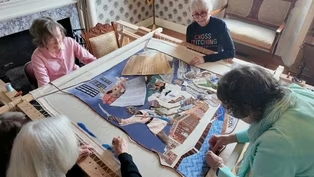
Construction of the tapestry began in April, 2025 at the historic Van Schaick Mansion in Cohoes, New York.
The mansion built in 1753 and run by the Daughters of the American Revolution has its own connection to America's fight for freedom.
Strategy for the Battle of Saratoga in 1777 was planned at the mansion.
- The room that they've let us use has excellent lighting for the stitching that we're doing.
So we're stitching this on 32 count, which means 32 stitches to the inch.
So having good lighting is really important for us.
There are five techniques that our chapter sort of focuses on, and all five of those techniques are in here somewhere.
Those techniques are something called white work, which is kind of a misnomer.
White work is basically the color of the fabric and the color of the stitching are the same.
So that's what we're doing for the cobblestones in front of the buildings.
It hasn't been stitched down yet, but that's over here.
Black work is, is sort of a fill pattern.
So that would be the British officers, the American officer, the father and the son on the boat, the woman pushing the wheelbarrow.
Her shirt is done with black work.
There's another technique called needle work, or needle point, specifically the technique is bar jello.
And that's what was done for the harbor.
It's done in different shades of blue, so it really looks like the waves of the harbor.
We also have something called counted thread, where you actually count the threads and a couple of the buildings have been done using that technique.
And then the last one is something called surface embroidery, where you just kind of do it as you feel.
It's kind of the best way to describe that.
So like all of the men's hair has been done with French knots where somebody's just stoked, sewed them down.
And they haven't done any counting.
They've just said, ah, that looks about right.
We also have some appliques that were done where either they were printed on fabric or they were hand drawn on fabric.
And then the other thing we've done is some fabric painting.
So this panel is 35 inches by 45 inches, which is 1,575 square inches.
The reason that number is important is that it takes approximately an hour per square inch of stitching.
So we're looking at 1500 hours of stitching if we tried to stitch the background.
So by doing fabric paint, we were able to get large swaths done, and then we could focus on the stitching - For members of the New York Capitol District chapter of the Embroiders Guild of America.
The tapestry has truly been a labor of love.
When the opportunity to be involved arose, there was never any doubt they were eager to take part and lend their time, talent, and dedication to the project.
- When Stefan Romero reached out, when he first came up with the idea, he reached out to every single stitching group he could think of in New York State asking for somebody to take the lead on the New York panel.
The New York Capital District chapter of the EGA was one of those that was, that he reached out to.
And I was like, we have to be involved.
We absolutely have to be involved.
Put me down as the, as the project lead, I'll figure this out.
And I have very much relied on the other members of the chapter.
- All told over 1000 volunteers in 13 states have joined America's tapestry to embroider the 13 panels after its inaugural display at the College of William and Mary's Mascara Museum of Art in Virginia This summer, America's Tapestry will tour a number of other historic venues throughout the East coast for a multi-year traveling exhibition.
From November, 2027 through February, 2028.
It will be on display at the New York State Museum in Albany.
More information can be found at americastapestry.com
Providing Support for PBS.org
Learn Moreabout PBS online sponsorship









Support for PBS provided by:
WPBS Weekly: Inside the Stories is a local public television program presented by WPBS