WPBS Weekly: Inside the Stories
June 16, 2026
6/16/2026 | 25m 59sVideo has Closed Captions
Sitting down with a local historian, hydroponic farming in Kingston, and Arihhonni David.
As the US prepares to celebrate its 250th anniversary, we ask a local historian: what the country's founding era can teach us about today's challenges? Extend-a-family Kingston's grow-ability project is not only growing produce - they're growing opportunities, independence, and a more equitable future. Also, the inspiration behind the work of Akwesasne author and illustrator Arihhonni David.
Problems playing video? | Closed Captioning Feedback
Problems playing video? | Closed Captioning Feedback
WPBS Weekly: Inside the Stories is a local public television program presented by WPBS
WPBS Weekly: Inside the Stories
June 16, 2026
6/16/2026 | 25m 59sVideo has Closed Captions
As the US prepares to celebrate its 250th anniversary, we ask a local historian: what the country's founding era can teach us about today's challenges? Extend-a-family Kingston's grow-ability project is not only growing produce - they're growing opportunities, independence, and a more equitable future. Also, the inspiration behind the work of Akwesasne author and illustrator Arihhonni David.
Problems playing video? | Closed Captioning Feedback
Where to Watch WPBS Weekly: Inside the Stories
WPBS Weekly: Inside the Stories is available to stream on pbs.org and the PBS app.
Providing Support for PBS.org
Learn Moreabout PBS online sponsorship- Tonight on WPBS Weekly: Inside the Stories.
As the US prepares to celebrate its 250th anniversary, we ask a local historian, what can the country's founding era teach us about today's challenges, and extend-a-family Kingston's Growability project is not only growing produce, that growing opportunities, independence, and a more equitable future.
Also, the inspiration behind the work of Akwesasne author and illustrator Arihhonni David.
Your stories, your region, coming up right now on WPBS Weekly Inside the Stories.
- Funding for WPBS Weekly Inside the stories is provided by the statewide Community Regrant Program, a REGRANT program of the New York State Council on the Arts, with the support of the office of the Governor and the New York State legislature.
And administered by the St.
Lawrence County Arts Council.
Carthage Savings, founded in 1888, offering VA, FHA, seasonal, and world development mortgage products.
Providing financial services to Northern New York from offices in Carthage, Clayton, Croghan, and Watertown online carthagesavings.com.
- Good Tuesday evening, everyone, and welcome to this edition of WPBS Weekly Inside the Stories, I'm Michael Riecke.
The ideas that shaped the United States nearly 250 years ago aren't just history.
They're still showing up in the challenges we face today.
A political historian from the North Country says the questions about freedom, responsibility and the role of government are still very much in play tonight.
Dr.
Ray Petersen walks us through what the founders got right and how those early ideals are shaping today's world.
Dr.
Ray Petersen, welcome to WPBS Weekly.
It's so great to have you here.
- Thank you.
- Well, before we dive into 250 years of American history, let's get to know you a little bit.
We know you grew up on a farm.
You spent decades teaching political science at Jefferson Community College.
I'm willing to bet some of your students out there might recognize you still.
You had plenty of them.
- Hope so.
- Yeah.
How did that background shape your interest in American history and civic life?
- Well, when I was in high school, voltage power lines came crashing through our farm.
- And your farm was in Oswego County?
- In Oswego County, yeah.
From the nuclear plants in Oswego County.
They destroyed nearly 13 acres of beautiful woodlands that were bordered on a river.
So my father fought it in court, but eventually had to give up.
So he bought a sawmill.
We made the trees into lumber, built houses and barns with it.
So we were resilient with that.
We learned the Jeffersonian, you know, characteristic of resilience.
My job on the farm was to raise calves and watching the calves, I became interested.
Why did they do what they did?
And I developed a lifelong interest in human nature as well.
So that'll produce my first novel, which is Cowkind, where the cows are characters as well as the humans.
Everybody there is trying to figure out why are we fighting the Vietnam War, the teaching political science at JCC, there were many great parts of it, but one of my favorites was advising student organizations.
So I was the first full-time advisor to the African-Latin Society, which I'm neither.
I was the first full-time advisor to the first gay lesbian bisexual support group, student group, and the students for peace group.
So my teaching always focused on looking at history from the point of view that the present is history.
What is it that we want to know about the past for our ourselves now and looking into the future?
- Let's dive into that.
I think that's so fascinating.
Thinking, taking our present time, this moment, and looking back in time.
In this case, as we approach the 250th anniversary of the United States, I've heard you describe the revolution as a moment that temporarily expanded opportunity and social equality.
And it sounds like that's right in your wheelhouse in terms of some of the work you did as a writer, as a professor, your work at JCC, what did that look like in real life for ordinary people, 250 years ago?
- As colonists, we were not allowed to make nails.
We are not allowed to make hats.
We had to provide all the raw materials to Britain to be manufactured into clothing or whatever, and it sold back to us.
So getting into like what we forget, we forget about what it was like to be colonies ourselves, exploited politically and economically.
So what happened once we severed ties was we could do those things for ourselves.
Women played a huge role in the revolutionary movement prior to the war, and then afterward by making clothing.
If you showed up in public in what was called home spun clothing, you were making a political statement.
'cause you were supposed to buy the clothing from England at a really, at quite the markup.
The tariffs of their time.
Another part of it is the diversity provided opportunities.
When we got away from feudalism, there are vestiges of feudalism in the colonies, including primogeniture.
So right now, we would settle the question about elections.
The oldest son gets to be the next ruler no matter what else transpires.
And we got away from that.
First with the state constitutions and then with the US Constitution.
- Just absolutely fascinating.
I like this idea too, that you often talk about in your work of, of civic virtue.
Describe to us what that is and why it was so critical 250 years ago.
- Jefferson's a person I like to go to for that.
His definition of freedom was all about being able to do the right thing.
Not to do my own thing, but to do the right thing, which is what's going to expand freedom for myself, my family, and the larger community.
What was involved in that was sacrificing a little bit of my own personal self-interest for the greater good of the larger group.
So civic virtue means that you, you do that.
You set aside that thing that I can gain maybe for myself, for the benefit of the greater group.
And without the larger group having more freedom, I really don't have more freedom.
Best example of civic virtue comes to mind with regard to the war.
George Washington couldn't wait until the war was over and he knew it, so he could hand back his commission as a leader of the continental army.
As soon as he found out that the treaty with Britain was concluded, the treat at the Treaty of Paris, as it was called, he's gave his commission back to back to Congress, he gave power back to the people to govern themselves.
That's a big part of civic virtue as well.
Not holding onto power, beyond your own time.
- So George Washington in many ways at the time, leading by example to what he saw the country wanting to fulfill.
- Well, another one of the things we forget, or if we ever were told this, Washington survived two attempted coup d'état while he was leading the continental army.
So that's the reason it's very important for us to know today.
That's the reason for the second and third amendments.
We've heard about the Second Amendment a lot.
Third Amendment protects us from having soldiers quartered in our homes, which is what, what was happening in Boston, you know, prior to the declaration.
So the second amendment goes a well-regulated militia being necessary for a free state.
The right of the people to keep and bear arms shall not be infringed.
They're all dependent clauses.
If you, you have a right to keep and bear arms because you're gonna be the front line of a defense.
We don't have a big army to defend ourselves that we're paying for raising our taxes, you know, and potentially a threat to a civilian government.
- We're the founders confident that America Americans could live up to that responsibility of that civic virtue of carrying forward that flag?
- If they were confident we wouldn't have checks and balances.
So there are two what's really important, we, and I've found this so many times, we're only told about one part of the checks and balances.
The checks internally to keep one branch from becoming too powerful.
But just as important, maybe even more important for the founders were the checks on the people could be described as external checks.
They didn't trust human nature enough that we could govern ourselves without having this outside force.
And the outside force would be led by these elites who somehow were, they had more reason.
How do we know they had more reason 'cause they had more property.
So if we extend that today, the richest person in the world then would be the most self-governing, virtuous person, not out of self, acting out of self-interest.
I think that kind of flips things on their head in some ways.
- Absolutely.
It makes me think of current conversations about the electoral college.
- Yeah.
- As well.
- The electoral college would be exhibit A for an external check.
We've had probably half a dozen situations in our history where the electoral college created a form of constitutional crisis just in itself.
That the person receiving the most number of votes might not become president, has happened several times in our history.
It always accompanies some controversy and some questioning about the viability of the constitution.
- Can we talk about this tension between liberty and order freedom and stability?
Is that tension part of what has kept the constitution alive for 250 years?
- It's kept the constitution alive sometimes on life support.
It's good to go to a quote from Benjamin Franklin here.
When he came, two quotes, actually, he came outta the Constitution convention.
He was asked by someone, what did we get, a monarchy or a republic?
And he said, a republic, if you can keep it.
it's gonna be up to constant efforts by the citizenry to exercise their civic virtue to maintain it.
He also, this is more, a little bit more pithy.
He said, those who would sacrifice liberty for security deserve neither.
And that's, it is a constant tension.
Lexus de Tocqueville in the early 19th century wrote democracy in America.
And he said, there's this tension between liberty and equality.
If we go for too much equality, it will threaten our liberty.
He was more worried about that.
I would argue that we need to do more in the way of the economic equality that the opportunities provided when we broke from, from Britain still today.
I brought this book to, to show, this was written in 1976 in the bicentennial crisis of democracy.
The authors are from elite universities in the us, in Europe and Japan, and they argued that we have too much democracy, today.
And democracy is, it grew up along with capitalism.
Adam Smith's wealth of a nation was also published in 1776.
So you've got the whole idea of not having monopolies, of having a competitive economy, a free trade economy to, to benefit us.
But they said in 1976, well, you know, there's too much democracy that hurts capitalism.
So we would go on capitalism and accept limits on our democracy.
I don't think we can tackle issues like climate change.
You name it.
Itself creates an immigration crisis unless we have an engaged citizenry willing to share in the burdens and the benefits.
- Yeah.
Conversations we're still having today.
We've got about a minute left.
If you could sit down with one of the founding fathers for a conversation, what would you want them to know about the country at 250 years old?
What would you tell them?
- I would say the science of your time, which was based upon the, the great chain of being.
The idea that all the creatures on earth are in this chain and the white male was at the top.
No one could exchange positions that this was maybe the best of its time, but in the 19th century brought us evolution.
We evolve, we grow, we change, we benefit.
So that to the extent that we take that in and we use the public education that Jefferson emphasized, local government, civil liberties, we are able to tackle the challenges.
But maybe some of the restrictions on majority rule from the external checks need to be loosened up a bit.
- Great.
Thank you so much.
This has been such a pleasure.
- Thanks.
- Happy 250.
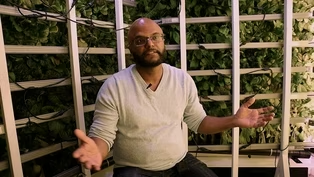
The Growability Hydroponic Greenhouse Project in Kingston, Ontario grows over 10,000 heads of produce annually with 90% less water operated by Extend-a-family Kingston.
The project supports food security, reduces carbon emissions, and provides therapeutic hands-on agricultural training for individuals of all abilities, all while cultivating fresh produce year round.
Here's WPBS producer Gale Paquette with more.
- In Kingston, a partnership has taken root one that blends innovation, sustainability, and community support Extend-a-family, Kingston, a non-profit dedicated to providing individuals with disabilities and their families with essential services and inclusive programs teamed up with Dunya habitats through the Kingston Community Climate Action Fund Initiative.
At the heart of this collaboration is Dunya's tiny farm system, a cutting edge, self-sustaining greenhouse designed to grow fresh, nutritious produce year round.
- All of this, like the a hundred square foot vertical kind of system hasn't been, was never designed when I started it right, we always had in the hydroponic space, very large guys, the warehouse size, greenhouse size suppliers out there.
And then you had the smaller, you know, you can put it on your countertop in the kitchen kind of systems.
So when I was looking at this, we were looking at how can we get into remote communities, refugee camps, we need something that's smaller, modular.
And then that's where the hexagon shape came out of as well.
So the hexagon, we have five walls so we can utilize the square footage much more efficiently.
You can put it into urban centers in a parking lot rooftops, things like that, right?
And then EAF is like, Hey, we don't have much space, what can we do?
And we're like, oh, this, this could be perfect for you guys, so let's, let's do a a pilot site.
So they're our flagship customer.
- Extend-a-family saw the opportunity to innovate and have since installed not one, but two compact greenhouses, specifically designed for accessibility, featuring open floor space and adjustable lighting.
By integrating this system into their existing gardening programs, they now provide fresh greens to local families year round.
- It's been a part of our programs for quite some time.
We really wanted to, to develop this seed to table program where you can learn how to grow your own food and then learn how to cook with it and, and get that independence of being able to grow your own food.
So it started with our diversity garden, which is an outdoor community garden that we developed in 2012.
It's a sensory garden that focuses on not only growing food, but also allowing opportunities to be outside, to engage with your community and to enjoy and relax.
So it consisted of just a few kind of things to start and then eventually expanded.
And then this is the latest expansion of that program to allow us to make more of an impact and also to allow us to grow.
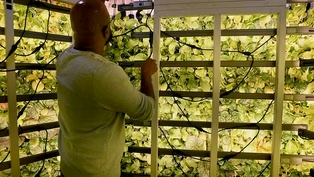
Year round - Hydroponics removes many of the traditional barriers to farming.
There's no soil, no heavy lifting, and it requires minimal space.
Extend-A-Family's hydroponic growability project allows participants to cultivate fresh produce year round, regardless of Kingston's coldest winters.
But this initiative is about more than just fresh produce.
It's about people.
It creates a sense of belonging, independence, and shared purpose, ensuring that sustainability and inclusion remain at the heart of the community.
- This is something that's different that's you wouldn't normally associate with the developmental service sector.
And what it does is gives us the opportunity to allow our program participants and people of all levels and people of all abilities to give back to their community, to learn and to grow.
So that was kind of the, the mission behind this project is that we wanted to provide opportunities for our participants to kind of learn about seed to table gardening, healthy cooking, growing locally, environmental sustainability, and also to donate produce that's grown here to, to people in need and, and address food security in our, in our community.
It's a lot of fun.
It's really diverse in what opportunities we can provide there from everything from, you know, planting the seeds to transplanting into our units, to harvesting.
And then obviously the most fun thing that we get to do is to actually give it to the people.
And I think everyone here agrees that that is the, the most impact and the, and the best thing that we can do is, is going out and actually delivering and meeting the people who were helping to feed.
- Empowering participants with new skills, encouraging environmental responsibility, and strengthening the local food network.
This project goes beyond providing fresh greens.
It offers hands-on learning experiences that promote self-sufficiency.
As the success of the greenhouses grow, Extend-A-Family is looking at ways to further expand their initiative.
- A lot of our folks, you know, this is their first experience with gardening, with volunteer opportunities, with sustainability, all of it.
And it's just, it's just been really, really powerful.
The sky's the limit for us.
So we are already hopeful.
We've got grant submissions out there to get another accessible pod.
We wanna do an inside wall as well so that there's one right in our space, just visually and just the impact of sort of what we're all about.
- As extend-a-family continues to explore ways to expand their programs, the success of these greenhouses serves as a model for sustainable community driven food security.
The hope is that projects like this will inspire more organizations to embrace innovative solutions to hunger and environmental challenges.
With partnerships like this, that vision is one step closer to reality.
- Super believe in it.
'cause you know, like the world has 800 million people that are starving every year.
So my, my hope is to be able to provide this to everybody so they can grow their own foods locally.
- For WPBS Weekly, I'm Gail Paquette.
- For more information, visit eafkingston.com/greenhouse.
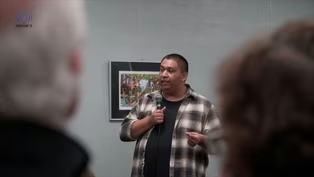
At SUNY Canton last fall, Akwesasne author and and illustrator Arihhonni David exhibited a collection of his original pieces.
Each was accompanied by a story highlighting the inspiration and meaning behind his work.
Take a look.
- I was supposed to be lacrosse player.
My first name's Cannon to look awesome on a jersey, but Art took me and I took off with it.
- SUNY Canton's, native American Student Alliance invited Akwesasne local artist and author Arihhonni David to display his artwork and share the meaning behind each piece.
David is known for his artwork and his writing credits on Marvel's Holy comic.
Part of the What If series - Today I gave a presentation here at SUNY Canton, my art, my fan art, and yeah, I talked to a lot of fellow nerdy art kids about the process of creating children's books and how my involvement with Marvel comics went - For honni, it was a first.
Having a gallery dedicated entirely to his work.
- I've never had a art gallery solely to myself, so I have been part of the Akwesasne Juried Art Ahow.
I've had my art on display with a lot of really awesome artists, but I've never done something where I'm speaking about myself and my artwork.
I do a lot of vending events, I do a lot of public speaking, I do a lot of stuff with the kids where I'm talking about my artwork, explaining it and explaining the stories and doing storytelling.
But I've never had a space where I'm just talking about myself as indigenous folk.
That's not something that we really do.
And it felt foreign to me at first, but I'm really happy again that we were able to pull this together because having all of my art on the walls is like, it's, it's hard to explain.
- Each section of the gallery was arranged to follow a story from cultural history and personal anecdotes to the modern and nerdy influences that shape his art today.
- I wanted to create the exhibit in a way that I could go through the narrative and speak about indigenous history in the past, the present to my children's books, and then to contemporary issues that we face today.
Talking about residential schools, talking about police brutality, talking about stereotypes, talking about all of these things that we face today and that we've persevered through.
And I tried to lighten the mood with some of my nerdy stuff and we talked about Guwandio and Gaholui and we led slowly into the scarier stuff, which I love talking about.
So yeah, I was able to curate this exhibit in a way that helped me as a storyteller and helped me lay out how I want to speak about each one of these topics and make that flow work.
- honni's Visit created a space for students and community members to connect through art and storytelling.
It was a great turnout and a proud moment for the Native American Student Alliance.
- Yep.
I grew up with comic books.
I grew up with Looney Tunes.
I grew up with Grew.
Does anybody know Gru the Barbar...?
Yeah!
- Find out more about Arihhonni David's honnidavid.com.
Well, that does it for this Tuesday night.
If you have a story idea you'd like us to explore, we would love to learn more.
All you need to do is send us an email at WPBS weekly@wpbstv.org and let's share it with the region.
That's it for now.
Join us next time for a fresh look inside the stories.
Have a safe night.
We'll see you soon.
Take care - Funding for WPBS Weekly Inside the Stories is provided by the statewide Community Regrant Program, a REGRANT program of the New York State Council on the Arts with the support of the office of the Governor and the New York State legislature.
And administered by the St.
Lawrence County Arts Council, Carthage Savings founded in 1888, offering VA FHA, seasonal, and rural development mortgage products.
Providing financial services to Northern New York from offices in Carthage, Clayton Croghan, and Watertown online@carthagesavings.com.
- Provide there from everything from, you know, planting the seeds to transplanting into our units, to harvesting.
And then obviously the most fun thing that we get to do is to actually give it to the people.
And I think everyone here agrees that that is the, the most impact and the, and the best thing that we can do is, is going out and actually delivering and meeting the people who we're helping to feed.
Video has Closed Captions
Explore the work of Akwesasne author and illustrator Arihhonni David. (2m 45s)
Video has Closed Captions
Explore the Grow-Ability Hydroponic Greenhouse Project in Kingston Ontario. (6m 3s)
Providing Support for PBS.org
Learn Moreabout PBS online sponsorship











Support for PBS provided by:
WPBS Weekly: Inside the Stories is a local public television program presented by WPBS