WPBS Weekly: Inside the Stories
Extend-A-Family Hydroponics
Clip: 6/16/2026 | 6m 3sVideo has Closed Captions
Explore the Grow-Ability Hydroponic Greenhouse Project in Kingston Ontario.
The Grow-Ability Hydroponic Greenhouse Project in Kingston Ontario, grows over ten thousand heads of produce annually with ninety percent less water. Operated by Extend-a-Family Kingston, the project supports food security, reduces carbon emissions, and provides therapeutic hands-on agricultural training for individuals of all abilities - all while cultivating fresh produce year-round.
Problems playing video? | Closed Captioning Feedback
Problems playing video? | Closed Captioning Feedback
WPBS Weekly: Inside the Stories is a local public television program presented by WPBS
WPBS Weekly: Inside the Stories
Extend-A-Family Hydroponics
Clip: 6/16/2026 | 6m 3sVideo has Closed Captions
The Grow-Ability Hydroponic Greenhouse Project in Kingston Ontario, grows over ten thousand heads of produce annually with ninety percent less water. Operated by Extend-a-Family Kingston, the project supports food security, reduces carbon emissions, and provides therapeutic hands-on agricultural training for individuals of all abilities - all while cultivating fresh produce year-round.
Problems playing video? | Closed Captioning Feedback
Where to Watch WPBS Weekly: Inside the Stories
WPBS Weekly: Inside the Stories is available to stream on pbs.org and the PBS app.
Providing Support for PBS.org
Learn Moreabout PBS online sponsorship- In Kingston, a partnership has taken root one that blends innovation, sustainability, and community support Extend-a-family, Kingston, a non-profit dedicated to providing individuals with disabilities and their families with essential services and inclusive programs teamed up with Dunya habitats through the Kingston Community Climate Action Fund Initiative.
At the heart of this collaboration is Dunya's tiny farm system, a cutting edge, self-sustaining greenhouse designed to grow fresh, nutritious produce year round.
- All of this, like the a hundred square foot vertical kind of system hasn't been, was never designed when I started it right, we always had in the hydroponic space, very large guys, the warehouse size, greenhouse size suppliers out there.
And then you had the smaller, you know, you can put it on your countertop in the kitchen kind of systems.
So when I was looking at this, we were looking at how can we get into remote communities, refugee camps, we need something that's smaller, modular.
And then that's where the hexagon shape came out of as well.
So the hexagon, we have five walls so we can utilize the square footage much more efficiently.
You can put it into urban centers in a parking lot rooftops, things like that, right?
And then EAF is like, Hey, we don't have much space, what can we do?
And we're like, oh, this, this could be perfect for you guys, so let's, let's do a a pilot site.
So they're our flagship customer.
- Extend-a-family saw the opportunity to innovate and have since installed not one, but two compact greenhouses, specifically designed for accessibility, featuring open floor space and adjustable lighting.
By integrating this system into their existing gardening programs, they now provide fresh greens to local families year round.
- It's been a part of our programs for quite some time.
We really wanted to, to develop this seed to table program where you can learn how to grow your own food and then learn how to cook with it and, and get that independence of being able to grow your own food.
So it started with our diversity garden, which is an outdoor community garden that we developed in 2012.
It's a sensory garden that focuses on not only growing food, but also allowing opportunities to be outside, to engage with your community and to enjoy and relax.
So it consisted of just a few kind of things to start and then eventually expanded.
And then this is the latest expansion of that program to allow us to make more of an impact and also to allow us to grow.
Year round - Hydroponics removes many of the traditional barriers to farming.
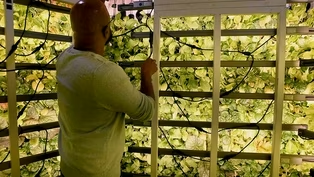
There's no soil, no heavy lifting, and it requires minimal space.
Extend-A-Family's hydroponic growability project allows participants to cultivate fresh produce year round, regardless of Kingston's coldest winters.
But this initiative is about more than just fresh produce.
It's about people.
It creates a sense of belonging, independence, and shared purpose, ensuring that sustainability and inclusion remain at the heart of the community.
- This is something that's different that's you wouldn't normally associate with the developmental service sector.
And what it does is gives us the opportunity to allow our program participants and people of all levels and people of all abilities to give back to their community, to learn and to grow.
So that was kind of the, the mission behind this project is that we wanted to provide opportunities for our participants to kind of learn about seed to table gardening, healthy cooking, growing locally, environmental sustainability, and also to donate produce that's grown here to, to people in need and, and address food security in our, in our community.
It's a lot of fun.
It's really diverse in what opportunities we can provide there from everything from, you know, planting the seeds to transplanting into our units, to harvesting.
And then obviously the most fun thing that we get to do is to actually give it to the people.
And I think everyone here agrees that that is the, the most impact and the, and the best thing that we can do is, is going out and actually delivering and meeting the people who were helping to feed.
- Empowering participants with new skills, encouraging environmental responsibility, and strengthening the local food network.
This project goes beyond providing fresh greens.
It offers hands-on learning experiences that promote self-sufficiency.
As the success of the greenhouses grow, Extend-A-Family is looking at ways to further expand their initiative.
- A lot of our folks, you know, this is their first experience with gardening, with volunteer opportunities, with sustainability, all of it.
And it's just, it's just been really, really powerful.
The sky's the limit for us.
So we are already hopeful.
We've got grant submissions out there to get another accessible pod.
We wanna do an inside wall as well so that there's one right in our space, just visually and just the impact of sort of what we're all about.
- As extend-a-family continues to explore ways to expand their programs, the success of these greenhouses serves as a model for sustainable community driven food security.
The hope is that projects like this will inspire more organizations to embrace innovative solutions to hunger and environmental challenges.
With partnerships like this, that vision is one step closer to reality.
- Super believe in it.
'cause you know, like the world has 800 million people that are starving every year.
So my, my hope is to be able to provide this to everybody so they can grow their own foods locally.
- For WPBS Weekly, I'm Gail Paquette.
Video has Closed Captions
Explore the work of Akwesasne author and illustrator Arihhonni David. (2m 45s)
Providing Support for PBS.org
Learn Moreabout PBS online sponsorship










Support for PBS provided by:
WPBS Weekly: Inside the Stories is a local public television program presented by WPBS