
January 9, 2026 - PBS News Hour full episode
1/9/2026 | 56m 44sVideo has Closed Captions
January 9, 2026 - PBS News Hour full episode
Friday on the News Hour, the latest jobs numbers show the economy growing at the slowest pace since the pandemic, and certain groups are taking the hardest hits. The wife of the woman killed by an ICE agent in Minneapolis speaks out as fear ripples through the community, including its schools. Plus, Iran threatens a further crackdown on protests, despite President Trump's threat to intervene.
Problems playing video? | Closed Captioning Feedback
Problems playing video? | Closed Captioning Feedback
Major corporate funding for the PBS News Hour is provided by BDO, BNSF, Consumer Cellular, American Cruise Lines, and Raymond James. Funding for the PBS NewsHour Weekend is provided by...
Support provided by:

January 9, 2026 - PBS News Hour full episode
1/9/2026 | 56m 44sVideo has Closed Captions
Friday on the News Hour, the latest jobs numbers show the economy growing at the slowest pace since the pandemic, and certain groups are taking the hardest hits. The wife of the woman killed by an ICE agent in Minneapolis speaks out as fear ripples through the community, including its schools. Plus, Iran threatens a further crackdown on protests, despite President Trump's threat to intervene.
Problems playing video? | Closed Captioning Feedback
How to Watch PBS News Hour
PBS News Hour is available to stream on pbs.org and the free PBS App, available on iPhone, Apple TV, Android TV, Android smartphones, Amazon Fire TV, Amazon Fire Tablet, Roku, Samsung Smart TV, and Vizio.
Providing Support for PBS.org
Learn Moreabout PBS online sponsorshipGEOFF BENNETT: Good evening.
I'm Geoff Bennett.
AMNA NAWAZ: And I'm Amna Nawaz.
On the "News Hour" tonight: The latest jobs numbers show the economy growing at the slowest pace since the pandemic, and certain groups are taking the hardest hits.
ANDRE PERRY, Brookings Institution: It's a phrase that we have heard since I can remember, last hire, first fired, and it's a phrase known too well by Black and brown people.
GEOFF BENNETT: New video emerges of the fatal shooting by an ICE agent in Minneapolis, while fear and tensions ripple through the community.
AMNA NAWAZ: And the Iranian government threatens a further crackdown on growing protests, despite President Trump's threat to intervene.
(BREAK) AMNA NAWAZ: Welcome to the "News Hour."
The U.S.
economy added a modest 50,000 jobs last month.
That was below expectations and capped the weakest year for job growth since the pandemic.
GEOFF BENNETT: Employers added a total of 584,000 jobs in the U.S.
for all of 2025, a big drop from the two million created in 2024.
Layoffs still remain low, hiring is still steady, and the unemployment rate ticked down to 4.4 percent.
Today, President Trump said it was an amazing report showing the strength of private hiring, and said any overall weakness was due to the government shutdown this past fall.
But as economics correspondent Paul Solman reports, it all points to a soft job market that's adding 100,000 fewer jobs a month compared to 2024.
PAUL SOLMAN: 2025 over.
Headline for the job market?
MARK ZANDI, Chief Economist, Moody's Analytics: Job market's weak.
The job market's not creating very many jobs at all.
PAUL SOLMAN: Economist Mark Zandi.
He says, if you look back to the start of President Trump's tariff regime, what the president called liberation day: MARK ZANDI: The economy has not been able to create any jobs.
And the job growth, we are getting, very narrowly concentrated in the health care sector, a bit in the hospitality, but, outside of that, we're seeing job loss and no job creation.
PAUL SOLMAN: In fact, just about all the new jobs created last month were in health care, social assistance and leisure and hospitality, no change or losses pretty much everywhere else.
Also in today's report, downward revisions to the jobs created in previous months.
MARK ZANDI: In total, they subtracted another close to 70,000 jobs from payrolls.
And this is not the end of it.
There's a lot more revisions that are coming, and everything suggests that they will show even weaker job market.
PAUL SOLMAN: So the job market since last January?
MARK ZANDI: It came into the year doing quite well.
Job -- monthly job growth was 150,000, 175,000, but since the spring, liberation day, it's flatlined.
There's been no job growth, some months up a little bit, some months down, essentially going nowhere fast.
PAUL SOLMAN: Especially, because while layoffs have been modest, there's been so little hiring.
MARK ZANDI: The length of unemployment is now becoming quite long.
People just can't get back into the labor market.
SHANA PINNOCK-GLOVER, Job Seeker: I know the exact date.
Got laid off February 10, 2025.
PAUL SOLMAN: Thirty-eight-year-old Shana Pinnock-Glover lost her job as a high-level social media director nearly a year ago.
A professional with 15 years of experience, she's been looking for 11 months.
SHANA PINNOCK-GLOVER: The job search emotionally is incredibly frustrating.
It is -- it can take you from the highest of highs to the lowest of lows.
PAUL SOLMAN: How many jobs do you think you have applied for either very seriously or at least somewhat seriously?
SHANA PINNOCK-GLOVER: And last I checked, I believe I was at some 860-something.
PAUL SOLMAN: How many times have you gotten an interview of those 860-some-odd?
SHANA PINNOCK-GLOVER: In the last 11 months, I have had -- I think I have interviewed with maybe nine or 10 companies.
PAUL SOLMAN: Pinnock-Glover is just one of many Black Americans whom the labor market has been hammering.
The Black unemployment rate is 7.5 percent, well above its record low in 2023, and nearly double the white unemployment rate.
ANDRE PERRY, Brookings Institution: It can't be explained by a lack of education or a lack of willingness.
PAUL SOLMAN: Andre Perry studies race and economics at the Brookings Institution.
ANDRE PERRY: It's a phrase that we have heard since I can remember, last hired, first fired, and it's a phrase known too well by Black and brown people, that Black workers are disproportionately impacted by economic downturns.
PAUL SOLMAN: And what about the Trump administration's anti-DEI campaign?
Have you felt the effects in the job market of the anti-DEI backlash, do you think?
SHANA PINNOCK-GLOVER: Yes, and that is what a lot of us are feeling, almost demoralizing aspects of all of this, because we know that we are qualified.
PAUL SOLMAN: Another cohort feeling the current crunch, the young.
ANGEL ESCOBEDO, Job Seeker: I have been applying, actively applying for a little over a year now.
PAUL SOLMAN: A process that started long before 22-year-old Angel Escobedo graduated college last month with degrees in finance and management.
How many jobs have you applied to in, I don't know, last six, seven months, and how many interviews have you got?
ANGEL ESCOBEDO: So I have applied, I want to say to a little over 100 positions over the past six, seven months, and I have gotten probably less than 10 interviews.
PAUL SOLMAN: So what are your friends doing if they can't get a job?
ANGEL ESCOBEDO: A lot of people are turning back to applying for the master's degree to actually get more experience on the resume, so they can then go find a job.
PAUL SOLMAN: And hide out from the job market?
ANGEL ESCOBEDO: Exactly, yes.
PAUL SOLMAN: The unemployment rate for Escobedo and his peers, Americans younger than 25, 10.4 percent, more than double the overall rate, and up from 6.6 percent in 2023.
CHRISTINE CRUZVERGARA, Handshake: We are seeing job postings down 15 percent compared to last year, while the class of 2026 is actually submitting 23 applications per full-time job, which is up 8 percent compared to last year.
PAUL SOLMAN: Christine Cruzvergara works with college students to help them get jobs.
CHRISTINE CRUZVERGARA: So there are less jobs and more people applying for those jobs.
That leads to more competition and a feeling of anxiousness amongst many of our early talent candidates.
PAUL SOLMAN: How much is due to A.I.?
CHRISTINE CRUZVERGARA: We are seeing employers either decide to cut head count or slow down their hiring because they're trying to figure out whether or not they need to allocate some of that money towards the use of A.I.
adoption, which has dollar costs to it.
Or they're trying to figure out, in the future, could I actually continue to grow my business?
PAUL SOLMAN: But it's not just A.I., says Cruzvergara.
CHRISTINE CRUZVERGARA: There's also government influence and pressure.
There's interest rates.
There's tariffs.
All of those pieces are coming together and kind of converging at a moment where it's impacting the numbers.
PAUL SOLMAN: One number on seemingly everyone's mind, the federal funds rate, and what today's report means for interest rates.
MARK ZANDI: We're not creating any jobs and unemployment is moving in the wrong direction.
There's no hiring.
All that adds up to reasons for the Fed to continue to cut rates at least one more, perhaps two or three more times in early 2026.
PAUL SOLMAN: The Fed meets later this month.
For the "PBS News Hour," Paul Solman.
GEOFF BENNETT: One other story tied to the jobs report, President Trump disclosed some of that key data on a TRUTH Social post last night, well in advance of today's release.
The president posted a chart focusing on growth in the private sector, matching in part what came out publicly this morning.
The jobs data is typically highly guarded until it's released because it can move markets.
The White House said it was -- quote -- "an inadvertent public disclosure" and that it would review its protocols.
Across the nation, tensions continue to rise over President Trump's immigration crackdown.
Yesterday, federal agents shot and wounded two people in Portland, Oregon, during a traffic stop.
AMNA NAWAZ: It came just one day, after the fatal shooting of a woman in Minneapolis stoked outrage and anger.
And, as special correspondent Fred de Sam Lazaro reports, new cell phone video deepened the debate over ISIS conduct.
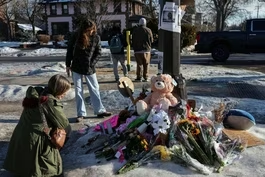
FRED DE SAM LAZARO: New video emerged today showing 37-year-old Renee Nicole Good and her wife just moments before Good was fatally shot in Minneapolis on Wednesday.
WOMAN: You want to come at us?
I say, go get yourself some lunch, big boy.
Go ahead.
FRED DE SAM LAZARO: It was reportedly taken by the federal agent who fired the shots and showed what happened next.
(GUNSHOTS) FRED DE SAM LAZARO: Earlier today, Good's wife released this statement saying, prior to being killed, they'd -- quote -- "stop to support our neighbors.
We had whistles.
They had guns."
MARY MORIARTY, Hennepin County, Minnesota, Attorney: We do have jurisdiction to make this decision that happened in this case where her life was taken in Hennepin County.
FRED DE SAM LAZARO: Meanwhile, Hennepin County attorney Mary Moriarty said Minnesota would be conducting its own investigation into the shooting and called on members of the public to send any evidence directly to her office.
The move came after federal officials reversed course and shut out state investigators.
MARY MORIARTY: It does not matter that it was a federal law enforcement agent.
I can say that the ICE officer does not have complete immunity here.
FRED DE SAM LAZARO: President Trump addressed the investigation this afternoon from the White House.
QUESTION: Do you believe that the FBI should be sharing evidence with state officials in Minnesota?
DONALD TRUMP, President of the United States: Well, normally, I would, but they're crooked officials.
I mean, Minneapolis and Minnesota, what a beautiful place, but it's being destroyed.
FRED DE SAM LAZARO: More than 1,000 protesters took to the streets here last night, calling for ICE's removal from the city.
RACHEL HOPPEI, Minneapolis Protester: Get out of here.
We don't want you.
You have no right to be here.
You're destroying our communities.
Just leave.
CINDY SUNDBERG, Minneapolis Protester: ICE is tearing us apart.
They're making people disappear.
They're not following the law.
And that's not Minnesota.
FRED DE SAM LAZARO: Minneapolis Mayor Jacob Frey also spoke today and pushed back against the notion that the city is unsafe.
JACOB FREY (D), Mayor of Minneapolis, Minnesota: Fifty percent of the shootings that have happened thus far in Minneapolis this year have been ICE.
In other words, we have only had two shootings.
One of them has been ICE.
We are a safe city.
ICE is making it less so.
FRED DE SAM LAZARO: Protests also erupted in Portland after Border Patrol agents shot and wounded two people on Thursday, a shooting Portland's Mayor Keith Wilson described as reckless.
KEITH WILSON, Mayor of Portland, Oregon: Today, I want to say clearly that we stand with Minneapolis, we stand with Minnesota, we stand with Chicago, we stand with L.A., we stand with every community that is hurting in our nation.
FRED DE SAM LAZARO: The Department of Homeland Security said the shooting in Portland took place during a targeted vehicle stop and alleged that the targets were undocumented immigrants with ties to a notorious Venezuelan gang.
But Portland's police chief, Bob Day, said he had no information on the two people shot.
BOB DAY, Portland, Oregon, Police Chief: This is not any way, shape or form of immigration-related on our end.
We do not know the facts of this case.
We are simply providing that traditional investigative support and perimeter support.
FRED DE SAM LAZARO: Back in Minneapolis, schools remain closed today and officials have offered students the option of remote learning through mid-February.
WOMAN: Time to go!
FRED DE SAM LAZARO: That follows a large confrontation just hours after Wednesday's shooting between immigration enforcement agents and community members outside a South Minneapolis school.
NICOLE LUNDHEIM, Minneapolis Parent and Teacher: Before I know it, I'm being attacked, pushed and pulled.
FRED DE SAM LAZARO: Nicole Lundheim had just arrived to pick up her daughter after school and captured the melee on her phone.
WOMAN: Step up!
Step up!
FRED DE SAM LAZARO: The Department of Homeland Security said agents were chasing a U.S.
citizen who impeded their work and the pursuit ended at the school.
It said no students or staff were targeted but that a man calling himself a teacher assaulted officers.
Lundheim recalls the episode very differently.
NICOLE LUNDHEIM: Is -- it almost seemed intentional to create -- to linger long enough to create a crowd, to create chaos.
FRED DE SAM LAZARO: And with reports of immigration enforcement efforts continuing across the Twin Cities today, Lundheim says the level of concern is rising.
NICOLE LUNDHEIM: So students who are immigrants, students who aren't immigrants, students who have legal standing to be here, but maybe are Black or brown, they are afraid because they could become in the crosshairs, because their best friend, their aunt, their uncle, family members -- like, the fear is visceral.
FRED DE SAM LAZARO: Fear that may only rise in coming days, as federal officials say they will reexamine the cases of more than 5,000 refugees living in the state, just the latest move in a widening immigration crackdown here.
For the "PBS News Hour," I'm Fred de Sam Lazaro in Minneapolis.
AMNA NAWAZ: We start the day's other headlines in the Caribbean and the latest action by U.S.
forces against a sanctioned oil tanker.
Southern Command posted unclassified footage today of U.S.
troops dropping from a helicopter onto the vessel called the Olina.
In their post, officials said -- quote -- "There is no safe haven for criminals."
U.S.
government records show that the ship was sanctioned for moving Russian oil under its prior name, Minerva M. The vessel is the fifth tanker seized or apprehended by U.S.
forces, as the Trump administration intensifies its efforts to control shipments to and from Venezuela.
Ukrainian President Volodymyr Zelenskyy says that Russia's use of a new hypersonic missile overnight was meant to send a message to other European nations.
Fragments of the Oreshnik missile were found in the Western city of Lviv near the Polish border.
It's only the second time that Russia has used such a weapon against Ukraine.
And it comes as Ukraine and its allies reported progress this week on security guarantees.
Moscow says it was retaliation for an attempted strike on one of President Vladimir Putin's residences last month, which Ukraine has called a lie.
In his evening address, Zelenskyy said that European cities could be next.
VOLODYMYR ZELENSKYY, Ukrainian President (through translator): There was another Oreshnik attack, this time against Lviv region.
This was again demonstratively close to the borders of the European Union.
And this, from the point of view of the use of medium-range ballistics, is the same challenge for Warsaw, Bucharest, Budapest and many other capitals.
AMNA NAWAZ: The use of the Oreshnik missile was part of a broader Russian barrage overnight, which included an attack on Kyiv that left at least four people dead and 25 others injured.
Thousands of apartment buildings were left without heat, even as temperatures plunged well below freezing.
In Gaza today, loved ones grieved the deaths of 13 people who officials say were killed in a wave of Israeli strikes.
One strike formed this massive crater in Gaza City.
Displaced Palestinians used shovels to clear sand and other debris.
Israel's army says that it targeted Hamas operations and that the strikes were a response to a failed projectile launched by militants.
Meantime, former U.N.
diplomat Nickolay Mladenov met with senior Palestinian officials in the West Bank today.
He's been tapped for President Trump's so-called Board of Peace, which Trump himself is heading.
He's expected to announce the rest of the board next week.
In Switzerland prosecutors are asking that a co-owner of the bar where a deadly fire broke out on New Year's be held in custody.
Officials argued that Jacques Moretti presents a flight risk.
His wife and co-owner will remain free under judicial supervision.
Meanwhile... (BELLS RINGING) AMNA NAWAZ: ... church bells rang out across Switzerland as the country held a national day of mourning for the 40 people killed in the blaze.
More than 100 others were injured.
A preliminary investigation suggests that sparklers and champagne bottles ignited the blaze.
In Europe, hundreds of thousands were without power today after a massive Atlantic storm brought heavy snow, high winds and drenching rain across the region.
In places like the Czech Republic to the U.K., plows were out in full force, with some areas seeing more than a foot of snow.
That left cars stranded and roads a mess.
Where snow didn't fall, many trees did from high winds.
In areas along the English Channel, residents and work crews were cleaning up the debris today.
Meanwhile, in parts of the Balkans, entire communities remain underwater from days of heavy rains.
At least one person has died and many more have been rescued from the flooding.
And on Wall Street today, stocks ended the week with solid gains following that underwhelming monthly jobs report.
The Dow Jones industrial average added more than 230 points.
The Nasdaq jumped nearly 200 points.
The S&P 500 also posted a solid gain.
And a rare copy of the comic book that introduced the world to Superman has sold for a record $15 million, "Action Comics" No.
1, cost just 10 cents when it was published in 1938.
It includes Superman's origin story and helps set the stage for the superhero genre we know today.
The copy was once stolen from the home of actor Nicolas Cage.
It's one of about 100 copies known to exist today.
The company that negotiated the private sale says the book's owner and buyer wish to remain anonymous.
Put another way, they don't want to reveal their secret identities.
Still to come on the "News Hour": oil executives meet with President Trump about rebuilding Venezuela's oil industry; journalist Jacob Soboroff chronicles the devastating Los Angeles fires one year later; and David Brooks and Jonathan Capehart weigh in on the week's political headlines.
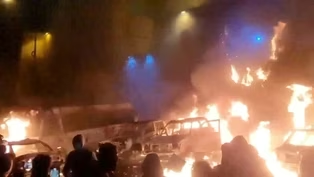
GEOFF BENNETT: Protests across Iran today continued to grow, despite a nationwide blackout implemented overnight, with sources telling the "News Hour" it is the largest ever cutoff in Iran's history.
AMNA NAWAZ: What started as street marches against crippling inflation in the autocratic state have quickly grown to become one of Iran's largest protest movements in years, as calls for Supreme Leader Ayatollah Khamenei's ouster mount.
Stephanie Sy begins our coverage.
STEPHANIE SY: In Iran, defiance reignited.
Hundreds of thousands marched across the nation, tearing up flags of the Islamic Republic, and chanting "Death to the dictator," Ayatollah Khamenei.
This bloody protester yells: "I am not scared.
I have been dead for 47 years."
That was when Iran's shah, Reza Pahlavi, was deposed in the Islamic revolution, and Ruhollah Khomeini took power.
It's the former monarch's son, the exiled crown prince, who has gone on social media to call for nightly protests in recent days and deal the -- quote -- "final blow to the regime."
Some Iranians are nostalgic for the past, hanging the pre-revolutionary flag on statues of the ruling clerics and waving it in the streets.
The protests began nearly two weeks ago, amid a failing economy and rising prices, and quickly morphed into mass protests across all 31 provinces, with many protesters calling for an end to a government that gives religious leaders ultimate control.
Videos from protests around the country were posted on social media, this one showing protesters hanging nooses off state CCTV cameras as they called for the end of the regime.
Authorities cut off Internet and phone access in Iran on Thursday.
Human rights groups say security forces have killed at least 48 protesters.
Today video surfaced showing lifeless bodies scattered on the streets of Fardis, 25 miles west of the capital; 2,000 protesters have been arrested, and authorities have said they'd be shown no leniency.
More than a dozen security officers have also been killed.
Today, the country's supreme leader blamed the uprising on U.S.
interference.
AYATOLLAH ALI KHAMENEI, Supreme Leader of Iran (through translator): Last night in Tehran and some other places, a bunch of vandals showed up in destroyed buildings belonging to their own country just to please the U.S.
president.
His hand is stained with the blood of Iranians.
STEPHANIE SY: But President Trump repeated a warning to Iran today.
DONALD TRUMP, President of the United States: I just hope the protesters in Iran are going to be safe, because that's a very dangerous place right now.
And, again, I tell the Iranian leaders, you better not start shooting, because we will start shooting too.
STEPHANIE SY: Iranian Foreign Minister Abbas Araghchi has dismissed Trump's threats.
ABBAS ARAGHCHI, Iranian Foreign Minister (through translator): The possibility of military intervention is very unlikely because it has been a failed experiment in the past.
STEPHANIE SY: But only last June, the United States launched a coordinated attack with Israel on Iran's nuclear enrichment sites.
For the "PBS News Hour," I'm Stephanie Sy.
AMNA NAWAZ: For perspective on these protests in Iran and how the government there is responding, we turn now to Vali Nasr, professor of international affairs and Middle East studies at the Johns Hopkins University School of Advanced International Studies.
His latest book is "Iran's Grand Strategy: A Political History."
Vali, welcome back to the show.
And before we get to the regime and the response, I want to ask you about these protests, the speed with which they grew, the scale to which they have now spread.
What does that say to you about the Iranian people?
VALI NASR, School of Advanced International Studies, Johns Hopkins University: It shows that this underlying anger in Iran is very serious, it's growing.
It has been there for some time.
It's now been aggravated by a worsening economic situation and also a sense of despondency, that nothing's going to change with Iran.
There are no negotiations with the U.S.
There's no sanctions relief.
There's no prospects of real change in Iran.
And all of this is coming to a head.
And I think also the protesters have been emboldened by the support that they're receiving from President Trump and a sense that perhaps the Islamic Republic is more vulnerable this time than it has been in the past.
AMNA NAWAZ: What should we take away from what we see in the way of the regime response so far, as we mentioned, Internet cut off, dozens killed, thousands arrested?
But it's not as brutal a crackdown as we have seen to protests in years past.
Why do you think that is?
VALI NASR: Well, first of all, I think the Iranian regime thinks that, during the June war with Israel, the Iranian public did not rise up.
And that was very important to Iran's survival in that war.
And I think they thought that they had created at least a bond of nationalism with the Iranian public, and they did not want to break that easily by reacting very adversely to the protests.
Secondly, the protests were economic when they began.
And economic protests in the past have not been very threatening to the regime.
It is only when they became much more about toppling the regime, an end to the Islamic Republic, and then they found support from President Trump, that the Islamic Republic decided that the protests needed to be cracked down.
AMNA NAWAZ: What do you make of that threat from President Trump?
I mean, do you believe that the Iranian regime thinks, if they crack down more severely, that could provide a pretext for Americans to intervene?
VALI NASR: I think they take that threat very seriously.
And I think they have assumed all along that domestic stability in Iran is an important signal as to whether Israel or the United States will decide to attack or not.
Secondly, they watched what happened in Venezuela, and they decided that President Trump could cross red lines and take actions that previously nobody assumed that he would.
And it is not beyond a realm of possibility that the United States may attack Iran, may attack, try to eliminate the leadership in Iran in a way that it didn't do during in the past, during the 12-day war.
And I think they think that the direction of the protests may signal to Washington that Iran is weak enough that the regime may fall with a military strike.
So I think they take that very seriously.
And that's what's different this time.
In other words, domestic protests are not in and of themselves threatening.
They are threatening to the regime because they are combined with an external threat coming from the United States.
AMNA NAWAZ: And all factors taken into consideration, what's your assessment of the leadership in Iran right now?
Are they at their weakest point?
Could external intervention topple this regime?
VALI NASR: I think the regime will not be easily toppled.
And the size of the protests have to be much larger for a much longer period of time.
But I think Iran is finding itself in a situation that it has not done before.
Even if these protests go away, the situation before the Islamic Republic is not going to change.
It's still facing a threat of war with the United States and Israel, and its economic situation is only going to get worse.
So I think the regime is not only trying to deal with the protests right now.
It's trying to figure out how it's going to survive.
How might it change in order to improve the situation before it?
And all of this is quite new.
AMNA NAWAZ: And, Vali, in the minute or so we have left, I want to ask you about the exiled Crown Prince Reza Pahlavi, who was the first to call for these protests that we have seen spread across Iran in the last couple of days.
Does the fact that the protest grew as they did say something about his level of support on the ground?
VALI NASR: I think it's very important in rallying the public and giving the protesters a purpose, particularly those protesters who want an end to the Islamic Republic.
They see in him the promise of something new, something different.
And there is nostalgia about the shah's period.
However, he doesn't have a ground game in Iran.
In other words, he doesn't have a political organization, political representation, and he hasn't built a coalition that cuts across various social sectors and social groups in order to be able to take these protests beyond just lashing out against the Islamic Republic towards a vision for the day after.
So I think it's very important at this point in time.
And, however, with the Internet cut off, because he doesn't have political organizations inside Iran, it's very difficult to see how he would be able to influence things going forward.
AMNA NAWAZ: Vali Nasr, always good to speak with you.
Thank you so much for your time and insights.
VALI NASR: Thank you.
AMNA NAWAZ: Today, just hours after the U.S.
military boarded another Venezuelan oil tanker in the Caribbean sea, President Trump hosted a group of top oil executives at the White House and outlined his plan for American companies to exploit Venezuelan resources.
DONALD TRUMP, President of the United States: The plan is for them to spend at least $100 billion to rebuild the capacity and the infrastructure necessary.
Venezuela has also agreed that the United States will immediately begin refining and selling up to 50 million barrels of Venezuelan crude oil, which will continue indefinitely.
AMNA NAWAZ: The president said the U.S.
government would provide total safety and security and that he expected the companies would in return move quickly to revitalize Venezuela's oil infrastructure.
Currently, Venezuela sits on more oil than any nation on the planet, but produces just 1 percent of global supply.
To help understand what comes next, we're joined now by Bob McNally, founder and president of Rapidan Energy Group and a former energy adviser to President George W. Bush.
Welcome to the show.
Thanks so much for joining us.
BOB MCNALLY, Founder and President, Rapidan Energy Group: Thank you, Amna.
Great to be here.
AMNA NAWAZ: So you saw a table there filled with oil executives surrounding the president, who seemed to be cautiously optimistic about their future investments in Venezuela.
From what you're hearing, how keen are big oil companies to plant a flag in Venezuela, as the president wants to see happen?
BOB MCNALLY: Well, you use the word cautious, and I think that's what oil company executives have been trying to get across to the administration in private conversations, and then today, even on camera.
Particularly Darren Woods from Exxon did a really good job of that.
But I think there's been progress in closing this expectations gap between the White House, the president, who wants capital to flow and oil production to grow fast now, and oil executives, who say it's going to be a long and winding road.
So I think, though, they're hearing each other, they're taking on board what each other is saying, and I think the expectations gap is closing steadily.
AMNA NAWAZ: That security guarantee that the president seemed to promise there for oil executives, is that something you think they need to be able to make investments and go into work in Venezuela?
And is that a guarantee that the U.S.
can make good on?
BOB MCNALLY: They absolutely need security.
I have never seen companies more obsessed with security than oil companies, really.
And they will not even send technical teams to look around unless they know they can keep their people safe.
I don't think the federal government can provide that.
The president, I think I heard him say there might be contractors.
The oil companies themselves are used to taking care of their own security.
They operate in very difficult places, more difficult places than Venezuela.
So I don't think they're going to expect or rely the U.S.
government to provide security.
They will do it themselves with their contractors, local partners, and their own security staff.
AMNA NAWAZ: Just to pull back a bit from the details of the logistics here and plans ahead, for context, we now have the president saying he expects us involvement in Venezuela to extend for many years.
You saw the energy secretary, Chris Wright, saying the U.S.
will control Venezuelan oil sales indefinitely.
Is all of this legal?
Is there any precedent for what we're seeing here?
BOB MCNALLY: I'm not aware of a precedent for what we're seeing here.
Legal -- the president asserting that it is.
If Venezuela, if the government, the post-Maduro, but still Chavismo government is OK with working with the president, I suppose it's legal over there.
They can pretty much do what they want.
But I think we're thinking about three buckets of oil here.
There's what to do with the 30 million barrels or so that's been produced and is stored.
And it seems the Venezuelan government and the United States legally, as far as they both are concerned, are going to sell that to the market.
So that's already been produced.
But then there's the next couple of years during the Trump administration.
Can they get production back up?
If the Venezuelan government is on board with changing its laws and regulations and the commercial terms, you will see more investment go in there.
It'll be legal and you will see production go up by a little bit.
But then, finally, there's the big oil.
And that's years down the road, well after the Trump administration and only after tens of billions of dollars have been spent.
The Trump administration has very little control over that.
AMNA NAWAZ: What about the potential impact here?
If production is able to be ramped up, we know the president has repeatedly talked about wanting to get -- bring oil prices down to $50 a barrel.
They're already, I think, at $59 a barrel, a four-year low.
Would ramping up production in Venezuela eventually bring down the cost?
Could it mean lower prices for American and global consumers?
BOB MCNALLY: You know, the Venezuelan oil will only really come on in large size and have a big price impact after 2030.
But barring a problem with Iran, as your recent segment discussed, barring a geopolitical risk, the president's lucky.
Oil prices have been trending down.
And it's possible that you will have at the same time later this year lower oil prices still, lower gasoline prices, and Venezuela increasing its production a little bit, sending more oil to the United States.
The Venezuelan oil won't cause the oil price to go down, but the coincidence of it will give the president some bragging rights, and I'm sure he will take advantage of it.
AMNA NAWAZ: Bob McNally of the Rapidan Energy Group joining us tonight.
Bob, thank you so much for your time.
Good to speak with you.
BOB MCNALLY: Thank you.
GEOFF BENNETT: This week saw a fatal shooting of a U.S.
citizen by an ICE agent and fresh signals of the Trump administration's emerging vision of U.S.
leadership.
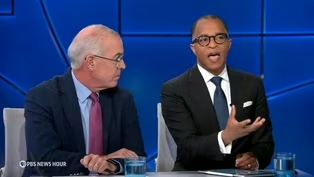
Time now for the analysis of Brooks and Capehart.
That's New York Times columnist David Brooks and Jonathan Capehart of MS NOW.
It has been a week, gentlemen.
It's good to see you both.
So, Jonathan, this week marked a grim turning point, as an ICE agent, as you both well know, shot and killed a U.S.
citizen during an enforcement operation as part of President Trump's expanded immigration raids.
Your reaction to all that's unfolded?
JONATHAN CAPEHART: It's a tragedy.
Excuse me.
It's a tragedy that's been unfolding in other communities around the country.
I think Governor Walz, Minnesota Governor Walz was correct when he said to the president, these federal agents, these ICE agents, they're not making us safer.
You are making the community, our citizens, more afraid.
And why shouldn't they be afraid?
Not just because of what happened to Renee Good, but the way they have been operating, not just in Minneapolis, but in other cities across the country, unmarked cars, unidentifiable, masked.
People don't know who these people are who are lunging at them on streets, lunging at them in their cars.
And so I think that the indignation, or, as I say, the righteous indignation that we have heard from state and local officials, from the governor, most definitely from the mayor, I think is warranted.
And anyone giving Mayor Frey, Minneapolis Mayor Frey the blues for being very explicit in what he wants ICE officers to do, how he feels about this, which is more unconscionable, him dropping the F-bomb or having a person who lives in his city killed by federal agents no one asked for?
The mayor didn't ask for them.
The governor didn't ask for them.
GEOFF BENNETT: And, David, video of the shooting spread almost instantly.
And just as quickly, the White House and DHS moved to label it an act of domestic terrorism, that the ICE agent, they said, was acting in self-defense.
What does this whole thing reveal about how narratives are being set before investigations are even complete?
DAVID BROOKS: Yes, let me talk first about the public debate, and then about the event, which Jonathan was talking about.
In 1951, there was a brutal football game between Princeton and Dartmouth.
And after the game, researchers sent the Princeton kids and the Dartmouth kids film, the exact same film video of the game.
And the Princeton kids said, look, this film proves beyond a shadow of a doubt that the Dartmouth kids did twice as many penalties.
And the Dartmouth kids said, this film proves without a shadow of a doubt that the Princeton kids did all the penalties.
And so they were looking at the same video.
And it's a very famous social science experiment.
And I watched it play out in real time this week, because every single Trump person on my feed, my social media feeds was saying, this proves he shot her with just cause.
And every single anti-Trump person on my feed said it was murder.
I did not see one exception.
And so I think what this tells us is the norm, which is essential to democracy, of putting the truth above your party and your team, that norm is eviscerated, at least on social media, hopefully not in real life.
As to the events of what actually happened, I'm not going to render a judgment on what happened, because we're going to have an investigation.
I will leave it to them.
And I hope Minnesota has full information to do the investigation.
But what Jonathan said is absolutely correct., that the atmosphere that ICE has created is incendiary, that people who have power and have guns are supposed to exercise restraint, and they are doing the opposite.
And the crust of civilization is thin.
And once people with guns and with power began acting like thugs, well, then things are going to spiral.
And that's what we have seen.
GEOFF BENNETT: Jonathan, to David's point about the public debate, it does feel like we live in this moment where this idea of seeing is believing has been replaced by what you believe now determines what you see.
JONATHAN CAPEHART: I mean, sure, but, I mean, maybe I come at this from the vantage point of being an African American man who, for decades, people talked about racial profiling by police officers, and there was no video to prove it.
And so we were deemed reactionary.
We were deemed taking things too seriously, being hyperbolic, until the person videoed Rodney King getting beaten up in Los Angeles.
And even with that, people came at it with their various perspectives.
Five years ago in Minneapolis, we saw Derek Chauvin with his knee on the neck of George Floyd for 9.5 minutes.
Imagine if the young woman who videoed -- who recorded that with her phone, if that video had not been there what the narrative would have been, the narrative that they tried to spin, even in the face of that video.
We now have a new video out of Minneapolis, out of Minnesota where -- I mean, I take your point, David, depending on your political perspective, you see what you want to see, but you're seeing.
And I think that the idea that the secretary of homeland security, the vice president of the United States, and the president of the United States are out there saying things that, whether -- you have got eyes.
You just match the video up against what they're saying.
Put aside your politics.
There is -- they are not trying to push that car out of the snow.
It's a lie.
And so I say all of that to say, I applaud people who are going out into their communities, seeing what's happening, and pulling out their phones and recording it.
As we have seen, multiple people were recording what happened to Renee Good.
And good for them, good for Minneapolis, good for Minnesota, but also good for America, because, as long as people are bearing witness to this with their phones and putting out a record, then the administration from the president on down cannot lie, baldly lie, to the American people without there being video evidence that they are lying.
GEOFF BENNETT: Let's shift our focus to foreign policy because President Trump is making clear that he won't be constrained by the law as he teases a takeover or a reimagining of the Western Hemisphere.
Here's what he told your paper, The New York Times, when asked if there are any limits on his global powers.
Mr.
Trump said: "Yes, there is one thing, my own morality, my own mind.
It's the only thing that can stop me.
I don't need international law.
I'm not looking to hurt people."
David?
DAVID BROOKS: We're doomed.
(LAUGHTER) DAVID BROOKS: Relying on Donald Trump's morality, we're doomed.
Sometimes, I think he's just trying to keep the reality show going, and every week has to show some sign of force.
But I tried to put my mind in, like, what -- if I want to make the best case for this Venezuela operation, obviously, Maduro was one of the worst people in the world.
The best case, I think, is that Trump happens to be in an office when a lot of really terrible regimes are crumbling, and he is a destructive force, and he is having some effect on causing terrible regimes to crumble.
And that's true in Iran.
The story is amazing what we're seeing in Iran.
It's true with Hamas.
It's true with Hezbollah.
It's true in Venezuela, Cuba.
There are a lot of terrible regimes that are in a very weak position.
And if he can push them off the edge, maybe that will be good for the world.
The problem with this approach is what Stephen Miller now famously said to Jake Tapper on Monday, which is, we don't believe in international law.
We believe in power.
We believe in force.
Strong wins.
Might makes right.
Deal with it.
The problem with that, it's like the ICE thing, frankly.
When there's restraint, when there's rules, when there's order, it does cause people to be less violent.
Between 1990 and 2014, in the world, there were less than an average of 15,000 war deaths per year, 15,000.
Since 2014, there have been over 100,000 war deaths per year around the world.
That is what you get when you erode the postwar international order.
You allow savagery to reign.
And what he's doing with this Stephen Miller might makes right, that's what you get.
GEOFF BENNETT: How do you see it, Jonathan?
If the administration is reviving this 19th century great power view of the world and abandoning the post-World War II order the U.S.
helped build, what's the result?
JONATHAN CAPEHART: Chaos?
I mean, I look at what he did in Venezuela and ask, to what end?
If it's regime change, is it really regime change if all you -- if the only thing you have done is remove the leader and leave the regime in place?
And so when you think about it that way, I now wonder, OK, how much will the United - - will the American people be asked to do in Venezuela to hold that country together so that President Trump can go and get the oil?
GEOFF BENNETT: How should the American people judge whether this approach is making the country safer or simply more feared?
DAVID BROOKS: Well, more feared.
I mean, it is making the country more feared.
If there was somehow -- their logic -- and, again, I'm trying to be fair to the Stephen Millers of the world.
Their logic is that it doesn't matter what they believe.
It doesn't matter what the party in Venezuela believes.
As long as we can intimidate them with - - by behaving roughly toward them, then they will do what we want, which is to let us build up the country and we will take the oil.
The amorality of that, people -- my friends on the left, they used to say, you have to see through what George W. Bush is doing.
He's waging war for oil.
Now you don't have to guess.
Donald Trump just says it.
And so that's a world of amorality.
GEOFF BENNETT: David Brooks, Jonathan Capehart, thank you both, as always, for your insights.
JONATHAN CAPEHART: Thanks, Geoff.
DAVID BROOKS: Thank you.
GEOFF BENNETT: It has been one year since the Palisades and Eaton fires tore through Los Angeles, destroying thousands of homes and killing more than 30 people.
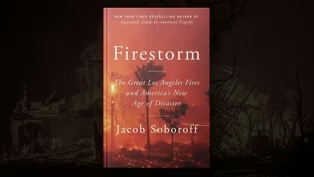
In his new book, journalist Jacob Soboroff offers a deeply reported account of the catastrophe told through the voices of firefighters, political leaders, residents and others, with a reflection on the lessons learned.
The book is called "Firestorm: The Great Los Angeles Fires and America's New Age."
And Jacob Soboroff of MS NOW joins us now.
It's good to see you.
JACOB SOBOROFF, Author, "Firestorm: The Great Los Angeles Fires and America's New Age": It's good to see you, Geoff.
Thanks for having me.
GEOFF BENNETT: You described the 2025 L.A.
fires as the fire of the future.
What made these fires qualitatively different from previous ones?
JACOB SOBOROFF: You know, what is so wild about this is that I was certain, having watched my childhood home carbonized in front of my own eyes, that what I was looking at was my past.
But when I sat down to sort of explore what it was that I had experienced in real time, which I couldn't process being out there covering this live on national television, I realized it was exactly that, the fire of the future.
And that is in talking to experts, firefighters, senior emergency management officials.
One of them here in Washington, D.C., said to me, what you experienced was the fire of the future because of four phenomenon.
Changes in the way we live, our infrastructure is falling apart, the global climate emergency, obviously, and the politics of misinformation and disinformation all played a part in making the great L.A.
fires not only the costliest wildfire event in American history, but something I think that will stick with Angelenos and people that read this book will soon experience in a neighborhood near them, I am sure, elsewhere in the United States and around the world.
GEOFF BENNETT: Let's talk more about that because fires are so often a climate story, but, this one, this became a political story in large part because of the misinformation.
How did that change the trajectory of the response?
JACOB SOBOROFF: It's so true.
And I think when people read "Firestorm," it reads like at times a sci-fi thriller, but it is as true of a true story as it possibly can be.
It is a minute-by-minute account of the lived experience of so many people.
And that lived experience includes being confused by misinformation and disinformation that was coming out of not only local leaders and the inability for the local infrastructure to have emergency alert systems that worked to get people information and appropriate amount of time to evacuate.
But the president-elect of the United States, Donald Trump -- and I don't think this is a secret or a surprise to anybody -- was sending out messages on his platform, TRUTH Social, about the causes of the fire that were based in no reality whatsoever.
You remember that he said there's a mystical tap that we can turn on and flow water down from the Pacific Northwest to stop the fire.
He blamed "Gavin Newscum" and the mayor of Los Angeles, Karen Bass.
This book doesn't absolve any official from what could have made these fires different, but it does, I think, point a finger at particularly Donald Trump and Elon Musk for, from the sidelines, making -- pouring rhetorical fuel on the very literal flames of the fire.
GEOFF BENNETT: There is this moment you capture in the book that really, I think, underscores the tension between the rhetoric and the reality.
You received a text from Stephen Miller's wife, Katie, in the midst of your reporting.
JACOB SOBOROFF: I did.
GEOFF BENNETT: Tell us about that.
JACOB SOBOROFF: Katie Miller and I were and have had a journalist-source relationship for the better part of the last -- I don't know, since the first Trump administration at least.
And she was the one when I covered family separation that let me into those detention centers to see the separated children for myself.
And when I wrote my first book, "Separated," it included some comments that she had made to me on the record about her feelings about the policy.
She didn't like that I included it and she cut off communication with me.
We hadn't talked since.
And as I stood there getting ready to deliver a special report to Lester Holt on NBC News, my phone rang, I looked down, and I picked it up.
It was Katie Miller.
And I told her I had to call her back, but before I could, she texted me and asked me to go check on, unbeknownst to me, Stephen Miller's parents' house.
They lived in the Palisades.
And just like I went and looked at my brother's house that he was living in, just like I went and looked at the house of the guy I drove in high school carpool, I went by the Millers' house.
And it too had burned down.
And the reason I include this story is because, number one, I was equally sad for them as I was for anybody else.
But, number two, within minutes of going to do that for her, I noticed that her boss, Donald Trump, and her future boss, Elon Musk at DOGE, were spreading this misinformation and disinformation that was hurting people, including her own in-laws.
And the irony of it to me, I think, is important to underscore and for people to really realize that this is the moment that we're living it.
GEOFF BENNETT: Based on your reporting, what were the systemic breakdowns that really put people in the community at the greatest risk?
JACOB SOBOROFF: So, there were two distinct fires that combined to burn 16,000 structures, kill 31 people, maybe as many as 400 if you look at excess mortality and some of the medical literature in the most populous county in America.
It was three times the size of Manhattan.
In the Palisades, this was a holdover fire from a previous fire that had been started allegedly by an arsonist on New Year's Day.
In Altadena, this was faulty electrical equipment, dormant electrical equipment that sat there unused and was electrified during the windstorm.
That there is no proximate cause is what I learned about wildfires like this in diving deep for this book, but those two fires were started distinctly and separately.
The common thread is that we knew that they were going to happen.
There was a particularly dangerous situation alert that went out from the National Weather Service.
I went and spent time with them.
You will meet in the book Dr.
Ariel Gomberg and Dave -- excuse me -- Dr.
Ariel Cohen and Dave Gomberg from the Oxnard office in Los Angeles.
These guys are heroes, the men and women that work in that office.
They knew exactly what was going to happen and what would happen if there was any form of ignition.
And in both of these places, hours apart, that exact thing happened and the consequences that they predicted, catastrophe, unfolded.
GEOFF BENNETT: Fast-forward to the current moment.
How are authorities and health agencies responding to concerns among firefighters, members of the community about their exposure to toxic smoke?
JACOB SOBOROFF: Yes, you will read in the book about a firefighter named Nick Schuler from Cal Fire, the state firefighting agency there.
And he told me: In all my years as a firefighter, this is the one fire that I thought in real time that I might get cancer fighting.
And there's research that shows elevated levels of lead and mercury in the blood of the firefighters already in the aftermath of the fire.
And there have been criticisms, including some great investigative reporting, which I cited in the book, by Tony Briscoe of The Los Angeles Times and others, about the cleanup effort.
And while it was fast, and President Trump and Gavin Newsom both liked to tout the speed with which these neighborhoods were cleaned up, there has been testing that shows that there are still elevated levels of toxic materials there, which are giving people pause about moving back, not just now, but if they will ever go back.
GEOFF BENNETT: How did you manage the emotional toll of covering the destruction of the neighborhood where you grew up, losing your own family home?
JACOB SOBOROFF: I don't know.
Actually, the truth is, I don't think I did at the time.
And that's why this book for me was equal parts investigative reporting and a cathartic journey to really rediscover myself and my neighborhood and my community.
And it is as much a love letter to L.A.
and dedicated to my fellow Angelenos as it is a work of political journalism or climate journalism or interviews with other human beings.
I think the book is as much about people as it is about politics or our environment.
And I think -- you have covered disasters like this as well.
So often, hope emerges in these stories.
I wasn't able to see it or feel it until I spent the better part of 2025 writing "Firestorm."
GEOFF BENNETT: The book is "Firestorm: The Great Los Angeles Fires and America's New Age."
Jacob Soboroff, always great to speak with you, friend.
JACOB SOBOROFF: Thanks, Geoff.
Appreciate it.
GEOFF BENNETT: Before we go tonight, we want to note a change for us here at PBS News.
AMNA NAWAZ: Due to federal budget cuts, we have had to make the difficult decision to rework our staffing and programming.
And this Sunday, our "PBS News Weekend" team will sign off the air.
"PBS News Weekend" anchor John Yang is here with us now.
And, John, we're going to miss you so, so much.
Thank you doesn't even begin to cover it.
You and the team have done incredible storytelling and covered major breaking news every weekend.
GEOFF BENNETT: That's right.
Weekend after weekend, you and the team brought such rigor and heart and care to the stories that you covered.
You will be deeply missed, and we are deeply grateful for all of your work.
JOHN YANG: Amna and Geoff, thank you very much.
And, Geoff, you know what this is like.
You sat in the chair I occupy now, the founding anchor of this program.
This has been a lot of news on weekends.
I can think back to the October 7 attacks in Israel, the first assassination attempt on President Trump, President Biden dropping out of the presidential race.
And this is, as I like to call it, the small, but mighty team that handled this, handled all these stories week in and week out.
We're proud of the creativity, the dedication they brought to each and every segment week in and week out.
I will be leaving PBS News at the end of the month as I step back from full-time work, but I'm delighted to say that many members of this team will be sticking around.
They will be producing some exciting new programming that you will be seeing in the coming days and coming weeks.
And so we thank them and look forward to that.
AMNA NAWAZ: Huge thank-you to you and the team, John.
GEOFF BENNETT: It's a remarkable crew.
Well, that is the "News Hour" for tonight.
I'm Geoff Bennett.
AMNA NAWAZ: And I'm Amna Nawaz.
On behalf of the entire "News Hour" team, thank you for joining us, and have a great weekend.
Brooks and Capehart on the Minnesota ICE shooting
Video has Closed Captions
Clip: 1/9/2026 | 10m 33s | Brooks and Capehart on the response to the Minnesota ICE shooting (10m 33s)
Iran threatens further crackdown as protests grow
Video has Closed Captions
Clip: 1/9/2026 | 9m | Iranian government threatens further crackdown as protests grow (9m)

The mounting economic challenges weakening the job market
Video has Closed Captions
Clip: 1/9/2026 | 7m 25s | The mounting economic challenges weakening the job market (7m 25s)
New video of ICE shooting emerges as tensions rise
Video has Closed Captions
Clip: 1/9/2026 | 5m 13s | New video of Minneapolis ICE shooting emerges as tensions rise across the nation (5m 13s)
Soboroff reflects on lessons of LA wildfires in 'Firestorm'
Video has Closed Captions
Clip: 1/9/2026 | 8m 4s | Jacob Soboroff reflects on lessons learned from LA wildfires in 'Firestorm' (8m 4s)

What oil companies need before tapping Venezuela’s reserves
Video has Closed Captions
Clip: 1/9/2026 | 5m 38s | What oil companies need before tapping Venezuela’s vast reserves (5m 38s)
Providing Support for PBS.org
Learn Moreabout PBS online sponsorship
- News and Public Affairs

FRONTLINE is investigative journalism that questions, explains and changes our world.

- News and Public Affairs

Amanpour and Company features conversations with leaders and decision makers.












Support for PBS provided by:
Major corporate funding for the PBS News Hour is provided by BDO, BNSF, Consumer Cellular, American Cruise Lines, and Raymond James. Funding for the PBS NewsHour Weekend is provided by...