
January 16, 2026
1/16/2026 | 55m 50sVideo has Closed Captions
Shirin Ebadi; Theodor Meron; Dr. Ezekiel Emanuel
Nobel Peace Prize Laureate Shirin Ebadi discusses Iran's antigovernment protests. Judge Theodor Meron introduces his new book "A Thousand Miles," which recounts his life from surviving the Holocaust to becoming an international criminal justice judge. Dr. Ezekiel Emanuel shares his advice for living a healthy life in his new book "Eat Your Ice Cream."
Problems playing video? | Closed Captioning Feedback
Problems playing video? | Closed Captioning Feedback
January 16, 2026
1/16/2026 | 55m 50sVideo has Closed Captions
Nobel Peace Prize Laureate Shirin Ebadi discusses Iran's antigovernment protests. Judge Theodor Meron introduces his new book "A Thousand Miles," which recounts his life from surviving the Holocaust to becoming an international criminal justice judge. Dr. Ezekiel Emanuel shares his advice for living a healthy life in his new book "Eat Your Ice Cream."
Problems playing video? | Closed Captioning Feedback
How to Watch Amanpour and Company
Amanpour and Company is available to stream on pbs.org and the free PBS App, available on iPhone, Apple TV, Android TV, Android smartphones, Amazon Fire TV, Amazon Fire Tablet, Roku, Samsung Smart TV, and Vizio.

Watch Amanpour and Company on PBS
PBS and WNET, in collaboration with CNN, launched Amanpour and Company in September 2018. The series features wide-ranging, in-depth conversations with global thought leaders and cultural influencers on issues impacting the world each day, from politics, business, technology and arts, to science and sports.Providing Support for PBS.org
Learn Moreabout PBS online sponsorshipHello everyone and welcome to Amanpour & Company.
Here's what's coming up.
Two weeks that shook Iran with thousands of protesters killed in a bloody crackdown and Trump pulling back his threats for now.
I asked Nobel Peace Laureate Shirin Ebadi if the regime will survive.
Then... I think God was on my side.
A Holocaust survivor and legal titan, 95-year-old Judge Theodore Moran joins me with reflections on his life's work, pursuing international justice.
Plus, eat your ice cream.
Advice from Dr.
Zeke Emanuel, who tells Walter Isaacson the secrets to living a long life.
♪♪ committed to bridging cultural differences in our communities.
And by contributions to your PBS station from viewers like you.
Thank you.
Welcome to the program, everyone.
I'm Christiane Amanpour in London.
The Iranian people's call for freedom was heard all over the world.
But has a bloody crackdown crushed the uprising?
President Trump appears to think the situation has calmed after he threatened the regime and promised to send help to the protesters.
It appears military action may be on hold for now, but thousands of protesters are thought to be dead.
Given the government's Internet blackout, information is scarce and the real number could be much higher.
These demonstrations started out over the cost of living and developed into something much larger, a call for basic freedoms and new leadership.
While the deposed Shah's son Reza Pahlavi is trying to position himself as a potential next leader, under the former Shah, Shirin Ebadi was Iran's first female judge, but was demoted following the 1979 Islamic Revolution.
But she kept advocating for women and human rights, and in 2003 she became Iran's first Nobel Peace Prize winner.
Now, more than 20 years later, she and her fellow female Nobel laureates around the world are standing in solidarity with the people of Iran.
Shirin Abadi, welcome back to our program.
So we've talked many times when there have been uprisings.
I want to know what you think of this one in terms of the history of modern Iran and the uprisings there.
[speaking in foreign language] - This recent uprising shows that the Iranian regime no longer want the regime.
What has happened in Iran is a tragedy and the number of those killed is far more than those killed in the previous unrests.
And I am very saddened to see the world has shut its eyes to the killing of our young people.
Why do you say shut its eyes?
This is top news all over the world.
Of course, in the news, yes, as you say, it's top news and it's been reported.
However, they don't see the real picture of what is happening in Iran.
see a much milder version of what is happening.
And the people's requests and demands have been ignored.
We have urged Europe to expel their ambassadors from Iran, to downgrade their diplomatic relations from Iran, from ambassadorial to charge at a fair level.
Moreover, we have urged them to force the Iranian government to stop the killing of the people and also the corruption and the high number of executions and the embezzlement that go on by this regime in this country.
For how long is the world going to turn a blind eye to what is really happening in Iran and we cannot do that single-handedly.
We cannot deal with a regime that is armed to the teeth.
We urge the West for help.
For five days there's been an Internet blackout.
We have asked them, just as the Iranian regime has managed to impose an Internet blackout so that the Iranian people cannot access the outside world, we urge you, why can you not do the same thing?
Why can you not shut down the Iranian telecommunication towers?
Please shut down the Iranian media, state media.
Do not allow the voice of the government to be heard outside.
Their propaganda and their mendacious reports to reach the outside world.
There seems to be selective internet.
Obviously, members of the regime can use it whenever they want and the people can't.
So that's a fact because they go and they talk.
You talked about executions and other crimes that you listed by the regime.
I mean, you're talking about that over the last several years.
Do you believe the foreign minister, when he went on Fox News this week and said there will be no hangings and that we now have the situation under control, there'll be no executions, no hangings, and the... Basically, the killings have stopped, the protests have stopped.
Do you believe that?
No, I do not believe the words of the Foreign Minister because he is not in principle an honest person.
He doesn't have any power.
If the Supreme Leader tomorrow orders further killings, of course they will carry out the killings.
Do you think that President Trump was right to promise to help the protesters and then seeming to agree with what he said he's been told, that the killings have stopped, that there will be no hangings, and we don't know if military action is still on the table.
Do you think Iran should be liberated, in your view, by external action, like military action, either from America or from Israel?
[Speaking in foreign language] No, we are against military strikes against Iran, because that will just lead to the killing of more people.
But the people have urged for so many, on so many occasions, just as they managed to target Ismail Haniyeh and kill him in one spot, why can you not have the same targeted assassination against the supreme leader of Iran and the current commanders of the Islamic Revolution Guard Corps?
Or why doesn't the European Union not expel Iranian ambassadors from their respective countries?
These are very easy actions that can be carried out, but unfortunately no one seems to be listening to the Iranian people.
Our young people are getting killed on the streets.
You remember obviously in June when the Israelis attacked by air and the United States attacked by air.
Certainly the Israelis took out a lot of the people that you're talking about.
Revolutionary Guards leaders, various security leaders.
They might have tried to get the Supreme Leader.
I don't know.
Anyway, they didn't.
So that's been tried.
I guess the question is, do you think that the West has ever paid attention to the human rights of the Iranian people?
Whenever we report about Iran, let's say on CNN or elsewhere, it's always about the nucleophile or terrorism or missiles or whatever.
Leaders generally don't talk about the human rights of the Iranian people.
You're a human rights champion, Nobel Peace Prize winner.
Why do you think that is?
Or do you think I'm wrong?
(SPEAKS IN FOREIGN LANGUAGE) What you're saying is totally right.
They do not care for human rights at all.
All they care about is their own security.
If they're against Iran's nuclear program, it's because they don't want their own security to be undermined.
They are thinking about their national security.
They're thinking about their pockets.
They don't care about the lives of the people.
What do you think about the opposition?
Who do you look at as the people who will lead what you want to see, an uprising, an end to this Islamic regime?
The Iranian people have been calling for one person, who is Reza Pahlavi.
Of course, I accept that there are many people in Iran who are not pro-monarchy.
There are some who would prefer a republic.
But please bear in mind, first we need to topple this regime.
Then the future system can be decided by the people through a free referendum, and this is something that Reza Pahlavi has accepted and he has said on many occasions that the future system must be decided through a referendum.
So, if the United States has decided to take back its threats against Iran and suddenly that it is not going to interfere, it's nothing but a pretext because they want to protect their own interests.
The Iranian people can choose their own leaders in a free referendum and nothing will happen once the regime is ousted.
There will not be chaos in the country after the collapse of the regime.
We will not allow that to happen.
When we spoke last time on this set, it was around the time of the 2022 Women Life Freedom Uprising after the death of Massa Amini in government custody, in the custody of the police.
At the time, you told me that if the government managed to quell, to crush this dissent, it wouldn't be the end, that they will succeed one day.
Now, every time there's an uprising, everybody, you, the diaspora, Europeans, the Americans, the whole world thinks this is it.
Why is it never it?
Why is it always that the regime can crush it?
Because the people do not want to resort to violence.
When the people take to the streets, with just using their fists in the air, and staging peaceful demonstrations, yet they are met with a brutal crackdown to such an extent that the Iranian security forces are using military weapons to kill the protesters.
What can they do?
But the more people are killed, the gap between the regime and the people will widen even more, and I promise you here that sooner or later this regime will collapse.
Just as what happened in Libya, just as what happened during the Arab Spring in several dictatorial regimes that were toppled, the same will happen in Iran.
There was a time when the Syrian people thought Assad can never be removed because he's so powerful.
But we've seen that even Assad ended up fleeing his country.
You know, there are a lot of people who would say that those countries ended up worse and under worse, difficult dictatorships, but that's for another day.
Do you remember, can you cast your mind back to 1979, around this time, when the Shah's forces were under protest and uprising from people on the streets?
What was the difference, do you think?
Did the Shah use that much violence?
He left, of course, he left the country and Ayatollah Khomeini came back.
I remember very well the 1979 revolution.
Unfortunately, I was also one of those who protested against the Shah of Iran at the time.
And since then, I have apologized to the Iranian people, especially to the young people, saying we made a mistake.
But I remember very well that in the 1979 revolution, the number of the protesters killed, not even one thousandth of those killed by the current regime.
Such brutality had never been seen in Iran.
Unfortunately we were deceived by two issues.
First, because at the time they had promised us democracy.
But we didn't know at the time that the person who was promising us a democracy didn't even know what democracy meant.
And it's only when he arrived in Iran we realized we were also deceived by religious promises.
We thought, "A religious person is not going to lie."
I want to add one thing.
In 1979, I believe that the Iranian people had unfortunately decided to throw themselves into a well.
And now we've decided to emerge from that well and come out of that.
And I promise you, one day we will come out of this.
We will.
>> Shireen Ebadi, thank you very much for joining us.
Now, with developments in Venezuela and Greenland highlighting the Trump doctrine of "might makes right," there couldn't be a more important time to talk about international law.
President Trump says there are no constraints on him, only "my own morality."
He says he doesn't need international law.
And his top aide, Stephen Miller, dismissed the long-time world order as "international niceties," saying the real world is governed by force and power.
At the same time, active war crimes charges are pending against Russian President Vladimir Putin and Israeli Prime Minister Benjamin Netanyahu, as well as his defense minister.
Those accused in Hamas were killed.
Judge Theodore Moran is a Holocaust survivor and legal titan who has dedicated his life towards the pursuit of justice and accountability, including for genocide.
Indeed, he was an advisor on the ICC indictments of Netanyahu and Defense Minister Yoav Galan, as well as the leaders of Hamas.
Prior to that, he oversaw many tribunals.
At 95 years old, Moran is as clear-eyed as ever.
His new book, "A Thousand Miracles," has just been published, and he came into the studio to talk about it.
Judge Theodore Moran, welcome to the program.
We go back a long, long time.
Sometimes I call you Ted.
You're a very special person.
Your latest book has just been published, and it's not just about your life, but it's essentially from surviving the Holocaust to judging genocide is the subtext.
So let me ask you about surviving the Holocaust.
You were born in 1930 in Poland.
When you were nine, Germany, the Nazis invaded and you lost much of your family in the... Most of it.
Most of your family.
Thank you for reminding me.
In Treblinka, including your older brother.
So for a long time, you wouldn't speak about the Holocaust.
You tried to bury the memories.
I know that's a common thing amongst survivors.
Why is that, do you think, when you reflect?
For you personally.
You are... I don't think that speaking about victimhood is something which is particularly useful or noble.
The pain was so rough that you try to forget it, you try to start a new life.
Mrs.
Weil, the famous French... Simone Weil.
Simone Weil wrote a book called, in French, In Vie, the Life.
And she tells the story which was almost mine, that for many years after Auschwitz, she refused to answer any questions about Auschwitz.
And then one day she decided that we must live a normal life, we must love, we must form families, perhaps have children.
And then she started not only talking about it, but wrote such a brilliant book about her experiences, how horrible in Auschwitz.
So this, as you said, it's quite common.
- Yes, and you have done the same now.
You talk about it now, plus you had family and you left Poland, you were able to be relocated after the war in what was then called Mandate, British Palestine, and you became eventually Israeli.
Tell me about that because you had been pulled out of school in Poland at nine.
You spent the next several years in the ghettos and in work camps.
How have those, did those years influence you and your hunger for a new life?
And not only that, for education, as you put it, a hunger for education.
Well, actually, education, the hunger for education became extremely central to my sort of motivations.
To not to be in school and not to be with children or teenagers your age for so many years leaves a tremendous hole in your cultural background, in your wholeness.
And therefore, I had this tremendous desire to try to catch up.
And I never quite caught up.
I think there are things, there are glaring holes in my education, which I will not reveal to you today.
OK, I won't ask you because nobody would imagine it.
You've reached the highest heights of your profession, jurisprudence, you speak languages, you still travel, your brain is on... firing on all pistons.
I worked very, very hard.
And I think that genetically I am in the right place.
Good.
So let me ask you this then.
One question about the camp, about Treblinka.
How do you think you survived?
Well, tremendous amount of luck and tremendous resilience and tremendous will to survive.
But mostly luck, luck, luck.
I think God was on my side.
And when my mother and my maternal grandparents were arrested because Jewish resistance was digging a tunnel in our house, and somebody denounced what was happening, and they were captured and taken, driven out of town and executed.
Had I come home 10 minutes earlier, I would have gone with them.
I was 15 minutes late in comparison to my normal schedule.
But this is one of the very many things that luck played a very favourable role.
And your brother, your older brother, how did you survive his killing?
I found it extremely hard.
In fact, his loss was in a way more difficult for me than the loss of my mother.
I always dreamt for years that one day the door will open and he will walk in, but this never happened.
And of course, this was augmented by the fact that I knew that he was in resistance.
He attacked a Nazi officer before being shipped to Treblinka to be killed, but they understood that and would not be so kind to him.
They decided that he must go.
And then he participated in the rebellion and the uprising of prisoners in Treblinka, which was an act of great courage, and I wish we would have seen a bit more of those things.
He lost his life there or immediately after that.
He never came back and he was five years older than I. You know, it is extraordinary, maybe or maybe not, that you then put your life's work into getting justice and accountability for these kinds of criminals.
Well, this was, I think, quite natural that this would be the result of that.
You learned, you had those lessons.
The loss of autonomy, the loss of childhood, the loss of school, the loss of company of people your age, the loss of reading.
And then you try to say to yourself, is there anything you could do?
Not to eliminate the possibility of those things recurring in the future, but at least reducing that possibility.
So I want to bring you back to when we first met.
Sure.
Because we spoke about a recently discovered by the journalist Gershom Gorenberg, the Israeli journalist, who wrote in his book about the 1967 war and the resulting building of settlements.
And he found your memo from, I believe, September 1967 in which... Which was designated as top secret.
And I have never gone public on that.
But you did to me.
Well, when it came out.
Not before that.
OK, so that's interesting too.
This is one of your most famous things, your most famous opinions, where you found Jewish settlements at the time in the occupied West Bank to be illegal under international law.
And that you issued to the government at the time, to the foreign minister, because you was the legal advisory.
I'd like to play a little soundbite from our interview back in 2007 for the film God's Warriors.
This is then President Shimon Peres, who I asked to reflect on what you had said.
- What does he think of my legal opinion?
- Yeah, what does he think of your legal opinion?
You're gonna see.
- I don't think he gave me great, high grades.
- He didn't.
- Are you saying Theodore Moran was wrong?
- I don't know if he was right or wrong from a legal point of view, but he was wrong from a pragmatic point of view.
- You can justify a lot of things on grounds of security, but you cannot settle your population in occupied territories.
- No doubt in your mind?
- No doubt.
- No wiggle room in the law?
- Not really.
- Pretty amazing watching you, watching him.
So what do you think of Shimon Peres?
I noticed him very uncomfortable, by the way, because he didn't want to say you were wrong.
- Well, Shimon Peres was a very decent person, and among the leaders of Israel, one of the perhaps more reasonable ones.
The opinion which I wrote, three pages, is one of the things I am most proud of.
I felt that this was, I knew that this was something that the government would hope I would not say.
But I felt I had a duty to say so.
Yes, and let me just be very clear to actually the heart of your opinion.
You concluded that creating Israeli settlements in occupied territories would violate... The Geneva Convention.
The Geneva Convention, period, end of story.
Do you think, did you ever think, that had the government then accepted your ruling and done what the international community said it should, don't build illegal settlements, that we would perhaps be, if not in peace, but a lot more close to peace.
In the process of reconciliation at least.
I thought about it quite often, and I am particularly sad, because had the government at that time followed my advice, we would really have been living now in a different Middle East, in a different Israel, in a different context of relations between Jews and Arabs.
I think, who knows, maybe we would have had a few peace then, but things are getting worse and worse and the current government multiplies settlements without worrying much about the question whether the settlements are or are not established on private Arab property.
I'm very worried.
I'm agonizing about what I see and read about the treatment of Arab villagers on the West Bank by Jewish settlers.
And this gives me a tremendous worry about I think everybody is terribly worried about what happens in that such important land that needs to be shared safely, securely for all of them.
But you fast forward to all those decades later.
You served as an advisor to the International Criminal Court, the ICC, when the prosecutor there, chief prosecutor, issued arrest warrants for the three Hamas leaders responsible for October 7th and for two Israeli leaders, the Prime Minister and the Defence Minister.
You have Gallant and Benjamin Netanyahu.
And you say the Gaza war has tested the system of international law to its limits.
But just before I get to that, you've also called yourself, or you've reacted to people suggesting that you might be swimming against your tribe, swimming against the tide, being a black sheep.
You came under... Did you come under criticism for being an advisor for this very controversial ruling?
A little bit, but I must tell you that most of the reactions I had from both Jews, my tribe, as you put it, and the public at large, were extremely positive.
But in any event, I think we have... And this is something that I felt very strongly when I led the UN war crimes tribunals.
We have an obligation as lawyers, as judges, as legal advisors to state the law as it is and not to play games with it.
And I was involved in some decisions as a judge and as the Chief Justice, which were very unpopular.
They involved in some cases of acquittals.
I believe that a legal system must show maturity by being willing from time to time to acquit people when we feel that the law and evidence requires not conviction but acquittal.
So you were the president at the turn of the century, frankly, for the International Criminal Tribunal for the former Yugoslavia.
And I also presided the Appeals Chamber for Rwanda.
Exactly.
And then the subsequent mechanism which succeeded both of them.
Exactly.
They both brought alleged war criminals to trial, convicted them, sentenced them, jailed them, particularly over Srebrenica and, as you say, the genocide in Rwanda as well.
In the interim, the ICC has presented war crimes charges to President Putin and one of his henchwomen for the war in Ukraine and the way they have forcedly deported children from Ukraine.
There's that.
Then you've got US striking boats in Venezuela.
I just want to put these together for a moment.
And you've got a whole load of world leaders who are a) not signed up to the ICC and b) don't give a hoot about international law.
President Trump recently said, you know, I don't need international law.
I've got myself and, you know, my own morality as judge.
Do you fear that all this that you've given your life to is at a risk right now, the principle of international law?
For the moment, I must admit that we live in a moment of retraction, a retrogressive step for international criminal justice.
After Nuremberg, we had a long period, half a century, in which no international courts were created.
It's great that because of this temporary detente between the United States and Soviet Union, the United Nations Security Council decided to go a different way and establish the United Nations War Crimes Tribunal.
And in those tribunals, this is a period of my two decades on the court, the period of life I would never have changed for anything else.
I think we were the architects of modern international law of war.
We revolutionized the rules pertaining to rape, which were wholly lamentable and inadequate.
So we did some great things.
We fleshed out rules governing conduct of hostilities and all of that.
Now, it's to be expected that the law will not, or anything else in life, will not always develop in a sort of linear way, with no ups and downs.
I think that now I have to acknowledge we are in a, in what the Bible would say, "linears."
But I'm quite convinced that sooner or later things will change, and there will be a return by world leaders to a more positive approach to international justice.
Incidentally, the ICRC, the International Committee of the Red Cross, with which I have worked now for decades, has been gracious enough to appoint me to an advisory group of how to galvanize political support of governments for respect for international humanitarian law, for international human rights, for international criminal law.
And I'm working on it with a very impressive group of people, and I'm very glad to be working that.
But sometimes the worst atrocities can produce the most important changes in the law.
Take the Holocaust.
At that time, the term genocide did not exist.
But we, in fact, witnessed a prime example of what we mean by genocide.
And after that, what was the reaction of the international community?
The Convention Against Genocide, the Universal Declaration of Human Rights, and the tremendous revolution of human rights on the positive side that we have seen.
So I'm hoping that we are perhaps in a bad period now, that in a few years it will change.
You cannot be an international criminal judge or an international criminal lawyer without being a tiny bit of an optimist.
You have to be an optimist and I believe that if people like you continue to fight for it, it will come back to where it's meant to be.
Now look, A Thousand Miracles has been dedicated to your wife, Monique Jonquier-Merant.
She died a couple of years ago and I know that you miss her a lot because you've talked to me about it.
Can you just talk a little bit about her legacy, her significance in your life?
She was an epitome of integrity.
Monique was someone who was really a watchdog of mine, never ever cutting corners.
And we had some difficult issues.
I remember that after the famous acquittal of General Gotowina, I was so much criticised by not only people... This was in the Balkan War.
That was in the Balkan.
Yes.
I was criticised by friends as well.
And I was wondering whether I should stand down from, at that time, candidature for another term as president or from the court at all.
And she said, "No, you can't do it.
"If you step down, you will be... "Everybody will say Ted Merrill realises that she made a mistake.
"He made a mistake.
"If your colleagues want to shoot you down, they can do it, "but then you go down with a bang and not with a whimper."
Wow, clever Monique.
How wise she was.
So she was a moral compass for me and she was a very, very close friend.
It's very difficult to manage without her.
Fortunately, I had Oxford who stepped in and gave me a job and a very supportive environment which I cherish.
That is just so fantastic.
Can I ask you to read the poem that you sent me months ago?
Oh, surely.
It's called The Things I Dread.
It was about life without Monique.
I dread boredom and loneliness, A dark, empty room's ghastliness, Crackling walls and howling wind, Not having a nearby can, Half-finished tasks, complaining look, Lack of companion that God took, an empty bed with cold sheets, no human touch and no heartbeats, missing her clutching hand and her love, long sleepless nights' grief, haunting dreams and sweat of fear, eyes that are fighting tears, a dining table with only one chair, a life without flair, a brain I could no longer pick, memories ever slowing rhythm.
- Wow.
Thank you.
- Thank you very much for inviting me.
- At a time of such global turmoil, here's some welcome advice, maybe, eat your ice cream.
It's the title of Dr.
Zeke Emanuel's new book, A Guide for Living a Long and Healthy Life Without Being Too Obsessive About It.
Walter Isaacson talked to Dr.
Emanuel, a former health advisor to President Barack Obama, about the power of moderation and the recent changes to US health policy under RFK Jr.
- Thank you, Christiane and Zeke Emanuel.
Welcome to the show.
It's my great honor, Walter, to be with you.
You have a book now on health and wellness, "Eat Your Ice Cream," and it has a wonderful line at the beginning of it that puzzled me, because most writers on this subject wouldn't have written this.
You say, "We're all going to die."
You can waste all your time trying to extend your life by a few minutes, or you can make the time you have healthier and more meaningful.
This sort of distinguishes your book.
It's not just about everything you can do to live a minute or two longer.
It's about living better.
Yeah, our goal shouldn't be just living a long time.
As a matter of fact, you're a historian and study history.
I went back, and one of the things you see is in the early 20th century, 1909, there's a big headline in the St.
Louis Post-Dispatch, "Live..." A scientist says, "You can live to 150 or 200 years."
And it's like, you read that headline, it could be today because everyone wants to live that long.
But I think the real thing we say to ourselves is we want quality of life.
Well, what's quality of life mean?
It means being healthy, not being obsessed about living every extra minute if it's going to compromise your pleasure, your fulfillment, your contribution to other people.
And that's the psychology, that's the underlying philosophy, if you will, of the book.
When I was at Time Magazine, and we weren't having a good year for newsstand sales, we just put a nutrition cover on, and you could do it either way because things kept changing.
We could say eggs good for you, no, eggs bad for you, or cholesterol good or bad, or butter versus margarine.
One time, butter would be better, margarine... Why don't we know more?
Why is it such a random science?
Well, diet is hard to study.
For one thing, what you eat today and every day has an impact over years.
Those kind of studies are hard to do.
That's the first thing.
Second, on diet, it's hard to randomize people and have them stick to the diet for five years while you're gonna study that.
That's one of the complications.
But I think we have made a lot of progress and we should undermine it.
The studies also need to be big, 100,000 people to really see the effects, and then to also unravel what the biological mechanisms of those effects.
But let's just go through them.
We know, one, that almost every American gets enough protein, and that should not really be an obsession of people.
Two, almost every American doesn't get enough fiber, and that should be something that people work on by eating more vegetables, eating more fruits, eating nuts, which are all high in protein.
Number three, we do know that dairy is probably net-net not bad for you and probably positive for you, and so we should encourage that.
We also know and have discovered fermented foods, really, really important.
We don't eat enough fermented foods, whether it's yogurt or kefir or cheeses or kimchi or sauerkraut or what your favorite fermented food is.
Those are good because of the microbiome.
I like to tell people, and this, I think, always knocks people's socks off, there are 100 trillion bacteria in your gut.
That's more cells than the rest of your body.
They're there for a reason.
Evolution didn't conserve them for no reason at all.
And having a big diversity of bacteria in the microbiome, really, really important.
So we need to eat fermented items, good for the microbiome.
And we also need to eat more fiber, good for those bacteria to grow.
And that, I think, as we're learning, has a huge impact on our body, on our mental function, on our behavior.
And I think that's going to be one of the big stories for the next 10 or 15 years as we unravel a lot of the different bacteria that are affecting us.
Let me talk about cognitive health because so many people now, I guess, especially my age, worried about dementia, losing a memory.
And I've started doing things like I started learning French, and suddenly my short-term memory is a whole lot better, I think.
What does work in terms of keeping your short-term memory?
There's a very important pivot point around retirement where you stop going into the office, you stop with the social engagement, the schedule kind of slips, you don't have another purpose.
And the content of the client seems to accelerate that, especially for white collar workers.
So you have to actually proactively go out and reestablish the schedule, your social interactions, the challenges that you might've faced at work now.
And I recommend to people, as you're gonna retire, plan it out, think about where you're gonna volunteer, how you're gonna do more things, how you're gonna interact with people.
That's very, very critical.
I think you're learning French, I totally endorse it.
Very, very good idea, because it involves so much of the language.
It involves your, not so much a language, so much a brain function.
It involves, you know, learning new words, it involves seeing things and being able to read, it involves being able to pronounce words, and it involves talking to someone else, which again, another social interaction.
- Every now and then, I like to have a drink, a glass of bourbon, I like to do it with friends.
Is drinking good for you or bad for you in the sense of what you're talking about of leading the good life?
- That's a complicated, so let's just talk about the physical manifestations.
And I think scientists have come to the position that alcohol, while 65 to 70% of Americans do drink, alcohol itself does have health risks.
It has health risks as far as the liver.
We're well acquainted with that.
It has health risks in terms of cancer and in terms of other conditions that disrupt sleep cycles.
So, that's the physical side.
But then there is, as you point out, lots of other aspects to alcohol.
Almost every culture, alcohol has been used in lots of ceremonies, but also in routine eating for celebrations, to be with other people, to lubricate social interactions, because it also happens to taste good.
And I think when you balance those things out, first of all, we're not going to get to everyone being a teetotaler, so we should be clear about it.
And the occasional drink is not going to disrupt, you know, your lifespan.
But if it increases your social interaction and the meaningful social interactions, it's a net positive in my view.
And I'm not a drinker, my wife likes to imbibe, she is actually very conscious of using it properly.
But I think, you know, for most people, it is a way of, it's a focus and brings people together.
And in that sense, I think net net, it's probably a positive for most people.
Now, there are things we shouldn't do, right?
Binge drinking, bad idea.
Drinking alone, bad idea.
Drinking to drown out our sorrows or because we're depressed, bad idea.
Drinking with other people as a social engagement over dinner or at a club, probably a really good idea.
When you talk about things like that, that it should be for interaction, it should be leading a fulfilling life, not just trying to win the gold medal for leading the longest life, it actually goes back in history.
It reminds me of Hippocrates, you know, the first of your line, and then Aristotle.
Is this something that's been known throughout history?
So generally, it is the fact that...I mean, the six things I point out, they're not unique under the sun.
We have known these for 2,500 years.
We have a lot more science about them and how they actually help the body.
And for example, how social interaction actually is good mentally.
It affects the brain through oxytocin, as well as dopamine and serotonin.
It also affects by decreasing cholesterol and therefore stress, the heart rate, blood pressure.
So we know it has physiological interactions.
But all of these things, whether social interaction, nutrition, exercise, sleep, they've been known throughout history.
What we know more now is their scientific basis, how much you need to do of each of these things.
And that is helpful.
But again, we've known a lot about this, which is why there are people who've been able to live long and healthy lives before the science.
There are a lot of happiness gurus out there saying, "Here's the seven ways to be happy," or giving advice on happiness.
Is happiness the ultimate goal?
It depends what you mean by happiness.
So happiness in our sort of modern lingo is, you know, pleasures, sitting on the beach and drinking piña coladas.
But happiness in the old Greek and the sense that our, you know, the founding fathers understood happiness as a fulfilling... The pursuit of happiness, you meant.
Yes, the fulfilling life.
And you know, I go back to Ben Franklin, one of your great heroes and someone you know a lot better than I do.
You know, Franklin had sort of three guiding principles, I would say, to his life.
One was curiosity.
He was endlessly curious about the world, people, social structures, etc.
The second was moral growth.
He was constantly trying to improve himself, recognizing his failures, trying to overcome them.
He didn't succeed always.
He sort of jokes that he never mastered orderliness in his life, that there was always a mess on his desk, as it were.
And his last one was be useful.
And by useful, he meant try to improve the world.
And this was the master of creating social organizations to improve his community.
He created the University of Pennsylvania, my university.
He created the first hospital in the United States.
He created insurance companies.
He created fire departments.
He created lending libraries.
He created learned societies, all to help improve the world.
And I think if you have those guiding principles, be curious, keep your mind active, grow, recognize your deficiencies and try to improve constantly, and be useful in terms of improving the world, that is the kind of happiness that I am sort of suggesting underlies these six behaviors.
Your friend, the former Surgeon General Vivek Murthy, wrote an important report about an epidemic of loneliness.
Tell me how that plays into this.
I actually think that's one of the great reports.
It goes along with the smoking report from 1964.
It'll be recognized as one of the transformative reports from a Surgeon General.
Smoking, there is a correlation because in his report, he reports on the fact that a study from Brigham Young University showed that being lonely is the equivalent of smoking 15 cigarettes a day, and that being lonely is, again, associated with about a 25 to 30 percent increase in mortality over the subsequent time, also increased risk of depression.
And we are going in the wrong direction.
Young people are not having as many intimate relationships with the opposite sex and their own sex.
They're dining alone.
They don't know how to navigate social situations.
This is a very bad situation.
And actually, when they do surveys, they report fewer close friends, fewer people they can call and talk to.
A large part of that is the cell phone and social media, but that's not all of it.
It predates the cell phone and social media.
And I think we are not paying enough attention to facilitating social interaction.
And part of it is we need deep relationships.
We need really those intimate relationships with deep friends who we can reveal inner secrets to.
But we also need much more casual relationships.
And you notice if you walk around that fewer people are actually talking to other people.
One of the contrasts I've noticed is if you go to Europe and you're in a cafe, no one's on their phone.
They're talking to each other.
In the United States, a lot of people, yes, they might be in a place with other people, but they're not interacting.
They're not talking.
And I think that's something we have to put the phone down and engage with people near us.
You say you're worried about the approach to vaccines now.
Drill down on that with Secretary of Health and Human Services Robert Kennedy.
What do you think of what's being done to the vaccine protocols now?
You're a doctor.
Well, first of all, I think the worries that are being fomented and the uncertainty and the complications are not going to help.
Over the last 30 years, we've saved at least 1.1 million lives in the United States through vaccination, everything from measles and chickenpox, rotavirus, flu, and we should recognize their value.
Overall, and I have actually a nice, I think, table in my book about how little the risks are of vaccines, especially when you compare them to things like peanut allergies.
So we should take vaccines and we should have them.
The cutting back of the vaccines to now 11 recommended vaccines, we are way on the outlier risk, as is Denmark.
Most countries have between 13 and 16.
Canada has, for example, 16, and we should be much closer there.
Taking away things like the hepatitis A vaccine from the mandatory list, not a good direction to go.
So I am very, very concerned about that, and I don't think the decisions are science-based.
If you look at the overwhelming data, and there is overwhelming data, more than 1.25 million people tested for just autism issues.
No evidence that that's true, but we still get this fear, this uncertainty, this pressure.
And I think it's going to undercut the public.
We've already seen a huge drop in the number of kids getting vaccinated.
Two-thirds of the counties in the United States now have less than 95% of the children vaccinated against MMR.
That's below the herd immunity level.
That is not a good place to be.
If we want to raise healthy kids, vaccinations is one of those steps.
You were very involved with dealing with the Affordable Care Act, Obamacare, and just recently the enhanced subsidies expired.
What are you worried that's going to do?
And more broadly, what can we do about health care costs and making sure that people have affordable access to health care?
Walter, you've put your finger on the issue.
It's beyond the expanded subsidies.
They're a manifestation of the fact that health care is now unaffordable.
That even insured people are worried about going to the emergency room or worrying about going to the doctor, that they can't afford it.
It has gotten way out of control.
Every part of the healthcare system has a responsibility to reduce costs.
We need to look at hospitals and reduce those costs.
They're way too high.
We need to look at insurance companies and reduce their costs and overhead and gaming of the system.
Drugs need to come down in price.
Administrative bloat, 20% of what we spend on healthcare goes to administration.
That is insane, and no one is going to shed a tear if we cut that back.
And McKinsey has a study that says we can cut that back by at least a quarter, $250 billion a year without serious effort.
And hopefully AI will help in that regard.
I'm very optimistic about that.
But the system has to incentivize people to make those cuts.
And we have to say, we're not going over 17% of GDP devoted to healthcare.
That's the first thing.
So we're going to put a cap on it.
Everyone is going to cut back, and we're actually going to try to roll back.
Just imagine, if we cut back from 17% of GDP going to healthcare to 16% or 15%, that's $3,000 per family, right, in their pocket.
That's savings out of the healthcare system.
That's real money to Americans.
That changes the affordability equation.
And I think that's very important to focus on.
By the way, it also gives us money to spend on other things, whether it's education, the environment, you know, our electrical grid, whatever you think our priorities ought to be.
And that, I think, is important.
We can't overinvest in healthcare and the healthcare system, which is what we're doing.
- Well, wait, you say you could cut $3,000 per family, maybe bring it down a bit.
That can't just be done with administrative costs.
- Let me just say the following.
$250 billion is roughly $700 per person in America.
A family of four, that's $2,800.
The amount we spend on healthcare is mind boggling, and you always have to add more zeros because even small changes in healthcare are big dollar amounts, and that's what we have to focus on.
And we have to do it relentlessly because it frees, I mean, if every family in America had a 3,000 extra dollars, that would really change the economic situation of a lot of people in this country in the bottom half of the income bracket.
Zeke Emanuel, thank you so much for joining us.
Thank you, Walter.
It's been a great interview.
And that's it for now.
Thank you for watching and goodbye from London.
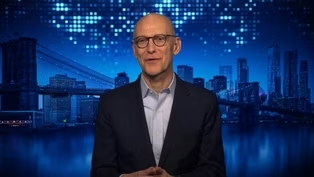
Dr. Ezekiel Emanuel on Vaccines, Healthcare and Living a Healthy Life
Video has Closed Captions
Clip: 1/16/2026 | 18m 8s | Dr. Ezekiel Emanuel offers his advice on leading a healthy life in his book "Eat Your Ice Cream." (18m 8s)
Providing Support for PBS.org
Learn Moreabout PBS online sponsorship
- News and Public Affairs

Top journalists deliver compelling original analysis of the hour's headlines.

- News and Public Affairs

FRONTLINE is investigative journalism that questions, explains and changes our world.











Support for PBS provided by: