
Iranian Americans express hope, fear about what comes next
Clip: 3/5/2026 | 5m 47sVideo has Closed Captions
Iranian Americans express hope and fear about what comes next
There are more than half a million people of Iranian ancestry living in the United States. We spoke to some of them to learn how they're feeling about the war and about what might come next.
Problems playing video? | Closed Captioning Feedback
Problems playing video? | Closed Captioning Feedback
Major corporate funding for the PBS News Hour is provided by BDO, BNSF, Consumer Cellular, American Cruise Lines, and Raymond James. Funding for the PBS NewsHour Weekend is provided by...
Support provided by:

Iranian Americans express hope, fear about what comes next
Clip: 3/5/2026 | 5m 47sVideo has Closed Captions
There are more than half a million people of Iranian ancestry living in the United States. We spoke to some of them to learn how they're feeling about the war and about what might come next.
Problems playing video? | Closed Captioning Feedback
How to Watch PBS News Hour
PBS News Hour is available to stream on pbs.org and the free PBS App, available on iPhone, Apple TV, Android TV, Android smartphones, Amazon Fire TV, Amazon Fire Tablet, Roku, Samsung Smart TV, and Vizio.
Providing Support for PBS.org
Learn Moreabout PBS online sponsorshipGood to speak with you.
Adm.
Kirby: Thank you.
Geoff: There are more than a half million people of Iranian ancestry living in the U.S.. We spoke with them to learn how they're feeling about the war and about what might come next.
>> Common American Iranian.
I move to the U.S.
14 years ago to pursue my phd.
I grew up in Iran my entire life.
But I did not see any future to stay and work there because of the government.
>> My name is Hamid Kashani.
I came from Iran in 1973, following graduating from high school to attend higher education in the United States.
>> I am Reza Ebrahimi.
I'm 37 years old.
I came to the United States on the age of 27 in 2015.
I'm a volunteer firefighter.
I'm a member of the sheet metal union.
I'm a U.S.
Citizen.
>> My name is kowsar gowhari.
I was born in 1979 at the height of the revolution.
Parents were students here in the U.S.
I was eight months when they decided to go back to Iran.
I grew up in Iran.
And in 2003, after graduating from undergrad school, I moved to the U.S.
And I have been living in the U.S.
State of Maryland.
>> My name is Ali taroq, and I arrived here 13 years ago as a refugee toward the U.S.
Refugee addition program from Iran.
>> My name is Betty amami, and I came to United States in 1982.
I left Iran in 1978.
It is very difficult to watch.
Especially for, you know, us in the diaspora because, you know, we are not there.
We are not in the forefront.
You know, we're praying that the men and women of Iran who are opposing this regime get their country back.
And at the same time, we just take it day by day and glued to the news channels and social media outlets.
>> I woke up Saturday morning and woke up to the news.
Definitely at first it was shocking.
It was scary.
But then we heard the news that the supreme leader was targeted and was killed.
That was the start to feel for us like we can exhale, there's finally some justice.
>> Although I think the grievances were very valid, very legitimate I don't see any , foreign intervention bringing any betterment of life to the Iranian people.
So with worry and sadness and anxiety, I watched the news and I'm really concerned for the future of Iran politically.
But also on a personal level, I'm very concerned for my family and friends.
I'm hoping for a cease-fire soon because this war won't benefit anybody, any parties involved.
>> When they started dropping bombs, we were so excited.
I was happy.
My heart was coming out of my chest.
That I was crying at the same time.
I couldn't believe it.
>> You never want your country to be invaded by an outside force.
You don't want innocent lives lost.
But in the current situation and what occurred just a few weeks ago with massacres in the streets, we realized that people's hands are empty a vicious regime that has no qualms about mass killing of its own people.
>> We can build it again.
He damage the regime has done to Iran is more than whatever the bombs are going to do.
♪ >> I was excited to talk to people.
It is very important for every single Iranian.
We always talk about it, show Americans who we are.
>> We go to protests.
We want to be seen.
We want to be heard.
I mean, it's a chaos.
Just seeing the pictures of these schoolgirls were killed in minhaab elementary school, they became very impactful in terms of making diaspora understand what the impact of military intervention would be.
>> I used to be an activist.
In 2009 after the election, I was arrested.
I was in solitary confinement for four months.
And later, they put me in prison for two years.
I don't like the regime.
I want them to go.
But I learned, okay, it's very important how to make changes.
I am against any foreign intervention.
It's very hard to see this war happen inside Iran.
And my most frustration is on the Iranian diaspora pushing for that war and they saw the war is a good thing.
>> War is tough.
But everything has a cost.
Yes.
But also we always look at the daylight after.
We believe in Reza pahlavi.
He - - his father built Iran very strong.
>> Since the war started, I braced myself for any scenarios of bad news.
Today my mom called me and she - - they are ready to be killed.
And this is the reality.
>> We did witness the result of the invasion of Iraq, for example.
And we saw the aftermath for years and years and years.
And then we saw what has happened in Afghanistan.
So we are definitely worried about the outcome in Iran.
>> Living in these moments, it is really scary.
Because again, I was born in Iran.
I grew up in Iran.
I know these people.
 New
NewIranian strikes on Gulf nations risk pulling more into war
Video has Closed Captions
Clip: 3/5/2026 | 3m 33s | Iranian drone, missile attacks on Gulf nations risk pulling more countries into war (3m 33s)
 New
NewIsraelis take shelter as Iran and Hezbollah launch attacks
Video has Closed Captions
Clip: 3/5/2026 | 5m 50s | Israelis take shelter as Iran and Hezbollah launch attacks: 'Here, the wars don't end' (5m 50s)
 New
NewJohn Kirby on concerns about Iran's future after the war
Video has Closed Captions
Clip: 3/5/2026 | 6m 57s | John Kirby on concerns about Iran's future after the war (6m 57s)
 New
NewLloyd Blankfein on his memoir and broader economic concerns
Video has Closed Captions
Clip: 3/5/2026 | 8m 4s | Lloyd Blankfein on his memoir 'Streetwise' and broader economic concerns (8m 4s)
 New
NewNews Wrap: States sue Trump over planned 15% global tariff
Video has Closed Captions
Clip: 3/5/2026 | 4m 40s | News Wrap: More than 20 states sue Trump over planned 15% global tariff (4m 40s)
 New
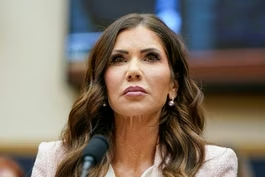
NewTrump fires Noem amid controversies over DHS leadership
Video has Closed Captions
Clip: 3/5/2026 | 4m 58s | Trump fires Noem amid controversies over her leadership at DHS (4m 58s)
 New
NewU.S. and Israel widen strikes on Iran's infrastructure
Video has Closed Captions
Clip: 3/5/2026 | 5m 9s | As U.S.-Israeli strikes intensify, Iran says it's no longer looking to negotiate (5m 9s)
Providing Support for PBS.org
Learn Moreabout PBS online sponsorship
- News and Public Affairs

FRONTLINE is investigative journalism that questions, explains and changes our world.

- News and Public Affairs

Amanpour and Company features conversations with leaders and decision makers.











Support for PBS provided by:
Major corporate funding for the PBS News Hour is provided by BDO, BNSF, Consumer Cellular, American Cruise Lines, and Raymond James. Funding for the PBS NewsHour Weekend is provided by...