
Iran’s uprising meets a brutal crackdown
Clip: 1/16/2026 | 9m 57sVideo has Closed Captions
As U.S. pledge for help goes unfulfilled, Iran’s uprising meets brutal crackdown
It’s been a week since Iran imposed a complete internet blackout, with most of its 90 million people cut off from the world. And on Friday, the crown prince in exile urged U.S. military intervention. Geoff Bennett discussed the latest with Abbas Milani, director of Iranian Studies at Stanford University, and Ray Takeyh, senior fellow for Middle East studies at the Council on Foreign Relations.
Problems playing video? | Closed Captioning Feedback
Problems playing video? | Closed Captioning Feedback
Major corporate funding for the PBS News Hour is provided by BDO, BNSF, Consumer Cellular, American Cruise Lines, and Raymond James. Funding for the PBS NewsHour Weekend is provided by...
Support provided by:

Iran’s uprising meets a brutal crackdown
Clip: 1/16/2026 | 9m 57sVideo has Closed Captions
It’s been a week since Iran imposed a complete internet blackout, with most of its 90 million people cut off from the world. And on Friday, the crown prince in exile urged U.S. military intervention. Geoff Bennett discussed the latest with Abbas Milani, director of Iranian Studies at Stanford University, and Ray Takeyh, senior fellow for Middle East studies at the Council on Foreign Relations.
Problems playing video? | Closed Captioning Feedback
How to Watch PBS News Hour
PBS News Hour is available to stream on pbs.org and the free PBS App, available on iPhone, Apple TV, Android TV, Android smartphones, Amazon Fire TV, Amazon Fire Tablet, Roku, Samsung Smart TV, and Vizio.
Providing Support for PBS.org
Learn Moreabout PBS online sponsorshipGEOFF BENNETT: It has been over a week since# Iran imposed a complete Internet blackout,## keeping most of its 90 million people cut off# from the outside world.
Human rights activists## say the death toll from the government# crackdown has risen to more than 3,000,## and a leading Iranian cleric called# today for the execution of prisoners.
But, today, President Trump thanked# the Iranian regime for not executing## what he said were hundreds of political# prisoners who were facing the death penalty.
DONALD TRUMP, President of the United States: Iran# canceled the hanging of over 800 people.
They were## going to hang over 800 people yesterday.
And I# greatly respect the fact that they canceled that.
GEOFF BENNETT: And the crown# prince in exile, Reza Pahlavi,## held a press briefing in Washington today# and urged U.S.
military intervention.
REZA PAHLAVI, Former Crown Prince of Iran: What# will hurt the regime most?
By dismantling its## apparatus of state terror and repression.# A lot of it are the regime's military,## paramilitary assets, mostly IRGC targets.
So I'm# calling for a surgical strike on those means.
GEOFF BENNETT: To help us understand the events# in Iran, we turn now to Abbas Milani, director## of Iranian studies at Stanford University,# and Ray Takeyh, senior fellow for Middle East## studies at the Council on Foreign Relations# specializing in Iran and U.S.
foreign policy.
Thank you both for being here.
Ray, we will start with you.
Was the regime in Iran ever truly on# the brink of.. what conditions need to exist for that to happen?
RAY TAKEYH, Former State Department Official:# When it comes to the Iranian regime collapsing,## we seem to oscillate between# inevitable and unthinkable.
The regime certainly experienced significant# stress in terms of popular uprisings that it## experienced throughout the country.
That# comes at a time of foreign intervention## that it was fearful of, and, of course,# depletion of its economic resources.
However, I do believe that the regime has# sufficient resources to get through this## particular phase of protests and gain# control of the streets.
Now, if these## demonstrations persist, then that is likely to# tax its resources in a more significant way.
GEOFF BENNETT: Abbas, a question about# these protests and demonstrations.
I## know you have been able to reach a few# people there, despite the blackout.
In simple terms, have the# protests been extinguished## or have they just been pushed underground?
ABBAS MILANI, Stanford University:# I think they have been pushed into## temporary silence.
I don't think# they have been extinguished.
If you look at the 45-year history of this regime,# you see these cycles of resistance, repression,## and then the reemergence of the resistance,# because these problems are structural.
The## regime is incapable of solving them.
People# become increasingly frustrated.
And people## become increasingly emboldened, particularly,# for example, by women, who have shown that,## if you are fierce, if you are in numbers strong# enough, you can force the regime to back down.
So I doubt that this will be# an end, but I think, right now,## clearly, by killing the thousands# -- and I think the number will go## higher than the 3,500 -- they have forced# people to retreat back to their homes.
GEOFF BENNETT: And right here in Washington,## there was talk of possible military# action and then a clear .. Based on your -- what you know# to be true, what happened?
RAY TAKEYH: Perhaps a number of things.
The president was under a lot of# pressure from the regional allies,## who did not want military action and# potentially expansion of this conflict## and destabilizing the region, particularly# their economy.
The Iranian regime began to## maintain greater control of the streets# and therefore possibility of a military## action significantly tipping the balance one# way or the other may have been in question.
And, also, the president declared victory.# He said executions have stopped and therefore## he doesn't need to abide by his own# established red lines.
I would say,## in 2013, when President Obama established# a red line that he did not adhere to,## he was criticized roundly by many# people, including President Trump.
But President Trump is not# a conventional politician## and he can do things that perhaps others can't.
GEOFF BENNETT: Abbas, how damaging was it,## if at all, for President Trump to say# that help is coming and then not act?
ABBAS MILANI: I think it was disheartening.
I# think many people took his promise seriously.## They thought that he would certainly come to# the help of the people.
He even invited people## to take over government buildings, which was even# more than inviting them to come to the streets.
So I think, knowing how President Trump# operates, I would be surprised if he## doesn't show some kind of a response.
But, as# Ray indicated, he has found a way to indicate## that maybe his red line wasn't shot down.# But we know, actually, in the last 24 hours,## the regime has hung at least 50-odd number# of people.
They claim they're criminals.
But we have to remember this regime has# killed 4,000 people almost in secret in## 1989.
So the fact that this regime says# I will not kill does not mean it will## not kill.
It might kill in secret.
The world# has to know the kind of regime we are facing.
GEOFF BENNETT: What leverage does the U.S.# have that doesn't involve military force,## be it sanctions, diplomacy, regional pressure,# leverage that actually matters to this regime?
RAY TAKEYH: I'm not sure how much more# Iranian economy can be sanctioned.
It's## already sequestered from the global economy.
It# does sell its oil on discount to the Chinese,## so perhaps an interdiction of its# oil supplies and sort of things## happening in Venezuela can put# some kind of a pressure on it.
In terms of diplomatic ostracism, they don't# seem to care that much about it.
They have## lost the global opinion, just to say they# don't have regional allies.
The regime is## on a considerable degree of press -- of pressure,# but I'm not quite sure if economic sanctions and## particularly individual designations are# going to do much at this particular stage.
The economy is already prostrate, and I'm# not sure how much more that can be done.
GEOFF BENNETT: Abbas, as you well know,## historically regimes fall when# elites or security forces defect.
At this point, do you see any# signs of cracks within the IRGC?
ABBAS MILANI: I see no cracks within the# IRGC, except occasional comments by past## commanders of the IRGC who indicate# that the status quo is untenable.
I do see cracks within the regime,## in the sense that there are many people# within the regime who sometimes even talk## on Iranian media who say Mr.
Khamenei's path# is untenable, the status quo is untenable.
And I just want to say that the notion# that this regime has been sanctioned## is partly true.
Last year, the indications# are from the government's own account that## they sold almost $60 billion of# oil in black markets.
So they## have the benefit of telling the Iranian# people that this is a sanctioned regime.
But using all kinds of very sophisticated# techniques, they have been able to sell## that money and, with that, keep their apparatus# of oppression oiled.
Economic pressure on this## regime, freezing their assets, freezing their# activities, diplomatic activities, around the## world, I think is the biggest leverage that the# international community has against this regime.
They have to understand that you cannot# kill your way out of these demonstrations.## You haven't been able to kill it out of# past demonstrations.
Every killing spree## has begotten larger demonstrations and# has forced the regime to more brutality.
This is arguably the bloodiest suppression# in a very bloody, sordid 44-year history.
GEOFF BENNETT: Ray, what specific signs# should we watch for in the coming weeks,## whether it's inside the security forces, in# the economy, or the clerical establishment,## that would signal that there is a shift under way?
RAY TAKEYH: The challenge for the# opposition is persistence.
People## say it has to have a structure and# leadership.
It doesn't meet those at## this point.
It has to have persistence# and ability to come to the streets.
And should it do so, those leaders and# structures will emerge.
And the longer this goes,## then you're going to see greater cracks within# the regime and greater defections within the armed## forces.
If this actually spreads throughout# the region, encompassing throughout Iran,## then the regime will have to bring in armed# forces, because Revolutionary Guards and## Basij forces are not sufficient in terms# of manpower if this is large and diffuse.
Then they're going to have to rely on conscripts# to go into the neighborhood and shantytowns that## are culturally familiar to them and engage# in repression.
They don't want to do that## because they recognize how risky it is.
I didn't# expect the Revolutionary Guards to break today,## but, over a period of time, if the opposition# managed to persist, then they have a chance.
As Professor Milani suggested, the problem with# Iranian opposition has been, it's episodic.## There's an eruption and everybody goes home.# There's an eruption.
So the regime has managed## to gain strength again.
If the 3,000 dead figures# are true -- and they're quite possibly discounted,## as Dr.
Milani indicated -- that is more# people than died in the '78-'79 revolution.
So this is the level of scale# of violence that we see,## which is almost unprecedented in Iranian history.
GEOFF BENNETT: Ray Takeyh, Abbas Milani, thank# you both for your insights.
We appreciate it.
RAY TAKEYH: Thank you.
ABBAS MILANI: Thank you.
Brooks and Capehart on Trump's threats
Video has Closed Captions
Clip: 1/16/2026 | 9m 48s | Brooks and Capehart on Trump's threats against Minnesota and Greenland (9m 48s)
Charles Duhigg joins Amna Nawaz for our ‘Settle In’ podcast
Video has Closed Captions
Clip: 1/16/2026 | 5m 57s | Author Charles Duhigg joins Amna Nawaz for our ‘Settle In’ podcast (5m 57s)
Introducing 'Horizons' and 'Compass Points' from PBS News
Video has Closed Captions
Clip: 1/16/2026 | 4m 10s | Introducing 'Horizons' and 'Compass Points' from PBS News (4m 10s)
Machado urges U.S. leaders to push for democratic Venezuela
Video has Closed Captions
Clip: 1/16/2026 | 4m 10s | Machado urges U.S. leaders to push for a democratic government in Venezuela (4m 10s)

Musk's Grok AI faces scrutiny for sexual deepfake images
Video has Closed Captions
Clip: 1/16/2026 | 6m 29s | Musk's Grok AI faces more scrutiny after generating sexual deepfake images (6m 29s)
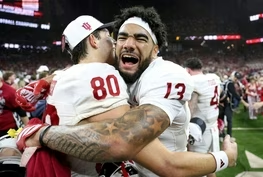
What to watch as Indiana and Miami face off for championship
Video has Closed Captions
Clip: 1/16/2026 | 6m 20s | What to watch as Indiana and Miami face off for college football's championship (6m 20s)
Providing Support for PBS.org
Learn Moreabout PBS online sponsorship
- News and Public Affairs

FRONTLINE is investigative journalism that questions, explains and changes our world.

- News and Public Affairs

Amanpour and Company features conversations with leaders and decision makers.












Support for PBS provided by:
Major corporate funding for the PBS News Hour is provided by BDO, BNSF, Consumer Cellular, American Cruise Lines, and Raymond James. Funding for the PBS NewsHour Weekend is provided by...