
Georgia State Railroad Museum, Hour 3
Season 30 Episode 6 | 52m 26sVideo has Closed Captions
Travel with ROADSHOW to historic Savannah and learn about intriguing Georgia discoveries.
Travel with ROADSHOW to historic Savannah, GA and learn the stories behind intriguing discoveries. Which artistic treasure is $85K-$95K?
Problems playing video? | Closed Captioning Feedback
Problems playing video? | Closed Captioning Feedback
Funding for ANTIQUES ROADSHOW is provided by Ancestry and American Cruise Lines. Additional funding is provided by public television viewers.
Support provided by:


Georgia State Railroad Museum, Hour 3
Season 30 Episode 6 | 52m 26sVideo has Closed Captions
Travel with ROADSHOW to historic Savannah, GA and learn the stories behind intriguing discoveries. Which artistic treasure is $85K-$95K?
Problems playing video? | Closed Captioning Feedback
How to Watch Antiques Roadshow
Antiques Roadshow is available to stream on pbs.org and the free PBS App, available on iPhone, Apple TV, Android TV, Android smartphones, Amazon Fire TV, Amazon Fire Tablet, Roku, Samsung Smart TV, and Vizio.
Buy Now

ANTIQUES ROADSHOW's 2026 Production Tour
Enter now for a chance to win a pair of free tickets to one of the three stops on ANTIQUES ROADSHOW's 2026 Tour. Sweepstakes entry deadline is April 6.Providing Support for PBS.org
Learn Moreabout PBS online sponsorship♪ ♪ CORAL PEÑA: All aboard for "Antiques Roadshow's" stop at the Georgia State Railroad Museum.
GUEST: I just like the color.
It matches a lot of my outfits.
(both laugh) It does.
APPRAISER: It's definitely a category where they're guilty until proven innocent.
♪ ♪ PEÑA: The Georgia State Railroad Museum is a hub of activity today, as "Roadshow" welcomes thousands for a free appraisal of their treasures.
The museum interprets more than a century's worth of Savannah railroad history, from 1853 to 1963.
The collection includes engines, passenger cars, and iconic cabooses.
"Roadshow" is definitely on track to finding a rail car full of treasures.
♪ ♪ We paid ten dollars for it at a flea market.
I'm in the medical field, and so I just thought it was interesting.
Seems like an item you can really sink your teeth into.
(laughs) It's a Gibson pedal steel guitar.
I think it was made maybe in the '50s, early-middle '50s.
It belonged to my uncle.
He used to play it in honky-tonks up in New York, near Buffalo, but he traded it to my dad for a cow, so my dad's had it since the late '60s.
My dad used to play it all the time.
I told my wife-- she got us on the show, and I said, "I got the exact thing I'm taking."
I brought an original Howard Finster piece that I purchased in 1993 when I visited Paradise Gardens in Summerville, Georgia.
I was a high school art teacher, and I was bringing my students for the day to walk around.
And at the time, they didn't charge you admission.
You could just walk around.
And I was told that sometimes he'd be in the shop, and you could get him to sign pieces.
And I happened to look out that day.
He was there.
I saw him sitting in the rocking chair.
He was very engaging, and he talked for a really long time and he let us take a lot of pictures and he signed our pieces that we bought.
Finster was born in 1916, and he pretty much had a religious life.
Early on, he had a Baptist radio show.
Oh, I didn't know that.
Uh, in the '30s and the '40s.
He started to create art, and this garden became a, a destination for a lot of people that loved what at that time, and still to this day, they call "outsider art."
Mm-hmm.
He operated outside the boundaries of the normal art world.
In the 1980s, he did an album cover for R.E.M.
and an album cover, a great one, for Talking Heads.
Mm-hmm.
And that's what put him on the, on the map.
And then everyone started to come to the garden.
And was the garden just, like, overflowing with artwork?
Yes, everywhere you turned.
He turned anything he could grab into art.
There were piles of bicycles, what people would call junk.
When you read about Paradise Garden, sometimes the account is, there were over 40,000 pieces of art that were installed there.
It was everywhere.
It's, it's mind-blowing.
Mm-hmm.
It really is-- so this is a wonderful little house.
He used very light wood, it's almost like balsa wood.
It took paint easy, and he used paint, and in this case, he used glitter, which is kind of nice.
Mm-hmm.
And a magic marker.
And on the back, it's dated when you bought it, in March of 1993.
And it has biblical sayings on it.
"Set thy house in order."
"Kingdoms divided cannot stand."
"Families who pray together stay together."
It's signed on the bottom, "To Evelyn."
Mm-hmm.
So he personalized it.
In the back, we see a priced tag.
Yes.
And how much was that?
$35.
And you didn't ask for a discount?
No.
(both laugh) We weren't allowed to.
There was a little sign that said "priced as marked."
(laughs) Ah, okay.
He's had a bit of a resurgence and there are a lot of new collectors that want a piece of his work.
I think people are familiar with his angels... Yes.
...and his Coca-Cola bottles.
Yes.
So I'm going to say, in a retail setting, I feel comfortable placing a value on this somewhere between $4,000 and $5,000.
Wow.
(laughs) I'm-- everybody says wow, but wow!
(both laugh) I had no clue.
My, my family's made fun of me for years with this, that ugly piece of art that I've had on a shelf.
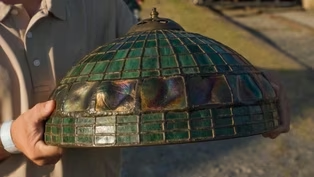
We believe it's around a 1930s Tiffany lamp.
It was my wife's great-grandfather's.
On the actual base of the lamp, there are Tiffany logos.
There is a marking somewhere on here.
While it is a Tiffany Studios pattern, it's not.
It is not.
Okay.
It is not a Tiffany Studios lamps, for a number of reasons.
Okay.
The construction, for number one.
They're very good facsimiles of what we call turtleback... Okay.
...turtleback glass.
But it's not Tiffany.
And I go like this.
These are tight as a drum.
The originals are loose.
The other thing that I noticed, they would never sign this part.
Decoratively, I would still say maybe $2,000 to $3,000, something along those lines.
If this were real, it would have been probably around $100,000.
My wife still loves it, so it'll still go in that... It's beautiful!
I just love turtlebacks.
I think they're one of the great types of glass that Tiffany made.
This was a gift to me several decades ago... Mm-hmm.
...from an old beau.
Our relationship didn't last, and I got to keep the bag.
It was a lovely gift-- I have used it on occasion.
I do think it's Tiffany... Mm-hmm.
But I, I'm not sure.
Okay, well, your bag is Tiffany-- it's marked on the inside-- and it's circa 1910, maybe 1915, and it is gold and platinum.
The lighter-color stripes are platinum... Wow!
...there's a lot of beautiful chased work on the frame, and in the center, you have a group of demantoid garnets and diamonds.
Inside, there's a small chain-- at one point, the bag had a little change purse that was attached, but that's missing now.
The chain handle is also gold.
Wow.
The retail value on this beautiful bag would be between $20,000 and $22,000.
No way.
Way.
Oh, my God!
(laughing) I had estimated maybe $3,500 just because of the gold.
Uh-huh.
And the, uh, cost of gold today.
Yep.
But I had no idea.
Yeah, it's over eight ounces of gold.
Wow.
If it were to be melted, scrapped, it would still be worth $19,000, um, gold weight.
In, just in gold.
Yeah.
It's not a very popular style anymore, so it's not a quick seller.
Otherwise, there would be more of a difference between the gold value and the retail value.
Thank you.
You're welcome.
Thank you.
Yay!
It's a beautiful bag.
It really is.
It is.
And I've enjoyed it... Yeah.
...when I've taken it fancy places.
PEÑA: The Georgia State Railroad Museum is a place with a long industrial history.
The Central Georgia Railroad had its repair facility at this location.
Much of these facilities were built in 1855 and it continued operating as a steam locomotive repair facility all the way to 1963.
The steam locomotive repair facilities, their entire purpose was to provide the routine maintenance and major repair work for, specifically, steam locomotives.
It was Savannah's largest employer for many years.
They were able to have everything that they needed to repair and maintain steam locomotives all in one location.
GUEST: These belonged to my great-grandfather.
He lived in Leicester in England, and as a child, I used to go visit him, and he had a house full of antiques.
When he passed away in 1973, my mother inherited them.
My parents emigrated to the United States in the '70s, and in one of their moves, these got lost.
She just passed away this last year, and we found them in a storage unit in November.
So your mother passed away thinking that these were forever lost... Yes.
...and she would never see them again.
Yes.
And they were in a box labeled "kitchen utensils."
What do you think these are?
When I was growing up, they were always referred to as the Sèvres vases.
The Sèvres factory started in 1740, and in 1756, they moved to Sèvres, which is on the outskirts of Paris.
These are very typical of what we would expect Sèvres porcelain to look like, especially if we look at the hand-painted designs.
The raised gilding, the ram's head handles is very typical of Sèvres porcelain.
So when we look at what we think might be Sèvres porcelain, we have to look at all kinds of things.
When I see a Sèvres mark, uh, they're almost always fake.
In fact, I would say 99% of the Sèvres marks that I see on porcelain or pottery are actually fake marks.
Oh, wow.
So it's definitely a category where it's, they're guilty until proven innocent.
So the quality of the painting is quite nice.
If we turn it, we see on the backside there is another scene, a pastoral scene of, a landscape, with trees and so forth.
The one near you is a little wobbly.
Right.
And because it's a little wobbly, I don't want to spin it.
Okay.
It, it might be a little precarious, but the back scene is very similar, complementary, but different.
If we turn it over, we do see a hand-painted Sèvres mark, but we can see that this is actually made of pottery and not soft-paste porcelain.
Ah.
So even though there are other things that might suggest that these could be authentic Sèvres, Sèvres didn't do pottery.
Right.
So, bam.
They, sadly, were not made by Sèvres.
Okay.
So these are antique, hand-painted pottery Sèvres-style urns.
I would guess that they are late 19th century.
They could be early 20th century.
Who made them?
Don't know.
I'm gonna guess that they are British.
Okay.
But they could be French.
Both lids have damages.
This lid has, like, five chips on it, and there's a little bit of gold wear.
So with damages, I would think a retail value for the pair might be in the range of $400 to $600.
Okay.
Lovely.
Yeah.
Thank you.
GUEST: I had purchased it a couple years ago from Wayne Kline estates, and didn't know much about it, but I heard about the artist, which is Beverly Buchanan, and I know she was a well-known artist, so I decided I would purchase it.
I know she was a Black artist.
It was from, uh... Wayne Kline estate.
He was the printer.
The printer.
Yes.
Right.
This is a color lithograph by Beverly Buchanan, and it's called "Happy Shack," from 1987.
Beverly Buchanan was born on October 8, 1940, and she died at the age of 74 in 2015.
She is not known as a printmaker, so it's really exciting to see a work of Beverly Buchanan in this form, as a color lithograph.
I can see it's Beverly Buchanan right away, because of what she's depicted here.
The shack.
Exactly, these shacks.
She grew up in the South, and she saw houses like this in the South.
She was a scientist, and she worked in public health in New York and New Jersey before becoming an artist.
And when she started to work as an artist, she always went to this image, the images of these shacks.
But she's probably best known for doing sculpture, little models out of painted card... Mm-hmm.
...and wood that r, represent these shacks.
So this was exciting, to see a big color lithograph by Beverly Buchanan, and it's signed by the artist.
It's annotated artist's proof, with a number.
And it comes from an edition.
There was an edition of 50 of these made, and then typically, there's a certain number of artist's proofs that are set aside.
And some are often kept by the printer.
So that's why, when you went to this estate, the printer's estate, they had this still.
That was sometimes a way to pay the printer-- they got to keep some of the prints.
And the colors are super-bright.
Each of the colors in a color lithograph is printed separately, they overlap, so it's almost like a stacking of all these colors to arrive at this image.
As far as I know, this is the only lithograph she made.
But it's in a number of museums.
But this has also never come to auction before.
I couldn't find any auction results.
What did you purchase it for?
I purchased for about $500, because, like I said, I liked the color in it, and I knew she was a Black artist.
Yes.
And that she had passed away, and I knew that one day, it would be worth money.
I would estimate it at $5,000 to $7,000.
And I would be not surprised if it sold for much more.
It would have a lot of interest at auction.
Okay, wow.
Good to know.
I would insure it for at least $10,000.
This is what I believe to be a late-16th-century halberd, I think from Germany.
I bought it about ten years ago on an auction site in, uh, London.
It's hung on my wall for so many years, and I thought it would be the perfect thing to bring to "Roadshow," just because of just how unique and cool it is.
I paid, I think, around, like, $800, so no small sum, but hoping to get good news today.
This is our family violin, and it's been handed down to Madison, so it's now hers.
It's been in the family since the 1800s.
PRODUCER: Do you all play violin?
No.
We do not.
We're hoping Madison will.
(laughs) GUEST: This was my mother's.
My mom and dad had moved from Detroit down to Colorado Springs, and they fell in love with the Southwest.
And Mom got into collecting turquoise and Indian jewelry.
And this is Navajo, but she had also Hopi and Zuni and... Mm-hmm.
Usually got the pieces in S, uh, Santa Fe or Taos.
I was probably in middle school... Okay.
...when she got this, so I don't really know what she paid.
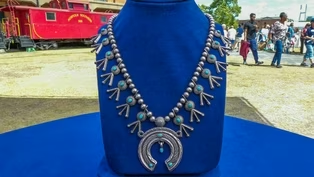
You have a Navajo squash blossom necklace here.
It's made out of silver and turquoise.
It dates to about 1930.
This was probably made for the trade.
Mm-hmm.
During the first half of the 20th century, there was a heavy tourism through S, in Santa Fe, in the Southwest, because of the railroad system.
Mm-hmm.
The naja in the center is a Spanish design that was adapted by Native peoples in the Southwest and Plains.
The original form was used on horse bridles, and it would have been on the center of the brow band, and then it was later adopted into the squash blossom necklace.
The squash blossoms are the little pendants along the side here.
These are very stylized ones.
Typically, they're a ball bead that flares out.
Your beads are handmade beads.
So they made the beads in two parts, and if you look at 'em really closely, you'll see that the metal points outward.
So they would dome them and make them in two parts, and then punch 'em from the inside-- you see the seam-- and then they were welded together.
The naja is a hammered technique.
It's a more traditional silver technique.
Any idea on its value?
In 2021, my brother, little brother, got a verbal, just somewhere around $2,000.
So at auction, I would expect this to sell in the $2,000 to $4,000 range.
Mm-hmm.
If you were to insure it... Mm-hmm?
...I would insure it for, in the $5,000 to $6,000 range.
$5,000 to $6,000, okay.
It's a lovely, lovely early example.
Okay, all right-- thank you.
My mother had two bishops... (chuckling): ...as her grandfathers, and their children went to China as missionaries around the turn of the last century.
They s, s, married and set up a household in China.
Every day, my grandmother and her sister walked to the market and they passed a Chinese antiquities dealer.
They wanted a Ming vase, and we are told this is a Ming vase, reportedly.
Mm-hmm.
And after about five or six years, they wore the gentleman down, and they bought their Ming vase.
How long have you lived with this?
About 25 years-- I inherited it in 1999.
Okay, about the turn... What city were they in?
They were in Shanghai.
This was probably purchased in about 1920.
It's kind of a pear shape.
In the bulbous part of the body, there's a mask, and that's called a taotie mask, T-A-O-T-I-E.
So it's liter, literally, a monster mask.
And that's something that was characteristic of ancient Chinese bronze ritual vessels.
When I say ancient, we're talking about archaic vessels from a very early period of time, roughly around 1000 B.C.
Around the neck, there is a very complicated design.
It's kind of a wave form.
Mm-hmm.
It's referencing ancient Chinese jade carvings.
And on the foot, you'll see this grid-like pattern.
Mm-hmm.
Which is something that would have been seen on ancient Chinese ritual bronze vessels of a much earlier date than the Ming Dynasty.
It's a reasonable assumption to be able to say this is from the Ming Dynasty.
It's very possible, with additional research, that it might be something that we could actually push back to an earlier date.
On the inside here... Mm-hmm.
...on the wall, what do you see?
It looks like it's been repaired.
It looks like a break mark in the surface.
It does.
And then, as I turn this, on the outside, it's a jagged patch.
If I violently knocked this off, and it fell onto a stone floor, and it happened to have a handle that was a curved handle... Oh, God.
...starting here.
It knocked the handle off.
One would expect at auction this to realize somewhere in the $5,000 to $8,000 range.
Okay-- that's what my wife said.
So there you go.
(both laugh) So... It wasn't my $50,000 that I wanted.
Well, that's wonderful-- it's excellent.
My grandmother owned a retail furniture store.
I think it may be a chair she bought that reminded her of the antique chair that she knew growing up.
So I came to find out how old this might be.
Excellent, and where was your grandmother from?
Uh, Titusville, Florida.
So, the great-grandmother lived there with five sisters, and the story was that each sister had a chair like this.
When they got married and moved away, they took the chair with them.
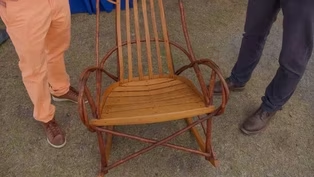
It's a great what, sort of what we call a, a twig-form Adirondack chair, made of some bent hardwood-- this looks like a combination of ash and oak-- and interwoven twig branches, which is absolutely killer.
I, I love Adirondack camp furniture.
This to me feels like it does have some age.
This is probably 1920s to 1950s.
It's got good color, good form, great condition.
And if this were to come to auction today, I would put an estimate of $500 to $1,000.
Do you guys use it at all, or... It stayed in a garage for at least 20 years.
Stayed in a garage-- what?!
Yeah, yeah.
Oh, you got, you got to pull it out... Yeah.
...put it in a, a place of honor, and rock on it.
(laughs) There's nothing better than a good rocking chair.
Isn't that comfortable?
That's great, yes.
(laughs) GUEST: I believe it is a wedding bouquet holder that was given to my great-grandmother at her wedding in 1869.
It was found in the attic as we were cleaning out my father's estate.
You were the first one that showed me that those legs opened up.
(both chuckle) We've been s, scared to move it around too much.
So why do you think they open?
So that it could stand at the table at the wedding afterwards?
Yeah.
So do you know what these are called?
No.
Okay.
So they're referred to as a tussie-mussie.
Tussie-mussie, okay.
(chuckles): Yeah, it's quite a name.
So also a, like, a posy holder or a nosegay holder, made in the Victorian era.
So the dates of your, um, ancestor fit in perfectly.
Queen Victoria was on the throne, um, from 1837 to 1901.
But the form originated in the Middle Ages.
Really?
There were odors of the, of the day, so you would have a small bouquet mixed with flowers and herbs that you'd be able to have with you on your person at all times... Excellent.
...to rid the odors, and at the time, again, these sort of, you know, odors were thought to sort of carry disease.
So you protect yourself, but became really popular during the Victorian era, because Queen Victoria used one.
You'd hold it in your hand.
So there's a little ring here which you could put on your finger, or, women of the day would wear a chatelaine, which was, um, sort of a, a group of accoutrements that they'd wear from their, their belt or a sash.
Okay.
And there's also a pin to be able to pin it to your clothing.
And at the time, too, there was sort of this language of flower, silent language of flowers.
Okay.
So depending on what flowers were in the bouquet, it could have silent, a meaning.
Yes.
So you, you've brought a, a note... Yes.
...with you-- what is that?
The note is inscribed by my great-grandmother.
And we felt it was rather racy, saying that this was given to her on her wedding day by her "lover."
Yeah, and it's... Who was actually her husband.
Oh, good.
(both laughing) That was the question I had.
Would have been racier if it hadn't been her husband.
Absolutely.
Didn't see any markings on it.
It's made out of a filigree, fine wire of silver.
It's either silver or silver plate.
Value-wise, it's a funny item.
They're not usable in today's society as much.
My sense is at auction, you'd be looking in the $300 to $500 range.
Interesting.
For insurance purposes, you can see them online for upwards of $1,000.
Very good-- thank you so much.
Sure, yeah.
Learned a lot.
Well, this is a painting by Mr.
A. E. Backus.
Uh, he was a South Florida artist, and when I was, uh, growing up in Coral Gables, Florida, he would stop by our house in an old car and pull a painting out of the trunk and knock on our door and try to sell it to my father.
And sometimes he'd buy and sometimes he wouldn't.
And he would also tell Mr.
Backus what he would like in a painting for a future painting.
Well, I was very young at the time.
He just seemed like an older man when he came to our house.
He was just in love with his paintings.
When my dad passed away, I chose to get this painting, because it was different than other paintings I'd seen from Mr.
Backus, because it was not an Everglades scene.
It was a scene of a woman picking peas.
How many did he have in total by the artist?
He probably had about five or six paintings.
My brothers have a couple.
Do you have any idea what your father may have paid for this painting?
I think hundreds of dollars.
Not more than a few hundreds of dollars.
And approximately what time period would that have been?
Any idea about... In the '60s.
This is an oil-on-canvas painting by Albert Backus, also known as Beanie Backus.
He is really the best-known 20th-century painter of the Florida landscape.
He is known as the dean of Florida painters.
He, of course, is known for the wonderful landscapes of the Everglades.
Also, just Florida life in general.
He went on to be a real sort of mentor.
He would just host parties and bring artists together and created a real energy around that South Florida art market.
There's a very famous group of Florida artists, the Florida Highwaymen, or the Highwaymen.
They are really the best-known folk artist group of Florida artist.
Was 26 African American artists that he mentored.
The founders of that, Alfred Hair and Harold Newton, are the two best-known Florida Highwaymen, and they traveled around Florida a lot of times with paintings in their trunks of their cars, selling the colorful landscapes, and they were very influenced by Albert Backus.
Now, he was really self-taught, for the most part.
He did take some summer art classes.
This one is particularly interesting, because he had an unfortunate personal event in 1955, when his wife passed away, his wife of only five years.
And it really took a toll on him, and he went to spend some time in Jamaica.
And so he started painting some new subjects while he was there in Jamaica.
This painting is called "Shelling Gungo Peas."
That title is on the back, with the date of 1966.
You have a figure who is quietly sitting, and it kind of evokes that solitude that he may have felt after his wife passed away, and he went to spend some time in Jamaica.
His paintings have become quite popular, as have the paintings of the Florida Highwaymen.
We see them continuing to go up in value.
An auction estimate on this painting today I would say should be $15,000 to $25,000.
That's, that's quite a lot-- that's very nice.
Just looking at it in this light is beautiful, and, and brings back a lot of memories of my childhood and my father wanting these paintings.
I love it very much.
Just a minute.
(chuckles) An insurance value for this painting I would put at $35,000.
Okay, thank you very much.
PEÑA: This old iron horse is the Central of Georgia locomotive number 223.
The steam engine was manufactured in 1907 by Baldwin Locomotive Works of Pennsylvania.
It had a long run pulling freight cars and was traded to the Wrightsville and Tennille Railroad, but returned to Central of Georgia when it was retired in 1952.
Number 223 came to the museum in 1998, where it has undergone three restorations and is a centerpiece in the collection.
GUEST: The story that I received was that it was a relative of mine who is a great-great-great-uncle, and he was a prisoner of war.
He was a Confederate, was captured and sent to a place called Johnson's Island, on Lake Erie.
It was for officers, and they evidently had pretty much free rein, and were allowed pastimes like carving.
He made this while he was a prisoner there, and then presented it back home when he was released.
The gentleman was interned on Johnson's Island... Yes.
...which is a bit unusual within the Civil War prison system in the North.
This is an island off of Sandusky, Ohio... Yes.
...in Lake Erie.
They designed this in late 1861, opened it in very early 1862, and they were running it through the end of the war.
Of all those individuals to go through, about 200 passed on from exposure, disease, and the things that normally hurt people... Sure.
...during the war.
It was considerably nicer than most other Civil War prison situations.
The value that is associated with it, both decorative, historical, monetary, does not really change because it's Union- or Confederate-made.
It's, just simply, it's a piece of Civil War prison art, and they're all of considerable interest to people who collect that material.
This one is of considerably more interest, in my opinion, because of the beauty of the work.
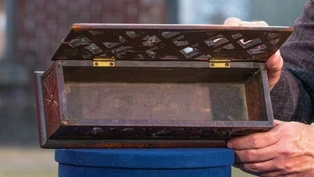
It's a nice openwork box.
You can see it's got the openwork details on the front and on the top, and just an absolutely gorgeous thing.
It seems to have seen happier centuries.
Yes.
It looks to me like your hinges may have been replaced, there are a couple of replacement nails, and somebody went wild with the wood glue down in there.
Much as we might have done something a little differently, that has kept it together.
And openwork like this is pretty fragile.
We've got a couple of cracks in here-- one right here, one right here from expansion.
But on the whole, there's nothing that, that threatens it structurally or aesthetically.
It's a beautiful piece.
You're looking at a piece that would have an auction estimate between $2,000 and $4,000.
Wow.
Okay.
Well, it's not for sale.
(laughs) Nope, it's going to stay in the family.
That's a little surprising to me.
So that's fantastic.
This is one of the most intricate and interesting Civil War pieces that I've ever run across.
I was in Florida at an antiques auction, in Palm Beach, Florida.
Purchased this vase there.
It was a, from a really nice estate.
When you were at the auction, did they give you any ideas of what it might be?
Uh, they s... Or you just liked the color?
I just liked the color.
(laughs) It matches a lot of my outfits.
(laughing) It does, you are correct.
It's rather fabulous.
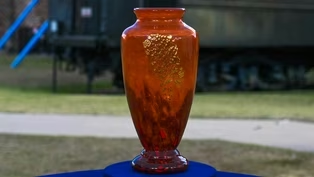
It's a large vase, very bright and colorful.
A glassblower would've taken the molten glass... Mm-hmm.
...and then rolled it into gold leaf.
As the flakes are inset within the glass, they start to melt.
Oh.
And then you get kind of those striations to it.
It's actually signed-- hard to see-- on the base here... Oh, okay.
And it's "Daum, Nancy, France."
Okay.
So you have a French vase made by Daum.
Are you familiar with the Daum manufactory?
I, I've heard of them, but most of the time, the pieces I've seen have been more of cameo-type glass.
Yes, yes.
I've never seen anything like this.
Mm-hmm.
Yeah, most people do think of them as cameo glass, and that's generally earlier.
And this was dur, done during the Art Deco period, so after the cameo.
Okay.
So you're, you're looking at around 1920s for this vase.
Oh, okay.
So, what's great about this is, it's an unusually large size.
In the marketplace, generally, we see them smaller... Oh, okay.
...come up.
What did you pay, may I ask?
Uh, $400.
That's a decent price.
Right.
I think it's worth a little bit more in today's market.
Oh, okay-- okay.
Um, when was that?
How long ago was that?
It was, I want to say two or three years ago.
Mm-hmm, mm-hmm.
Okay, okay-- if this were to come to auction today, I would say it would bring between $1,000 and $1,500.
Great!
So you did well.
I did-- thank you.
Good eye.
I love it.
These are some, uh, Rawlings baseballs from the World Series that never was because of the baseball strike.
It was 1994, and we were reps for Rawlings at the time, and they got the instructions to destroy the baseballs.
Management gave us, all the reps, uh, a box of, uh, the World Series baseballs, and we have a few left, and one's signed by Terry Pendleton.
This is a piece that I saw in an online auction during the pandemic.
This is a bowl, so that is the lid, and I believe it's a medicine bowl.
I paid $400 for it.
The shipping was actually more than the bowl.
(laughs) GUEST: This was a gift to my husband from his grandmother.
She worked for American Smelting and Refinery.
When metals came in from whatever wreck, they would analyze them.
They were working on it, and they kind of grabbed pieces, I guess, and, and she wrote all the notes on it.
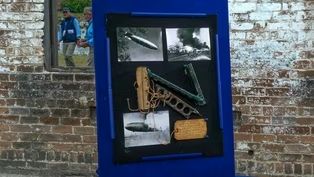
May 6, 1937, that was the day that the Hindenburg came into Lakehurst and... Mm-hmm.
...was circling for a landing.
And from accounts that were eyewitness accounts, it seems that they saw some sort of flapping in the skin of the ship first.
Apparently, a gas leak was taking place.
They think static electricity hit that, and it wound up killing 36 people.
Ship went down in flames in a field in Lakehurst, and these are some of the remains.
They did an investigation, Germany and the United States.
Mm-hmm.
A lot of the pieces were reclaimed to Germany.
People were on the fields just grabbing souvenirs.
Pretty terrible, but that's what was happening.
Mm-hmm.
Yeah.
And it really knocked the faith in, in air travel down for Americans and for people around the world.
So what you have on the board here is three reproduction photos.
And it shows the zeppelin before anything happened, circling.
You can see where it combusts, starts the fire.
And on the ground here, you can see the flames and the debris.
You have some ribbing struts, interior portions of the Hindenburg, which are large portions, including some of the canvas.
Not the exterior canvas, but interior.
You would think, in a, in a inferno, those would have been destroyed.
It's an unusual-sized piece and -shaped piece.
At auction, I would put an estimate on this conservatively at $3,000 to $5,000, for the, for the piece.
Whoa.
(laughs) Yeah, yeah-- yeah.
That's crazy!
Sounds crazy... Yeah.
...but people are really hot on buying pieces like this.
Um, anything related to history.
Yeah?
And this is pure history.
Nice.
Pure history, yeah.
Yeah.
It's so crazy, we just threw it in the closet.
There you go.
(laughs) Well, the closet-- closet was a good safe place to keep it.
Yeah.
I have brought in a letter that was written by my husband's great-grandfather.
He was in the Ford Theatre when Lincoln was shot.
And that next day, he wrote a, uh, detailed account of the shooting to his sister Hattie.
And it's been passed down.
At one point, it was tacked up to some high school bulletin boards, and they realized, "Oh, it might be too precious for that."
It is an eyewitness account of Lincoln's assassination at Ford's Theatre on the night of April 14, 1865.
And we actually know it's written in the evening of April 15, because he mentions that Lincoln has already died.
He's, he's shot the night before, and he lingers the next day, but then he dies about 7:30.
It's really well-written, it's really vivid.
I'll read just the first paragraph to you.
Okay, yep.
"Dear Hattie, I'm too excited and nervous "to write or compose a letter after having witnessed "and been subject to the shock "of the most horrible and atrocious murder "history records.
"You will probably receive the painful intelligence, "ere this reaches you, "of the murder of President Lincoln and the attempted assassination of Secretary Seward."
Yes.
Have you ever noticed anything weird about this letter?
I, I didn't.
He doesn't know who did it.
(gasps) That's true.
He doesn't mention Booth.
He doesn't.
He doesn't know yet.
No, you're right.
Right?
He talks about the "dastardly character"... ...acter... ...who, "who did this terrible deed"... Right.
...but he doesn't know his name yet.
Right.
Other people knew it.
I mean, it really is as, as if... Sure.
...a teen idol assassinated the president.
Like, Booth was famous and handsome and a stage star.
Right.
But, so people in the theater saw him... Oh.
...but it wasn't public knowledge yet.
Oh, wow.
And he didn't know.
Right.
He didn't recognize him when he ran across the stage.
Huh.
And then he sort of closes with the shock that you would, one would feel after... Right, right, for witnessing that.
...a really terrible nati, national disaster.
Yeah.
A letter like this sort of breaks a lot of the rules of manuscript collecting, because usually, the first thing we ask is, "Who's the author?
Who signed it?"
Right?
Right.
This is a letter where content trumps everything else.
Mm.
A few letters in the past couple of years of eyewitness accounts have sold... Yeah.
...but they were written by s, somebody who was at the theater across the street, and came out and saw Lincoln get carried... Oh, I see.
Wasn't in the theater.
Uh-huh.
Or it was written ten days after the assassination, not right when he learned that Lincoln had died.
Oh, I see, yeah.
So there's a real immediacy here.
I would put an auction estimate of $20,000 to $30,000 on it.
Wow.
And it probably would blow way past that.
Wow!
I would suggest that you insure it at $40,000.
Okay.
(chuckles) We were thinking a couple hundred dollars.
No-- it's amazing.
We're very surprised.
This is a clock I got from my uncle after he passed away.
He went to flea markets and garage sales.
We rented a limousine and put it in the back, with all three seats down.
It's seven-and-a-half feet tall.
It's a sculpture.
PRODUCER: How much did you have to pay for it?
About $30.
And it says 1991.
(slowly): A Michael Ganman?
I've never heard of him, so I don't know.
I brought a sweatshirt-- it was my dad's.
He got it at an Ozzy concert in San Bernardino in 1982.
You've seen your dad wear this?
'Cause look how tiny it is!
Yeah.
(laughs) Like, he was a small dude!
He got that when he was 15, so it's been a while.
Okay, fair enough.
(laughs) Can't fit in it anymore.
Probably not.
You ever rock the sweatshirt?
I used to wear it a ton, but not recently.
Very cool.
So, obviously, as blatant as it is on the front, yes... Yes.
This is a concert sweatshirt for Ozzy Osbourne.
Mm-hmm.
Really interesting when we look at the graphic on the back.
You'll see "Blizzard of '82."
The "Blizzard of Ozz" tour was actually 1980 to 1981.
Mm-hmm.
Didn't happen in 1982.
Mm-hmm.
1982 was "Diary of a Madman."
Mm-hmm.
So, that makes the question how did this sweatshirt come into fruition?
We are confident that this is actually a parking lot bootleg... (laughs) ...of a sweatshirt-- correct.
So when you look at the graphic, there's no licensing.
There's nothing that says, like, "Official property," with the year for a record label.
Mm-hmm.
This sweatshirt is actually more desirable because it is a bootleg.
It would have had an extremely low production.
Conservatively, at auction, this would be a $400 to $600 sweatshirt today.
Wow, that's really surprising.
(chuckles) I bought this piece back in about 1985 in Athens, Georgia, at a thrift shop.
Do you know where it's from?
No-- I don't know anything about who made it or, you know, what part of the country, or anything.
It's from the Great Lakes area.
It's made by the Chippewa Indians.
In Canada, they're referred to as the Ojibwe, and they refer to themselves as the Anishinaabe, the people who were the original ones of that area.
It's one of the largest tribes in North America and Canada.
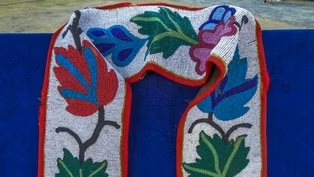
This is called a bandolier bag, made by a woman.
A man would wear this across his shoulder, along his side.
Anybody who saw that man wearing this would instantly know his tribal affiliation.
And the man would put all sorts of things in the pouch: fire-making materials, maybe potions to keep him safe.
The woman who made this had a, a certain brilliance for design.
The color combinations are exceptional.
Do you know where the beads are from?
No.
Venice, Italy.
Are you serious?
(chuckling) And all of these cloths were imported from Europe.
You have all this white background in what's called lane stitch, and they're just laying down horizontal lines.
But notice the pattern on the flowers.
It's all what's called contour beading.
This is not the first bandolier bag that she made.
Yeah?
This is special.
We can date this in a variety of ways.
The beads, particularly these clear beads, came into, uh, the Great Lakes region around 1880, 1890.
The floral arrangements have developed from very abstract forms to figurative forms, and that, too, helps date it.
Maybe right around 1880, 1890.
These geometric patterns going up and down the sides and across the top, those are called patterns of power.
And in abstract form, they replicate the footprints or patterns of an otter trail.
Otters are very special creatures, because they inhabit two domains, both the underwater world and the land world, and that was considered quite special.
So this is a protective design, empowering the person who's wearing this.
And then all of these floral elements, they're not just decorative flowers, they're representations of herbal healing power.
So there's a lot of symbolism going on here.
This bandolier was longer at one time, and the lady reduced the size by maybe eight or ten inches.
At some point, it got passed on, perhaps to a smaller person.
And it, that kind of suggests how much it was a treasured object.
It wasn't going to be discarded.
It wasn't going to be packed away.
Do you recall what you paid for it?
I think I paid about $30.
I think on a retail basis today, this would sell for about $1,800.
Okay, okay.
Yeah.
Thank you!
And, and if you were insuring it, maybe about $2,400.
Okay.
I love it.
Oh, I do, too-- thank you very much.
(chuckles) TERRY KOLLER: This caboose was built by the Central of Georgia Railroad.
It was one of many cabooses that they built in this series.
This caboose was built in the 1930s and was in service into the 1950s.
The caboose had many functions on the train.
It was the break room for the crew, it was the kitchen, it was the bathroom.
There's always a spot on the caboose where the crew could watch the train in front of them to see if there were any problems.
And the most common question is, why is it red?
The answer is for safety and visibility.
GUEST: I found it on an auction site.
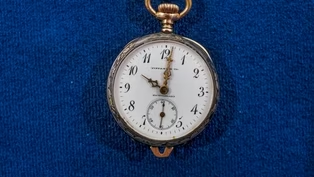
It's marked Tiffany and Co., and that it was made by Longines for Tiffany and Co.
And I thought, "Let me grab that real quick," 'cause it was priced super-low.
And I get the thing in the mail, and I, I see that it has someone's name written on it, Mary Corbit Warner's name.
And she lived in Odessa.
Where's Odessa?
Uh, it's in Delaware.
It's, uh, called, uh, the Sharp-Warner House, I believe, in Odessa?
Okay.
That she had given to the state of Odessa.
When I was, uh, reading more and more about it, her family just became so interesting.
I guess they'd hid a slave there from the Underground Railroad.
I followed up on your story, and the Corbit House is a famous house.
It's a museum now in Odessa, and it's actually a National Historic Site.
Mm.
The story about the Underground Railroad is also correct.
So this is by Tiffany and Company.
They've been around since 1835, very prominent designer company in New York.
It's sterling silver with niello.
And what they did was, they would engrave the silver out and put this material, niello, in there, and they'd bake it on there... Mm.
...to give it this beautiful look.
So I opened it up and I saw the signature in there, the Mary Corbit Warner, and it's dated 1911.
However, I do believe that the watch is from the late 1800s.
So it also comes with this chain.
It is original to the era.
I don't n, necessarily know that it's Tiffany.
There's no marks on that indicating that.
Mm-hmm.
It's gold-filled.
Okay.
Meaning it's covered in gold-- basically, gold-plated.
Still in great condition, and it has this nice little opal set in the slider there.
Can you tell me what you paid for it?
$360.
How much do you think it's worth?
Oh, goodness.
(chuckles) I would imagine maybe $600?
I believe that, in a retail environment, it would sell for around $2,000.
Yay!
(laughs) I would hug you-- I, like, I don't know if... But yeah, I would, I would hug you.
In a minute.
In a minute, I'm gonna jump over the table and hug you.
(chuckling) That's awesome.
GUEST: I went to law school at Emory University in Atlanta, and every spring, a group would go to a Braves game.
And it just so happened we chose the Braves game where Hank Aaron broke Babe Ruth's home run record.
After he hit the home run, the ushers passed out a certificate to prove that you were there.
I stapled, uh, my ticket stub to it, and a short time later, I was able to send it to Hank Aaron to get him to autograph it.
I think you're the first person I've ever met that was there, actually there that day.
What can you tell me about that game, about, about the atmosphere?
It was early April.
The weather was not good.
I'm not sure they would have played the game but for the chance to break the record.
So it was a sold-out stadium, but cold and cloudy.
When he came up to bat, everybody was standing.
And when he hit the ball, you knew it had a real chance.
Mm-hmm.
So you're just waiting for it to go.
Mm-hmm.
So, like, the, the emotion built as the ball went out.
Yeah, waiting for it to clear that fence.
Yep, clear that fence.
After he hit the home run, the stadium basically cleared out because of the weather.
So with your certificate here, you've neatly handwritten the event, as the certificates were issued blank.
And then you have your ticket stub that you kept from that date.
And then the nice Hank Aaron signature he was k, so kind as to sign and send back to you, there, lower center.
So your certificate, can you read for me what it says?
"I was there when Hank Aaron hit his 715th career home run "to pass Babe Ruth as the top home run hitter "in the history of baseball.
April 8, 1974, Atlanta Stadium."
And then he ended up hitting another, another 40 home runs to finish at 755 home runs for his career.
And Aaron's lengthy career, he started in 1954 and played through 1976.
Aaron had many obstacles to break Babe Ruth's record, including the hate mail and the death threats that he received as he was on this journey to be the home run king.
And then he holds on to that record until Barry Bonds came along, dethroned him as the home run king by breaking that record on August 7 of 2007.
Have you ever had it evaluated before?
No.
Okay, yeah.
It's the first time I've had it looked at.
Yeah.
Well, you did, it was a wonderful thing you did to keep the stub and to send it off for an autograph.
And I can tell you that that autograph is authentic, which you don't always know when you send off a request by mail.
It's true.
There are situations where there are secretarial signatures or other non-malicious, uh, copies, but in this case, I can confirm the signature is authentic.
Great.
I was surprised that there weren't more of these certificates that have come to auction, considering it was reported as a sellout, at 53,775 people.
But who knows, by the time they handed the certificates out, who knows how many people were still there if the weather was, was poor?
Yeah.
I would put an estimate on that at auction at $2,000 to $2,500.
Wow.
Amazing.
But I'm keeping it.
I don't blame you.
I got these G.I.
Joes for Christmas when I was about 11 years old, so that'd have been about 1967 or so.
Camouflaged uniform, fatigues from Vietnam, the Marine uniform, World War II uniform, snowshoes, white helmet, white boots, radio, an old-timey World War II hat, what's left of a flamethrower that I, that I used to have.
The flamethrower that went with that.
The snow parkas, two machine guns, all kinds of rifles, a little .45-caliber handgun.
And for the snow guys, I got their ice picks.
Just a collection of stuff that I've saved for over the years.
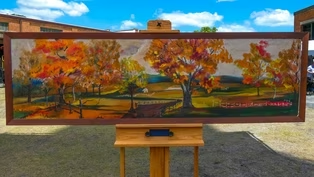
GUEST: This painting was done for my dad, Harold Olson.
He played football with Ernie Barnes, um, in the '60s.
They played for the Denver Broncos.
And they became friends.
And when they would go away for games, they were roommates and things.
He would come over for lunch a lot, and my mom would fix food and fix sandwiches and things.
And they had a place in their living room, it was a big empty wall space.
And my dad said, "Hey, Ernie, can you paint me a painting?"
And, um, he said, "Sure."
And this is what he came up with.
From what I was told, um, Mr.
Barnes was from North Carolina and Dad was from South Carolina.
So they bonded that way.
But they were just really good friends.
And this was just something that a friend gave a friend.
Oh, excellent, excellent-- that's a beautiful example.
And it's very unusual, because Ernie is famous for his paintings of football players, basketball players, party scenes, and so on.
Uh, this is the first time I've seen a landscape painting by Ernie.
Ernie Barnes was born in 1938 in North Carolina.
He died in 2009.
He's an African American artist.
As early as elementary school, he showed talent and promise.
Uh, he actually excelled at art in high school, and he was a art major in college.
He was a, a lineman for the, uh, Denver Broncos.
And I think your dad was, too, right?
Didn't his, uh, wasn't he an offensive lineman?
Yes.
Yeah.
So they both were on the offensive line together.
For me, it's an interesting contrast to see... The game itself is known as a, kind of a violent game, with all these collisions, and yet, at the same time, he's this painter.
And even throughout the entire time he was playing, he was still painting.
And I was reading that he was making more money selling his paintings than he was playing football.
Here we have, like, this serene landscape, probably in the fall, based on the colors, which I think shows a whole nother side of him.
It's an oil on board.
It's six feet by two feet, and it's signed by him right there.
Just "Ernie."
Normally, he would sign it "Ernie Barnes."
Right, right.
But this is an early painting.
Right.
This was painted, I want to say, in the '60s.
And I asked my dad one time, "How long did it take?"
He said, "About a month."
Oh, okay.
There's a photograph of you as a child.
Right.
Can, tell us about that.
Sure, that was taken in 1964.
And it was the painting in the background.
And the sofa, that was the place that Mother wanted the painting.
And I just remember laying on the sofa looking up at this painting, and it was just so serene and so peaceful, because this was not, definitely not something you would see in Colorado.
It's unusual, so that it's hard to come up with a comparable, but I think I would put a, an auction estimate on this of anywhere between $85,000 and $95,000.
Wow, okay.
PEÑA: And now it's time for the "Roadshow" Feedback Booth.
We came hoping that our picture would break the bank... But instead, I broke the glass in our print.
(chuckling) We... (imitates sad trombone) We still had fun.
Thanks to "Antiques Roadshow."
And this is my mom's candy dish.
My sister was going to put it in a garage sale, but I told her no.
Jackie, guess what, it's worth at least $100.
I brought my whole Garfield collection.
And here at "Antiques Roadshow," Garfield is at large.
And I brought my granddad's Buffalo Soldier patch from the 19, uh, '40s.
Uh, he served in Italy during World War II.
It's not worth very much, uh, pricewise, but I'm very proud of my granddad and the Greatest Generation and his history.
We brought my mother's ring that, um, she passed on to me, and my sisters told me it was fake.
But we found out today that this is not fake, this is a real, genuine sapphire, and it's worth between $5,000 and $8,000.
Whoo!
So there you go, sisters.
(chuckles) Woo-hoo!
We have the mask from the "Perry Mason" show, but when it came to value, we got no dough.
(laughs) We have this painting that she bought from... Where did you buy this?
At a yard sale.
Yeah, and... And I thought it was a great, surreal painting.
And, apparently, it's just great to me.
(chuckles) But we still love it.
And also... Oh, this, Which are also not worth anything, but they make me beautiful.
(chuckles) PEÑA: Thanks for watching.
See you next time on "Antiques Roadshow."
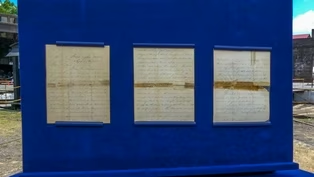
Appraisal: 1865 Eyewitness Account of Lincoln Assassination
Video has Closed Captions
Clip: S30 Ep6 | 2m 58s | Appraisal: 1865 Eyewitness Account of Lincoln Assassination (2m 58s)
Appraisal: 1937 Hindenburg Airship Fragments
Video has Closed Captions
Clip: S30 Ep6 | 2m 8s | Appraisal: 1937 Hindenburg Airship Fragments (2m 8s)
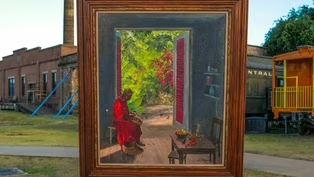
Appraisal: 1966 A.E. Backus "Shelling Gungo Peas" Oil Painting
Video has Closed Captions
Clip: S30 Ep6 | 3m 22s | Appraisal: 1966 A.E. Backus "Shelling Gungo Peas" Oil Painting (3m 22s)
Appraisal: 1974 Cundo Bermudez Watercolor Painting
Video has Closed Captions
Clip: S30 Ep6 | 1m 4s | Appraisal: 1974 Cundo Bermudez Watercolor Painting (1m 4s)
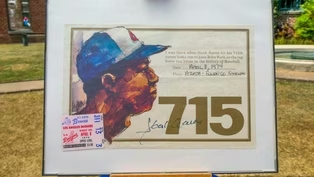
Appraisal: 1974 Hank Aaron 715th Home Run Group
Video has Closed Captions
Clip: S30 Ep6 | 3m 4s | Appraisal: 1974 Hank Aaron 715th Home Run Group (3m 4s)
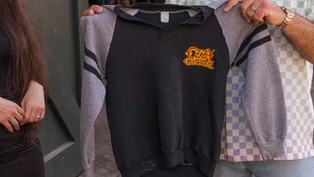
Appraisal: 1982 Bootleg Ozzy Osbourne Sweatshirt
Video has Closed Captions
Clip: S30 Ep6 | 1m 21s | Appraisal: 1982 Bootleg Ozzy Osbourne Sweatshirt (1m 21s)
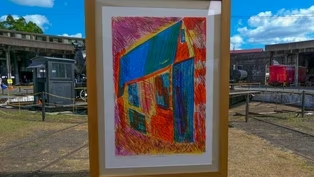
Appraisal: 1987 Beverly Buchanan "Happy Shack" Lithograph
Video has Closed Captions
Clip: S30 Ep6 | 2m 57s | Appraisal: 1987 Beverly Buchanan Happy Shack Lithograph (2m 57s)
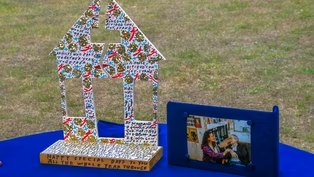
Appraisal: 1993 Howard Finster Mixed-media Artwork
Video has Closed Captions
Clip: S30 Ep6 | 3m 14s | Appraisal: 1993 Howard Finster Mixed-media Artwork (3m 14s)
Appraisal: Adirondack Twig Rocking Chair, ca. 1930
Video has Closed Captions
Clip: S30 Ep6 | 1m 18s | Appraisal: Adirondack Twig Rocking Chair, ca. 1930 (1m 18s)
Appraisal: Anishinaabe Man's Beaded Bandolier Bag, ca. 1890
Video has Closed Captions
Clip: S30 Ep6 | 2m 56s | Appraisal: Anishinaabe Man's Beaded Bandolier Bag, ca. 1890 (2m 56s)
Appraisal: Civil War POW Carved Wooden Box
Video has Closed Captions
Clip: S30 Ep6 | 2m 49s | Appraisal: Civil War POW Carved Wooden Box (2m 49s)
Appraisal: Daum Nancy Art Deco Glass Vase, ca. 1920
Video has Closed Captions
Clip: S30 Ep6 | 1m 52s | Appraisal: Daum Nancy Art Deco Glass Vase, ca. 1920 (1m 52s)
Appraisal: Ernie Barnes Oil Painting, ca. 1963
Video has Closed Captions
Clip: S30 Ep6 | 2m 47s | Appraisal: Ernie Barnes Oil Painting, ca. 1963 (2m 47s)

Appraisal: Ming Dynasty Bronze Vase
Video has Closed Captions
Clip: S30 Ep6 | 2m 29s | Appraisal: Ming Dynasty Bronze Vase (2m 29s)
Appraisal: Navajo Squash Blossom Necklace, ca. 1930
Video has Closed Captions
Clip: S30 Ep6 | 1m 56s | Appraisal: Navajo Squash Blossom Necklace, ca. 1930 (1m 56s)
Appraisal: Reproduction Tiffany Lamp, ca. 1980
Video has Closed Captions
Clip: S30 Ep6 | 1m 1s | Appraisal: Reproduction Tiffany Lamp, ca. 1980 (1m 1s)

Appraisal: Sèvres-style Pottery Urns, ca. 1900
Video has Closed Captions
Clip: S30 Ep6 | 2m 57s | Appraisal: Sèvres-style Pottery Urns, ca. 1900 (2m 57s)
Appraisal: Tiffany & Co. Pocket Watch, ca. 1890
Video has Closed Captions
Clip: S30 Ep6 | 2m 10s | Appraisal: Tiffany & Co. Pocket Watch, ca. 1890 (2m 10s)
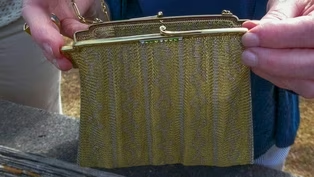
Appraisal: Tiffany & Co. Purse, ca. 1915
Video has Closed Captions
Clip: S30 Ep6 | 2m 6s | Appraisal: Tiffany & Co. Purse, ca. 1915 (2m 6s)
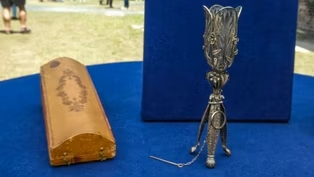
Appraisal: Tussie-Mussie with Fitted Box, ca. 1869
Video has Closed Captions
Clip: S30 Ep6 | 2m 20s | Appraisal: Tussie-Mussie with Fitted Box, ca. 1869 (2m 20s)
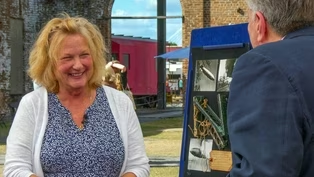
Preview: Georgia State Railroad Museum, Hour 3
Video has Closed Captions
Preview: S30 Ep6 | 30s | Preview: Georgia State Railroad Museum, Hour 3 (30s)
Providing Support for PBS.org
Learn Moreabout PBS online sponsorship
- Home and How To

Hit the road in a classic car for a tour through Great Britain with two antiques experts.













Support for PBS provided by:
Funding for ANTIQUES ROADSHOW is provided by Ancestry and American Cruise Lines. Additional funding is provided by public television viewers.