
For Country: First In, Last Out
Special | 57m 6sVideo has Closed Captions
Firsthand accounts from Fort Drum’s 10th Mountain Division soldiers on their service and sacrifice.
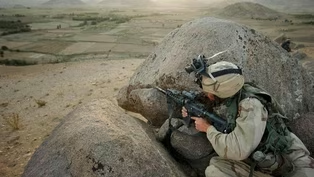
Soldiers from the 10th Mountain Division, 4th Battalion, 3lst Infantry Regiment (4-31 IN) based at Fort Drum, New York were “first in and last out” in Afghanistan fighting the Global War on Terror. Soldiers from the regiment recount their service and sacrifice during America’s longest war.
Problems playing video? | Closed Captioning Feedback
Problems playing video? | Closed Captioning Feedback
For Country: First In, Last Out is a local public television program presented by WPBS
For Country: First In, Last Out
Special | 57m 6sVideo has Closed Captions
Soldiers from the 10th Mountain Division, 4th Battalion, 3lst Infantry Regiment (4-31 IN) based at Fort Drum, New York were “first in and last out” in Afghanistan fighting the Global War on Terror. Soldiers from the regiment recount their service and sacrifice during America’s longest war.
Problems playing video? | Closed Captioning Feedback
Where to Watch For Country: First In, Last Out
For Country: First In, Last Out is available to stream on pbs.org and the PBS app.
NARRATOR: The fourth Battalion, 31st Infantry Regiment is part of the Second Brigade Combat Team, 10th Mountain Division, known as the Polar Bears for their World War I service in Russia.
Formed for the world's harshest environments.
They have fought in the most demanding battles, from World War II to Afghanistan.
431 has seen service not only in the frigid conditions of Russia, but also the Pacific, Korea and Vietnam.
Today, they are a vital part of the division's high mobility rapid response capability that can be rapidly deployed to go anywhere in the world on short notice.
They specialize in operations of the most challenging missions that require resilience.
In the war on terror, they played a crucial role engaging in direct combat operations in both Iraq and Afghanistan.
Well the 31st Infantry Regiment is a story or an account of grit and tenacity.
Over the first 50 years of the 107 year history.
They were underdogs and were undermanned, underequipped, and set out in the Indo-Pacific basin as America's frontline.
In the Philippines, started in August 1916.
From there, interestingly enough, they thought they were going to go somewhere.
They started getting equipped and had to go into World War I, only to find out that they were going to be assigned to Siberia, where they received the name Polar Bears.
The 10th Mountain Divisions remarkable history includes its pivotal role in World War Two, leading the assault on Riva Ridge and Mount Belvedere in the Apennine Mountains of Italy.
They were the first to break into the Po Valley, cutting off Highway Nine to Lake Garda and blocking the German escape route to the Brenner Pass, a decisive action that helped bring an end to World War II in Italy.
In response to the September 11th, 2001 attacks, 431 deployed to Afghanistan.
They took part in Operation Enduring Freedom and Operation Anaconda, engaging in both direct combat and humanitarian efforts.
They were among the last units to withdraw in 2021.
Closing out both the Resolute Support Mission, Operation Freedom's Sentinel and Operation Allied Refuge, signifying nearly two decades of commitment and sacrifice in the war on terror.
It was unbelievable terrain.
It was mountainous.
It was difficult.
The Afghans scurried up those mountains as if there was no issue or no problem.
We were used to carrying the heavy weights over long distances.
It was strenuous.
It was difficult.
But we had pressed during all the training to continue on.
And that's what our warriors did, because that was who they were.
They were mountaineers.
They hit the ground running.
They executed missions, despite this kind of unknown enemy at the time.
And that was probably the proudest thing, was the grit and tenacity of Polar Bears, not unlike those who went into Siberia, into Shanghai, into Korea, into Vietnam.
It's carried across 107 years, and it's still today just ingrained in that, that American fighting spirit.
When 9/11 occurred, I was actually doing a PT (physical training) run.
We were running around the Riva Ridge Loop with my platoon.
We didn't, we didn't know that the attack was actually happening.
Right then and there.
I didn't find out until, I was coming back with the, fallout group.
My PL (Platoon Leader) come running out and said, hey, a plane just went into one of the towers.
I was just kind of set back going, really?
A plane went into the tower?
Every news broadcast had everything going, and I'm just like, oh, wow!
We were kind of just waiting in the wings and watching everything unfold on TV.
My wife at the time started screaming.
I jumped out of the shower, come running into the front room and, the second plane went into the tower.
As soon as that happened, my phone rang.
Was given orders to come right back to the battalion.
And then we were locked down.
The morning of 911, our company had just come off DRF-1, which is pretty much the highest alert status that there is in the Army.
You know, if something was to happen, we would be the first to go.
We had just got done PT (Physical Training).
Everybody had gone home for the morning to get changed before coming back to work for formation at 9:30.
I was actually at home getting dressed and I turned on the TV, and I thought that, you know, probably like a lot of people that, you know, it's just an accident that somebody had flown a plane into one of the World Trade Centers, and I was actually watching the news live when the second plane came in.
And I just remember, you know, getting like a horrible feeling.
So I figure we would be, we'd be headed out pretty soon after that.
I had just gone to Fort Drum here at 431.
We had the TV out of the day room.
We saw the news, we saw the planes crashed into the towers.
Our reaction was, okay, now we need to get ready and go to war.
We've been training for so long.
We need to get ready to do something.
Something's going to happen.
The whole unit shut down.
We got word from our command, that everybody was on lockdown.
You know, less than a month afterwards, we were deployed.
Answering the call to deploy, the soldiers of the 10th Mountain Division.
Fourth Battalion, 31st Infantry Regiment, exemplified unwavering dedication.
Skillfully applying their rigorous training to meet the challenges head on and fulfill their mission with precision and valor.
I was ready, my guys were ready.
We were just like, all right.
This is actually going to happen.
We're going somewhere.
We just don't know where.
Planes have been taken over, hijacked.
Now they run them into the Twin Towers in New York City, and you're like, okay, this is real.
We had no idea where we were going.
We were just told to pack our bags, get to the tarmac, get on the bird and go.
We'd find out in route.
Next thing you know, our company commander was briefing us that we were going into Afghanistan.
That Operation Anaconda was kicking off, and that we were going to be part of it.
I was pretty nervous.
I really was.
I mean, I had a lot of young kids.
We were getting brand new out of basic training.
You know, they get off the bus, and I had first round picks because I was standing up a new platoon.
it was a shock and awe for sure.
I was the youngest platoon sergeant.
Kind of surreal.
I mean, I think I was 21, 22 years old at the time.
I think everybody kind of joins the army of that feeling that it could happen.
So it was almost anticipation, anxiety.
The unknown, what was going to happen next.
It's pretty overwhelming, I guess.
Most of all, we trained and trained and trained and trained every single day.
Just in the offshoot, you know, something might come down to where we leave from there.
And it, in the end, it did.
I guess the, the most surreal thing was flying through the mountains of Afghanistan with a bunch of 18 year old kids that I was now in charge of, and I think we had flown maybe three hours, crammed into a back of a Chinook helicopter.
And, you know, we were there for so long, our legs were asleep.
You know, we started going through the mountains and the gunners on the Chinook, you know, they start firing their weapons.
You finally realize, this is this is it.
[laughs] You know, The feeling I got when we first landed into Afghanistan, 19 at the time, so it was eerie.
We landed in the middle of the mountains.
We're almost setting the tone for the deployments to come, because we were essentially the first ones to be in Afghanistan, to be in Kabul, to be in in Bagram, right, in the airfield.
Everything felt fresh.
Everything felt like we were like trendsetting, everything was new, right.
So, felt like we were doing the job.
It felt like we were responding immediately to what September 11th happened.
And we had like a active task, an active mission to get the bad people right.
I was doing what I signed up for, infantrymen going to combat, get the bad guy.
We were clearing bunkers and areas of operation that had been bombed, and we were to go in and just, rud around, look for ammo.
You know, kind of hunter killer teams and looking for the bad guy and just clearing areas.
Next thing you know, I get a call.
I got to meet my company commander up front.
We got a full blown objective that we got to take out.
Right then in that moment, I'm just like, wow, this is it!
Keep your head on a swivel.
You can see the whites of my eyes.
I'm like, oh man, you know, I'm like, oh, here we go, you know.
So, that being like my very first combat mission and actually pulling the trigger and fighting.
I don't know how many feet we were up in the mountains.
We crested this ridgeline, and I swear it looked like a scene out of some movie where you're in a war torn country.
I see all these, like, beautiful grass and water.
These dikes, and I see just people living their lives, probably knowing that there's a war going on in their country, but it's like they're in their own little world.
You got aircraft flying all around.
You got bombs going off.
You got actual, you know, fighting going on.
You know, lives are being lost and you come across this ridgeline at I don't know how many thousand feet, and it's like nothing's going on.
The morning waking up, it was just, it was like, surreal of how beautiful it looked.
And then you would hear, you know, explosions.
And then, [laughs] you know, you'd hear an explosion and kind of bring you back to reality.
But even flying in the helicopters flying over all the villages below.
It seemed like something out of like a National Geographic magazine.
The last time the U.S.
Army was fully engaged in combat before the war on terror was ten years prior, during Operation Desert Storm in 1991, as one of the first units into Afghanistan, 431 set the stage for a new era of conflict that would last 20 years.
Soldiers from all different backgrounds would now come together to fight for freedom like their predecessors.
It's so fascinating because in our immediate unit, there was somebody from North Carolina, somebody from Texas, somebody from Oregon, somebody from New York City, somebody from Korea, or somebody myself from Peru, Puerto Rico.
So there's this group of young people that would never have met otherwise had they not signed up for the infantry to go to combat.
And we came together and were in a country that none of us ever even heard of.
And being so, so different and so diverse made us become closer, right.
Because we didn't have anything in common except the fact that we were in this foreign country fighting another group of individuals.
So that made us even closer, I feel, and so much so, that even to this day, we're meeting reuniting again almost 20 years later.
We are the strength and the honor, you know, of the people who can't fight for themselves.
But you got to also realize different parts of the combat arms circle in the military.
You know, we're training for certain theaters.
And when September 11th happened, I mean, it was all hands on deck, and they dropped us in and we made it happen.
We're going to do it.
We're going to do it regardless.
Things that we were doing that we normally wouldn't do, but that's the mission and we're going to make it happen.
You know, in the Taliban, relentless, relentless.
And for them to come over on U.S.
soil and do what they did to us.
And 9/11, yeah that kind of rubbed a lot of us the wrong way.
Quite the adversary.
I just say that.
I mean, I was nervous, you know, but I always reverted back to what my first team leader said.
And he goes, no matter what Rod, violence of action.
Violence of action.
As soon as that first round goes off, it's violence of action.
And you do not stop unless somebody stops you.
You know, historically speaking, you know, it's, a lot of people never really get a chance to do a full blown platoon attack on an objective at high elevation.
Fighting for the guy to the left and right of you, and just trying to do everything you can to come home.
I think it's the brotherhood, the being there for each other.
Really proud of myself on that.
That bond that I had with my guys.
Were the only people that had our combat infantryman badges.
We were the only ones who had, you know, our 10th mountain on both sleeves, our combat pads.
So it was really a feeling of, I guess, heroism and like just feeling good about yourself that you had gone there and done these things and came back and, you know, you're part of kind of an elite group of people who had been to combat because at that time, you know, since Desert Storm, there had really been no conventional Army units in any kind of combat.
It felt like we became part of the time honored tradition for the 31st Infantry.
We had made our mark in the history of the 31st Infantry Regiment.
Operation Anaconda targeted Taliban and Al-Qaeda forces in the rugged mountains of eastern Afghanistan's Shah-i-Kot Valley.
They were rapidly mobilized as few qualified forces were available.
During this mission.
Our soldiers fought bravely to protect America, ensure safety and honor those who were tragically killed in the 9/11 attacks, cementing their legacy and history.
To be part of Operation Anaconda and some of the other, some of the other operations that we did in the invasion, my era of soldier gets to have a chance to write our history.
It means a lot.
It really does.
When we were there the first time, we were up in the mountains, very unpopulated.
You kind of knew if they were up there, more than likely nine out of ten times.
It was a bad guy.
And we were moving into a very heavily populated urban environment.
And that is two completely different animals, because at that point, you don't know who, who's a good guy, who's a bad guy.
Your sense of awareness, your heightened awareness really starts to come into effect.
Your training comes into effect.
It is a completely different thing when you get into populated areas.
We had a lot more of interactions with civilians on that deployment, which was was good on tower guard, I had a at a group of kids that would come.
This kids name was, his name was Mullah.
He would search for me like he would, like we had multiple towers all around.
He would walk from tower to tower, and people would tell me this, like when they would come off guard like, hey, that kid was looking for you.
He call me Bob, I guess, because that's what I, Yeah, of course they ask what your name is or whatever.
but he be like, hey, Bob.
Like he would walk from tower to tower to give me to come out and talk to him and stuff like that.
Was always so interested in what I had to say or just talking to me, you know, even though he spoke very broken english, but he always sought me out, you know, just to see what I was doing that day or how I was or, you know, to tell me a joke or dance or anything.
Whatever he had, you know, whatever he had to say or do, you know, that I would entertain him, I guess, thinking if he was one of these kids, that possibly may have become an interpreter or worked with the government.
And I always wondered, especially when that stuff happened, when we left and all those people were jumping on the, you know, the wheels of the plane or the wings of the plane trying to get out of there.
One of the first things that popped in my head was, I wonder, you know, if he got out of there or if he was still over there.
[echoing] Hey, Bob.
In times of war our shared humanity compels us to empathize, especially with children seeking normalcy amid conflict.
The 10th Mountain Division was deployed in support of the NATO mandate.
They balanced combat operations with supporting humanitarian efforts and rebuilding infrastructure and institutions.
All the while supporting Afghan forces and governmental agencies and fostering local stability.
431 was among the last to withdraw in 2021.
Closing nearly two decades of service.
The legacy reflects both the challenges of modern warfare and the sacrifices made throughout a sustained conflict DANIEL: Urban, door to door fighting, desert fighting, mountainous fighting.
They have that experience and now they're training their soldiers in those multi different environments, and they've developed a level of confidence in that a tactics, techniques, procedures that they'll be able to teach our soldiers who are just coming in kind of at the end of this, this war fight, this particular war fight.
NARRATOR: General Stephen J. Townsend, who led as a commander of the Fourth Battalion, 31st Infantry Regiment during Operation Anaconda, returned to Afghanistan 11 years later as a major general, commanding combat operation, developing Afghan security forces and supporting the Afghan government.
This reflects the complex and evolving nature of U.S.
efforts in Afghanistan, from fighting insurgents to rebuilding a fragile nation.
STEPHEN J. TOWNSEND: After 9/11, the missions of 431 progressed from preparation for combat to deploying for security operations at various locations around the globe, and ultimately close combat to destroy al-Qaida forces in Afghanistan during Operation Anaconda.
One of the things I'm most proud of is how the task force polar bear, the 431 Infantry, responded to the demands placed upon us after 9/11.
We stayed ready wherever we were.
Even the scattered platoons and companies found ways to keep their training levels up and sharp.
And once we were committed to battle, which my gut told me, eventually we would be, I think our soldiers responded, really magnificently.
NARRATOR: This battle flag, now proudly displayed at 431s headquarters, once flew over Charlie Company's command post at Hamid Karzai International Airport during Operation Allied Refuge, August 15th to 18th, 2021.
In those critical days, just 119 soldiers of 431 carried out vital security missions in and around Kabul.
A plaque alongside the flag reads the flag was a beacon to the Soldiers, Airmen, Marines and NATO Allies, signifying where to find fighting men with sound moral judgment to do what was necessary at their time of need.
A Tribute to Charlie Company, 431 Infantry, 2-30 Infantry and 1-8 Marines.
These few brave soldiers and Marines secured a foothold that made the evacuations from Afghanistan possible during the crucial days of the 15th to the 18th of August.
SOLDIER: Go!
The U.S.
military's initial mission in Afghanistan aimed to dismantle Al-Qaeda and remove the Taliban by August 2021.
The advance by the Taliban on Kabul prompted Non-Combatant Evacuation Operation (NEO) The last exit for NATO civilians and vulnerable locals.
This period highlights the challenges and complexities of military and humanitarian efforts.
BEN CROSS: I got there in January.
Half my platoon was already there starting in December.
Immediately following there started to integrate myself, familiarize myself with the surrounding element.
We stayed there.
We worked with the Afghanistan security police, controlling and trying to improve their security postures along with their entrance and exit protocols of the actual base.
Every day, every night.
NARRATOR: Charlie Company guarded the perimeters of Bagram Air Base and Hamid Karzai International Airport (HKIA), Kabul's main airport, to keep these vital airfields secure as NATO forces left Afghanistan.
ANTHONY MAYNARD: 3rd Platoon was was in charge of the GDR patrols outside of Bagram Airfield.
So that's what we were tasked with originally, when we got to, Afghanistan, we closed Bagram Airfield.
Everything was ramping down to, you know, return home.
So the 12th and 13th leading up to the 15th, everything was fine.
The coffee shop was still open.
Haircuts are still happening.
Guys were excited.
I remember, you know, I got a fresh haircut.
I got everything done, you know, getting ready to come home and see my wife so, leading up to the 15th, got the call to move forward to HKIA.
We were the last platoon, to leave Bagram.
We knew that Taliban was closing in on Kabul.
I don't think anybody could have imagined how quickly, things, dissolved, you know, right around noon on the 15th.
STEPHEN A. HAPPY: Prior to getting to HKIA, my platoon had been to several posts.
We've been to Kandahar, we've been in Bagram, we've been in Dwyer.
We've been in several parts of the country at that point.
And pretty much everywhere we went, you get to the base, you get briefed on the situation around the base, and there's a little bubble around the base.
It's like ANA (Afghan National Army) controls this, and, you know, a couple main roads that the ANA patrols and like that's that's good guy territory.
And then everything outside of that's red.
We turned races over to the, the Afghan government and we leave, we get to the next base, and by the time we land, that same Intel brief we got at the last place, except now it includes, oh yeah, and that place you just left now belongs to the Taliban.
You just see, every time the the coalition element picks up and moves, that place just falls immediately.
Either the unit just disappears or it gets directly attacked and overrun and same, same end result either way.
Higher echelons didn't expect this to happen this quickly, like the official line was that we're going to politically and humanitarily support the Afghan government and they're going to fight their own war.
When immediately the American presence leaves and every section of this country falls to the Taliban.
HKIA is supposed to be the last American presence, but it is not supposed to be [laughs] the last bastion of the Afghan government at whole.
We started formally taking over some security responsibilities around the base from the Turks.
We took over the base QRF (Quick Response Force) role, and in that, us and 1st Platoon split 24 hours on, 24 hours off.
ANDREW KELLY: The mission that the company received was we need to provide two simultaneous QRFs to the U.S.
embassy in expanded Green Zone.
One via ground, one via air.
NARRATOR: A Quick Response Force, or QRF, is a fast, highly trained unit prepared to respond to emergencies, threats, extractions, or evacuations in combat zones.
The airport in Kabul spanned ten square kilometers, with hundreds of buildings, guard towers every 400 meters, and multiple access gates.
A very complex site to secure.
ANDREW: HKIA is comprised of ten ramps, two of which were controlled by NATO forces, one of which, ramp ten, which was controlled by the embassy.
Ramp eight is where we were stationed.
Ramp eight was controlled by our NATO allies.
BEN: My initial security concerns, around the airport was having the civilian population having multiple accesses through the civilian airport, which is not guarded by anybody other than the local police.
NARRATOR: A Non-Combatant Evacuation Operation (NEO) is used to move civilians such as embassy personnel to a secure airfield for evacuation from a conflict zone.
These missions are often led by U.S.
Marines, but Army units like 431 can also be called upon to conduct or support.
ANTHONY: So leading up to the days of the 15th, we had seen the Marines start to trickle in.
Specifically, my platoon was paired up with a platoon from, Aztec Company, 1st Battalion, 8th Marines.
Some unsure about what role soldiers and specifically Charlie Company would play.
Our commander and commander of Aztec Company.
had kind of done a handshake agreement.
What we're calling, you know, the Alamo.
This is where, you know, all red blooded Americans will come to in the event that things do go wrong.
STEPHEN A. HAPPY: We had conducted a drill with the Marines, and it's like, all right, if whatever happens, Aztec Company is going to secure these gates of the NATO portion of the base, which is going to allow us to push out farther and have some initiative to secure the wider base and give us some breathing room.
And thank God we did.
NARRATOR: Tensions escalated as Afghans began to gather at the airport, desperate to flee the country as the Taliban took over the city.
And we just drove over to ramp ten and we were like, man, there's Afghans everywhere.
And Polar Bear Six came in and was just like, we need people at ramp nine right now.
Shots are fired on ramp nine, there's a Afghan person trying to steal an airplane.
STEPHEN A. HAPPY: I'm like, what?
Like, yeah, some dude just ran out on the tarmac from the Afghan side and tried to get in one of the little prop planes.
they use, one of those Cessnas.
And when the security forces came out, he had a pistol and he fired a shot or two at them and then ran off.
SOLDIER: We got small arms fire.
ANTHONY: And that was the first time that we realized that this might be an intense situation moving forward.
STEPHEN A. HAPPY: Oh, there's a rumor over here the Taliban have entered the city.
Oh, there's a rumor over here that there's, like, gun fighting on the outskirts.
And I I see Colonel Rowe borderline sprinting to the company, and behind him there's a tall general in Marine uniform that I don't recognize.
We can stop.
Turn.
Hey, sir, what's going on?
And at that time, I see a star on the Marine General's collar.
And at that point, Captain Brown looks at me and announces, get your platoons up.
Something's going on.
I don't know what it is yet, but you guys need to get ready.
And I'm like, is this a drill or is this real?
And he's like, it's real.
We don't know where the Afghan government is.
And I'm just like, what?
Hes like they don't know where the president is.
No one is for sure what's going on, but everyone is just getting pings of every kind of rumor threat report that they can get.
Finally, Colonel Rowe says, all right, we're going to secure every gate to HKIA.
We're going to we're just going to call the security posture right now.
The Marines are going to secure the NATO compound, and Charlie Company is going to get the trucks, and they're going to secure all the main gates coming in HKIA.
ANDREW: Now, the marine units started to reinforce the proper gates.
So they reinforce North Gate and Abbey gate, while Charlie Company, we were more mobile, because at that point in time, we were the only unit on the ground that had fully functioning vehicles.
So not only did we have the level seven, which are like SUVs, but we also were the only ones that had fully functioning max pros, which are the big tan trucks.
STEPHEN A. HAPPY: Given that we were already on shift and already mounted, they sent us to the farthest gate from our compound, which was South Gate, which would have been in the southwest corner of HKIA.
And as we're driving down the outskirts of the base wall, my lead truck notices, like, hey sir, there's nobody in the towers.
Usually there's a company, at least out here manning these gates, these intersections, these towers.
There is not a soul.
As we got to the main entrance of the, Afghan Air Force side of the base, there's just a line of people down the road to the nearest gate.
Walking out of the base.
Dudes in underwear, dudes dudes in civilian clothes, bags on shoulders, leaving.
All of the Afghans have just shed their uniforms and are, like, fleeing the base.
There's not a person here pulling security.
Immediately I call that up.
I know we had a rumor that Afghans were abandoning their posts, that there is nobody out here, and I am watching a line of several hundred people exit this base in underwear with bags on their shoulders.
The second I said that, it was like all four platoons go.
We're going to assume as of this point right now that everything outside of this NATO compound is not secure.
That changes the whole dynamic, the realization that every person walking alongside the road, every person standing at a corner by themselves, like, it could be anybody.
It could be the Taliban.
It could be, you know, I don't know how long these gates haven't been manned.
And that also affected the actual airfield status.
Like I can't land military aircraft on a tarmac.
If there could be a dude with a V-bed (vehicle bed-mounted weapon) sitting on the other side of the airfield waiting, drive it into a C-130.
BEN: They were heading straight for an aircraft, straight for our base.
So just pushing back, trying to get some sort of a line protective line to stop them.
Because at that time, I mean, I have women, children, older, younger men, you know, just families, everything coming at you.
What they're coming with, some of them had bags from backpacks to suitcases.
They were trying to get on a plane and leave the country.
You know, you don't know what's inside their bags.
That continued on what seemed like for hours, through the night.
I mean, it was definitely nighttime.
ANDREW: There were three C-130s that were on the tarmac.
We had gotten a call over the radio that, you know, civilians were running across the airfield.
[Panicked crowds crying and yelling] The Afghan civilians had actually, at this point taken over two of the C-130s.
Now, we sat there for, I'd say, about two hours, trying to get these people off.
SOLDIER: Leave!
No!
[crowds in distress] SOLDIER: You cant make it in!
AFGHAN CIVILIAN: Please!
Please!
[People pushing and scrambling] AFGHAN CIVILIAN: Please!
SOLDIER: Please hold her.
[crowds in distress] BEN: Eventually we got them all out of the aircraft.
Once we got our immediate area secure, we started to push them back across to the location where we initially started to hold them.
ANDREW: It was half a company of a Marines, half a company, an army.
We kind of pushed these guys back off the airfield.
Its Air force protocol, if they feel like the aircraft is in danger, they're just going to close it up.
Those C-130s were, those were our lifelines, because without those C-130s, we were on an island.
Any medical care, any evacuation was dependent upon whether or not a C-130 could land and take off from that airfield.
They were our only way out.
NARRATOR: As Kabul descended into chaos, many diplomats were trapped in their compounds awaiting transport to the airport, with security rapidly deteriorating, some took matters into their own hands, navigating congested streets as events were unfolding.
STEPHEN A. HAPPY: The first of the embassy shows up, I believe it was the Japanese first.
Long line of blacked out Suburbans.
Go outside, walk up for the first car, I wave them in.
I don't know what they went through getting there, but I do know that the dude that got out of the first vehicle to like, link up with me, like burnt off side of a shirt, like all messed up, covered in dirt, like something had gone wrong.
And then the back vehicle had pockmarks and, somebody shot at them.
The Indian Embassy arrived while we were getting them into the gate.
That one was just three vehicles.
We got them inside the gate.
We closed that off and then it was, we got the call on the radio of like, okay, like South Gate done.
And they spent about 15, 20 minutes piling vehicles up against the gate, making a making a barricade.
Once we pretty well shut that off, we got marching orders then to head to the center of the airfield where the other platoons were.
AIDEN GAFFNEY: It was an absolute nightmare.
It was, it was scary.
Because we're driving these trucks up.
And as far as you can see, it's just people.
Just people.
And we get to a point where there's gates that lead up, just before we can actually get to the Pax Terminal, to, like, get cars in and out.
And we were able to successfully close those gates and we had parked our MATVs on the sidewalks and everything like that.
At that point, I asked for some more help and we ended up getting, I believe, like four more gun trucks from our company.
So we ended up having the majority of the company at our location.
And First Sergeant Kelly came and, he started helping take control of the situation.
NARRATOR: The traffic circle leading into the civilian terminal was a crucial bottleneck.
First platoon initially positioned their trucks as makeshift barricades to control the flood of Afghans trying to access the terminal.
Second and fourth platoon were sent to the civilian terminal.
As desperation grew, the crowd became overwhelming and chaos set in.
ANDREW: In the traffic circle is what you can expect, right?
It's a traffic circle.
There's a sign says, I love Kabul.
I heart Kabul right there.
You know, it's very nice.
There's a nice parking lot.
There's some nice cars in the parking lot, but there's high concrete walls.
And there's one road in, one road out.
It goes directly into a traffic circle, into two parking lots.
We pull the trucks up into this roundabout, start using trucks to close off like there's an alleyway there, put a truck in that alleyway so people can't get through.
There's a doorway there, put that truck over that door and just drive it up to it.
People can't get in.
ANDREW: And all the soldiers from first platoon, second platooon, forth platoon, kind of secured that traffic circle from about 1:00 in the morning until about 6 a.m., we held that traffic circle.
During that time, it was becoming more than we could handle.
SOLDIER: Go!
Move!
Go!
Go!
STEPHEN A. KELLY: They didn't know if, there was a plane for them on the other side of the terminal or not.
They didn't know if they were going to go anywhere, but they knew that the crowd was going that way, and so they were following it.
And in the way the crowds work, by the time they actually got to the airfield, it's definitely spurred on by people getting shot at the streets behind them like it was.
It was pandemonium, like they didn't know where they were going.
They didn't know what they wanted.
They just knew that the American flag was still flying over there and there was planes in front of it.
If I get over there, I have the highest chance of getting out of here than I do anywhere else.
[crowd noise] AIDEN: People started really getting restless because we weren't letting them in, and then people started shooting.
[gunshots] SOLDIER: GO!
AIDEN: People were really getting eerie of it because now theyre there, they're innocent.
They're they're just, they're trying to leave their country.
Now there's two shots going everywhere.
ANDREW: There were thousands of people, I mean, thousands, you know, I, I remember distinctly, you know, coming over the radio when I was like, yeah I need reinforcements.
I need somebody to help us secure this traffic circle.
We're going to lose it.
There's too many people.
We had sprung a leak to our right flank, where people were kind of like squeezing their way and squeeze their way and past the trucks, because we just didn't have enough vehicles.
We knew if we lost that traffic circle that they were going to flood over us into the civilian PAX (passenger) terminal.
Never at that point, I was in the army 17.5 years.
Never, never my military career where I ever thought that I would have got on the radio and made an official radio call to my higher headquarters that, I had lost my line.
SOLDIER: Lets go!
NARRATOR: soldiers worked relentlessly to manage the crowds, but the sheer volume of people trying to escape and the uncertainty of who posed a threat made it nearly impossible to maintain control.
This prompted third platoon to provide additional support.
ANTHONY: We could hear, gunfire coming from, traffic circle.
We pulled up on the north end of the PAX terminal.
We can hear, you know, machine gun fire consistently.
I radioed up to First Sergeant Kelly, First Sergeant Kelly came back and met me.
I said, you know, what is going on?
And, having, you know, known him for quite some time, you know, he looked at me dead in the face and said, that's us, and we're losing.
So it was, it was, for us, it was that moment that we realized, like, okay, things have gone awry.
SOLDIER: GO!
ANTHONY: After multiple deployments [gunshots] and training, you always, you always think everything's going to be under control, and this was the first time in my career that it wasn't.
AIDEN: I mean, people started shaking the trucks.
We tried flashbangs, we tried smoke grenades, we tried CO2 gas.
We tried anything and everything we could to keep the people back.
SOLDIER: Officer, this guy is a U.S.
citizen.
OFFICER: Does he have a passport?
SOLDIER: You have your passport, right?
AIDEN: We were just trying to find U.S citizens at that point.
We realized that there were citizens in that crowd.
OFFICER: When you have a passport, we will get someone to take care of you.
CITIZEN: Right in 10 minutes... (Inaudible) [gunshots] OFFICER: Okay, once it gets here let him know.
AIDEN: We wanted to try to help them.
We wanted to do everything we could to get these citizens, get these Americans that we said we were going to help defend and protect home.
SOLDIER: Yep.
AIDEN: We had to set up a casualty collection point because there were sporadic gunfire, [gunshots] people were bringing us injured American citizens, Afghan civilians, and we started performing aid and treatment to them.
STEPHEN A. HAPPY: Like, now there's blood, now there's gunshots.
Now the crowd is going crazy.
And that was the start of that.
That wall starting to fall apart.
It worked itself up into a frenzy.
[gunshots] At that point.
People started coming over the walls.
People in the crowd started reaching over and trying to pull soldiers into the crowd, trying to throw stuff at us.
One of my soldiers, like someone had a pipe and he was like, up against the barricade.
And he turned to tell someone else to stop climbing on the barricade.
Someone in the crowd reaches out, swings this pipe at him.
Luckily, one of the NCOs (Non-Commissioned Officer) pulled him back before he smacked him in the side of the head.
It just turns into pandemonium.
ANTHONY: The call was made that we had lost we had lost traffic circle.
I mean, the crowds were just pushing, pushing, pushing.
There's only so much that you could do based on personnel that we have, equipment that we have and the amount, just the sheer size of the crowds coming at us.
SOLDIER: Hey!
AIDEN: While we were holding the people upside the gate, the 230 guys and the Marines that they could spare, were setting up a position basically to funnel all the people in and catch all the people.
They had c-wire (concertina wire) out and they thought the c-wire would be able to hold them back.
They were met with a sea of people.
I don't think they were prepared for what we were bringing and what we were stopping.
[crowd choas] NARRATOR: Charlie Company's efforts at the traffic circle made it possible for soldiers of the 2-30 infantry and one eight Marines to set up concertina wire and vehicle barricades on the airfield side of the terminal.
Tens of thousands of Afghan civilians breached the civilian terminal and side gate, overrunning the barricades multiple times.
They don't care about the concertina wire.
They're desperate.
Individuals take off running, running through it, cutting themselves, you know, bleeding all over the place, you see it.
But that's a breach that's opened up.
And then we've got to move over there and try to contain those individuals.
STPEHEN A. HAPPY: At this point, my platoon hasn't slept in 36 hours like we've been on our feet this whole time, and now we're getting in wrestling matches with grown men.
And it's like any one of these dudes could have, you know, a backpack full of explosives, an AK, a pistol tucked into his shirt that he's going to pull out, and the blast, the gunner that he's now standing six feet away from.
Dudes on top of the PAX terminal.
2 or 3 of them, start shooting in the crowd, shooting at us.
And I'm so exhausted at that point, it's like I can't even be scared or wound up.
No energy left.
Watching thousands of people swarm by me.
[helicopter whirring overhead] AIDEN: This is when stuff got really tough for, I know a lot of soldiers.
They started using people as body breaches.
Didn't matter their age.
Didn't matter, if they were an infant.
Didnt matter if they were a child.
Didn't matter if it was an elderly person.
They just put them down on the c-wire.
They wanted to leave.
And again, that goes back to the desperation.
ANTHONY: Never in my career have I ever been able to to say to myself, I'm never going home.
This is just where I live now.
And that's what it felt like.
Every time that they would break through 600m to the other side, push them back, cross the airfield, break through again, Just back and forth and back and forth.
AIDEN: Our reinforcements were supposed to be coming that day.
They're supposed to be coming to help.
And now we can't land.
We can't land aircraft.
NARRATOR: The crowds poured onto the runway.
Some forced their way onto civilian aircraft, even occupying the cockpits, refusing to leave.
for the soldiers and Marines on the ground.
They had to rely heavily on their training, their discipline, and each other to navigate the security threat.
We were locked arms.
I had, I just kind of looked next to me, and I, I had a marine on my right arm.
I had a soldier on my left arm.
Soldiers never met each other.
All different chains of command.
Everybody was acting based on what their best moral judgment was and what they thought was the right thing to do at the time.
That is, to me, the proudest moment of this entire operation is the fact that you had so many different military entities, you know, at the soldier level that nobody needed to be told this is what needs to happen.
SOLDIER 1: The trucks are the only thing that can really stop them at this point.
Yeah, I mean, well.
SOLDIER 2: If it's a truck and then us in between the trucks SOLDIER 2: Then its fine.
ANTHONY: My fifth deployment, its the first time that I ever thought to myself, like, wow, I don't see an end to this.
I don't know how this is going to come to a head.
I just said to myself, you know, many times like, this is just where I live now.
This is, there's no end in sight Just the amount of people on the runway going through my mind.
If these people want to get on an aircraft, they have to have some sort of semblance to know, can't bring more aircraft in until the flight line is clear.
[gunshots] SOLDIER: We can't fly planes with y'all on the field.
So if yall are here, planes will not go.
So y'all are the problem Very clearly I remember three Air Force personnel coming out of the front door of the C-17.
They all came down, took a knee, pointed the rifles at the crowd coming, and very clearly as soon as that they saw, you know, the amount of people coming at us and Americans running this way, Afghans running this way, the lines breaking down.
As soon as they took their knee, they button right up, got back in the, aircraft.
That's when the aircraft started up and began, to move.
AIDEN: People just rushed the plane.
They were like, hey, if I'm the first one there, I'm going to get on it and I'm going to leave this country.
And Afghans started clinging on to the aircraft.
I mean, people have seen those videos circulate throughout the throughout the news that people clung on to the aircraft.
[aircraft flying over] That.
When the Afghans saw their people coming off the plane, that's that's what I think a lot of stuff changed.
NARRATOR: The heartbreaking images of individuals falling from the C-17 military plane shattered the spirits of those desperately trying to flee Kabul.
The emotional impact of those images was felt not only by the onlookers in Kabul, but also by audiences globally, ANTHONY: something that I had never, you know, been trained for.
I'd been doing this for, you know, close to 18 years now is my fifth combat deployment.
They don't teach you how to deal with, you know, screaming civilians.
They don't they don't teach you how to look at families and tell them... SOLDIER: Were taking anyone right now.
ANTHONY: You can't come in.
SOLDIER: Push in!
ANTHONY: So it was it was very difficult.
SOLDIER: Push In!
ANTHONY: The airfield mission ended probably around evening time on the 17th.
We got to tasked out with, aztec company, and I believe their Bravo company, first Battalion, eighth Marines at North Gate, to begin the vetting process.
And you know that starting the actual NEO mission itself, NARRATOR: After four days of intense operations, C-Company, 431 Infantry finally got some relief with the arrival of thousands of Army and Marine reinforcements from August 18th to the 23rd.
They focused on supporting security duties, but the situation remained dire and platoons were called to Abbey Gate.
ANTHONY: There was a variety of of just, you know, catastrophic, you know, instances where, you know, families were getting pushed into the c-wire.
Kids were falling into the wire, and there was a woman getting, you know, dragged towards a gate.
Her family was trying to get her.
She, you can tell she was very clearly, pregnant.
And she was screaming for the high heavens and, so she was dragged through by, you know, her family after getting caught in the c-wire.
She was dragged through the gate into, North Gate and it's the last time I ever saw her.
But just the image of, you know, this pregnant, you know, woman being, you know, dragged, it was, it was tough.
Was tough.
And there was a lot of that going on, you know, very clearly it was a woman, you know, she had been pressed up against the car right in front of me and for maybe about, I don't know, an hour or two hours.
And she just screamed, somebody kill me, somebody kill me, somebody kill me.
And I just again, you know, morally, emotionally, how do you, you know, wrestle with with things like that?
As an American, you know, this is what we do professionally.
Being able to know what is right, what is just, what is moral is paramount to how we operate as a military.
So it takes a mental toll on you.
And I still have moments where, you know, I can close my eyes and you smell it, you feel it, and you can just see that lady asking to be killed, or the kids that kept constantly falling in wire and having to get pulled out and dragged through.
And so those are the types of things that we train for to show restraint, to show, you know, what side of the moral line we're going to be on.
And again, that is, it's a tough it's tougher than I thought it would be.
[helicopter whirling] I think the biggest thing that I've pushed over the past two years is to seek help if you need it.
I think it takes an incredible personality to have the self-realization like, hey man, I've been through some stuff.
I have seen some things that there are a very small amount of this population could even fathom or comprehend.
And I think it's very important.
It's one of the reasons that I talk about resiliency so much during this is, is to continue to push people to seek help if they need it.
If they need to reach out and talk to somebody or whatever the case may be.
I struggled for a long time.
There are people out there for us.
NARRATOR: From August 15th to the 18th, 2021, these brave soldiers and Marines faced overwhelming crowds and direct attacks while holding the line long enough for reinforcements to arrive.
Their efforts to secure the runway allowed for the NEO element to evacuate over 125,000 people safely until the deadline of August 30th.
STEPHEN J. TOWNSEND: As I look back on my experience in Afghanistan and in Iraq and Syria later, I think the lessons for me, for Afghanistan, we had it about right, When we had a pretty small footprint and very limited aims at the start of the war in Afghanistan in the 2001, 2002, even 2003 timeframe.
I think, where we probably went off the right path was when we, decided to, increase U.S.
and NATO forces significantly and go to a much larger footprint.
I think secondly, when we tried to build an Afghan national security forces in NATO's own image, which there was no way they could maintain and sustain into the future.
Third, I think when we tried to, build a liberal Western style democracy in Afghanistan and I think fourth, when we decided to, just wash our hands of it, quit and leave.
So those are my big, takeaways, from the 20 years of our effort there.
I tried to apply those lessons learned, later, during roles that I had, fighting ISIS in Iraq and Syria and, doing counterterrorism operations in Africa.
We have deliberately worked to keep our footprint small.
And we had deliberately chosen not to create, local security forces in our own image, even though they might aspire to be equipped with us, trained like us.
There are differences in insurgencies and counterterrorism operations, and we can't forget the lessons that we have learned.
I want to say to my Polar Bears and all the soldiers of our armed forces, that, despite how Afghanistan turned out in the end, they should be very proud of their service there.
They kept our nation and the world safe from attack from Afghanistan for more than 20 years, which was our primary task.
I just want them to be proud that they did their duty and did and did it well.
NARRATOR: On the fifth anniversary of 9/11 a girder from the World Trade Center was presented to the 10th Mountain Division, symbolizing unity and resolve of the 20 year long war on terror.
It serves as a tribute to the U.S.
military's unwavering commitment to national security through bravery, strength and honor.
Providing Support for PBS.org
Learn Moreabout PBS online sponsorship New Episode
- News and Public Affairs

Top journalists deliver compelling original analysis of the hour's headlines.
 New Episode
 New Episode



 New Season



Support for PBS provided by:
For Country: First In, Last Out is a local public television program presented by WPBS