
E23 | Paver Walkway; Mowing a Lawn 101 | Ask This Old House
Season 24 Episode 23 | 23m 42sVideo has Closed Captions
Basics of mowing a lawn; how to vet a contractor; installing a concrete paver walkway.
Lee Gilliam and Kevin O'Connor cover lawn-mowing basics, from choosing the right mower to preparing and mowing a lawn. The team shares expert tips for vetting and hiring a trustworthy contractor to avoid costly mistakes. Mark McCullough heads to Washington state to replace a bumpy flagstone path with a smooth, durable concrete paver walkway.
Problems playing video? | Closed Captioning Feedback
Problems playing video? | Closed Captioning Feedback
Funding for Ask This Old House is provided by The Home Depot, Renewal By Andersen, and ChipDrop.
Support provided by:


E23 | Paver Walkway; Mowing a Lawn 101 | Ask This Old House
Season 24 Episode 23 | 23m 42sVideo has Closed Captions
Lee Gilliam and Kevin O'Connor cover lawn-mowing basics, from choosing the right mower to preparing and mowing a lawn. The team shares expert tips for vetting and hiring a trustworthy contractor to avoid costly mistakes. Mark McCullough heads to Washington state to replace a bumpy flagstone path with a smooth, durable concrete paver walkway.
Problems playing video? | Closed Captioning Feedback
How to Watch Ask This Old House
Ask This Old House is available to stream on pbs.org and the free PBS App, available on iPhone, Apple TV, Android TV, Android smartphones, Amazon Fire TV, Amazon Fire Tablet, Roku, Samsung Smart TV, LG TV, and Vizio.
Keep Exploring

This Old House Insider Newsletter
Get This Old House exclusive stories, tips, and behind-the-scenes information delivered right to your inbox every month.Providing Support for PBS.org
Learn Moreabout PBS online sponsorship♪♪ Kevin: On "Ask This Old House," our experts travel across the country to answer questions about your house.
♪♪ Today, Lee gives some tips on how to properly mow your lawn.
Then, do you have questions on how to vet a contractor?
Well, our team offers some insight.
Zack: It's a two-way street, so that contractor is vetting you just the way you're vetting them.
Kevin: And Mark heads to Washington state to help some homeowners replace their front walk.
All that on "Ask This Old House."
♪♪ Kevin: Lee, good to see you.
Lee: Kevin, good to see you.
How you doing?
Kevin: I'm doing alright.
Better now that I'm with you.
And we got ourselves a beautiful lawn.
Lee: Not bad.
Kevin: Let's go.
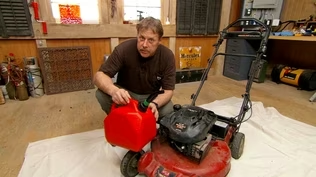
Lee: So I want to talk about push mowers.
Kevin: Okay.
Lee: We got three of them out here.
I got a gas one, I have a battery-operated one, and a manual one.
Kevin: Alright, let's talk gas first.
What do you like?
What don't you like?
Lee: Nice machine.
Power.
A lot of moving parts, though.
Kevin: Yeah.
Lee: We have the oil, spark plug.
Over here is your air filter.
Kevin: So more moving parts, more things that I've got to take care of, that I've got to maintain.
Lee: Yes, yes.
Kevin: And louder, which is, you know, we're used to it, but the neighbors don't always like it.
Lee: True.
A lot of noise ordinances out there.
Kevin: Alright.
But standard, standby, tried and true.
What about this one?
Lee: Then we have over here the battery-operated ones.
Really nice, heavy-duty batteries in there.
Kevin: These have come a long way.
Lee: They have come a long way.
They have come a long way.
Kevin: So what am I getting in terms of coverage?
Like how much?
Lee: This one here, you can probably do like a quarter of an acre, a little bit, maybe a little bit more on a full-charge battery.
Kevin: Not so bad.
Lee: But I suggest to always have a couple extra batteries.
Kevin: And again, we like them because for the environment we're not burning gas.
Quiet?
Lee: Quiet.
This one here actually has lights, so you can cut your grass at night.
Kevin: [ Laughs ] Or you could cut my grass at night with the lights.
Alright.
Lee: But these work really well.
Kevin: Yeah, yeah.
Look at this.
Old school.
Lee: Old school.
Kevin: Oh, my God.
Lee: My grandparents had one of these.
Kevin: Yeah.
Lee: I mean, you know, look at that.
Kevin: But you like the way the cut it gives you.
Lee: I love the way it cuts the grass.
Kevin: Look at all those blades.
Lee: Yeah.
Kevin: That's awesome.
Lee: Cuts them all nice and sharp.
Kevin: Alright.
And use it if you need a workout.
Lee: Exactly.
Small courtyards all the ways, you know.
Kevin: Alright, so let's talk about when we're mowing but when we're not mowing.
Lee: Okay.
When -- In the morning after -- after it's raining or, you know, watering like that, don't cut it.
Kevin: You don't like cutting wet long?
Lee: Yeah, because it'll clog up your machine and it'll maybe stress out the grass.
Kevin: Okay.
Lee: So I don't want to do that.
Kevin: Dry lawn.
Lee: Dry lawn is perfect.
Okay?
Always.
Kevin: What about height?
Lee: Height -- I like to do -- take a third off.
I like to cut certain times of the year shorter than others.
Springtime a little bit short.
Fall short.
But in the summertime, I want to cut it high and take a little third off.
Kevin: So you're thinking about every cut is taking just a third off, so you don't want -- So, like, how high -- Like, is it too high sometimes to cut?
Lee: Uh, yes, and then I'd probably bring in the trimmer.
You know what I mean?
If the grass was really high.
Kevin: Oh, you're gonna hit it with this first?
Lee: I would do this if the grass is really high.
Kevin: Like how high?
Lee: I'd say knee high.
Kevin: Yeah.
Lee: That's high.
Kevin: That's high.
Someone forgot to mow the lawn.
Lee: Exactly.
So that, I would use the trimmer in here.
Okay?
And this will less stress in the grass.
So I'd hit that.
And then after that, then I would come back in and, you know, cut it with the lawn mower.
Kevin: Beautiful.
Alright.
Things to think about before we start once we've decided that it is okay to cut?
Lee: So I would check -- Your blades are really important.
See this one here?
Kevin: So I'm gonna just reach underneath here.
Oh, you got some right there.
So I look underneath.
Lee: Yep.
Got blades in there.
Right?
Kevin: That's there.
It looks pretty good but it might not if I've been going after it hard.
Lee: That's probably about a season.
Kevin: And so this is the cutting edge here.
Lee: Yes.
Kevin: Another cutting edge right there.
Not only rusted but also dull.
Lee: Yes.
And then look at what we have.
This is a new one that I sharpened up.
Kevin: Look at that.
Lee: Razor sharp.
And it gives you a nice cut.
Kevin: So your idea is pop them off, give them a nice sharpen.
Lee: Correct.
Kevin: Or have someone do it.
Lee: Yes.
You have hardware stores will do them as well as lawn and small lawn engine places that'll do them too as well.
Kevin: Beautiful.
Lee: Okay?
Kevin: You probably do them all the time.
Lee: Yes, we do.
Kevin: For a regular homeowner, how often do you think you're doing it?
Lee: For just a season, if you're cutting the grass once a week, you can get away with it for a season.
Kevin: Yeah.
Okay.
Lee: Okay?
But it's good to always have two just in case.
Kevin: Alright, so it's dry enough and it's not too high, we're ready to mow.
You want to give it a look.
Make sure there's no, you know, things in the lawn, beer cans or something from the night before.
I'm just saying, you know.
Lee: So I want to make sure we have no toys out there.
Also a nice pair of shoes -- sneakers, no sandals.
Kevin: Closed toe.
My dad used to make me wear boots.
Lee: Really?
Kevin: Every time.
Seemed a little bit like overkill, but I still do it.
Alright.
Lee: We got safety glasses.
Kevin: So obviously glasses.
Lee: Correct.
Things come flying out of these things, alright?
And some air protection.
Kevin: Okay.
So are you ready to show me some technique?
Lee: Alright, let's get going.
Cut some grass.
Let's get started.
Kevin: Alright.
Lee: What do you think?
So, I like to cut the grass about three inches.
Kevin: Yeah.
Lee: Okay?
Especially this time of year in this region.
Kevin: So this time of year meaning what?
Different heights, different times?
Lee: Correct.
So springtime, I want to cut a little bit shorter -- two inches.
Fall, I want to cut about two inches.
In the summertime, due to the hot weather that we have and, you know, we have a cool-weather grass.
So that's why I want to do that.
Kevin: So cool weather, it's growing faster.
It's okay to get after it.
Lee: Correct.
Kevin: It slows down in the summer.
You don't want to... Lee: Exactly.
Kevin: So where are we going to put the adjustment in?
Lee: Okay.
So, this one here, easy.
Three inches I'm going to do.
Kevin: Beautiful.
Lee: Back in the day, they used to have... Kevin: Got to adjust each wheel.
Lee: Exactly.
Now it's one lever.
It's nice, really convenient.
Kevin: If you do the mowing and it passes, I'll follow along with the trimmer.
Lee: Awesome.
Alright.
Ready?
Kevin: Ready.
Lee: So what I like to do is I like to cut the perimeter first.
And I want to do at least two passes.
So that gives me room so I can go and turn in those two perimeters and cut my grass.
Kevin: Alright.
Lee: Okay?
Kevin: And then once you do the perimeter, is that when you're hitting it with the string trimmer?
Lee: Absolutely.
Yes.
Correct.
But you don't want to get too close to the bed.
Kevin: With the mower.
Lee: Correct.
Because you can fall into it.
You know, things like that, damage the bed, damage the machine, things like that.
Kevin: Alright.
Lee: Don't want to do that.
♪♪ ♪♪ Kevin: Looks good.
Right?
Lee: What do you think?
Kevin: Yeah.
It cleans right up.
That's nice.
Lee: Not bad.
Kevin: Alright.
Lee: So what do we got?
I have some clippings in here.
Kevin: So you're definitely of the ilk to pick them up.
Don't leave them on the lawn.
Right?
Lee: Correct.
Kevin: That's good.
Lee: That's a lot of stuff in there.
I'm going to dump this out.
These things here can go to your local -- towns will pick them up, you know, put them on curbside or just even have a nice compost in the backyard.
Kevin: Very good.
Well, hopefully people got everything they need to know about the mowers and how to properly mow the lawn.
Lee: I think we did a good job.
Kevin: Nice job.
You got it.
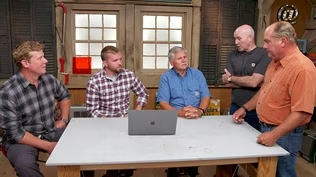
♪♪ Oh, look at this brain trust, huh?
You guys all got the memo, huh?
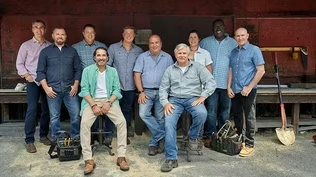
So with these years of wisdom in the room, you know, we get this question all the time.
You get it personally, we get it on the show.
Everyone's always asking, "how do I find a really good contractor tradesperson who I can trust?"
So this is what you guys do and you've done it forever.
Who wants to jump in first?
Heath: I'll start.
Kevin: Go for it, Heath.
Heath: So, I'm going to take one of the ones that seems the most obvious.
When you're dealing with a trade that requires a license, something like a plumber or electrician or general contractor, make sure they actually have a license that's valid and that they have insurance.
I mean, it seems simple enough, but people don't always check.
One of the easiest ways to check is you can check the license online usually with the state that issues it.
You can see if it's current and if there are any issues with that license.
Kevin: And do you think that there's a lot of folks out there who don't have a license and like, what should... Heath: Well, that's when of these red flags comes up.
So a lot of times you'll see some of these guys come along that should have a license and ask the homeowner to pull the permit.
When you see that, that's an immediate red flag.
That means that they probably can't pull the permit for some reason, whether it's an issue with the license, insurance or something else.
So definitely avoid that.
Kevin: Alright.
First on the list.
Ross: After licensing and insurance, next one for me is third-party certifications, especially in the HVAC industry, right?
Different skilled trades have different, you know, standards, but there are third-party organizations around the country that offer training for HVAC technicians so they can really get good at their craft.
It also tells me something about the company.
If the company is willing to invest in their staff to get them better trained at what they want to do and become pros, that's a huge differentiating factor.
And then with heat pumps, mini splits especially, those are computer-controlled machines.
And so you really need to know what you're doing.
And so the manufacturers offer their own trainings on installation, service, and commissioning.
So you really need to make sure that that contractor is trained on that specific brand before they do the installation.
Kevin: So similar to licensing, but in your part of the world, a lot of it is "Are they certified and properly trained?"
Ross: Yeah.
That piece of paper actually does matter.
Kevin: Yeah, yeah.
What do you think, Dad?
Richard: I agree with that.
And I got to warn you.
The other thing is, watch out for low bid, believe it or not.
Low bid -- You can't get a lot for a little, you know.
And if you take the middle bit or even the higher bit, you know, there's a good chance that they're going to have licenses.
They're going to go to training, they're going to have insurance, they'll do all -- file all the right permits, and they'll actually have employees that work directly for them, not just subcontractors.
Kevin: Right.
Richard: The other thing is look around your town, sort of see at the Little League games, you know, whose trucks are parked there.
And so that suggests that those guys are invested.
Guys or gals are invested in the local town.
And that means you might be able to find them later on, too.
Kevin: There's probably going to be a callback.
Richard: That's right.
There could be.
There could be.
Kevin: Right?
Richard: Not with our stuff.
Kevin: No, but I'm just saying like, help me with this, like, whatever.
Yeah, it makes total sense.
Alright.
Pops, you know, what do you think?
Certifications, licenses?
Tom: I think all of that is very important.
Absolutely.
A lot of people get, you know, they ask for a reference on a contract, but they don't follow up on it.
They don't call them.
They don't follow up with, you know, how was the job done?
If you find a contractor that you're going to work with, that you think you're going to work with, go to the jobsite and visit the jobsite.
How neat is the jobsite?
Is it clean?
Is it put together?
Is it organized?
If it's not, mm, that says a lot about a lot.
And do the subs all work together?
I mean, are they like -- It has to be like a team.
Let's face it, your house is probably the biggest investment that you make in your life, yet you want the cheapest guy to work for you and you wonder why it doesn't come out right.
Kevin: Yeah.
Tom: You're going to have to pay for the quality work, and you're going to be happy with it, and you'll forget about the extra money that you spend over time because you have a quality job.
But if you've got something that fails over time because you cut bids -- "I never should've have used that one, I never should've used that, I wish I'd gone and got it done correctly."
You got to be able to get along with that contractor because you're going to be around for a long time.
Kevin: So referrals is way up on your list of people you can really work with.
Yeah.
Okay.
Next G.C.
How about you, Zack?
What do you got?
Zack: You know, I think about these people we hire, whether it's for a large construction project that lasts 12 months, or whether it's someone who's mowing my grass, which could be working with them for years.
These are long-term relationships.
And what do we want out of our long-term relationships, right?
We want honesty, we want trustworthiness, and we want to feel heard.
So I think people should really, um, see things through the lens of dating.
Right?
Did you feel -- Did you feel seen and heard?
Right?
Did they lie about their height?
Richard: That's right.
Zack: You know?
If I have a social-media page with all these big projects, did I actually build those or is that some AI generation?
Right?
So really sort of treat the person -- You know, dig through their social media like you would someone you were dating, you know, really do your homework on them.
And that's sort of the way I treat it and also understand what it is you're trying to do, right?
It's a two-way street, so that contractor is vetting you just the way you're vetting them.
And if you're showing up with bad energy or being demanding, they may back away and you might scare them off.
So understand that there's a lot of other projects out there that they could be taking.
And if you want top-tier talent, you have to make yourself attractive to them.
Kevin: High emotional intelligence over here.
I mean, we all have friends who tell us like, "Oh, they won't call me back.
They never call me back."
And you're kind of like, "Mm, maybe it's you."
Heath: Wonder why.
Tom: Yeah, exactly.
Richard: Welcome back to "Love Life."
[ Laughter ] Tom: That's so true.
Kevin: Jenn, what do you think?
Jenn: Well, I often call it the breakup at the end of a good project because I fall in love with my clients because I want them to know that I will always come back to fix something.
But when you're looking for a landscape designer, contractor versus landscape maintenance, a lot of people say, "Oh, I just want landscaping."
There's a big difference, right?
There's maintenance, which is lawn mowing, you know, irrigation, all the -- all these things that are like the to-do's after a garden is installed.
So, like, my job is design the master plan.
You get the contractor to install it, you have multiple subs, and like you said, all the subs should really get along.
See how -- Tom: Get along.
Jenn: Yep.
See how they interact.
So that's doing an installation doing the construction part.
And then maintenance is caretaking and after.
Kevin: Alright.
Got a little romantic corner over here.
Jenn: Well, you know.
Kevin: That's good.
So, Nathan, I guess that leaves you with the last word.
Nathan: I'm going to go all the way back to the beginning because I think it's really important for the homeowners to figure out what's the scale, the scope, the size of their project they're taking on.
Are we hiring a general contractor?
Are we hiring just a good carpenter to tackle that job?
Or maybe it's a handyman, you know, and those terms can all be really vague, you know?
Are you swapping a light bulb or are you putting an addition on your house?
You know, what's the goal there?
So go online, visit websites, visit jobsites, check their social media, as long as it's not AI-generated.
You know what I mean?
Ask questions.
See if the project you want to do is something they're interested in taking on.
Kevin: Cool.
Alright.
Well, the breadth of experience, the years of experience in this little table right here is amazing.
So thank you for your guys' wisdom and thank you for sharing it.
So where are my flowers?
[ Laughter ] ♪♪ ♪♪ Mark: Kylie?
Kylie: Yeah.
Mark: Hello, Kylie.
I'm Mark.
Kylie: Nice to meet you.
Welcome to Washington state.
Mark: Alright.
I love the chickens.
Now, I have chickens in Boston.
I wish I brought a couple.
They could have met Washington chickens.
Kylie: Oh, we love our chickens.
They eat a ton of bugs and help out in the garden.
And I love the eggs.
Mark: I know the chickens don't need a walkway, but I think that's what you wrote in about.
Kylie: Yes, absolutely.
Mark: Alright.
Okay.
Over this way?
Kylie: Yes.
Mark: Alright.
Let's go.
Alright.
So this is the walk.
Kylie: This is.
And this is my husband, Shaun.
Mark: Hey, Shaun.
Sean: Hi, Mark.
Nice to meet you.
Mark: My pleasure.
Sean: So, yeah, we're looking for a new walkway.
As you can see, it's pretty uneven.
There's sharp edges.
It's hard to shovel in the wintertime just due to the uneven nature of the stones themselves.
So we were just looking to see what -- what you could do with this.
Mark: Alright.
So, uh, I do see a couple things that I would change.
Um, are you guys thinking repair or you want to go brand new?
Shaun: We would like to go brand new.
Mark: Okay.
And I can either take these stones out of here and maybe put them somewhere else.
Or if you guys have another idea.
Shaun: I've got a friend that's actually willing to take them.
Mark: Alright.
Repurpose any material.
I always love that.
So why don't we go over here, get some tools and get this stuff up?
Shaun: Perfect.
Kylie: Let's do it.
Mark: Alright, let's go.
♪♪ Alright.
So because these stones are laid in gravel, they're going to come up pretty easily.
So, Kylie, why don't you just grab some of the smaller stuff?
Shaun, I'm going to get my shovel under some of the bigger ones, and you can just pick them up and stack them behind me.
These are nice stone, though, I'll have to say that.
Shaun: They are.
Mark: Yeah.
Alright.
So next step -- we have to remove the gravel.
So we're going to pile it up, get it in the wheelbarrow, get it out of here.
Well, this is actually coming up a little better than I expected, but why don't we get the shovels in on that.
Shaun: Okay.
So, Mark, how much wider are we going to go?
Mark: So when we're doing walkways, things like this, I like to over-dig.
Shaun: Okay.
Mark: So I'm going to go six inches past the step and then tamp it down.
Kylie: Am I trying to get this level or just compacting right now?
Mark: So leveling is always important.
But this exercise is more for compaction.
Leveling comes with the base, which is very important.
Alright.
So up in the northeast, we use what we call a crusher run or sometimes we call it crushed gravel.
This is a basalt-based material.
What is that?
Shaun: So, most of Spokane is built on a basalt shelf.
And so it's the material that's most readily available in this region.
Mark: Okay.
And it looks like to me it does the same thing it does out where we are.
Shaun: Yeah.
It compacts real well.
Mark: Alright.
So we're going to hit this a couple more times and then we'll be ready for you to dump that, Shaun.
Shaun: Okay.
Mark: I'm going to spread it with my rake.
And I'm going to do the entire pad.
And I want to only do it two inches.
Kylie: So will we do it in multiple rounds?
Two inches, tamp, and then another two?
Mark: Yep.
We call it multiple lifts, so every two inches is a lift.
So once we do the first lift, rinse and repeat a couple times.
Kylie: Alright.
Mark: Alright.
And we'll work from this edge backwards.
Kylie: Okay.
So what's the water for?
Mark: So, the water is going to help us lock the material together.
So once I get done soaking this down, we're going to want to tamp it one more time.
Shaun: So are we done with the base material then?
Mark: Not quite.
As we discussed before, we got a slope in this walkway.
So we're a little bit low up by the steps.
We're going to add to that.
Tamp it down, soak it down, tamp it down again, and then we should be ready to go.
And if you guys look behind you, that'll give you some indication on what our slope is actually going to be like when we finish.
Shaun: Great.
Kylie: Really gradual.
Mark: Yep.
Alright.
We're looking like we're in pretty good shape.
I think all we're going to have to do right now is the coarse sand.
♪♪ Shaun: Wow, Mark, you've been busy.
Mark: Sure.
Kylie: What layer are you working on?
Mark: Okay, so this is that sand that we were talking about.
We know we needed one inch.
This white pipe that I have actually represents that one inch.
So I put it up top.
I followed our pitch all the way down to this point, but you can see the pavers that I put in.
That's just going to tell me that the top of this pipe and the bottom of that paver are exactly where they're supposed to be.
Shaun: Okay.
Mark: So all we have to do, if you guys don't mind giving me a hand, it's just giving me more of the sand.
Shaun: Yeah.
Mark: And we'll work ourselves all the way down to the end.
Alright.
Kylie: So are we leaving the rails in?
Mark: So actually the rails come out.
And once they do, all we do is take this little trowel, this margin trowel, and then all I'm going to do is start to sprinkle the sand where the pipe was.
Kylie: Is our sand pad the size that our pavers are going to be?
Mark: So that's what we're going to do layout for.
We'll space them appropriately.
Kylie: And then that's where we'll backfill so we won't see the sand?
Mark: Exactly.
Kylie: Okay.
Mark: Okay, now we're ready for pavers.
Kylie: So, Mark, what's the orange string for?
Mark: So the orange string is going to represent our height.
So I'm going to go right under this step.
And I'm going to go all the way down to the driveway.
My pitch is built in so I don't have to worry about the pitch.
Kylie: So the stones will fit smoothly under it.
Mark: Exactly.
♪♪ ♪♪ ♪♪ Shaun: So, Mark, I got to say, I thought this walkway was going to be a little bigger.
Mark: Alright, well, we're not done yet.
We have one more piece to put in.
It's a decorative piece that we're going to run all the way around each edge.
So it's going to get a little bigger before we're done.
Shaun: Great.
That'll look nice.
Mark: Alright.
Let's get at it.
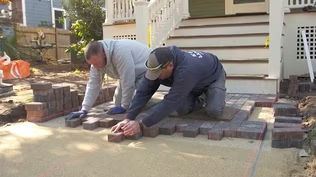
We take one of these bricks and we overhang it half a brick.
So we line it up like that.
We'll put this whole decorative edge in this way.
And then we're going to run it up this edge and we'll be done.
♪♪ Cool.
Shaun: Looks great.
Mark: Alright.
Now it's time for our aluminum edging.
I've already laid some nails out for everybody.
Those are six-inch spikes, and I want to hit every single available hole on this edging.
Why?
Sometimes frost will push it up if you don't nail every single one.
So that's why we won't skip any holes.
♪♪ Alright, now it's ready for the sand.
So I'm just going to spill some sand for you guys.
You can push it around with the brooms once I get you going.
Kylie: And what does the sand do?
Mark: So the sand, you can see it already starting to fill in the gaps.
That's going to help lock all these pavers together.
So just keep sweeping.
Kylie: Is there any other maintenance to it?
Do we have to do anything else to the sand?
Mark: So after a rainstorm, you might notice that some of the sand has settled.
So that's when we'll repeat the process.
♪♪ Shaun: So, Mark, is the goal to backfill this enough so we don't see that aluminum edge?
Mark: Exactly.
That's why we held it down just a little bit.
Shaun: Okay.
Mark: So you're good.
♪♪ Okay.
So you can see we watered it down a little bit.
That's just to help the sand work into the joints.
I've actually left you guys a bag of sand.
So anytime you see the joints wanting to be fed, feed them up.
Other than that, I do have a little homework for you.
It's going to be grass seed over here, over here.
Other than that, you guys should be all set.
Shaun: Okay.
Kylie: Well, it turned out so great.
I think we've been inspired to come up with a permanent marker so it doesn't get plowed up again this winter.
Mark: Okay, I love that idea.
And if you have questions about your house, we'd love to hear from you.
So keep them coming.
Until next time, I'm Mark McCullough for "Ask This Old House."
♪♪ Kevin: Next time on "Ask This Old House," when a homeowner wants to add storage to their bathroom, Nathan steps in to give it a facelift.
Woman: This changed the game.
It looks so good.
Kevin: Then the crew gets together for a round of "What is it?"
Ah, now they're coming.
And Mauro helps a homeowner patch a textured ceiling.
Mauro: Stretch it down a little more.
Kevin: All that on "Ask This Old House."
















Support for PBS provided by:
Funding for Ask This Old House is provided by The Home Depot, Renewal By Andersen, and ChipDrop.