
April 9, 2026
4/9/2026 | 55m 28sVideo has Closed Captions
Volodymyr Zelensky; Mark Rutte; Roberta Metsola; Sen. Roger Wicker; Jesús Armas; Margaret Hany
Ukrainian President Volodymyr Zelensky, NATO Secretary General Mark Rutte, EU President Roberta Metsola, and Sen. Roger Wicker discuss the Russia-Ukraine war at the Munich Security Conference. Freed Venezuelan opposition activist Jesús Armas on his time in prison and his hopes for his country. Neurobiology professor Margaret Hany evaluates Americans’ relationship with marijuana.
Problems playing video? | Closed Captioning Feedback
Problems playing video? | Closed Captioning Feedback
April 9, 2026
4/9/2026 | 55m 28sVideo has Closed Captions
Ukrainian President Volodymyr Zelensky, NATO Secretary General Mark Rutte, EU President Roberta Metsola, and Sen. Roger Wicker discuss the Russia-Ukraine war at the Munich Security Conference. Freed Venezuelan opposition activist Jesús Armas on his time in prison and his hopes for his country. Neurobiology professor Margaret Hany evaluates Americans’ relationship with marijuana.
Problems playing video? | Closed Captioning Feedback
How to Watch Amanpour and Company
Amanpour and Company is available to stream on pbs.org and the free PBS App, available on iPhone, Apple TV, Android TV, Android smartphones, Amazon Fire TV, Amazon Fire Tablet, Roku, Samsung Smart TV, and Vizio.
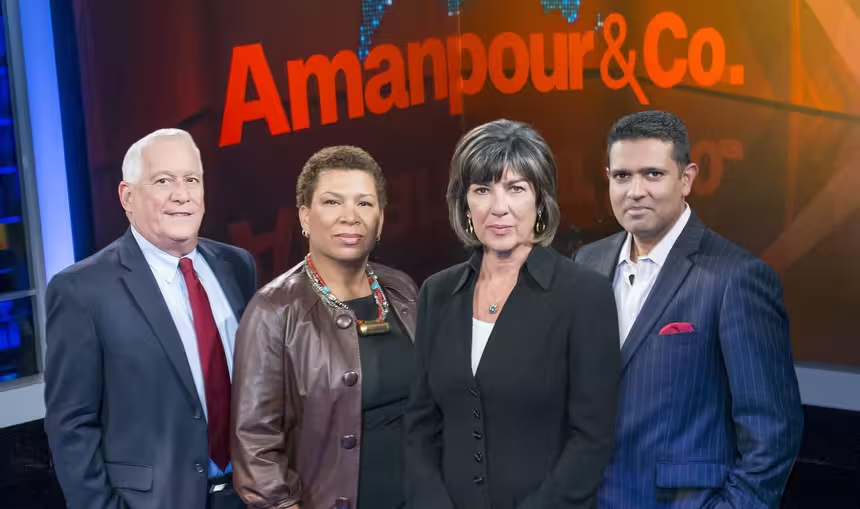
Watch Amanpour and Company on PBS
PBS and WNET, in collaboration with CNN, launched Amanpour and Company in September 2018. The series features wide-ranging, in-depth conversations with global thought leaders and cultural influencers on issues impacting the world each day, from politics, business, technology and arts, to science and sports.Providing Support for PBS.org
Learn Moreabout PBS online sponsorship(dramatic music) - Hello everyone and welcome to Amanpour & Company.
Here's what's coming up.
- Our people are dying too.
That is why we are doing everything to stop this war and to guarantee security.
- [Bianna] As delegates head to Geneva For the next round of Ukraine peace talks, Christiane discusses what's at stake in Munich with President Zelenskyy and leaders from NATO, Europe, and the United States.
Then in Venezuela celebrations as some political prisoners are released, while many more remain behind bars.
I asked one of them, leading opposition activist Jesus Armas, if he believes Venezuela is on a path to democracy.
And.
- It's a drug that can be misused and it's a drug with potential therapeutic consequences.
But that doesn't mean it's all good or all bad.
- [Bianna] With marijuana legalized in state after state, Michel Martin speaks to neurobiologist, Margaret Haney about how the drug affects the brain.
(dramatic music) (dramatic music continues) - [Announcer] Amanpour & Company is made possible by the Anderson Family Endowment.
Jim Attwood and Leslie Williams.
Candace King Weir.
The Sylvia A. and Simon B. Poyta Programming Endowment to Fight Antisemitism.
The Straus Family Foundation.
The Peter G. Peterson and Joan Ganz Cooney Fund.
Charles Rosenblum.
Monique Schoen Warshaw.
Koo and Patricia Yuen, committed to bridging cultural differences in our communities.
Barbara Hope Zuckerberg.
And by contributions to your PBS station from viewers like you.
Thank you.
- Welcome to the program everyone.
I'm Bianna Golodryga in New York sitting in for Christiane Amanpour.
It's been almost four years since Russia's brutal full scale invasion of Ukraine began, and now Ukrainian negotiators are headed to Geneva to meet with Russia and the United States for the next round of talks, hoping to hammer out a ceasefire agreement.
Secretary of State Marco Rubio says President Trump wants a solution that ends the bloodshed once and for all.
And President Trump says Kyiv has to move because Russia wants to make a deal.
Speaking at the Munich Security Conference, President Zelenskyy told delegates that Ukraine will do everything to make these negotiations successful.
- The Americans often return to the topic of concessions, and too often those concessions are discussed in the context only of Ukraine, not Russia.
This is very important and Ukraine keeps returning to one simple point, peace can only be built on clear, clear security guarantees.
Where there is no clear security system, war always returns.
- And there's still no end to the war in sight as tens of thousands of soldiers on both sides are killed each month.
And Ukrainians huddle in the cold, their energy system decimated by Russian bombardment.
In Munich, Christiane sat down with Zelenskyy alongside NATO Secretary General Mark Rutte, European Parliament President Roberta Metsola, and US Republican Senator Roger Wicker.
Here's their conversation.
- Can I just ask you, what do you need right now?
I'm really conscious of the time and owning time issue that you've talked about, but if you were to put out a wishlist or a shopping list right now, is it mostly anti-aircraft and anti, you know, missiles to protect your skies?
What do you need right now?
- So, thank you very much for this conversation.
Let's look at priorities.
All our challenges are first energy challenge.
We need missiles for patriot systems, first of all for patriots.
And so we spoke yesterday with our Norway partners, Americans and also with Germany.
So we need also missiles for NASAMS and for IRIS-T systems.
This is crucial.
This is number one what we need missiles and as quick as possible, I'm very thankful for possibility Mark for you and thanks to you and not only we're thankful for Ramstein, I think that it was positive, I will tell you successful when missiles will come to Ukraine.
Yeah.
So, I hope that it will be successful and it was very difficult and Germany helped very much.
And the Minister Pistorius, I don't know where is he.
I think he works, yes, on this plan.
So, yeah, to bring more missiles to us.
So, this is about energy.
We spoke yesterday with our Berlins group, how we call it, because we had successful meeting yesterday with all the partners.
And I think the idea before 21 was to strengthen Ukraine as much as possible with energy supplies will be a plan of energy support plan of missile.
This is important.
Then it's (indistinct), Mark is sitting here.
Now then I see Roberta.
So we need membership in EU.
(audience laughing and clapping) You said which list.
- [Christiane] And then membership in NATO.
- Yeah, yeah, yeah.
- Okay.
All right.
Let me ask- - And we need security guarantees.
- [Christiane] Yes.
- Which been voted in- - [Christiane] In a second.
- Yeah.
- Secretary General, President Zelenskyy and the Ukrainian people, and as he said, Europe, expects right now for the defense of that land and your land, what can they get right now?
- Can I, before I answer the question, just share with you two things I saw myself last week in Kyiv.
I was with a small team of colleagues from NATO.
First of all, you saw one of the pictures here of the impact of five missiles taking out one of these huge heating plants.
And we do not always realize in this part of Europe that when it comes to Kyiv and the big cities, they are heated centrally.
So what the Russians did was five missiles take out this heating plant responsible for heating the homes of a quarter of a million people.
That plants will be down at least for two months.
That means that these people and it was minus 25 degrees last week in Kyiv during night and minus 15 degrees during day, that they are living in those conditions.
When you speak with the people, they're telling me, "Hey, keep on supporting us.
We will not give in."
It only makes them almost stronger despite the terrible difficulty they are facing.
We have to realize solutions are not winning this.
As you said, they lost 65,000 people in December and in January.
They are not winning this.
They make very small gains in Donetsk and other places, so small that it's almost not relevant.
But they lose all these people.
If there is a dictator in Moscow willing to do that, we are really working with somebody who is willing to do that to get so many of his own people killed in that war.
We have to take that seriously because this is crazy behavior at every level.
So what we need to do here in this room, in all our positions, the politicians and everybody who can influence this, is to make sure that these people who are staunch, who are defending themselves, who will never give up, that they have the offensive stuff they need, we need to do this, keep them strong in the fight.
They will do it, but they need our support.
- And the second part of that, (audience applauding) the other side of that coin, is putting enough pain on Putin, as you have said, and as others have said, to actually get serious about a serious negotiation.
- And that's exactly what Rubio said today.
- Right.
- It is testing him.
Is he serious, Putin, about all of this?
And he is again, sending this historian next week to the talks in Geneva.
So he will again lecture the Ukrainians about how to rest from Sweden or whatever.
- But in his speech, in his speech, he mentioned Ukraine only in passing and the words were elusive peace.
So we'll get to that in a minute.
Roberta Metsola, for Europe, you saw a call to arms today from Commission President Ursula von der Leyen, from Prime Minister Starmer, really rebuilding Europe's military industrial complex.
What though can you do now?
How come you haven't managed to get all those, you know, the money of Russia that you could actually give to Ukraine and most of the Europeans agree with it.
Why can't you just get it done and put pressure on Putin as President Zelenskyy says, and as it is patently clear that there is not enough pressure on Putin yet, he doesn't feel enough pain.
- On that we agree.
Next week I will sign a 90 billion Euro loan to Ukraine agreed in under four weeks in an unprecedented speed.
You might say it took us too long.
We used to do things much slower before, but when push came to shove, we really put our money where our mouth is and this is what we need to use as the strongest of message that when I first came to Ukraine couple of weeks into the beginning of the war, Volodymyr, I told you that we would stand with you and I preside over a parliament where the majorities are huge.
And I want to say this because every second question wherever we go, we're asked, "But there's fatigue and people are looking away and you're losing your priorities on what you should do."
My answer is I was in the opening of the Winter Olympics one week ago and the loudest cheer was for the Ukrainian delegation.
And that is what shows spontaneously that the people of Europe are with you.
What have we done since the 24th of February, 2022.
So we have the immense increase in GDP expenditure on defense.
That's also thanks to your leadership, Mark.
Secondly, we have adopted an unprecedented number of sanctions in terms of packages, we're waiting for the 20th package now.
We are working and agreed with Volodymyr when he talked about the next step on what we should do on the shadow fleet.
We have two new members in NATO and this is particularly personal for me because one of my sons is serving in the military of one of them.
And that is what would never have been done if it were not for Ukrainians fighting for the freedom that we took for granted, that we looked away, that we took too long to respond to.
- Okay, Senator Wicker, senior senator, Republican senator, what more can the United States do?
We've had a year of so-called negotiations in which every time we look around, it appears that President Trump puts more pressure on President Zelenskyy than on President Putin.
There is a package of sanctions that's ready to go, I understand both houses of Congress.
- That's right, that's right.
- So tell us about it.
- And that's the good news.
And what we've just heard from Europe is very good news.
What we need specifically is we need for the administration to unleash the tomahawk missiles.
And that's a message that will come from the Congress.
It's the decision of the administration.
But the very good news, in addition to the good news about messages of reassurance today and the support that this room has shown, we will be able to vote in two weeks time on sanctions.
And what Ukraine really needs is for Russia to run out of oil.
And if we pass meaningful, serious sanctions on the oil producers on say the eight refineries around the world that Russia depends on, that can bring a meaningful change in the negotiations.
Some other good news.
Public opinion in favor of Ukraine in the United States is growing, public opinion among Republicans being polled is growing in the United States.
And we are in a position with the sanctions bill perhaps next week for this to be a turning point.
- Well that is very interesting news for sure.
President Zelenskyy, we were talking about, you know, security guarantees, all the things that you need in order to actually sign on to a peace process.
I don't know what you make of President Trump's latest in which I believe yesterday he said, "Zelenskyy is going to have to get moving.
Russia wants to make a deal and Zelenskyy is going to have to get moving.
Otherwise, he's going to miss a great opportunity.
He has to move."
Obviously, I mean this is pressure.
Are you feeling the pressure?
(audience laughing) - A little bit.
(audience laughing) Oh, I mean there's, I understand signals of the president, maybe it's preparing atmosphere before Switzerland meeting, trilateral meeting and et cetera.
So, not losing our dignity, we can move.
We made a lot of compromises speaking with Russians beginning even with this.
We have trilateral meetings with all respect to the United States.
They proposed us to have such meetings.
I think it was a compromise from the side of Ukrainian people.
The second point, we are ready to speak and continue.
We are ready to speak about constant line.
We are ready to speak about the stop on the contact line and then begin to talk.
This is also compromised because we are speaking about our territories which are temporarily occupied, our people which have been killed.
So a lot of different compromises.
The question is what Russians are ready to do.
We don't hear compromises from Russian side.
We want to hear from them something.
And I think this is important.
- Before you carry on, can I just ask you about two press- - Our people under pressure, by the way.
- Of course.
- Under pressure.
Our people, Ukrainians under pressure.
- Of course they're being killed.
The FT reports that you are prepared to announce a plan for presidential elections and a referendum on a peace deal that you're prepared to announce that even potentially by the end of this month.
True or false?
- Something new for me.
- So you don't know.
- It was new for me.
Yes, I think I answered already on this question, but I can repeat.
First of all, of course nobody support elections during the war.
It's something strange.
I said it about so many times.
Then I said, if American side will push this signal, I'm ready to show that we are ready for this.
Okay, give us, I'm very honest, give us two months of ceasefire, we will go to elections.
That's it.
Give us ceasefire, give us security infrastructure.
Maybe not two months but we need a lot of days to prepare then give us possibility, our soldiers to vote, how they can, I mean, defend our lives, our country.
And at the same moment to vote.
This is something difficult.
Even not, I mean this is strange.
It's something very difficult and I don't know who has such experience.
We don't have it.
And we can't compare.
Sometimes I heard, sorry.
Sometimes I heard, yes, we had elections in the United States during Lincoln's time and et cetera.
How we can compare it.
We have missiles, our people under missiles.
It's not just land war, a lot of missiles.
We're under ballistic attacks.
So give us ceasefire.
President Trump can do it.
Push Putin, make ceasefire, then our parliament will change the law and we will go to elections if they need them, if Americans need elections in Ukraine and if Russians need elections in Ukraine, we are open for this.
- Secretary General, even- - But we can also give ceasefire for Russians if they will do elections in Russia.
(audience applauding and cheering) (audience continue applauding and cheering) (audience continue applauding and cheering) - Secretary General, even the China- - This is why he is- - But that's his previous and his current- - Never give in.
- Strength, right?
Communication.
Can I ask you, even the Chinese foreign minister, as he was talking and addressing today, did the whole Russian trope about having to talk about the historical reasons and the preconditions and this and that for a ceasefire.
What do you see as the vital security guarantees that need to be in place?
And so far, Russia has said no to even an international monitoring force of Europeans.
So what do you see is a realistic security guarantee?
- We need security guarantees at three levels.
Level one is the Ukrainian Armed Forces.
They have to be so strong and so well trained and of course they are already battle hardened that they can first of all, of course defend themselves.
Then we need, and this is the leadership of Macron and Starmer within Europe, the coalition of the willing, many other countries participating in Europe, Canada, and also by the way, more and more the US getting involved, we will come to that, with the coalition of the willing, and nations in NATO but also outside NATO working.
And then the third element is the Americans.
It was a crucial moment when the American President Trump said in August, "I want to be part of that.
I want to be participating."
And then we articulated the Ukrainians and the Americans and the coalition of the willing what that will be.
And this is exactly as the president said, as Volodymyr said in January, we had a meeting in Paris, very successful with the Americans where I would say 95, 96, 97% of the security guarantees now done.
So this is crucial because that means that when that peace deal is there, we can make sure collectively with Ukrainian Armed Forces as the first line of defense that the Russian will not attack again.
But obviously to do that, you need Putin to play ball.
What I am seeing, what the Americans are doing consistently since February under President Trump's leadership, Marco Rubio, Steve Witkoff, Jared Kushner, is they're testing the Russians to see whether they are serious- - [Christiane] Yeah, but this has been going on for a year.
- Yeah, but hey.
- How much testing?
- We can have as much criticism as you want on the present American government, but I am going to defend them there.
- [Christiane] No, it's the question.
- I know, I know.
- It's a question actually.
- But in the question I hear so- - How long?
- I know and I don't mind.
- How long do you- - But let me- - [Christiane] This has been the deadliest year for Ukraine.
- But here's the thing.
Here's the thing.
If we agree that only the American president was able to break the death lock with Putin, I think it was only him because he is the leader of the mightiest nation on earth, a quarter of the world economy, the mightiest military on earth.
He did that in February.
He brought a deadlock and never, no one expected this to end soon.
It is an extremely difficult situation we are dealing with.
And the most important issue here is not Zelenskyy or the Ukrainian team.
They are willing to play ball.
They want this to end as soon as possible.
Nobody wants to prolong this.
So, it is the Russians who have to play ball.
- Senator Wicker, as far as I gather and you can confirm, that Secretary of State Marco Rubio did not choose to go to the special Berlin format meeting of all the President Zelenskyy, Mark Rutte, and the other leaders.
What do you think that signals and do you think as Secretary General Rutte says, that the United States is absolutely committed to a fair and just peace and is willing to do the work for it?
When I say the United States, I mean this administration.
- I take the Secretary of States statement on face value.
I don't think it matters very much, but let me say this.
Vladimir Putin has not yet negotiated in good faith.
Never once.
Vladimir Putin started this war.
He's a war criminal.
And as you've pointed out, he started committing more war crimes this year by attacking civilians.
He will begin to negotiate in good faith only when he is hurting enough.
And that's what these all sanctions may do.
- Last word to you, Mr.
President, how do you think this year is going to go?
And let's take the next six months.
- Let's think about tomorrow.
- Tomorrow.
(audience laughing) - Really, and the day after tomorrow, how it will be?
We will support peace dialogue.
If United States will stay, I hope will stay in negotiation panels and dialogues.
It's important for us.
I hope that we will involve more and we will work on it, more European colleagues.
Then I really hope that we will have support from the United States, from administration, and congress on security grantees.
We need their votings.
I hope that we will have security grantees very, very clear for, sorry, but first of all, for our people, that our people will know what will be if Russia will come again.
Then we really want to work on EU membership.
And I know that some European leaders are not happy with my rhetoric and messages.
I'm sorry, but I will continue because we need... We are very thankful, it's true.
We are very thankful but we can't save only by say thank you, can't save our lives.
That's why I'm very honest.
For us, it's very important to have a date, day for our membership.
Otherwise, after this war will end, I'm sure that it will end, Putin will do everything.
Doesn't matter what he will negotiate.
He will do everything by his hands or by hands of some, not big countries, but very ambition leaders.
He'll do everything by using them to block our EU membership.
That's why I want very much to have signing by Americans, Russians, Europeans, and Ukrainians in this 20 points plan where the date is written.
What can I say?
The unity is very important and the United States is important.
They have only to make Ukraine stronger than Russia.
- Okay.
- Thank you.
- On that note, Mr.
President, Secretary General, President of the Parliament, Senator Wicker, thank you so much.
(audience applauding) - Well, since the US grabbed Nicolas Maduro, there have been mixed messages out of Venezuela on restoring democracy.
On one hand, acting President Delcy Rodriguez defends Maduro's legitimacy.
Here's what she said in an interview with NBC News.
(Delcy speaking in foreign language) - So yes, I can tell you that President Nicolas Maduro is the legitimate president.
They are both President Maduro and Cilia Flores, the first lady, are both innocent.
- On the other, she touts Venezuela's cooperation with the US speaking here on a visit to oil facilities with the American Energy Secretary.
- We're doing extraordinary work as partners to improve production facilities, infrastructure and maintenance.
This is the path of cooperation and the agenda for a long-term productive partnership.
No obstacle should stand in the way of this productive path that we are on.
- Rodriguez is also sending mixed messages on human rights.
She's overseeing the release of dozens of political prisoners while many more remain behind bars.
Among those released is Jesus Armas, who led what most observers called a winning presidential campaign for Edmundo Gonzalez.
Following that, Armas was held in jail for over a year.
I spoke to him about what he endured in prison and his hopes for democracy in Venezuela.
Jesus Armas, thank you so much for taking the time to join us.
Let's go back to 14 months ago when you were abducted at gunpoint, suffocated with a plastic bag over your head, and not knowing if you would live to see another day, a week, a month, and really enduring so much torture.
Can you just give us a sense of what that says about the Venezuelan state under Nicholas Maduro and his number two, Delcy Rodriguez, at the time?
- So, without any doubt in Venezuela, we live under an authoritarian regime and not only authoritarian in a classical way, it's also a criminal regime that violates human rights.
But at the same time, it's connected with all the cartels and different criminal organizations all around the world.
So this total thing is a common practice between the different policies or security movement of the government of Nicolas Maduro's regime.
So, we are really happy that Nicolas Maduro is right now facing the justice in the US but we know that it's not enough that we need also to have a transition to democracy in Venezuela because the regime, Delcy Rodriguez, is still in power.
- You were in a windowless cell.
If we go back to that date of January 3rd, when the explosions began, I know you were unaware of what was happening.
You only learned two days later that Maduro was actually captured by the United States.
In that moment when you were isolated, did you comprehend that this could in fact be the end of his regime or of Nicolas Maduro's reign over the country and what were you thinking about how that would impact you?
- So, it was a really weird moment because as you described, we didn't have any window in the cell.
So, in that moment we listened to a big explosion that was really, really loud.
And we saw the members of the Maduro secret police or the guards running around without any notion about what was happening.
And we saw in that moment that maybe it could be related with the United States.
And then when we really realized that Maduro has gone, that he was in Brooklyn, we started to think that maybe there was a real opportunity for a transition to democracy.
- Yeah and rights groups now in the country, as we are seeing some ease over the authoritarian rule of that country, we are seeing a bit more freedom, more political prisoners released though not all, and I'll get to that in just a second.
There is concern among rights groups that the United States is prioritizing some sort of stabilization right now as opposed to democracy and elections.
- For us, the priority is to have a free and fair election, a general election where people can choose their national assembly representative, their president, their mayors, the governors.
Because right now we live under a regime that of course, it doesn't have any legitimacy.
So, we want to organize the people in the next few months to put more pressure on the regime and to achieve this election because the regime is going to try to stay in power.
It's going to try to stall another election if we have an election.
They will do whatever they can do to stay in power and to keep the repression and the authorities in Venezuela.
So, we now need a United States that can commit not only with the economical transition in Venezuela, which is really important.
You know, that Venezuela was a few years ago in a humanitarian crisis, but also that can commit, really commit to have an election this year.
So of course for us is our main concern.
- Yeah, and Secretary Rubio said that that is the US' goal too, to one day have elections.
It may not be though as soon as this year, as soon as you would like, the United States has already started to roll back sanctions.
President Trump has repeated that Delcy Rodriguez is somebody that he can work with, that his administration can work with.
The Energy Secretary was just in Venezuela last week meeting with Delcy Rodriguez.
And we know that prioritizing the oil and control over the oil has been a top focus of this administration.
We haven't heard President Trump speak much about upcoming elections.
And when you look at even recent polling since the last few weeks, Maria Corina Machado, your candidate, would win 67% of the vote compared to 25% that would go to Delcy Rodriguez.
If that support is so clear, are you concerned as to why the United States isn't then pushing for an election sooner?
- I think that statements like the statement of the Secretary of Energy about elections are really important at that we will have enough pressure in Venezuela and also enough organization of the civil society and the opposition.
In the next few months that we will have the opportunity to achieve a general election.
That's our plan, that's our goal to have a general free and fair election.
- Well, we know the government says that it wants a reconciliation in the country through an amnesty bill.
There are 644 political prisoners that remain behind bars right now, families holding hunger strikes outside of these prisons until their loved ones are released.
I know you say that this amnesty law as is is not far enough, does not go far enough in releasing and giving amnesty to all of those political prisoners.
If you can just give us a sense of what your experience was like behind bars in one of the most notorious prisons in that region of the country, which by the way we should note, there's now discussions about turning that prison facility into a community center.
I'd love to get your thoughts on that too.
- So I have four stages in my prison experience.
The first stage was about torture, was to be disappeared by the Maduro secret police, was to be in a clandestine, a safe house, being tortured and also being interrogated for hours.
They wanted to know where was the Maria Corina Machado location, the Juan Pablo Guanipa location.
So after that they moved me to Zona Siete which is the place where the people are right now in hunger strike.
And that may be the hell on earth.
There was a place where I have to live in a really small cell with 37 other people that were in a really, really bad shape.
Actually a lot of them were sick and they didn't receive any medical attention.
And also we have to live with rats.
There were rats everywhere.
There was no bathroom inside of the cell.
So the people have to go to a bathroom in these plastic bags.
And there was a lot of cruelty by the guards.
So, it was a really, really hard time.
Then I was moved to El Helicoide and in the El Helicoide I lived under psychological pressure on the psychological torture.
We were threatened a lot.
We were all the time under interrogation process that lasted for hours.
For example, they maybe intergrade me at 10:00 AM then at 2:00 PM, and then they woke me up at two or 3:00 AM and asked me again and again the same questions.
And I was, it's isolated.
I was isolated for 10 months without any information about my family, without any information about my girlfriend.
And I didn't know that if my dad was dead or he was alive.
And also my family was really scared because they didn't know if I was really alive.
So it was really exhausting, really hard for me to go through this experience.
And finally after January 3rd, the thing changed and so, they started to give me visits.
So, after 12, 30 months, I have the opportunity to talk with my mom, to talk with my girlfriend.
And they started to treat us better, to give more time under the sun, to give us more time to exercise.
So this was like hell but believe me, we are stronger now and we know that everything we did have a value and it's gonna have this big price at the end, which is democracy.
- Yeah, hell on earth is one way to describe it.
El Helicoide is what is being now discussed to turn into a community center.
Final question for you, Jesus.
You are still under court supervision.
You're required to report to authorities every month as you are a free man right now.
You're being watched.
So I'm wondering why risk it?
Why speak out now the way you are with the media and with me?
- Actually they want to change these conditions and maybe to put more pressure on me and maybe put some more restrictions.
So, let's see in this week what will happen.
But the thing is that I don't have any other option.
My only option is to fight for freedom, is to fight for democracy, to fight for have a better country because I will never be free until we have political prisoner is innocent, political prisoners inside these places that are the hell in earth as we say a few moments ago.
I will never be free until we don't have democracy.
So, I will fight hand by hand with Mario Corina Machado and other freedom fighters from Venezuela until we got this transition to democracy.
- And after everything you've gone through, you still say that you are optimistic about the future of your country and the Venezuelan people.
Jesus, thank you so much for taking the time.
Really appreciate it.
- Thank you so much.
- Does America have a marijuana problem?
The New York Times editorial board argues in a recent opinion piece that it does.
And it's certainly true that in just over 10 years, attitudes to the drug have changed dramatically.
It's now legal in some 40 states for medical use, 24 for recreational use.
And it's more common to use cannabis daily than it is alcohol.
That's according to the national survey on drug use and health.
But is it as safe as regular users think?
Margaret Haney is a neurobiology professor at Columbia University Medical Center and has spent decades researching how marijuana affects the brain.
She joins Michel Martin to unpack the latest data.
- Thanks, Bianna.
Dr.
Margaret Haney, thank you so much for talking with us.
- I'm very happy to be here.
- You've studied cannabis for 30 years, you've studied cannabis, the health effects.
For some 30 years now, how did you get started in this?
And the reason I ask is it's not easy to study a drug that is considered illegal in the United States, even if it's for medical research.
- Yeah, no, it's a really good question.
I don't think the public is aware of how difficult it is to study cannabis.
So I got into it because I was studying the cocaine addiction.
It was, it was kind of the era of crack cocaine and I was doing a lot of research looking at potential treatment medications for cocaine, which is an easier drug to study, believe it or not 'cause it's not Schedule I, 'cause it's considered to have some medicinal benefit.
- Hmm.
- So while I was doing this back in the '90s, this paper came out showing that there's a cannabis withdrawal that you could precipitate in rats.
And it really blew our minds.
We did not think something like withdrawal to cannabis existed.
This was to THC.
So we enrolled daily cannabis smokers.
They lived in the lab with us.
We had the licenses and approvals in place to give them cannabis.
And then when we switched their active cannabis to placebo cannabis, we could track the whole withdrawal syndrome to cannabis.
And this was the '90s and it got me completely immersed in the field.
But when it comes to studying cannabis, I have to have cannabis stored in a gun safe in a drug room.
I get in with my fingerprints treated like as if I were giving people heroin.
So it's an extraordinarily difficult drug to study at Schedule I drug.
You need DEA license, you need narcotics control license, you need FDA approval.
It's a very high bar and it's significantly limiting how we can study this plant that, you know, millions and millions of people are using, thinking it has medical benefit for which we don't have good scientific evidence for 'cause we can't conduct these studies.
- So when you saw that marijuana, cannabis, was being legalized at a very rapid pace, right, were you relieved or were you worried?
- Yeah, so I have a lot of thoughts on that because it's still federally illegal.
States can do whatever they want.
It doesn't matter federally.
So it's federally illegal.
So I still have to operate under those rules.
So there's two things when you legalize, there's legalization for recreational, you know, use, and then there's medical cannabis.
And what really, really bothered me was that politicians were basically deciding what was a medicine or not.
You know, at one point in New Jersey, it was deemed a medication for glaucoma, in New York it was illegal.
So, that's not the way we decide what a medicine is.
So, just as a scientist, it really made me crazy that in lieu of any evidence that's needed for every other drug and medication, cannabis got this backdoor entry as a medicine.
Now that's not to say it doesn't have therapeutic potential, but I think everyone would benefit if we could demonstrate what it has therapeutical potential for.
This is a safe medication at this dose.
It works for this indication.
There's no data.
So when you ask, they say talk to your doctor.
Your doctor doesn't have anything to go by about what dose or what indication.
So, it's a problem the way we're treating it as a medicine for everything.
I think there's like 60 indications if you add them up across the United States and vary state by state.
So, you know, anti-depressants don't vary state by state.
It works in New Jersey, not in New York.
So that's where I would really wanna start.
Like recreational use, that's a decision for voters to have.
Do we want another legal intoxicant out there?
Let's look at the pros and cons and decide federally.
But in terms of the medicine, it really bothers me.
- Well, it's already kind of decided.
I mean the fact is a 2024 study from Carnegie Mellon University estimates that roughly 18 million Americans now use marijuana almost daily.
That's up from under 1 million in 1992.
The study shows that in 2022, for the first time, there were more daily or near daily users of cannabis than alcohol.
Cannabis.
When we talk about, what are we talking about?
Is weed, is it weed?
- Yes.
It's the plant.
- Okay.
And so when you see people sort of selling, you know, THC products, is that the same thing?
- No, it can be, you know, quite different.
And that's been the other enormous societal shifts.
So you have the plant and the plant can only get up to, I don't know, maybe 25% delta-9 THC.
That's as good as you're gonna get in terms of that.
You know, in the '70s it was one to 4% THC.
Now it's, you can get up to 20, 25% THC.
But the other thing is now are these THC oil sold in, you know, pens and then there's stabbing and it's very concentrated.
THC can be up to 90% THC.
That's a whole other can of worms.
Like the plant, we kinda understand and know what to do, we know how to handle, understand its effects.
But these very, very high concentrated solutions of THC that are so easy in the vape pens to mask and to hide and to use in school and so forth, that's a real concern.
- What are some of the things that people thought were true when there was this big push to decriminalize and then legalize that turned out just not to be true?
- Well, like the one near and dear to my heart is addiction.
You know, the way we define a use disorder, there's a list of criteria and all the drugs, you have the same criteria.
Do you undergo withdrawal?
Are you giving up important things in your life for the drug?
You know, is it disrupting your family and job?
You know, there's a series of criteria and the more you meet, the more severe your use disorder is.
When I started, the notion was laughed at that addiction to cannabis can occur.
And now people are seeing it and I think most significantly, all the people who start using cannabis for therapeutic reasons are developing a use disorder.
If you're using cannabis for pain, what are you gonna do?
You're gonna use it as soon as you wake up, you're gonna use it as soon as it wears off, you're gonna use it repeatedly throughout the day.
These are enormous risk factors for developing a use disorder.
And nobody's telling them that this is.
Now it's not gonna kill you, but who wants it?
Because the defining feature of use disorder, not only is it impeding various aspects of your life, but quitting or just waning it in is enormously difficult.
That's what people seeking treatment for come in for and they're really hard on themselves.
It's just cannabis.
Why can't I quit this?
Why can't I use two days a week instead of seven days a week?
And they're, you know, because it's, quote, unquote, "just cannabis."
And that's something that we're seeing over and over and over again and we're doing multiple studies looking for potential treatments for cannabis use disorder because there's a need for it.
- You as a medical researcher are saying you are seeing people who are really sick, who are having serious health effects, who are unable to stop using if they want to.
I'm just curious, like why is there this big disconnect between what you're seeing in the health field and what our sort of public conversation about it is?
- Yes, completely.
And I think that's the public conversation we have to have.
And I think it's been this halo effect around cannabis.
Parents have been kind of unsure what to say to their kids 'cause they don't think it's all that terrible.
We have our own endocannabinoid system, we have this part of our brain where THC binds and it goes under tremendous development in the adolescent years.
That's when your brain develops.
And, you know, to be exposing it to high levels of THC on a daily basis is a risk factor.
You know, there's consequences for educational achievement, psychiatric outcomes, a range of things.
So, the point being, and what I would try to say to my own sons is, you know, it's a big difference between smoking every day when you're 14 and when you're 34.
That really matters.
And that's something again, ER doctors talk about the high incidence of psychiatric consequences of people who are smoking.
And the younger you start, the more vulnerable you are to developing cannabis use disorder, but also having psychiatric and other outcomes.
- What I think I hear you saying is that you can actually have psychiatric impacts from heavy use.
- Yeah.
- Daily use, near daily use.
Why is that?
- There is something, the cannabis-induced psychosis that is increasingly pretty common.
These receptors where THC binds are in every part of the brain in areas that are important for mood and mood regulation and so forth.
But there is an association between a lot of cannabis use and development of these psychiatric symptoms, psychosis being one of them.
That's the other thing that I really care about.
If you think about, if you look at surveys as to why people seek medical cannabis, the three top reasons are pain, anxiety, and sleep.
Well, all three of those have an enormous placebo response.
That means if, you know, you have society telling you this plant is gonna cure what ails you.
The placebo response people taking something they think is gonna help them have a tremendously high, you know, success rate, They literally feel better.
They're paying neurobiology lessons when they take a placebo that they think is gonna help.
So placebos work.
So people do feel better.
This just can't be our medical policy.
This is why we need to bring good science to this question because we need to account, for every other medication, you have to compare it to a placebo and say the medication is superior.
It's not expectation.
We don't have that for cannabis.
And the few studies that have done that have not really panned out.
- You're saying that even people are using cannabis every day can't stop if they want to.
Somehow they don't see it as a problem or they don't understand that it is a problem.
Like why is there this halo effect?
Is it because it's a plant because people think, oh, it's a plant.
- I think it was because it was so unreasonably demonized for long.
Really was.
I mean, and when I started, my participants were thrown in jail constantly for having a nickel bag in their pocket.
You know, they'd go through the system for the weekend.
It was so demonized for so long.
I think the whole, everyone was just like, enough.
This went too far in that direction.
This is just my own thought on this.
And now it went out in the complete other direction, which is why it was very hard to bring up any negative consequences to cannabis 'cause people were like, "We don't wanna hear this."
- We don't want to hear it.
- It's fine.
Yeah, we're not ready for this.
Now again, it seems to me people are starting to recognize, of course it's a drug that can be misused and it's a drug with potential therapeutic consequences.
But that doesn't mean it's all good or all bad.
It's something in between.
And if people can come into it recognizing if I'm using it for my pain every day, I might run the risk of developing a problem with that.
I don't think anyone's warned of that.
- And you touched on this a bit earlier.
There was a joint study between Danish researchers and the NIH looking at more than 6 million people in Denmark.
And they found a strong link between cannabis use disorder and schizophrenia, especially among young men.
I mean, it was estimated that up to 30% of schizophrenia cases in men age 21 to 30 might not have occurred without heavy cannabis use.
Like there's a link there.
Can you say more about that?
- Yeah, there's definitely a link.
There is a strong association between cannabis use and psychotic symptoms and including psychotic disorders.
The causality of the link is still tricky.
So we know there's a link, just like we know there's a link between early onset cannabis use and worse educational outcome.
The trick is the causality of it.
So, I remain a tiny bit agnostic about causality, but it is, there is a strong association between cannabis and you know, psychotic symptoms.
- Do we have enough to know that there's a difference between occasional use and heavy use?
Is there a difference and what defines the difference?
- Yeah, you know, it's hard for us to say like, what level is acceptable and what's not.
Clinically what is a big red flag for me is morning use, wake and bake.
You know, somebody who's doing that to me, that's you're showing, if you're doing that every day, you're really showing signs of an increased likelihood of a cannabis use disorder.
But, you know, clearly the poison's in the dose.
So, you know, if you're... You know, before going to bed two nights a week, you know, smoke half a joint, you know, I'm not gonna be... It's all, you know, proportionate just like the person who has a glass of wine on a Saturday night.
You know, of course it all depends on the dose.
So, there's no hard and fast rule.
There's different vulnerabilities, but daily use, repeated use throughout the day, these are all the things that are red flags for me.
- So there was an NIH study that found that daily cannabis smoking was associated with a 25% higher likelihood of heart attack and a 42% higher likelihood of stroke.
Why might that be?
- Yeah, I mean, well kind of, one of its very, very reliable and robust effects is to increase heart rate and, you know, not to the level that cocaine does, but it's a very reliable 10 to 15 beats per minute increase in heart rate.
And I think if there's underlying vulnerability in any way that somebody's vulnerable cardiovascularly, that could be one consequence.
- That's counterintuitive because I think a lot of people think that it's a relaxant, it would open up the sort of blood flow, right?
- You know, like even low doses of alcohol have like a stimulant-like effect.
And I think this is almost like a stimulant-like effect that cannabis has.
And it's something I can see, it's one of my most robust effects I see in a lab when people smoke cannabis is an increase in heart rate.
So, that's completely- - Interesting.
Okay.
- There's a lot more that needs to be done about the cardiovascular, like the cardiovascular risks of that for sure.
- There's also this other syndrome.
- Hyperemesis, yeah.
- Hyperemesis, which is basically violent vomiting, right?
Why does that happen?
- You know, we don't entirely understand it.
It didn't exist back in the '70s, '80s when cannabis was much less potent.
But it seems to be with these new products, this phenomenon is real.
- And it affects apparently women, particularly older women apparently, more than men.
- Yeah, yeah.
- So in December, President Trump reclassified cannabis from Schedule I to Schedule III drug by executive order.
And the White House says that this is gonna facilitate research on how marijuana can treat pain.
Is that true?
- It hasn't happened yet.
Like it hasn't, that rescheduling hasn't occurred yet and I have advocated for this because I do wanna open the doors for more people to be able to study it with all these barriers, with all the regulatory barriers in place, could be easier to study.
There's still a lot of questions that remain and of course business, the cannabis industry, it's a billion dollar industry and they were extremely excited about this change.
So that, I have a cynical reason as to why I think that this change is happening, but it should improve research and it's gonna greatly improve profits for the cannabis industry because the tax, you know, there's financial differences when it's- - Well, you're not, you're cut out, you're essentially, if it's a Schedule I drug, you're basically barred from the kind of banking system.
- Exactly.
- That most people, that most businesses use it.
But it hasn't happened yet.
You know, what about this whole thing?
You started hearing people talk about big weed.
- Yeah.
- You know, big weed in the same way that people used to talk about big pharma.
- Yeah.
- Okay?
So, what impact does the commercialization of the industry have on the issues that you've been working on?
- No, it has a tremendous impact because they're driving the narratives because the science can't get done and it's, you know, the horse is out of the barn and everyone's gobbling up for every indication.
We can't keep up.
They're driving the narratives.
They're selling, you know, there's dispensaries.
If I can leave the viewers with one piece of advice is do not believe a word your very friendly budtender tells you on a dispensary because they're making it up.
Their claim- - They don't know.
- The cannabigerol, the content is gonna help with this and the cannabidiol content is gonna help with that.
It's nonsense.
It's made up.
It's based on in vitro data or mice data at best.
They're marketers and they're driven by the cannabis industry.
So, this is hugely distressing to me.
The other avenue I care about greatly is pregnant, use during pregnancy and not to demonize anybody, but again, you call a dispensary and say, "I'm nauseated and I'm pregnant."
They're gonna tell you to come right in and get a particular product.
Another time of tremendous brain development.
Not a good time to be introducing cannabis or cannabinoids.
That's distressing to me.
- For people who are listening to our conversation, whether they don't use at all, whether they're occasional users, whether they're considering it, whether they think, gee, I am in chronic pain.
I'd like to be more comfortable.
Like, how would you go about creating a risk benefit analysis for yourself?
- I think I just would leave people with there are consequences to using cannabis.
I mean, it can, depending on how you're taking it, it could affect metabolism of your other drugs, it increases heart rate.
There are consequences.
It's not the worst drug in the world, but there are consequences to using it.
And whatever the budtenders tell you, you can just forget.
Don't trust that.
Don't trust them at all.
But, you know, that's something I really wanna emphasize.
- Dr.
Margaret Haney, thanks so much for talking with us.
- You bet.
I'm very happy to be here.
- And finally, samba, singing, and sparkle.
It is of course Carnival time.
All over South America, millions of revelers have been partying in the streets, marking the annual festival.
In each country it's celebrated people have their own special take.
In Rio, Brazil, on top of the world's famous Samba parade, there are also hundreds of street parties known as Blocos.
In Northern Argentina, performers enact a ceremony called The Descent of the Devil to begin the season.
And in Bolivia's El Alto City, indigenous traditions take center stage with dances honoring Mother Earth and the beginning of the harvest season.
(Eusberto speaking in foreign language) - We are always venerating the rainy season so that the products that nature gives us will be plenty like potatoes, canola, oca, barley.
So that is what we venerate in these Carnival times.
- Happy Carnival to all celebrating.
Love these images.
And that's it for our program tonight.
If you wanna find out what's coming up on the show each night, sign up for our newsletter at PBS.org/Amanpour.
Thank you for watching Amanpour & Company on PBS.
Join us again tomorrow night.
(uptempo music)

- News and Public Affairs

Top journalists deliver compelling original analysis of the hour's headlines.

- News and Public Affairs

FRONTLINE is investigative journalism that questions, explains and changes our world.











Support for PBS provided by: