
After Francis Fukuyama’s “Last Man” Theory Came Donald Trump
Clip: 9/18/2026 | 18m 8sVideo has Closed Captions
Francis Fukuyama discusses his new book "In the Realm of the Last Man."
In his new memoir, political scientist Francis Fukuyama revisits the ideals of liberal democracy that made his name 37 years ago in his essay “The End of History?” Fukuyama joins Walter Isaacson to reflect on what he got right, what he got wrong, and the powers that threaten our political system.
Problems playing video? | Closed Captioning Feedback
Problems playing video? | Closed Captioning Feedback
After Francis Fukuyama’s “Last Man” Theory Came Donald Trump
Clip: 9/18/2026 | 18m 8sVideo has Closed Captions
In his new memoir, political scientist Francis Fukuyama revisits the ideals of liberal democracy that made his name 37 years ago in his essay “The End of History?” Fukuyama joins Walter Isaacson to reflect on what he got right, what he got wrong, and the powers that threaten our political system.
Problems playing video? | Closed Captioning Feedback
Where to Watch Amanpour and Company
Amanpour and Company is available to stream on pbs.org and the PBS app.
Watch Amanpour and Company on PBS
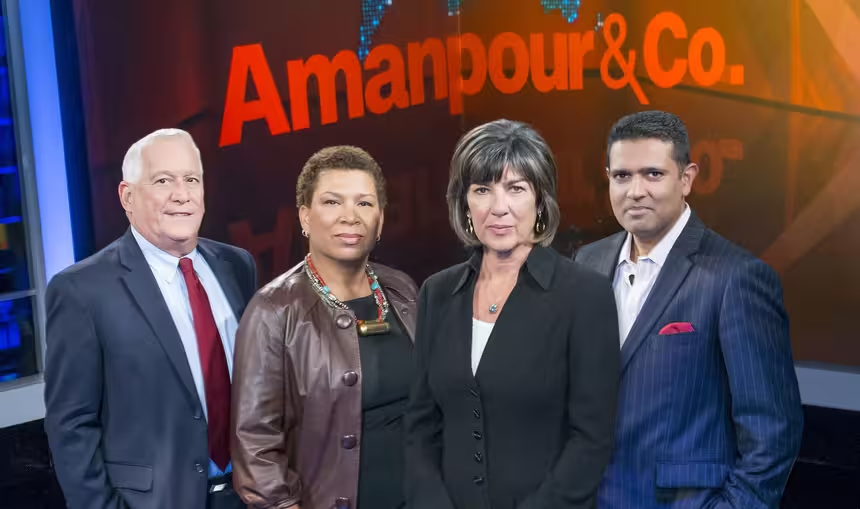
PBS and WNET, in collaboration with CNN, launched Amanpour and Company in September 2018. The series features wide-ranging, in-depth conversations with global thought leaders and cultural influencers on issues impacting the world each day, from politics, business, technology and arts, to science and sports.Providing Support for PBS.org
Learn Moreabout PBS online sponsorship>> As we've heard, President Trump has been pushing his executive power to the limits, showing little respect for the guardrails of U.S.
liberal democracy.
Our next guest made his name 37 years ago with his landmark essay, "The End of History," celebrating the triumphs of liberal democracy over Soviet communism.
Now, political scientist Francis Fukuyama has a new memoir, "In the Realm of the Last Man."
And he's joining Walter Isaacson to reflect on what he got right and wrong nearly four decades ago, and the powers that still threaten this political system.
Thank you, Christiane and Dr.
Francis Fukuyama.
Welcome back to the show.
Thanks very much for having me.
In your new book, "In the Realm of the Last Man," you say you wanted to set straight some misconceptions about your 1992 work, "The End of History and the Last Man."
What were those misconceptions?
Well, there are several.
I mean, some people just read the title and assumed that I meant that events would stop happening, which was obviously not the case.
A slightly better interpretation was that I was being a naive triumphalist about democracy spreading everywhere.
The reason I picked the title in the realm of The Last Man was that the title of the original book was The End of History and The Last Man.
Most people didn't read the last Five Chapters on The Last Man, which was about how democracy could break down in the future because of some of the intrinsic stresses within a liberal order.
So, that was really, you know, what that was about.
Well, you were right in many ways.
Your book came out right after the end of the Cold War, and I think the number of democracies went from about 30 to 100 right after that.
There was a burst of democracy.
Let's start there.
Why did that happen?
Well, there's a lot of causes.
I think part of it had to do with the problems within autocracies.
You know, China had just gotten over the Cultural Revolution.
It was liberalizing very rapidly.
The old system there didn't seem to be working.
And then Gorbachev unleashed perestroika and glasnost in the former Soviet Union.
And both of these two powers were the leading alternative systems, communist systems, and both of them seemed to be in big trouble.
Also, the United States was doing well itself.
You know, you were at the end of the Reagan era when the United States had regained the confidence that it had lost in the 1970s, and its influence and its model seemed to be spreading everywhere.
So let's talk about "In the Realm of the Last Man," which is the last five chapters of your 1992 book, the theme of this.
The last man is sort of a concept from Nietzsche.
What do you mean by that?
Well, Nietzsche really hated English liberalism.
He felt that it flattened people's horizons.
And because it asserted that every human being was equal to every other human being, there was no room for greatness, for striving, for struggle, for risk.
And he really thought that this world would produce kind of the opposite, that people wouldn't be satisfied with such a flat, you know, world with such a low horizon.
And therefore, you would have a revolt against the last man, and that would be a revolt against democracy, because, you know, you have a lot of people in the world that want to dominate, that want to prove that they're better than other people.
And that was the power that he saw unleashed.
And is that what we've seen happening for the past 10 or 20 years?
So I think that a lot of the extremism that you see on both the left and the right is driven by a revolt against this kind of flat world created by liberalism.
In a liberal society, you have to tolerate everyone.
There's a plurality of views about the good life, and people want more.
They want a sense of community, but more than anything else, they want a sense of struggle.
And you know, you saw that, for example, in all these guys on January 6th that dressed up in camo and stormed the Capitol.
They pretended that they were brave patriots trying to defend the American way of life.
And you know, it was play acting, basically.
But I think it bespoke a kind of desire to struggle for the sake of struggle.
And it's very dangerous, I think, to our democracy.
So this is a populist movement towards more authoritarian.
You say it's a bit of a backlash against liberal democracy.
By liberal, you mean sort of a tolerant, individual rights-based democracy.
And why would that be a problem?
Well, I think my definition of a liberal state is one that operates by a rule of law that restricts executive power through law, through a system of constitutional checks and balances.
And there's two things that people don't like about that.
I mean, first of all, this idea of the premise of liberal society is that everybody deserves equal recognition is something that makes people unhappy because they want, you know, a greater sense of community.
They want to emphasize the nation, its traditions and values, but that necessarily doesn't include everybody in the actual society.
The other big problem, I think, is that liberal societies are based on a rule of law, but they tend to accumulate too much law.
They tend to have lots of rules and procedures that you have to follow when you arrest somebody, when you build a train line.
And I think that part of the appeal of a strongman is that the strongman isn't limited by rules.
The strongman just uses force of will to get things done.
And I think that's part of the appeal of people like Donald Trump and Elon Musk.
Do you think Donald Trump is a product of this revolt against liberal democracy?
Oh, absolutely.
I think that he has a concept of power that is really incompatible with the kind of liberal constitutional regime that our founding fathers set up.
He wants his personality and his priorities to be the ones that, you know, define the nation that he's leading.
So I think in that sense, he's a very, you know, big danger to our liberal order.
Well, this has been happening all over Europe, in the United States, this nationalistic, populist, strongman, somewhat authoritarian yearning.
What did liberalism do wrong?
Well, I think one of the things, especially in Europe, well, but also in this country, too, that defines the nationalist right is immigration.
People believe that they are losing their culture.
They believe that they've got a certain set of values, in fact, a kind of common ethnicity that defined who they were, and you're having these floods of people from, especially from developing countries, entering and bringing their own customs.
And in a liberal society, you have to tolerate different ways of life.
So that, I think, is one of the big themes that really got Donald Trump elected and is helping, you know, like the AFD, this nationalist party in Germany.
Well, you come from a family of immigrants.
Indeed, some in your family, your uncle and your aunts, were interned during World War II because they were Japanese immigrants.
We now see in Texas some politicians demonizing Asian immigrants for doing—being successful enough to get into the University of Texas.
How does your own background inform your thinking about this backlash against immigration?
Yeah, by the way, some of those relatives of mine who are interned were actually born in the United States and were American citizens, and that did not prevent the government from basically holding them for three years during the war.
I think that it makes me very sympathetic to the people that are fighting back against the ICE and the current way that this administration is treating people.
It's outside the bounds of law.
I'm particularly unhappy with Donald Trump's effort to overturn the 14th Amendment's birthright citizenship.
I would not be a citizen if he overturned that, because my mother was a Japanese immigrant on a student visa at the time at the University of Chicago when I was born, and therefore I would have been denied citizenship under the rules that they favor.
So I think this really affects me, you know, very personally.
You frequently reference the Greek concept of thymus.
Am I pronouncing it right?
Thymus.
Yeah, thymus.
The individual's desire for recognition and for dignity.
How is that something that, I'll say, we, meaning those in the West who felt triumphant at the end of the Cold War, how did we, is that something we missed?
I think that it's something that economists miss because they focus on the material satisfaction of desires, but there's something that actually is oftentimes more powerful in politics than that, which is this desire for recognition.
You know, a lot of the people in the MAGA base supporting Donald Trump feel that the liberal elites, the educated liberal elites that live in big cities, really don't respect them.
They think they're a bunch of yahoos that, you know, don't know what they're voting for.
And I think that, unfortunately, there's, you know, a degree of truth.
One of the things that's happened in American society, and also in other advanced societies, is that people have resorted themselves sociologically.
So it used to be that the left-wing parties were based on the working class.
That's true of the British Labour Party and of the Democrats in this country.
But both of those parties in recent years have become parties of educated professionals, and they've kind of lost touch with the working class.
And that divide is not just an economic divide.
It's a cultural divide in terms of what kind of music you listen to, what kind of, you know, sports you enjoy.
You know, I think most college-educated people don't go to UFC fights.
You know, they just don't.
And so I think that that reinforces the sense on the part of people without those elite educations that, you know, they're being looked down upon, and that really generates a lot of anger and support for populist politicians.
One of the things I found very admirable in your book is talking about how you've changed your mind.
That seems to be a talent we've lost, we've kind of lost in our society today.
And I noticed that in things you change your mind on, I felt I had gotten wrong too and have changed my mind.
But let's talk about those.
You chart how you changed your thinking on the 2003 invasion of Iraq, your faith in free markets and free trade, and your move away from conservative politics.
Tell me how those were connected.
Well, first of all, I think that the Iraq War especially made me question this kind of classic model of human rationality.
You know, since the Enlightenment, people think, well, human beings take in empirical information, they process it, they look for patterns, and then they build conclusions based on that.
I think that the real way that people think is what's called motivated reasoning, which is that they start out with the conclusions that they want to affirm, and they use their cognitive power to marshal evidence to support those conclusions.
I mean, you see that just in the way that people have flipped in politics.
Republicans that supported free trade under Ronald Reagan all of a sudden are told that tariffs are good, and so they start looking for reasons to support tariffs.
That was certainly the case with the Iraq War.
Part of the reason that I supported, you know, in the early stages the invasion of Iraq was that my friends did that.
You know, I was in the circle of neoconservatives, and if you go against that consensus in that circle, you're basically ejected from it.
And that, I think, is a step that many people are very reluctant to take.
What do you think we could do to get out of this period of polarization?
Well, that's a big question.
I think that it's not necessarily going to be solved by, you know, greater equality, although I do think that reigning in some of the oligarchs and some of the big concentrations of wealth, you know, might help a little bit.
A lot of it is cultural.
I think that it really has to do with this feeling that many working class people have that they are not being listened to.
And I think that listening better and also, you know, talking in a different way is something that politicians that want to reach out and begin to heal some of those divisions have to take seriously.
The other thing is that it turns out that even a polarized society can actually get together when they've got concrete tasks.
And one of the things that we've not been very good at doing is, you know, building things again.
You know, like infrastructure.
We were promised high-speed rail in California back in the 1990s, and it really doesn't exist today.
And I think that if we had a government that could actually accomplish things that people saw as concrete proof that government was effective, they would get together more.
I mean, you see this actually in cities where there's less polarization than in the nation's capital because, you know, cities have to take out the garbage.
They have to keep the streets paved.
And it's much easier to focus people's attention on real world tasks that government is supposed to do in the first place.
And so that might be a way of getting out of this morass that we find ourselves in.
What type of message and what type of leader could best follow a Donald Trump?
Well, I think that the nature of executive power is probably going to change.
You know, Trump has tried to basically turn the presidency into a kind of dictatorship where he can do everything by executive order.
I think, however, that we do need a little bit more ability of the government to actually do things, not by, you know, breaking the law and doing manifestly unconstitutional things like Trump has done, but by strengthening, you know, the ability of the president, governors, other leaders to actually, you know, accomplish things.
That can be done by modifying some of the myriad constraints that we put on, you know, on political action.
And I think it's going to be particularly an issue if, you know, someone from the progressive wing of the Democratic Party becomes president.
There, I would say, there's actually a kind of danger, because there's going to be a lot of opposition.
It's going to be very hard to get a real left-wing agenda through Congress.
And then there'll actually be a kind of temptation to imitate Trump, to, you know, simply disobey or ignore the kinds of constraints and rules that exist, rather than trying to modify those rules to make action a little bit more—a little bit easier.
Well, one of the great themes of your 1989 article, your 1992 book, was that at the end of the Cold War, there was a sense of optimism.
Do you think one of the underlying problems is that we've lost our optimism, and how can we regain that?
Well, I think there's a cultural side to this where we don't really have the kind of fear of extremism that really generates support for liberal values and a liberal system.
And I think that, you know, perhaps, unfortunately, experiencing a little bit more turmoil where we're kind of in a conflict together might do that.
I don't think that's a good alternative because, you know, that's the path to, you know, outright conflict and violence.
I think that, you know, if you think about leaders in the past during the progressive era with Teddy Roosevelt or in the New Deal under Franklin Roosevelt, the country did really big things.
It built Hoover Dam.
It electrified the Upper South, you know, and the TVA.
It engaged in—well, the most amazing one was actually going to the moon.
Kennedy announced the intention to land an American on the moon in 1961, and eight years later it was actually accomplished.
And so I think that if you had leaders that could think big in terms of national objectives and then knew how to restructure the government in ways that actually brought that about, you know, that might be inspiring enough to give people the optimistic sense that, yeah, actually as a collective entity, the United States can actually do stuff again.
Dr.
Francis Fukuyama, thank you so much for joining us.
Thank you very much for having me.
 New Episode
- News and Public Affairs

Top journalists deliver compelling original analysis of the hour's headlines.

- News and Public Affairs

FRONTLINE is investigative journalism that questions, explains and changes our world.
 New Episode
 New Episode
 New Episode
 New Episode
 New Episode
 New Episode

 New Episode
 New Episode
Support for PBS provided by: