WPBS Weekly: Inside the Stories
September 15, 2026
9/15/2026 | 26mVideo has Closed Captions
Lowville Village Band turns 200, plus New Yorkers in the American Revolution and 23 & Co.
Celebrate the 200th anniversary of the Lowville Village Band, one of the oldest community orchestras in the country. We continue our America@250 series with Professor Dr. Melissane Parm Schrems, who explores the complicated role New Yorkers played in the American Revolution. Plus, we meet the woman behind 23 & Co., whose cookies went from NHL game days to becoming the heart of her own shop.
Problems playing video? | Closed Captioning Feedback
Problems playing video? | Closed Captioning Feedback
WPBS Weekly: Inside the Stories is a local public television program presented by WPBS
WPBS Weekly: Inside the Stories
September 15, 2026
9/15/2026 | 26mVideo has Closed Captions
Celebrate the 200th anniversary of the Lowville Village Band, one of the oldest community orchestras in the country. We continue our America@250 series with Professor Dr. Melissane Parm Schrems, who explores the complicated role New Yorkers played in the American Revolution. Plus, we meet the woman behind 23 & Co., whose cookies went from NHL game days to becoming the heart of her own shop.
Problems playing video? | Closed Captioning Feedback
Where to Watch WPBS Weekly: Inside the Stories
WPBS Weekly: Inside the Stories is available to stream on pbs.org and the PBS app.
Providing Support for PBS.org
Learn Moreabout PBS online sponsorship- Tonight on WPBS Weekly Inside the Stories, the Lowville Village Band celebrates its 200th anniversary as one of the oldest community orchestras in the country.
And we continue our America at 250 series with a St.
Lawrence University professor who shares the complicated role New Yorkers played in the American revolution.
Also, the story of a woman whose cookies were once part of NHL Game Days and are now the heart of her own shop.
Your stories, your region coming up right now on WPBS Weekly, Inside the Stories.
- Funding for WPBS Weekly, Inside the Stories, is provided by the Statewide Community Regrants Program, a regrant program of the New York State Council on the Arts with the support of the Office of the Governor and the New York State Legislature and administered by the St.
Lawrence County Arts Council.
Carthage Savings founded in 1888, offering VA, FHA, seasonal and rural development mortgage products, providing financial services to Northern New York from offices in Carthage, Clayton, Croghan, and Watertown.
Online at carthagesavings.com.
- Good Tuesday evening everyone, and welcome to this edition of WPBS Weekly Inside the Stories.
I'm Michael Riecke.
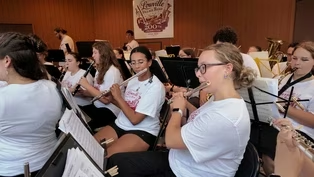
The Lowville Village Band performed its first concert in 1826.
Two centuries later, the band continues to thrive, bringing music, tradition, and community spirit to audiences while remaining a cherished and enduring part of life in Lowville.
Take a look.
- Being involved in actually making music for our community, it's an awesome legacy to be part of.
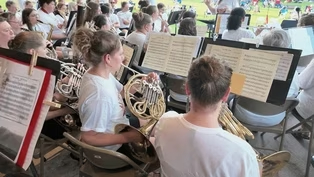
- The Lowville Village Band has been a cornerstone of cultural life in Northern New York as it celebrates its 200th anniversary in 2026.
The band's members come from a wide range of backgrounds, including students, military personnel, and professionals from various fields.
In addition to sharing a passion for music, members gain valuable experience performing locally, entertaining audiences at parades, festivals, and private celebrations.
I - Feel the Lowville Village band to our community especially is an essential hub.
We are in the north country where some people don't even know what upstate New York really is.
And so I think for us knowing that it seems like a lot of people move away from the area to seek employment, I feel like our band is a reminder of the longstanding traditions that still exist in our area and the power of what family and community is really about.
- Each member brings unique skills and experiences to the ensemble, creating opportunities to learn from one another and grow as musicians.
- We have currently about 55 members in the Lowville Village Band.
We have a wide range of ages.
Our youngest is 14.
We have a member turning 97 and we have a member turning 87.
So we have a really wide range of members in the group.
- People know our, our band locally and it keeps us here.
It keeps us strong.
And even we played for St.
Stevens Festival in Croghan last week and it was the same truth is when you have the strength of a community, the music is always there and even dates back to the Civil War time.
- The band's history dates back even earlier than that being founded as a union band in 1826.
The band would be renamed the Lowville Village Band around the 1930s after it began receiving financial support from the village.
Although the band's activity declined during the height of the Civil War, it recovered in the following years and has remained an enduring part of the community's cultural heritage.
In the late 1800s, the band hired a director with ties to one of the most famous figures of the American Old West.
- We had a lot of directors over the years.
One of our directors, Frank Thompson, he was really good friends with Buffalo Bill and Frank Thompson was one of the directors of the Buffalo Bill Wild West Show, and so they were really great friends.
So Buffalo Bill actually gave Frank Thompson a silver cornet as a gift, and we have that in our historical society here in Lowville.
So it's a really fun piece of knowledge with the history of the group.
- I enjoyed being in the Village Band because it's very interesting to see how many people actually show up for us and how many people from the community enjoy the band and music.
- It really brings the folks together.
You got 30 to 50 people all working for a common good.
The other way we're bringing the community together, of course, is the audience.
Come here on Wednesday night, any night during the summer, there's going to be maybe a hundred people.
There's going to be seats all over.
So we're really dragging folks out of their houses, really make them come be here, talking amongst each other, feeling like they belong here.
- You'll see somebody in the community, like in the store and they'll say, "Oh, I enjoy that band so much."
Like they recognize you.
And it's really nice when they support us like that because it makes our work getting the music together more meaningful.
- I think the band, to our community, is an important part.
Not a lot of communities around here have their own village band, so I think it's a very unique aspect to our community.
I would say just some favorite memories from the band is just continuing to make memories with my high school band teacher.
The director, Kelly Kilcer, she was my band teacher in high school, so it's just really special to me that I can continue to keep making music with her.
- Being part of the village band means a lot.
It's really truly is an honor that I get to say I'm one of the directors of this group.
We have such a long history and it's something that everyone in Lowville knows.
So many people come to our concerts and they come from all different places, different towns, communities to come see us perform.
So it's really great to know that I can be a part of something that's really historic for a lot of people.
- In Lowville for WPBS Weekly, I'm Ruth Quinal.
- For more information on the concert schedule, you can just check out the Lowville Village Band's Facebook page.
As part of our America at 250 series, we're looking beyond the familiar stories of the revolution and at the people and perspectives that don't always make it into history books.
Here in New York, the story was especially complicated.
Colonists were divided, indigenous nations faced impossible choices, and black Americans saw the war as both a danger and an opportunity to pursue freedom.
I recently sat down with Dr.
Melissane Parm Schrems, an associate professor of history at St.
Lawrence University to talk about the revolution we didn't learn about in school.
Welcome Dr.
Mel Schrems, associate professor of history at St.
Lawrence University.
We're really glad to have you here.
- Thank you.
- So tell us what part of American history is your main point of view or your main area of study?
- I'd say my main area of study is the American founding.
So it would be the colonial wars and then the American Revolution, War of 1812.
I think I sort of fade out around the 1830s, but I really enjoy the entire narrative.
- And as America prepares to celebrate its 250th anniversary, it's perfect timing to have you here with us.
I think when most people think about the American Revolution, we go straight to the colonists versus the British.
What's missing from that story?
- Oh, there's a lot missing from that.
I think what people say now about the relationship or any relationship is that it's complicated.
So they're colonists, but they're not all on the same side.
The British, the people who are not colonists, are also not all on the same side.
So you've got Americans who are very much aware that to finish what they start will make them traitors, and they're not wanting to do that because the wages of being a traitor would be death.
And so it's a very serious decision and we find most Americans making that decision as late as possible.
So the idea that patriots spring up, ready to throw off the shackles of Britain, not accurate.
And I actually find that very admirable.
You only have one life and colonists are very much aware of that.
And so they're very careful about what they're going to do with that life.
And then we also have the idea that the British are all against the Americans, but actually on the floor of parliament, you have members of parliament making speeches in favor, not of the revolution, but trying to see the point of view of the Americans.
- How does New York State fit into this complicated picture at the time?
- You can't have the story without New York.
You just cannot.
Colonists are really important.
The British are really important.
The indigenous population that has been here forever is important.
Also, colonists or members of the community brought here against their will, like Africans or sometimes we call them Atlantic Creoles.
They all appear in New York.
England is not the only identity.
English is not the only identity for colonists.
And in New York, especially in Northern New York, we're basically, certainly up in Ogdensburg, up at Fort Lauder presentation, you're looking at New France.
I teach at St.
Lawrence University and I tell my students all the time, we're not in New England, we're really in New France.
So it's really important to be aware of that.
And New York is interesting in that, yes, New York City becomes a center of loyalists, but the rest of New York, especially this part and further north, we're sort of on a border and we're very much aware that we have different choices to make.
And so if you could only study one state, and I was born and raised in Massachusetts, so I'm going to say after Massachusetts, I would say it's New York.
New York is extremely important.
- Let's talk about the indigenous nations in New York.
How were they impacted at the time?
- The indigenous nations, I would say, especially around Deck Park and where I teach and I live, would be the Haudenosaunee Confederacy.
Some people still think of them as the Iroquois Confederacy, although the term Iroquois is falling out of use.
Haudenosaunee as a Confederacy represent many different nations, six nations on this side, seven on the Canadian side.
And they're not all in agreement.
For the most part, if we were to poll them, the vast majority of them want to just stay out of it.
They've participated in colonial wars.
They've seen, for lack of a better word, that colonists cannot, at the end of the day, cannot be trusted to keep the promises that are made.
Even though there are good actors, these people don't seem to be in positions of authority.
And so many of them, many of the Haudenosaunee decide they just want to sit it out.
The two different sides, the Oneida on one side and the Mohawks on the other, the Oneida decide that they're going to side with the Americans.
Now I said the Mohawks are on the other side, but in reality, the Mohawks themselves, members of the nation, are split, not evenly because there's never an even split, but there are ones who are very much in favor of supporting the British while others are insistent on supporting the Americans.
- What did they risk by picking a side at that time?
- I want to say, I think it'd be very dramatic to say they risked everything, but to be fair, they risked everything no matter what they chose.
In attempting to stay out of it, Haudenosaunee still come under the consideration of the leader of the continental army, a man in the Haudenosaunee narrative whose name translates to town destroyer.
He takes it upon himself.
He lays out his generals.
He has them cut a swath through the Haudenosaunee Confederacy from where we are now down through Buffalo that decimates them.
And it's done to people, to nations who have done their best to stay out of it.
It's so brutal and so complete that he gets the name or he's given the name Town Destroyer.
We know this man is General George Washington.
So doing nothing risks everything.
Doing something, I think the risk is as great, but there's a tiny possibility you might win.
In my mind, it reminds me of the Civil War, the English Civil War, where single houses split and fought on either side in the hopes of preserving what was going on, right?
The Oneida side with the Americans and certainly right after the war, they're winners, it sides in their favor.
And traditional Haudenosaunee territory up in Canton, Potsdam, Ogdensburg area, traditionally Oneida and in also Mohawk.
And so that's the good thing, right?
For the Mohawks, those who side with the British, they stand in very good stead with the British.
Initially, certainly right after, they benefit, I would say, more than the people who tried to stay out of it.
But as I said, within the Mohawk Nation, they're split along the lines of who will side with whom, people like Joseph Brandt, Molly Brandt, they lead Mohawks to side with the English, and then people like Colonel Louis Cook, he and others, other Mohawks centered mostly in Ganawage.
These people decide that they're going to side with the Americans, and so they sort of benefit.
One of the reasons it doesn't show up in the regular narrative of most things is because it's complicated.
- It's complicated.
That seems to be the key word.
Let's talk about Black communities in New York at the time of the revolution.
How were they impacted?
What did they risk?
- It's an excellent question.
Black communities in New York.
In New York State or up here in Northern New York?
- Let's keep it local.
- Okay.
Thank you.
Most people sort of assume that Americans of African descent are not present in this narrative, and they definitely are.
There are not as many, but they certainly are here.
And the risk is not so much a risk as an opportunity.
Conflict breeds opportunity and something as devastating, potentially as devastating as a war leads to greater benefit.
And by that, you have people on either side who need other bodies, other people to fight.
Initially, George Washington is not interested in opening up the Continental Army or any of the armies to service from African Americans.
He's not interested in it.
He doesn't want it.
People can say he's a Virginian and he's not thinking about that, but eventually he finds much to his surprise, but not to ours, that everyone isn't willing to go out and risk their lives because the war, the American Revolution, isn't going well at all.
It looks really bleak.
Up until the battles of Saratoga, the Americans are absolutely going to lose and nobody wants to risk that.
And so desperate for manpower, Washington changes his mind.
Desperate for manpower, people open up, right?
The English know this, and I really think of this as if there's Warcraft 101, I always remind my students that if you know your enemy is oppressing a group as the opponent, if you do not find a way to communicate to that oppressed group that you offer them freedom, you're not doing it right.
So when we have Lord Dunsmore in Virginia, okay, the English sort of say, "If you make it over here, if you come to us, we will allow you freedom," that is taken up.
With Washington and others, when they make the same offer out of desperation, people of color, African Americans accept that as well, because out of all of this, no matter which side they fight on, their goal is to be free.
- Dr.
Schrems, we are unfortunately out of time, but it's been such a pleasure.
Thank you so much for your insight.
- Thank you for having me.
- For years, Krista Gill's cookies were part of life behind the scenes of her husband, Todd Gill's professional hockey career, shared in dressing rooms, on road trips, and with teammates who came to look forward to every batch.
Today, that same love for baking has become 23 & Co, her Kingston cookie shop built on nostalgia, connection, and community.
- For many people, a cookie is more than just something sweet.
It's a memory, a familiar taste that brings you back to a moment in time, and sometimes those memories are where a story begins.
- Cookies are nostalgic for people.
Absolutely.
And I hear that a lot in here.
I think of it myself.
Like I make a cookie that's Mabel's molasses ginger.
My grandmother was Mabel, and I think of her every time I eat that.
And I'm not the only person.
People think about their childhood and the cookies they used to eat.
That's part of the experience that happens in here is people sharing their favorites.
For - Krista, the love of baking started early, from her grandmother's kitchen to the early days of marriage, as she and her husband began building a life together.
- I just fell in love with it then.
I started collecting cookbooks and baking, and one day my husband said, "I'd really like something to go with my cup of coffee on the way to the arena on a game day."
And I said, "Oh yeah, what do you want?"
And he said, "Well, I don't know, like a chocolate chip cookie."
And I was like, "Oh, okay, cool."
So I bought every cookbook in North America that had a chocolate chip cookie recipe in it, honestly.
And I just kept trying recipes until one day and he said, "Okay, that's the one and it's the OG."
It was our original cookie, and it was never meant to be anything other than just a snack on a game day.
- At the time, Krista was supporting her husband, Todd, as he played professional hockey, a life that meant constant moving and little time to build something of her own.
- I know she has a love for it, and she's always wanted to do it.
Unfortunately, with my profession, we were moving, moving, moving, so she never really could get her both feet on the ground, so to speak.
Here we are at 60 and decided she's always wanted to open a brick and mortar, and I said, "Well, you followed me for the last 30 years.
It's my turn to follow you," and here we are.
It's awesome.
- Before opening her own shop, Krista built her business piece by piece, working out of commercial kitchens, selling wholesale, and growing a following online.
But without a space of her own, something was missing.
- It became very clear to me that in order to be able to control the customer experience and control my product and my brand, I had to have my own location.
And so it was probably one of the biggest decisions in my life was to either continue and go out on my own or to quit.
But again, with the support of my family, my children, my husband, my friends, we're all like, "If you don't shoot your shot now, you're never going to shoot it.
Why wouldn't now be the right time?
It's the perfect time for you.
You haven't had time before now."
So I did it.
I shot my shot.
And - What started as a chance she was willing to take has become something much more, not just a business, but something deeply personal, a place that reflects who she is in years of life, love, and support that brought her here.
- It's been going really well.
Customers are fantastic.
We're getting customers from all over that have heard of us that are coming in.
We have repeat customers.
People are dropping in because they see the storefront and are like, "Oh, I haven't seen you before.
What's going on in here?"
People come in and talk about their favorite cookies, talk about their childhood cookies, talk about their sports events, their kids, their grandkids, their parents, their grandmother.
"Oh yeah, my grandmother used to make that.
"So it's really super emotional for me because it's mine.
It's like, yeah, it's unlike anything I've done before.
I mean, obviously getting married, having children, having grandchildren are highlights of my entire life, but this is really different.
This was my personal growth and development, which I've waited a long time for and didn't really know it was.
I didn't know it was in there.
I didn't know it needed to come out, so it's pretty cool.
- And for Krista, that feeling shows up in all the little ways, in how things are made, how people are welcomed, and in those everyday moments when someone treats themselves, no questions asked.
- Well, food is love and yeah, is truly very organic and the quality is really important.
The experience is really important.
Having them here in the shop and being able to sell them individually for someone on their lunch or, you know, on a break or going home after work to eat in the car on the way home, whatever you do with them.
We joke all the time and say when you leave the building with your cookies, it's none of our business what you do with them, where you eat them, just as long as you're happy about it.
- And that's what it all comes down to, creating something that brings people a little bit of joy.
And in Kingston, it's something people are genuinely excited to have.
- I'm always excited when anybody moves to Kingston, especially a business that you already support, people that you've known forever.
So rewarding to watch anybody find their place and be a success and blossom.
It's something so unique.
It's care, perfection, kindness.
I often have a client or perhaps another business that I want to thank, and I used to do flowers or try to find something personal that might please them, and I don't anymore.
I come and get cookies.
And when anybody sees me coming with a box of cookies, let me tell you, they're very happy.
- It's moments like that when people light up as soon as those cookies arrive that show how this has grown into something more than a business, but something truly sweet in Kingston.
- We've been supported unbelievably here in Kingston.
We've got a great location and great neighbors, so everything's just working out peachy.
- I love everything about it.
I love seeing something come together, and I love the experience of watching someone you love eat something that you've made and be like, "Oh my gosh, this is so great."
For - WPBS Weekly, I'm Gail Paquette.
- To learn more about those tasty looking cookies, you can visit 23andco.ca.
Well, that does it for this Tuesday night.
If you have a story idea you'd like us to explore, we would love to learn more.
All you need to do is send us an email at wpbsweekly@wpbstv.org and let's share it with the region.
That's it for tonight, everyone.
Join us next time for a fresh look inside the stories.
Until then, take care.
- Funding for WPBS Weekly, Inside the Stories, is provided by the Statewide Community Regrants Program, a re-grant program of the New York State Council on the Arts with the support of the Office of the Governor and the New York State Legislature and administered by the St.
Lawrence County Arts Council.
Carthage Savings, founded in 1888, offering VA, FHA, seasonal and rural development mortgage products, providing financial services to Northern New York from offices in Carthage, Clayton, Croghan, and Watertown.
Online at carthagesavings.com.
- If you know your enemy is oppressing a group, if you do not find a way to communicate to that oppressed group that you offer them freedom, you're not doing it right.
The Lowville Village Band Turns 200!
Video has Closed Captions
The Lowville Village Band performed its first concert in 1826. (4m 13s)
Providing Support for PBS.org
Learn Moreabout PBS online sponsorship











Support for PBS provided by:
WPBS Weekly: Inside the Stories is a local public television program presented by WPBS