
Pet-Friendly Landscaping
Special | 51m 48sVideo has Closed Captions
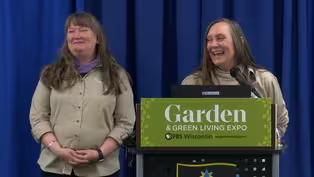
Jamie Viebach offers ideas for a safe and beautiful yard for your animal companions.
Jamie Viebach, horticulture educator at the University of Illinois Extension, offers thoughtful hardscape features, practical plant choices and expert tips for creating a beautiful, safe and enjoyable outdoor environment for you and your animal companions.
Problems playing video? | Closed Captioning Feedback
Problems playing video? | Closed Captioning Feedback
University Place is a local public television program presented by PBS Wisconsin
University Place is made possible by the Corporation for Public Broadcasting.
Pet-Friendly Landscaping
Special | 51m 48sVideo has Closed Captions
Jamie Viebach, horticulture educator at the University of Illinois Extension, offers thoughtful hardscape features, practical plant choices and expert tips for creating a beautiful, safe and enjoyable outdoor environment for you and your animal companions.
Problems playing video? | Closed Captioning Feedback
How to Watch University Place
University Place is available to stream on pbs.org and the free PBS App, available on iPhone, Apple TV, Android TV, Android smartphones, Amazon Fire TV, Amazon Fire Tablet, Roku, Samsung Smart TV, LG TV, and Vizio.
More from This Collection
Experts share horticultural research and gardening tips for Midwest growers. Discover techniques on topics from vegetables and native plants to beekeeping and sustainable landscaping. These talks help gardeners of all levels create beautiful, productive and ecologically sound spaces at home and in their communities.

Video has Closed Captions
Bruce Spangenberg explains the timing of grass maintenance to keep your lawn looking good. (53m 28s)

From Seed to Spicy: Create Your Own Hot Pepper Sauce
Video has Closed Captions
Homesteader Ed Buc details how to grow pepper plants and make delicious hot pepper sauces. (45m 6s)

Environmentally Conscious Lighting
Video has Closed Captions
Scott Lind and Samantha Saeger explain how to fight light pollution with smarter lighting. (35m 37s)

Video has Closed Captions
Cora Borgens explains why and how to prune woody plants for optimal plant health. (50m 56s)

Video has Closed Captions
Patrick Smith uses principles of improv comedy to create a sustainable garden. (49m 23s)

Indoor Gardening for Food and Fun
Video has Closed Captions
Victor Zaderej offers practical advice on how to easily grow produce indoors. (49m 6s)
Wonderful Wool for Your Plants and Your Planet
Video has Closed Captions
Elaine Becker and Karen Mayhew describe how wool is a healthy soil alternative to peat. (48m 2s)

New and Unique Plant Varieties
Video has Closed Captions
Horticulture specialist Allen Pyle showcases standout plants from 2024 trial gardens. (45m 16s)

Video has Closed Captions
Rachel Belida presents ideas for creating a seven-layer food forest in your yard. (45m 45s)

Video has Closed Captions
Becky Gutzman shows how to safely preserve your summer garden bounty for the rest of the year. (58m 35s)

Simple Steps to a Beautiful Rose Garden
Video has Closed Captions
Diane Sommers shares suggestions on growing roses for the home gardener. (47m 50s)

Video has Closed Captions
Alena Joling explains how to take care of your bladed garden tools. (50m 25s)
Providing Support for PBS.org
Learn Moreabout PBS online sponsorship[gentle music] - Jamie Viebach: Good afternoon, everybody.
My name is Jamie Viebach.
I'm a horticulture educator with the University of Illinois Extension, based out of the Chicago suburbs.
So, today I am here to talk with you a little bit about pet-friendly landscaping.
So, in addition to being a horticulture educator, I am also a dog mom.
I also have three aquatic turtles and a box turtle.
And so, quick poll here, who here has a dog?
Cat?
I asked this yesterday-- chickens?
Something else I didn't mention?
- Attendee 1: Ducks.
- Jamie: Ducks?
Okay, fantastic.
So, as a homeowner and a dog owner for many years, I hadn't really considered how my landscape practices might impact my pets, until one day I was over at a friend's house and I saw her dog start chewing on some mulch.
And it kind of dawned on me, "Ooh, maybe this is something that we really need to think about," and, you know, having to wonder, "How is what I'm doing in my yard potentially impacting my pets?"
So, what do you want out of your yard?
Well, you wanna have a beautiful garden maybe to show off to your friends and neighbors.
You wanna be able to relax and enjoy it.
You want it to be functional from both a use and a maintenance standpoint, maybe reduces maintenance efforts and costs, reduces the need for fertilizers, pesticides, equipment, water, et cetera.
I would say I'm a lazy gardener.
I heard, somebody today said, "No, no, no, don't say lazy.
Say efficient."
I need to be an efficient gardener because I got a full time job, right?
I am also a mom to a human kid, too, and he's got all his activities and things.
So, I got a lot going on.
I don't have all this time to spend in my garden, as much as I want to.
So, I need to be efficient in what I do.
And maybe you have an energetic dog who gets the zoomies every now and then, or is more bull in a china shop than, you know, calm lapdog.
I have a cattle dog.
You will see a picture of her later.
She is not calm lapdog.
Five minutes a day, I get five minutes a day of calm cuddles, and the rest of the time, she's a cattle dog.
You're gonna wanna make sure that your pots don't get knocked over or your plants get rearranged to make room for that prized bone, right?
But there are some things that your pet's gonna want out of your yard too.
So, they're gonna want safety, right?
We wanna make sure that we keep them safe while they're in our yards.
They're gonna want water to drink or to play in, shade or shelter, someplace to answer nature's call, some play space, maybe some space to dig.
All depends on your dog and what they're interested in.
So, my talk today is gonna be in kind of two parts.
The first part, we're gonna talk about more of the hardscaping design kind of elements that we're going to do in our yard.
And the second part, we're gonna do more of a deep dive into specific plants.
So, if you're here just to hear about plants, I will get there, I promise.
- Attendee 2: Oh, no!
[audience laughs] - Jamie: Sometimes, your pets also wanna rearrange the furniture.
That is not one of mine.
That is my friend Deb's.
His name is Tank.
[audience laughs] So, one of the biggest conflicts with dogs and lawns are these dreaded burn spots.
Female dogs are the primary culprits of lawn damage since they'll urinate pretty much anywhere on a lawn, and usually all at once.
Unlike male dogs that are gonna dribble it out all over the place to mark their territory, females tend to go all at once.
So, this is gonna result in a large volume of urine concentrated into a small patch of grass.
The ammonia overload at the center of the patch is what causes the grass burn.
Studies have shown that tall fescue and perennial ryegrass are the most resistant to these urine effects.
And in fact, the urine routinely produced a fertilizer effect on these grasses at diluted concentrations.
Kentucky bluegrass and Bermuda grass are very sensitive to urine concentrations, and severe burns can result that last even over 30 days after the initial exposure to even just four ounces of concentrated urine.
It's really sort of an issue of the dose makes the poison here.
So, how much is the area getting?
How concentrated is it?
That's what's gonna determine whether you get that burn spot or not.
Watering that spot after urination will accomplish a dilution without any ill effects on the lawn.
So, in this case, if you can dilute that urine even up to eight hours later, that can help prevent those lawn burn spots.
Over 12 hours, that's usually when those burns develop.
So, if it's a real issue for you and how you feel about your lawn, maybe just set up a sprinkler to go off in the evenings, right?
We all know evening's not the best time to water, but after your dog goes, that may help to reduce that if you're having those issues.
Now, also, you'll want to avoid synthetic chemicals and fertilizers whenever possible.
Even if your dog doesn't eat the plants, he can be affected by walking on or laying in treated areas.
You'll wanna use best practices and manual weeding if necessary, for safety's sake.
If your lawn does require frequent pesticide use, especially herbicides, you may have an underlying problem that's causing these repeated invasions of things like weeds.
Correcting that problem's gonna lead to a healthier lawn that's going to be better able to resist those invasions.
Good soil conditions are also really important for healthy lawns.
Many lawns are growing on soils high in clay, at least in my area of northern Illinois.
We have very, very heavy clay soils here.
Again, depending on where you're at, that may be different.
But heavy clay is not always the best for lawns.
So, aerating and top dressing with organic matter can improve these conditions.
Repeated aeration might be necessary to adequately reduce soil compaction and increase your levels of oxygen, right?
That's gonna give you that healthier plant, that individual grass plant.
Another option is, if you can start over, if you've got a small enough spot that you're just gonna completely start over on, then maybe you can address those soil issues on the front end before you sod or seed.
That can be a lot easier to do than trying to fix it after the fact.
A soil test is recommended to be sure that other factors like pH and levels of nutrition are adequate for grass growth.
You'll also wanna make sure that you're using the proper grass species on the site.
So, full sun or sun shade environments both call for different types of grasses.
So, in addition, you can consider the quality that you're looking for.
Some people want that golf course-looking perfect lawn.
Other people are okay if it's got a few dandelions and maybe a little creeping Charlie and some violets and whatever.
I think they're pretty, I don't know.
Not everybody likes that, though, so... So, selecting the proper grass type for your site will also help there.
So, Kentucky bluegrass is the primary species in northern Illinois lawns in full sun.
In some cases, it'll be mixed with a perennial ryegrass and/or fine fescues.
But in shadier areas, a shade-tolerant Kentucky bluegrass cultivar is commonly mixed with fine fescues, but they don't always stand up to activity very well, even though there are those Kentucky bluegrass cultivars in the mix.
Your cultural practices are also gonna play a big role in the health of the lawn and your need for pesticides.
Proper watering includes irrigating the lawns as they need it and getting the moisture down to the root zone.
You wanna water less often, but for a longer period of time to ensure that deeper root growth.
If you're only watering for a little bit and just getting that water in the top inch or so of soil, that's where your roots are gonna grow.
If you water it more deeply, that's going to encourage deeper root growth, which is gonna mean, A, you have to water less frequently, but you'll still have that nice, healthy lawn that's going to be better able to resist grubs, resist weeds and all of that.
And then, proper fertilizing, includes supplying adequate nutrients and proper soil pH.
In particular, you want to avoid excess or lack of nitrogen when using synthetic fertilizers.
Fertilize during cooler weather, especially early fall and late fall, and use a controlled release nitrogen fertilizer to avoid the swings in food availability.
And you also don't want to apply really high rates of nitrogen in the spring.
Proper mowing is also going to have an impact on your lawn health.
Many lawns are mowed too short, allowing the weeds to invade and other problems to appear.
You want to mow between two and a half and three inches and mow often enough so that you're never removing more than a third of the leaf blade at a time.
So, if you go away on vacation for a couple of weeks and come back and your lawn is, like, super out of control, you'll wanna mow as high as you possibly can and then, a couple days later, a little bit shorter to bring it back into that two and a half to three-inch rate.
You never wanna remove more than a third of that leaf blade at a time, or it's really gonna stress out your grass.
And you also wanna manage lawn stress factors, like thatch, shade, and soil compaction, right?
Urban soils usually tend to be really compacted and really bad.
So, doing things like core aeration on a regular basis, that's an excellent practice to consider to help remove some of that compaction.
And occasionally, problems are still gonna come up that require special management.
You wanna start by identifying the problem first, right?
Can't treat what you don't know what it is.
So, identify what that problem is first and then look at control options.
You'll wanna start with cultural options first.
Can you just pull that weed?
Is there something-- Can you remove the pest physically?
And then, go on to organic and then chemical practices when the situation warrants.
Even if you're using organic management practices, some weeds, there's just no way to get rid of 'em without chemical means, right?
Sometimes, we just have to employ chemical warfare if we're gonna get rid of things like buckthorn, honeysuckle, stuff like that.
Sometimes, you just can't pull it out.
So, when you do have to use that, read, understand, and follow all label directions.
[audiences coos and laughs] That's my cattle dog.
[laughs] You may wanna consider creating a specific bathroom area for your dog to go in.
That'll make it easier for you to clean up and maybe have to worry less about those burn patches in the yard.
And you can-- Maybe it's a mulched area.
I've seen some people use artificial turf on it.
All depends on your dog and what your dog's gonna prefer.
You wanna consider the location if you're gonna do this.
You probably don't wanna put it right next to, you know, the patio, where you're gonna be sitting out in the summer.
But you also don't want it to be too far away for when there's six inches of snow on the ground.
So, be mindful with where you locate that area.
You might be able to train your dog to go in a specific area.
If this isn't something you've done before, go to the spot.
Give their command, you know, "Go potty," whatever you tell them.
And then, when they do, treat, treat, treat, treat, treat, right?
So, same way you train your dog to do anything.
Or you can spray the area.
They have pheromone-scented products that you can put in there that-, you know, dogs always sniff before they go, so you put those pheromone-scented products there.
The dog sniffs, goes, "Oh, this is where I'm supposed to go," and there you go.
And again, some dogs prefer grass or mulch.
I had a dog who would not go on anything but grass, which was really fun in the winter.
[audience laughs] But you know your dog best, so whatever is gonna work for your dog.
Not all mulches are safe for dogs.
We're gonna discuss that shortly.
For your hardscaping, creating paths can be a way to keep your dog out of certain areas.
So, if you give them a runway to go, you make it easy on them to get through there, that's what they're gonna do most of the time.
If just trying to get from point A to point B, they're going to look for an opener area than they will for, you know, something where they're gonna have to fight their way through shrubs and tall grasses and stuff.
That said, tall grasses can hide lots of interesting little critters and can also be fun.
But when you do create pathways, if you use flagstone, stuff like this, watch out for sharp edges 'cause you don't want your dog to cut their feet on 'em.
And you can use fences and pathways also to help establish these kind of boundaries.
When it comes to fences, there may be some zoning restrictions where you live, so you'll wanna make sure you understand what you can and can't do before you start down that path, whether there's restrictions on height, type.
Some communities prohibit chain-link fences.
Black or green might blend in better with the landscape, but that may not be the aesthetic you're looking for.
Now, a note on invisible fences.
They're really not recommended.
The veterinarians, the companion animal specialist at the University of Illinois that I spoke with, they really don't recommend invisible fences for a couple of reasons.
One is-- Like, I know with my dog, if there is a squirrel outside of her boundary, that one-time shock's gonna be worth it.
So, she will run right through it and take the shock so that she can go after the squirrel.
I don't know what she has against squirrels, but, man, yeah.
[audience laughs] So, invisible fences are really not recommended for that reason.
And then, when they try to come back, they remember that they got that shock last time and they may be hesitant to come back.
I think some of the newer models, they've fixed that, but the dog may not know that.
So, the other thing about invisible fences is they don't keep other animals out.
So, you still have that to contend with as well.
A high solid fence isn't going to quiet a barky dog, no matter how much you want it to.
They're still gonna be able to smell and hear the people or the animals on the other side of it, so that may not work.
If your dog jumps fences or tunnels under them, there are things you can do there.
If they tunnel under 'em, maybe you put a planter in the areas where they've been trying to dig.
You know, looks nice and also is a physical barrier to keep them from being able to dig.
Or if they like to jump-- I've seen it done.
It's actually really cool.
String a wire up a little ways and then put a pool noodle on there.
So, as they jump, they're gonna try and grab onto something, but the pool noodle's gonna roll, and that's gonna roll them right back into the yard.
So, I've seen that done as, like, a coyote boundary, as well, because it works either way.
So, that is an option that you can try.
Now, when it comes to water, you wanna make sure that, while your dog's outside, they always have access to clean water, especially on hot days.
If you're planning a pond in your area, make sure that, if your dog gets in it, whether you want him to or not, there's a way for him to easily get out.
The last thing you want is the dog to fall in and then not be able to pull himself out of it again.
And decide if you even want him to be able to climb in if, you know, he's gonna be tracking that pond right back into your house.
So, you also will wanna be mindful of cyanobacteria blooms.
This is something that happens in warmer weather when the blue-green algae reproduce quickly, which is what's referred to as the bloom.
It resembles blue or green paint spilled in the water, or it might have a blue or green crust at the shoreline.
It can also be a thick, puffy foam on the water's surface.
Basically, water looking like it's not supposed to look.
Now, this is different from duckweed or regular algae on there.
Duckweed is that little, teeny, tiny plant.
You can see the individual leaves on it if you look up close.
And algae, you know, the stringy-type stuff.
This is very different from that.
This is actually very toxic to humans and dogs.
If you're at dog parks and stuff, keep an eye out for this, for the ones that have ponds on 'em.
A lot of times, at least where I'm at, the forest preserves actively monitor that and may put a warning out ahead of time, but it's just something to be aware of if you have a pond on your own property.
Now, your dog's also gonna need shade or shelter if he's spending a lot of time outside in the summer or inclement weather.
Maybe he's the type to lay under a tree, and that's fine, or they'd prefer something softer to lay on.
If you provide a doghouse, make sure it's in the shade or create shade with a canopy.
Now, I don't love the photo on the right for a number of reasons.
This is not a long-term place for your dog to hang out.
But it was really one of the few photos I could find that actually had a canopy or, like, some shade cloth over the top of it.
And that's a great way to provide some shade for your dog, if you need that kind of thing.
Now, let's talk about mulch.
Cocoa mulch is super popular.
I think I've even seen some for sale here.
It is highly toxic to dogs for the same reason that chocolate is toxic to dogs, right?
It's made from-- Cocoa mulch is made from the hulls of cocoa beans.
And it's still high in theobromine, which is that toxic component, why dogs can't have chocolate.
It may also contain pesticide residue and mycotoxin-producing molds, which can be dangerous for pets.
So, pine needle mulch is also considered harmful if it's swallowed.
If your dog's a chewer, avoid mulch with large chunks, as they can cause obstructions.
You'll wanna stick to untreated wood mulch, sometimes called arborist chips.
Rocks as mulch is really never a good idea, as it can compact the soil, it can heat up the soil and cause problems for your plants as well.
Also bad if your dog likes to swallow them.
Cedar and cypress mulch, though, are good and digestible if your dog is one to eat it.
So, those are ones that you could look at as well.
And I should mention, I did have a handout that goes along with this presentation that's on the conference website, so feel free to download that.
And it's got all of this information on it.
So, I am a native plant person kind of-- I shouldn't say by trade, but I am a big native plant person.
That's what I learned a lot about.
Kind of an ecologist.
So, a lot of what we talk about is removing lawns, getting rid of lawns.
However, sometimes lawns make sense.
Sometimes lawns have a function.
Your kids play soccer on 'em.
You know, it's kind of hard to play soccer in a prairie.
Or maybe you want space for your dog to be able to run around in.
So, having that lawn is a functional thing.
How much room does your dog need to run?
Bigger dogs typically need more room, but it depends on their personalities.
You know, maybe they are a couch potato who is happy walking out three feet and coming back inside.
Or maybe they're one who likes to run laps around the yard.
Whatever the case may be, keeping in mind what kind of space your dog's gonna want will help.
Dense landscaping, as I mentioned before, can sometimes lead to wildlife.
But in the case of my dog, that's what she loves.
So, I've got some big tufts of grass that I know, like, bunnies will hide in or mice will hide in.
And that's the first place she checks when she goes outside to do her patrols.
Now, as I mentioned, I also have turtles, so I thought I would throw a slide in here on some suggestions if you have turtles that spend time outside.
The suggestions are gonna change depending on what type of turtle or tortoise you have.
You'll want to recreate your shelled friend's natural habitat as best as you can, and this is gonna change depending on whether you have a forest-dwelling species or a desert-dwelling species.
For example, an adult sulcata is not gonna be as agile climbing a fence as a slider, but he will be a better digger.
So, research is warranted, but some general guidelines are the fencing in that area should be buried one to two feet down and also at least two feet high to prevent climbing.
Every year, I see on these Facebook neighborhood pages people talk about their turtles escaping, and everyone's like, "What?!
[audience laughs] "Your turtle?
"Did he run away?
Like, how did your turtle escape?"
'Cause they are actually faster than you think they are.
And they are escape artists.
They will dig under your fence no matter how good you think you did it.
They will climb over it.
And they are like toddlers.
There is nothing more attractive to them than being able to see something that they can't get to.
So, if a little red ball catches their eye and it's on the other side of the fence, that fence is no longer a problem.
So, you know, fences are suggestions, in their mind.
So, again, making sure you do what you can to fortify this area to prevent their escape is always a good thing.
I found a Hermann's tortoise in my neighborhood, and thank God I finally found the owner.
But I said, "How did he get out?"
And they said, "Oh, we had this great outdoor enclosure, and our friends came over to see him and left the gate open."
[audience groans] So, making sure, you know, if you have gates and stuff like that, making sure that they are always closed.
So, again, making sure that they can't get out is important.
You'll also want a solid fence.
And make sure they're protected from predators like raccoons.
Raccoons are also very determined, and turtles make great little snacks, sadly.
So, make sure that it-- You know, you might need a top to it.
If your raccoons are gonna be-- "If your raccoon"-- If your turtles are gonna be out overnight, you know, just try and-- Like I said, it's pretty hard to defeat a determined raccoon, but, you know, keep that in mind when you're looking at things to do.
Also, regardless of the kind of turtle you have, you'll wannna have a water feature that they can easily get in and out of.
Even if you have more of a forest-dwelling or a land-based turtle, they do like to spend some time soaking in the water, so make sure that there's a shallow water dish that they can get in and out of.
If you have more of an aquatic species that needs deeper water, they're still gonna wanna be able to get out and bask.
So, having some rocks or logs or something that they can get out of the water and bask on is great, especially having it south facing so they get a lot of that warmth from the sun.
Now, having plants in there is also good.
There is a great site out there called The Tortoise Table that has plant recommendations on there.
And to prevent the turtles from completely decimating your plants, you can go to, like, the dollar store and get those wire garbage cans.
Put 'em upside down on the plant.
That way, the plant can grow through it, they get plenty of light, plenty of water, but your turtle can only kind of nibble the ends of it.
They can't tear up the whole thing, so... Also good if you've got bunnies.
That's a good technique to use if you've got bunnies you're trying to thwart.
All right, so, cats.
Domestic cats kill 1.3 to 4 billion-- that is "billion" with a B-- birds in the U.S.
annually, according to an article in Nature Communications.
They also kill many other small animals, including mammals and reptiles.
And additionally, outdoor cats only have a life expectancy of two to three years, compared to 12 to 15 years for indoor cats.
Their reduced mortality is due to things like poisoning, vehicle strikes, and predators like coyotes.
I know I have coyotes in my neighborhood, and I have cats in my neighborhood, and I just-- [sighs] Yeah.
So, programs exist to help transition outdoor cats to indoors, like Ohio State's College of Vet Med program.
They have an indoor pet initiative.
And there's other steps you can take, like creating a catio, which is an enclosed space where kitty can be outside, but not get into things.
So, here, this is my-- one of my coworker's cat.
She has this very nice little pop-up screen tent that her cat goes in, can see the bunny, but both the cat and the bunny are protected in this case.
You know, very fun, exciting for the cat, but safe for everybody.
And you can also train your cat to walk on a leash, is another way to get them outside and get all that outside stimulation that they like.
Having an assortment of toys for cats can keep them from getting bored, and having cat-friendly houseplants like spider plants and cat grass can also help entertain them.
Of course, if your cat spends any time outdoors, you'll wanna have 'em fixed just in case to prevent unwanted litters.
Anybody remember the old Price is Right?
What did Bob Barker always tell us at the end of every episode?
[audience murmurs] "Always spay and neuter your pets," yes.
All right, so, using herbicides and insecticides are a very common part of home landscaping, but knowing what's being applied to your landscaping is even more important if you have a pet.
Chemicals can be absorbed through your pet's pads on their feet, those cute little toe beans.
And that can sometimes be fatal.
So, the risk can be reduced if the pesticides are allowed to dry completely before allowing your dog to walk on them.
A good rule of thumb is allowing 24 hours to make sure the area is completely dry before your dog enters that area.
Of course, reducing or eliminating chemical use is another way to keep our furry friends safe.
Pet-safe alternatives could include fertilizing with worm castings or fish fertilizer, mechanical removal, like pulling, and controlling things like aphids with horticultural oils.
But, again, read the labels first.
Not everything that's organic is safe, so always read that label first.
If your pet does come into contact with pesticide, contact your vet for guidance.
You'll always wanna store your garden chemicals properly in sealed containers, right?
We all know all the safety things that go along with using chemicals in our garden.
Read the labels to understand the restrictions.
Like, the big thing on there is the reentry period.
Reentry period means the time period between the application and when you or anybody else should be going back in that area.
So, that gives the chemical a chance to work, to dry, and everything to reduce the risk.
Rodenticides, which are poisons for rodents like mice and rats, are extremely toxic to dogs and should not be used.
Once a mouse or a rat has eaten the poison, it doesn't die right away.
Sometimes, it can take several hours, and in the meantime, it can be lethargic and confused and just kind of wandering around, not afraid of anything, which could give dogs or cats a chance to get at them.
Many pets and wild animals like coyotes and owls are sickened and/or die every year from ingesting poisoned rodents.
I don't know about up here, but the wildlife rescues by my house every year have raptors usually coming in, hawks, owls.
And, you know, if it's not lead poisoning from getting into, like, lead shot or something, it's always rodenticides.
So, please, please don't use those.
If you need to control mice or rats on your property, snap traps are quick and way more humane than using rodenticides.
Now, salt.
I know it's a big thing up here, as well as down by me in Illinois.
Most deicers contain some form of a chloride, sodium chloride, potassium chloride, magnesium chloride, et cetera, and sometimes other chemicals as well.
These can cause burns on the pads of your pet's feet, especially if granules get stuck between their toes.
It can also cause toxicity if they lick their feet after walking on it.
Signs of salt toxicity include thirst, vomiting, lethargy, confusion, kidney damage, lots of bad stuff.
If you're concerned, you should contact your vet for advice.
But to help prevent this, wash your dog's feet and belly when you come back inside.
I know my dog does not have mud flaps.
And when I bring her back inside, her whole belly is soaking wet and muddy and dirty, and I just wanna give her a bath right away because, you know, she's so dirty.
But that can have salt and stuff in there too.
And then, as the dog cleans themselves, they're now ingesting that salt.
You can also get booties for your dog to help prevent contact and keep their feet warm.
And then, you can make those really cute videos of your dog standing there like a statue when you put the booties on them because they now can no longer walk.
[audience laughs] That's what happened every time I tried to put booties on my dog.
She somehow forgets how to walk and stares at me like, "Why did you do this?"
But you know, whatever.
You can also use a paw wax, which acts as a barrier.
You wanna keep your walks short and watch for limping or dryness and cracking of the pads.
And when clearing your own sidewalk, you wanna shovel as much snow and ice off as possible first.
And then, use your salt sparingly.
A coffee cup, not like my giant thing over there, but, like, a regular coffee mug.
That much salt should be able to cover ten sidewalk squares.
We all use way, way, way too much salt.
And then, what happens to that salt?
Afterwards, it's gonna dissolve, and that salt then is gonna go into the drains.
It's gonna go into our soils.
And then, we're gonna end up with salt burn on our plants.
Or it's going to go into our waterways, and we're gonna end up with too salty water, which is bad for our fish, so... You really don't need that much salt to be effective.
They've done these studies.
Minnesota does a whole bunch of great studies on this too.
So, you really don't need nearly as much salt as you think you do.
And then, afterwards, you can sweep up that leftover salt to get rid of it so, again, it's not going into our streams and into our soils.
And using pet-safe products, even though they may be a little bit pricier, not only benefits you, but also everyone else who walks their dogs in your neighborhood too.
But even the pet-safe salt should not be consumed by the dog.
So, while it is nontoxic, it can still cause drooling and vomiting if it's ingested.
Antifreeze or ethylene glycol is a big no-no.
Every year, dogs and sometimes kids are poisoned by consuming antifreeze because not only is it super toxic, it tastes sweet.
I don't know this from experience, but that's what they tell me.
So, because it's sweet, they are more likely to consume it.
So, definitely don't use that as a deicer, and make sure if you have any that it's stored up and away from your pets.
Other tips, make sure any compost bins are sealed or fenced, as rotting vegetation can cause tummy upset.
Frequently check your pet for ticks and remove debris that might harbor ticks.
It should be noted that some plants, like barberry, are noted to be a favorite of ticks.
So, not only is it invasive, not only does it have thorns, it also harbors ticks.
So, get rid of 'em.
[attendee chuckles] Mosquitoes will breed in standing water, so if you have birdbaths, change the water frequently, at least once a week.
And watch for buckets, wheelbarrows, and other things that act as containers that can hold rainwater and become breeding grounds for mosquitoes.
Doug Tallamy-- Anybody know Doug Tallamy?
You're all gardeners, I'm assuming a lot of you do.
Noted entomologist and Nature's Best Hope and-- His recommendation for helping to prevent mosquitoes is something he calls the bucket of doom, [audience laughs] which, A, has an amazing name, and, B, is a technique that will target only mosquitoes.
It won't hurt any of our other pollinators.
And it's so easy to do.
You take a five-gallon bucket, put about, you know, six inches of water in it, a handful of weeds, leaves, straw, whatever you got, and a quarter of a Mosquito Dunk.
So, those are those little things they sell.
They're, you know, about, like, this big.
Cut those into quarters, throw a quarter of it in there, and it contains BT, which targets mosquito larvae.
So, it's gonna kill the mosquitoes.
The mosquitoes are gonna fly in there like, "Hey, water, this is where I wanna lay my eggs."
And they're gonna lay their eggs in there, they're gonna hatch, and they're gonna kill those larvae right away.
So, you won't have to worry about the adults.
The foggers and things, much less effective, much worse for the pollinators.
This technique only targets mosquitoes, which makes it super awesome.
And it's nontoxic for pets and for humans too.
If you're concerned about your dog getting in there and, like, trying to get a drink out of there, just put some chicken wire over the top of it, and it'll be fine.
All right, so, let's start talking about some plants here.
There are, first off, some snacks that you can grow for your pets.
Green beans are a great treat for dogs, either raw or cooked, as long as they're not prepared with other ingredients like salt.
Carrots are also a treat many dogs like.
Even the tops are safe for them to eat.
Cranberries, blueberries, raspberries, and strawberries are safe in small quantities, and herbs like rosemary, basil, and thyme all contain healthy antioxidants, as well as vitamins and minerals.
Curly leaf parsley is okay, but it can be a diuretic, so you don't wanna give them too much.
Spring parsley can be toxic, though, so you'll wanna make sure you avoid that.
Tomatoes are okay, though they're high in acid, which can cause some tummy upset.
But the tomato plants themselves are toxic.
So, you know, feel free to give your dog the occasional tomato, but you don't wanna have the plants-- If they're prone to chewing on things, you don't wanna have the plants there too.
Dandelions are also fine, but make sure they haven't been treated with any pesticides.
And anything in the Allium genus, garlic, onions, chives, can all be toxic, so it's best to avoid planting those where your dog might get to them.
And while cooked asparagus can be okay for dogs to eat, when it's raw, the high fiber content may be difficult to digest.
And the seeds can be poisonous-- to humans, too-- if ingested, so... And a note about mushrooms.
Many wild mushrooms are poisonous.
I know not all of 'em, and some are delicious, if you like that kind of thing.
But I know the ones that pop up in my yard tend to be the not-safe-to-eat kind.
So, they can cause everything from vomiting and diarrhea to seizures and comas, so try and keep your dog away from those.
If they are ingested, you wanna talk to your vet immediately.
Save any leftover parts of it for possible identification.
We at the University of Illinois Extension do not identify mushrooms, but we do have a mycologist on university staff.
So, if you send me pictures of mushrooms to ID, I will be sending them to him.
Now, some plants to avoid.
These are toxic to dogs, cats, pretty much everybody here.
There are different levels of toxicity to these plants.
Some may just cause a little tummy upset, like elderberry, while others are far more serious, like lily of the valley and castor bean.
If you suspect your pet's ingested any of these plants, call your veterinarian immediately.
Don't wait to see if symptoms appear because in som poisoning cases, by the time symptoms appear, it's kind of too late.
All that said, most toxic plants taste really bad, and many animals will avoid chewing on milkweed, for example, 'cause it just doesn't taste very good.
So, it's still better to be safe than sorry, though.
This is only a selection of toxic plants.
I mean, there's a billion and one different kinds of plants out there, so this is just a selection of some of the more common ones.
Make sure, if you're bringing anything new into your garden, you double-check that it's okay if it's gonna be in an area where your pets are at.
Again, anything in the Allium family is out.
That includes ornamental varieties of things.
So, those big, pretty, puffbally Allium things are also very toxic.
And that's because of the presence of propyl disulfide.
And solanine is present in all members of the Solanum family, like tomatoes, potatoes, and eggplants.
So, if your dog is prone to eating things, you'll wanna do, make sure you're doing even more careful research.
The ASPCA has a really thorough list of plants and whether or not they're toxic to dogs, cats, and even horses.
So, this is the pet poison control hotline.
It should be noted, there is a fee to use this service.
The human poison control hotline is subsidized, so that's why that one's free to call.
This one, there is a fee to use, but it could be faster to ask them than to get your pet to your vet.
Or maybe your vet's closed, maybe it's a holiday, whatever.
They are open 24 hours, I believe.
And that ASPCA list of toxic and nontoxic plants, that's where I got a lot of the information that I use in this presentation here.
Huge, huge, very comprehensive list.
It's pretty awesome.
All right, so, now we're gonna get into the fun plant part of this talk here.
So, Celosia, "Celo-sia," depending on-- I've heard it both ways.
It's a large plant group that's got a great variety and flower type.
Got the cockscomb type, the feather type, the wheat type, whatever type you like.
I like the cockscomb type because I think it looks like brains and I like weird flowers.
[audience laughs] Those kind may need to be staked due to the heavy flower head.
Use of fertilizer with higher phosphorus to promote blooming.
Deadhead to promote new flowers.
They are good for cut flower displays, and if you wanna use 'em for that, you just kind of cut 'em, bundle 'em together, and hang 'em upside down for two weeks, and you're good to go.
Snapdragons can also work well as a cut flower with the right cultivar.
Tons of cultivars exist now in a variety of colors and heights.
Look for taller ones if you wanna use 'em in cut flower arrangements.
Otherwise, shorter ones are a great addition to window boxes, porch pots, or just in the ground.
They can also be overwintered.
If you have 'em in a pot and you bring the pot inside, you can overwinter 'em like that.
And they're edible for humans too.
They're not just non-toxic; they're actually edible.
So, you could, like, put these in your salad.
You can play with 'em first.
Anybody else like playing with them as a kid?
Okay, how about-- and like now, too?
But, yeah, you, like, pinch the little sides and make 'em talk.
And then you can eat 'em afterwards, so there you go.
Hollyhocks may need staking to prevent wind damage.
You'll wanna pinch the main stem early in the season to produce a bushier, shorter plant that's less likely to need staking.
Or just, you know, let 'em grow as tall as they'd like.
It's your garden, you do what you like.
Plant 'em somewhat far apart to get good airflow 'cause they can be prone to rust.
They can do okay in shade, but, or part shade, but they may get a little floppy then.
So, they really do like full sun.
They'll be fine in less than perfect soils, but if your soils are, like, really bad, you might need to amend 'em with something like organic matter or fish emulsion.
Deadhead 'em to prevent spreading 'cause they can get a little spready out there.
So, make sure you deadhead 'em.
Remove any seed pods before they go to seed.
And speaking of the seeds, they can be sown indoors in late spring, or you can just plant 'em outside in the summer.
And the seeds can be overwintered in a cold frame or a greenhouse.
Marigolds, there are three types.
The French ones are shorter, with a single or double flower.
African marigolds can grow up to four feet tall and have large double flowers.
And signet are the kind that I-- like, they always trip me up.
I never think that's a marigold 'cause it just doesn't look like one.
But plant in full sun, moderate moisture.
Nasturtiums, of course.
Another easy-to-grow annual.
It's got very distinctive leaves that resemble lily pads and those bright flowers.
They either form a low mound, or they can trail up to three feet.
They're great for hanging baskets or window boxes.
I read that Monet had nasturtiums lining the walkway up to his house in Giverny, France.
So, if you're an art lover, maybe that's a nice, fun touch there too.
Fertilizing will encourage leaf growth over flowering, so make sure you don't fertilize them unless the soil is, like, really bad.
And both the flowers and the young leaves are edible, with a slightly peppery flavor.
So, another one that you can also put in your salads.
Or, you know, if your dog eats them, that's fine too.
Petunias, right?
The eponymous garden flower here.
Very dependable annual, a million and six colors, you know, ground cover, trailing plants, or tall plants with flowers of all different sizes.
You know, again, very dependable.
Use 'em for anything.
Occasional pinching late in the season will help to keep the plants more compact and blooming well.
And they tend not to bloom very well in heavy soil, so, again, before you plant those, make sure you amend the soils if needed.
Now, for rex begonias, don't confuse these with the smaller leaf species of begonias, like wax begonias or something, 'cause those can be toxic to dogs and cats, though the most toxic parts are underground, but still.
They're annuals here.
They're perennial in zone 10 to 12, so they're annuals here.
Often sold as houseplants.
So, again, can be a good houseplant to have if you have maybe a cat that likes nibbling on foliage.
The flowers are single, small, relatively inconspicuous.
You don't get these for the flowers.
But there's tons of cultivars available with interesting leaf patterns.
Patterns are best when they're in bright but indirect light.
They do have a lot of pest issues with them, so just know that.
And avoid getting water on the leaves 'cause that'll cause leaf spotting.
Now, let's try some pet-friendly native plants, if you are looking for native plants to add to your yard for your pets.
So, sunflowers.
Don't always think of these as being native, but there are some species that are native to our prairies and some that are native more further west.
They were planted by early Native Americans, and there's evidence of them that's been found dating back over 5,000 years, which I think is kind of cool.
Protect the young seedlings because they may be munched by rabbits and deer.
They are sometimes sold as microgreens and stuff too, so, like, they are very edible as well.
If anybody gets into them, staking the plants as they get taller can help 'em stay upright.
And then, after the flower is spent, hey, you got free bird seed.
Little bluestem is one of my favorite grasses.
It makes a very nice ornamental bunchgrass that forms dense mounds.
Has great winter interest.
Does not like wet or heavy clay soils, but it is known to be deer-resistant, at least as deer-resistant as something can be, and is also drought-tolerant.
Bumblebee queens will overwinter at the base of it, and it is a host plant for some skipper butterflies.
I just love the coppery red color this gets in the winter.
Like, it is just, it is a gorgeous grass.
Alumroot is a fun one, also called Heuchera or coral bells.
There are two species that are native to North America, the woodland alumroot and the prairie alumroot.
These grow from thick roots in a rosette, and, again, flowers are kind of small and held up on these big stalks.
Again, you don't generally get these for the flowers.
It's that foliage and that, you know, nice groundcover greenery that it makes.
Only gets to about six to twelve inches in height, twelve to twenty-four inches in width.
And, you know, there are different species and a variety of different habitats.
So, you can probably find one that fits your habit.
Common blue violets, some people consider it weedy.
But it is the Illinois state wildflower.
And this tough little plant, it's got those really cute heart-shaped leaves, that gorgeous flower that ranges in color from deep purple to white.
It's not only nontoxic, it is also edible.
Anybody ever had candied violets?
Yeah, they're a kind of tasty, little delicate treat.
The young leaves can also be eaten like lettuce.
In my yard, it's a favorite of deer, meaning, since this just kind of grows wild in my lawn, they leave my other stuff alone.
So, you know, there's that.
It can be difficult to start from seed, but in the wild-- I think this is so cool-- in the wild, ants will take the seeds-- They have this protein coating on them, and they'll take these seeds back to their colony and they'll eat that protein coat off and pitch the rest of the seed in their waste pile.
Well, their waste pile is essentially, like, organic matter, which is great fertilizer, and that will help them to sprout.
And that process is called myrmecochory, which, you know, it means, essentially, ants and plants working together.
But it comes from the Greek word for "ants" and "dancing," which I just think is a lovely image.
Anyway, it's a great native ground cover.
It's not really picky about where it grows, and it'll grow pretty easily just about anywhere.
Purple coneflower, this is another great native, very, very well accepted.
If you're in an area that's, you know, like, "Ooh, native plants, those are weeds," everybody knows and loves coneflowers.
They are easy to grow, long-lived.
Avoid fertilizing them 'cause that'll make 'em tall and leggy, and they'll flop.
They are reported to be deer-resistant, again, as much as anything can be.
The seed heads can attract birds.
It's a nectaring plant for loads of butterflies, bees, and even hummingbirds.
It also tends to be salt-resistant, making it a great choice along driveways, roadways, and sidewalks.
It will readily reseed, but it doesn't get crazy.
You'll hear a lot about aster yellows when it comes to this, but a lot of times, it's actually just a mite that gets in there, spread by leafhoppers.
It's-- Like, it's not that big an issue.
They're also prone to fasciation, which I am gonna use this photo in every presentation I can because it's so weird.
Fasciation is just a little bit of genetic weirdness that happens to the plant when it just kind of gets some mixed signals about how it's supposed to grow, and that's all right.
They're fun to find.
Rose mallow is a great plant to use around ponds and wetlands.
The flowers are often white or pink, with a darker reddish throat.
The really cool thing about these is these flowers are, like, dinner plate-sized, okay?
We're talking, like, eight inches across.
They are huge, and so if you have a particularly wet area, this is a great plant to put there.
You know, maybe you've got a pond again, like we had talked about for the turtles or something.
And speaking of, turtles can eat these flowers as well, so it makes a nice little treat for them.
And it's a host plant for moth and butterfly species, like the checkered skipper, as well as visited frequently by hummingbirds, orioles, and a whole host of pollinators.
Coreopsis is another great choice that's native and doesn't need fertilizing.
There are many species of Coreopsis that'll fit a variety of landscape types.
Some like it dry, others not as much.
Some like sandy soils, while others can handle heavier clay.
Just don't fertilize it and don't overwater it or-- You know, most of the time, you don't need to water it at all.
And they'll be fine.
All the species I have experience with bloom for a really long time, and they just make these really bright, showy mounds.
It's just really great to have these big, gold-colored mounds.
And, this is cool, research has shown that Coreopsis is attractive to the natural predators of some of the more prolific pests, like aphids.
So, if you have trouble with aphids, plant some Coreopsis, and it will bring in the minute pirate bug.
Now, I'm sure the minute pirate bug does not look like what I'm picturing in my head.
[audience laughs] I'm sure it does not have an eye patch and a peg leg.
But that is how I'm going to picture it.
I have specifically not looked it up because that's what I wanna picture.
Anyway, there are also many, many more great native options, including black-eyed Susans, bee balms, goldenrod, Liatris, wild rose, though watch out for the thorns with the wild rose.
They can be kind of nasty.
And I would like to thank Dr.
Amy Fischer-Brown, as I mentioned earlier, the professor of Companion Animal Biology and Humane Education at the University of Illinois.
Again, that ASPCA link is there.
It's got that huge list of plants that are toxic to dogs and cats, as well as safe.
And not only does it have the plant listed on there, it'll tell you what the specific compound that's bad is, what effects to look out for, and again, dogs, cats, horses.
You know, it's really a great website.
And that's it.
With that, I will take some questions.
[audience applauds]














Support for PBS provided by:
University Place is a local public television program presented by PBS Wisconsin
University Place is made possible by the Corporation for Public Broadcasting.