WPBS Weekly: Inside the Stories
October 6, 2026
10/6/2026 | 27m 24sVideo has Closed Captions
GLP-1s, a recipe for Banoffee Pie, and Graves from the Revolutionary War.
A pilot program is making popular weightless drugs more affordable...we'll explain who qualifies. Plus, a recipe for banoffee pie - which just might become your new Canadian thanksgiving tradition. Also, over 400 revolutionary war veterans helped settle Jefferson county. We visit just a few of their graves in local cemeteries.
Problems playing video? | Closed Captioning Feedback
Problems playing video? | Closed Captioning Feedback
WPBS Weekly: Inside the Stories is a local public television program presented by WPBS
WPBS Weekly: Inside the Stories
October 6, 2026
10/6/2026 | 27m 24sVideo has Closed Captions
A pilot program is making popular weightless drugs more affordable...we'll explain who qualifies. Plus, a recipe for banoffee pie - which just might become your new Canadian thanksgiving tradition. Also, over 400 revolutionary war veterans helped settle Jefferson county. We visit just a few of their graves in local cemeteries.
Problems playing video? | Closed Captioning Feedback
Where to Watch WPBS Weekly: Inside the Stories
WPBS Weekly: Inside the Stories is available to stream on pbs.org and the PBS app.
Providing Support for PBS.org
Learn Moreabout PBS online sponsorship- Tonight on WPBS Weekly Inside the Stories, a pilot program is making popular weight loss drugs more affordable.
We'll explain who qualifies.
And a recipe for banoffee pie, which just might become your new Canadian Thanksgiving tradition.
Also, over 400 revolutionary war veterans helped settle Jefferson County, revisit just a few of their graves in local cemeteries.
Your stories, your region, coming up right now on WPBS Weekly, Inside the Stories.
- Funding for WPBS Weekly, Inside the Stories is provided by the Statewide Community Re-Grants Program, a re-grant program of the New York State Council on the Arts with the support of the Office of the Governor and the New York State Legislature and administered by the St.
Lawrence County Arts Council.
Carthage Savings founded in 1888, offering VA, FHA, seasonal and rural development mortgage products, providing financial services to Northern New York from offices in Carthage, Clayton, Croghan, and Watertown.
Online at carthagesavings.com.
- Good Tuesday evening everyone, and welcome to this edition of WPBS Weekly Inside the Stories.
I'm Michael Riecke.
You've probably heard some of the brand names, Ozempic, Wegovy, Zepbound, medications known as GLP-1s.
Now, a new federal program is underway that's putting some GLP-1 weight loss drugs within reach for qualifying Medicare patients.
I sat down with Kinney Drugs pharmacist Natalie Powers to learn more about the program and some of the pros and cons of these popular weight loss medications.
Natalie Powers, who is a pharmacist and the director of clinical programs at Kinney Drugs, joins us to talk about the new Medicare Bridge program as it relates to GLP-1s.
But before we dive into what that is all about, just to make sure we're all on the same page, can you explain to us what a GLP-1 is?
It's been in the news so much.
I think most people have heard of them or their brand names at least, but what are they?
What do they do?
- Yes, that's a great question.
Great way to kick this off today.
So a GLP-1 stands for glucagon-like peptide-1.
This is a natural hormone that your body produces in response to eating.
And so what that hormone does is it regulates your blood sugar and it helps with appetite.
So a new hot topic, like you just said, is GLP-1 medications.
And these medications mimic that natural GLP-1 hormone in your body to help reduce your appetite and control your blood sugar.
So they are very effective in helping patients with type two diabetes, aiding and weight loss, as well as reducing some cardiovascular complications or outcomes that patients can have.
So like you said, GLP-1 is the class of medications, and then there's a lot of different brand names people are more familiar with.
So Ozempic, Mounjaro, Wegovy, Zepbound, and the newest one on the market is Fundayo.
- Probably seen some of those commercials for folks watching TVs.
Let's talk about this new Medicare bridge program that launched back on July 1st.
What has changed?
What is new about that that folks should know about?
- Yes.
So July 1st of 2026, the GLP-1 Bridge program was released.
So this is an exciting program for Medicare patients who are interested in taking a GLP-1 medication for weight loss.
So prior to July 1st, Medicare patients could only get a GLP-1 medication covered if they had a certain medical condition.
So type two diabetes, obstructive sleep apnea, those are a couple conditions where Medicare would cover the medication, but if a patient wanted to use the medication for weight loss, they had to either pay out of pocket, use a discount card, which was still resulting in a copay of hundreds, if not thousands of dollars every month, or be disappointed and kind of go without the medication.
- What prompted the bridge program?
- So the Center for Medicare and Medicaid Services, otherwise known as CMS, are evaluating different coverage options.
So this is going to be a temporary program that runs from July 1st of 2026, and it runs through December 31st of 2027.
And during these 18 months, CMS is evaluating the impact that patients taking these medications for weight loss is going to have on the overall healthcare system and patient outcomes.
So during this temporary program, CMS is really diving in to say, okay, when we have overweight patients or obese patients, a lot of times this brings on other medical conditions.
So this could put patients at increased risk for heart attacks, stroke, diabetes, hospitalizations, kidney disease.
So CMS is looking to show these plans.
We think that if we can get patients to lose weight before these other conditions come on, we can improve patient outcomes and save money in the healthcare system overall.
So really they're providing 18 months of a lower cost pathway to get these medications for Medicare beneficiaries for weight loss exclusively.
And then we'll see after that 18 months is up, maybe more plans will come on or maybe this will turn into something more long-term.
- I'm guessing there's some more fine print here in terms of who actually qualifies.
- Yes.
So great question.
Yes.
So for our viewers at home, everybody's thinking, "Ooh, I'm going to go get one."
But yes, you're right.
But it is pretty.
We can help you determine if you're eligible for the program as well as your primary care physician as well.
But basically, if you are a Medicare recipient already receiving a medication for a condition such as type two diabetes or obstructive sleep apnea, you are going to continue using your Medicare plan for that because your Medicare plan will cover it for those conditions.
But if you are a Medicare recipient who wants to use these medications to lose weight, you are likely eligible.
So there's three eligibility buckets.
So that first eligibility bucket is if you have a BMI of 35 or greater, automatically you'll be able to enroll in the bridge program.
If your BMI is between 30 and 35, you do need an additional condition to qualify.
And that is if you have uncontrolled hypertension, so taking two or more blood pressure medications and still not able to control your blood pressure, heart failure or chronic kidney disease, then you'll be eligible.
And then that third bucket is a lower BMI of 27 to 30, but you do have to have either prediabetes, a prior heart attack or stroke or have symptomatic peripheral artery disease.
So I know that's a lot of information, but really, truly, if you're a Medicare patient and you fit in one of those buckets and you're not taking it for type two diabetes or sleep apnea, then you will be eligible for the program.
- So for our Medicare patients who may be eligible, or even for folks at home who aren't quite at the point of Medicare yet, but they're thinking about a GLP-1, what are some of the pros and cons?
What are the benefits?
What are the side effects?
- Absolutely.
So we always start patients out on the lowest dose possible.
This is a hormone your body already makes, but we don't want to give you too much of that hormone, otherwise you're going to experience some undesirable side effects.
Every patient that starts the medication can expect some gastrointestinal side effects at the start of it.
And every time we increase that dose for our patients, they also can experience it at that point.
So this is going to be obviously a decreased appetite.
You're not going to really feel hungry because that's really the mechanism of action of these drugs.
Along with that, we have indigestion, nausea, vomiting, constipation, diarrhea.
So these are common side effects that you're going to experience when you initiate the medication and as you increase your dose.
A misconception sometimes that patients do find with these medicines is they think, "I'll just go on a GLP-1 for a little bit, lose a whole bunch of weight, and then I'll just diet and exercise."
And it could be possible if your lifestyle changes are significant, but for the most part, these are more of a longer term medication.
So patients need to think of that that way.
It's a medication similar to a blood pressure medication.
To control your blood pressure, you have to take it every day.
For these GLP-1s, it's the same thing.
You have to either take the oral tablet daily or the injectable once a week for you to maintain that BMI that you want to do.
So I think that - It's a for - Life sort of - Maintenance program then?
Yes.
Yes.
We do really encourage patients to do this in combination with lifestyle changes.
So take the medication, lose weight.
We want you to remain strong, so we want you to exercise.
We want you to have a healthy diet in order to get all the benefits from the medication.
So - That's key.
The exercise still matters.
It doesn't give us a green card to get out of it, - Right?
That's correct.
Yes.
- It's 18 months.
So folks who do qualify, who are thinking about it, there might be some fear that I get to the end of that 18-month period and then what?
- Absolutely.
And a lot of patients are feeling that way.
The program is 18 months.
It goes until December 31st of 2027.
And at that point, CMS is hoping that they have grabbed enough data to really prove to other insurance companies, Medicare, Medicaid, and commercial payers, the benefit that these medications can have on weight loss and the money these plans could potentially save with having their patients lose weight and not be at increased risk for these other medical conditions.
So I think I wouldn't hesitate to get on the medication because you're afraid that the program's going to end.
Our hope as a healthcare system is that these medications will be covered in a different capacity by the end of this program.
It's called the Bridge Program because it's hoping to be a bridge for a longer term program.
- And if you're on it long-term, you talked about some of those side effects.
Are they permanent or do they improve with time?
- With time, they do improve.
And again, when you start the medication or when you increase the doses, when those side effects are greatest.
So once you've lost weight and you're on more of a maintenance dose and you're on that same dose and you're not jumping up to different higher doses, then those side effects really should get better.
Your appetite is not going to come back because as long as you're on these medications, it's helping control your blood sugar as well as your appetite.
So you're not going to have a huge appetite, but other than that, you shouldn't experience all of those gastrointestinal side effects forever until your body's used to having that natural GLP-1 peptide hormone a little bit higher in your system.
- It becomes part of the norm of your body.
- Exactly.
- So if someone qualifies or if they're still curious if they qualify, they have questions, they're curious about GLP-1s and what it means for them, what should the next steps be?
- Absolutely.
So I should point out that if you are eligible for the bridge program, you're going to get these medications at a $50 monthly copayment.
So I think that's an important piece and every single GLP-1 is not included in the bridge program.
So the three drugs that are included in the program are Wegovy, which is an injectable as well as a tablet.
Fundayo, which is the newest on the market, it's a tablet version, as well as Zepbound Quickpens, which is a once weekly injection.
So you will need to obtain a prescription from your physician for one of those three medications.
Again, you can't qualify for the program if you have a different condition that will go under regular Medicare.
So if you have type two diabetes or sleep apnea, that's going to go to Medicare.
So for weight loss specifically, we'll receive that prescription at the pharmacy.
We will send a prior authorization to the doctor's office.
The doctor's office will get with the bridge program and say, yes, this patient falls in one of those three buckets.
They'll approve the medication.
And once they do that, that's one time only.
So the first time you get prescribed a medication, it could take a few days for that to come through and for us to be able to fill your medication.
But after that, you're a prior auth, it's not like it's needed every month.
You need to do it again.
Exactly.
So then know it will be approved and we'll be able to fill the medication at Kinney for you.
We can only do one month at a time on the program.
Again, $50 copayment.
But yeah, that's the details.
- Natalie, thank you so much.
Check with your doctor then if you're interested for more information or your pharmacist.
Appreciate it.
- Yeah, thanks so much.
Thanks, - Natalie.
People with Medicare can learn more about Medicare's GLP-1 Bridge program and check if they might qualify at medicare.gov/glp1bridge.
Another source is kinneydrugs.com.
What is banoffee pie, you ask?
It's a popular English dessert whose name combines bananas and toffee.
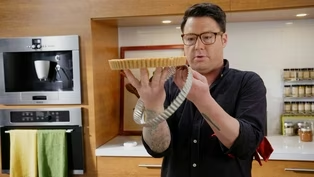
With a graham cracker crust, thick caramel or dolce de leche fresh bananas and lots of whipped cream, this delectable dessert is sure to please and maybe your new Thanksgiving tradition.
Here's chef Spencer Watts of the television show Comfort Food with the recipe.
- Oh, that is such a nice crust.
Couple bananas and look at this crust.
Ready?
This is what I love about the false bottom.
So good.
It looks exactly like the bottom of the cheesecake.
And that's why I love it.
It's so simple.
You just grind up some cookies, a little bit of melted butter, instant crust for anything, especially some bananas, whipped cream and toffee.
Now banoffee's made with toffee or caramel and I have like a really cool mix.
It's almost both.
It's like toffee caramel.
It's really thick and just get it on there.
I like to fill the bottom of the tray with the caramel.
That just makes me so happy right now.
Bananas, caramel, whipped cream, life is good.
Take a spoon.
You just want to mix it out to the sides a little bit.
I like these cake things because they turn and that's the base of it.
So a good thick crust and then the caramel toffee.
Oh, it's just got such a good texture.
All right.
Bananas are used all over the world in desserts, especially in Asian countries.
And bananas are so wonderful.
They go with a lot of things.
They go with coconut.
So you see a lot of tropical desserts made with bananas, but bananas are so cheap and so versatile, they've kind of made themselves all around the world be a staple in desserts.
And this one's from Britain and it's delicious.
So just a few bananas, the caramel, the crust.
I like to cut them on a bias like that.
Just put your knife in and pull it, and that's a really cool shape.
You get a lot of surface area and a lot of good flavor, banana flavor.
And this is a bit of a chefy term, but it's called cutting it on a bias and it opens up the banana.
It's a really cool looking shape.
And the great thing about this dessert is the bananas are really creamy.
And then you got a nice crust, some caramel, some whipped cream, and it's the best of all worlds.
You have really good flavor, you have crunch, you have caramel.
It's a rye.
This dessert is like a bit of a roller coaster.
It's great.
So nothing fussy here.
Just get the bananas on.
You want it so when you cut it, you get a little bit of banana, a little bit of caramel, a little bit of whipped cream, make it nice and even, and the best part of it all, the whipped cream.
So good.
This whipped cream is classic.
So heavy cream, a little bit of icing, sugar, and vanilla.
It just helps that flavor with the bananas and the caramel spread it out.
This is what I love about the cake spreader.
I'm having fun.
Just a shot of cocoa powder.
It's kind of dark and mysterious and adds a little bit of savory and depth.
- For Spencer Watts' full recipe, you can visit gustotv.com.
Well, at the time of the American Revolution, much of Northern New York was unsettled and largely unchartered wilderness.
While no battles were fought in Jefferson County, the war left a lasting mark on the region.
After the revolution, many veterans made their homes here, drawn by land grants awarded in recognition of their service.
With the Continental Congress and individual states short on cash, soldiers were often compensated with bounty and land instead of money.
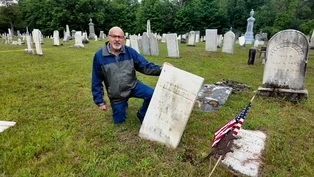
This week, we visit just a few of the more than 450 Revolutionary War veterans laid to rest in Jefferson County whose graves stand as lasting reminders of the nation's founding generation.
- We're in the old Evans Mills Cemetery in Evans Mills, New York where several Revolutionary War patriots are buried.
This one is John Evans.
John was born in New Hampshire, joined the military in 1777, found himself at Mount Independence, which was the sister's fort of Fort Ticonderoga across on the Vermont border.
Both forts were overrun.
John found himself in retreat, very harsh, difficult retreat.
He later joined forces at Saratoga, served in the Battle of Saratoga, and was at the surrender of Burgoin.
Rhoda, his wife, had two brothers and a father who served in the Revolutionary War.
Of note, her brother Gideon Putnam founded Saratoga Springs.
We're at the grave of John Wilson.
John served in the Revolutionary War as a drummer.
Drummers were usually young individuals and their purpose was to provide marching cadence as well as instructions during the actual battle.
This is the grave of Efrain Smith.
Efrain was drafted into the war in 1778.
He was involved in the attack on the British and Newport, Rhode Island.
Later, he returned to Long Island Sound, where he spent the rest of the war serving as a scout on the coast.
We're at the grave of Jonathan Cohen.
Jonathan joined the revolution in December of 1776 and served in Rhode Island, primarily protecting the coastline.
In February of 1777, he stepped in and substituted for his father's service, marched to Providence, and defended the village from attack.
This is the grave of Jacob Shew.
Jacob was from Johnstown, New York, known as Trion back then.
He, his father, and two of his brothers served in the war and were captured by Native Americans and Torres and brought to Canada.
Later, they were brought to Boston in exchange for British prisoners.
This is the grave of Alicia Scofield.
Alicia was from Connecticut.
He entered continental service as a teenager.
In 1780, he served for one year as a waiter for George Washington.
- We're at Huntingtonville Cemetery in Watertown, New York with the grave of Thomas Delano.
He was born in 1760 and served in the Revolutionary War at just 16 years old.
He enlisted in January of 1777 and served at least five terms during the Revolutionary War.
His pension record shows that he was serving at New Brunswick and eventually joined George Washington at the Camp at Valley Forge.
He remained in the Continental Army through the brutal winter, and by 1782, after years of service, he had risen to the rank of Sergeant Major.
He would later return to military service in the war of 1812.
And when the war was finally behind him, he married Olive Griswold in Connecticut in 1783, and together they raised 11 children together.
He died in 1835 and he left behind more than a headstone.
He left behind a legacy that helped create the Americas.
Here we have the grave of Joel Goodard Sr.
He was born in 1760 and enlisted in the American Revolution at the age of 16.
Records show he served as a private and Colonel Nathan Sparhawk's Massachusetts Regiment, and he likely took place in the militia expedition connected to the 1777 surrender of British General Burgoin at Saratoga, definitely a turning point in the revolution.
After the revolution, he married Molly Swain in 1783, and together they raised an incredible 14 children while beginning a new chapter here in the country that he helped fight for.
In 1803, Joel and his family moved here to Watertown, New York, becoming one of the first settlers when Northern New York was still much a frontier land with a lot of woods and not a lot of roads or supplies.
Here we have the grave of Abel Crandall.
He was born in Connecticut in 1757.
He served as a sergeant in Colonel Fletcher's Vermont militia during the Revolutionary War, answering multiple emergency alarms between 1780 and 1781 as the British loyalists threatened remaining activities along the northern frontier.
In October of 1781, while the revolution was still unfolding, Abel married Elizabeth Crocker and began raising a family in the country he helped defend.
When the winter of 1804, Abel packed his family and household goods into an oxen-drawn wagon and made the difficult journey from Vermont to northern New York.
Here in Champion, he purchased 50 acres of land, built a log cabin, and raised his family and was one of the first settlers of Jefferson County.
Here we have the grave of Joseph Cook.
He was only 16 years old living in Connecticut when he joined the revolutionary militia in July of 1775, just few months after the first shots were fired.
He first served after Long Island Sound before being sent north to Roxbury, Massachusetts during the siege of Boston.
He returned to service in 1776, moving to Long Island, New York City, Turtle Bay, and White Plains during Britain's massive invasion that nearly crushed the revolution in the early days.
Then in 1777, Joseph was called to fish kill on Hudson River during the Saratoga campaign as British General Burgoin was captured at the turning point of the battle of the war.
In 1778, Joseph married Esther Clark and became a farmer and stock raiser.
In 1809, he settled here in Champion, and by 1831, he was granted a pension for his service during the Revolutionary War.
Here we have the grave of Jonathan Carter.
He was born in Connecticut in 1751.
Jonathan served during the Revolutionary War as a private and company minuteman in the 15th Connecticut militia.
These were civilian soldiers expected to respond immediately in times of crisis, making them some of the earliest Americans called to defend the cause of independence.
In January of 1776, as the revolution was still unfolding, Jonathan married Abigail Monthrop and began raising a family during one of the most uncertain chapters of American history.
In 1803, nearly 20 years after the war ended, Jonathan moved his family to Champion, New York, joining the early settlers helping transform Northern New York from frontierland into growing communities.
Later known as Deacon Jonathan Carter, he was not only known for his revolutionary service, but also his community involvement and leadership.
Here we have the grave of Stephen Johnson Jr.
He was born in Connecticut, and at just 16 years old, he enlisted in the Connecticut militia men.
He spent months defending the vulnerable coastline, serving in New Haven before being stationed at both Fort Trumbull and Fort Griswald, guarding against British naval threats.
The following year, Stephen was drafted into the Continental Army and marched south to the defense of West Point, where he helped build fortifications protecting one of the most strategically important positions of the entire war.
He later marched through New Jersey and spent time near the famous winter campment at Morristown.
In 1781, he enlisted once again, joining expeditions in Connecticut aimed at driving loyalist raiders from the region.
After the war, Stephen married Phoebe Bird Johnson, raised a family, including sons Nathaniel and Nathan Porter Johnson, and moved first to Washington County before settling here in Champion in 1808.
Stephen Johnson died here in 1832 and he's buried here in Hillside Cemetery Champion next to his wife.
Buried here in Champion is Asa Harris.
He was born in Connecticut in 1763.
Asa enlisted in the Revolutionary War at just 16 years old, along with his father who also served.
His first service placed him along the Connecticut coast at Groton, New London, and Fairfield, helping build and defend fortifications as British Naval forces threatened American communities.
Soon after, he took on an even more dangerous role serving as a Marine aboard a 34 gun privateer ship named Dean.
Sailing off the banks of Newfoundland, his crew captured three enemy vessels before returning safely to Boston.
In 1782, he enlisted once again, marching north through Vermont and into New York as the revolution entered its final chapter.
After the war, he moved west and settled here in Champion in 1803, where he raised his 10 children and helped build the growing community, but his service wasn't over.
When war broke out again with Britain in 1812, he returned to duty, serving first as a captain and later as a major in the New York militia defending the northern frontier.
When he died in 1835, he left behind not just a headstone, he left behind a community that was still building into the next generation.
- Next time, we'll explore revolutionary war graves in St.
Lawrence and Lewis counties.
Well, that does it for this Tuesday night.
If you have a story idea you'd like us to explore, we would love to learn more.
All you need to do is send us an email at wpbsweekly@wpbstv.org and let's share it with the region.
That's it for tonight.
Join us next time for a fresh look inside The Stories.
Until then, take care.
- Funding for WPBS Weekly, Inside the Stories, is provided by the Statewide Community Re-Grants Program, a re-grant program of the New York State Council on the Arts with the support of the Office of the Governor and the New York State Legislature and administered by the St.
Lawrence County Arts Council.
Carthage Savings founded in 1888, offering VA, FHA, seasonal and rural development mortgage products, providing financial services to Northern New York from offices in Carthage, Clayton, Croghan, and Watertown.
Online at carthagesavings.com.
- Yes, we do really encourage patients to do this in combination with lifestyle changes.
So take the medication, lose weight.
We want you to remain strong, so we want you to exercise.
We want you to have a healthy diet in order to get all the benefits from the medication.
So that's - Key.
The exercise still matters.
It doesn't give us a green card to get out of that, right?
- That's correct, yes.
 New
NewRevolutionary War Graves in Jefferson County
Video has Closed Captions
While no battles were fought in Jefferson County, the Revolutionary War left a lasting mark. (8m 59s)
Providing Support for PBS.org
Learn Moreabout PBS online sponsorship












Support for PBS provided by:
WPBS Weekly: Inside the Stories is a local public television program presented by WPBS