WPBS Weekly: Inside the Stories
May 12, 2026
5/12/2026 | 24m 45sVideo has Closed Captions
A Sanctuary for Chickens, Sitting down with John Holbrook & the Akwesasne Medicine Game.
Giving chickens a second chance with a forever home built on compassion, community, and the belief that every life - no matter how small - has a story worth continuing. And from high beams to a higher calling, Author John A. Holbrook stops by the studio to share his inspirational story. Also Players from Akwesasne and the Canadian armed forces come together on Armed Forces Day.
Problems playing video? | Closed Captioning Feedback
Problems playing video? | Closed Captioning Feedback
WPBS Weekly: Inside the Stories is a local public television program presented by WPBS
WPBS Weekly: Inside the Stories
May 12, 2026
5/12/2026 | 24m 45sVideo has Closed Captions
Giving chickens a second chance with a forever home built on compassion, community, and the belief that every life - no matter how small - has a story worth continuing. And from high beams to a higher calling, Author John A. Holbrook stops by the studio to share his inspirational story. Also Players from Akwesasne and the Canadian armed forces come together on Armed Forces Day.
Problems playing video? | Closed Captioning Feedback
Where to Watch WPBS Weekly: Inside the Stories
WPBS Weekly: Inside the Stories is available to stream on pbs.org and the PBS app.
Providing Support for PBS.org
Learn Moreabout PBS online sponsorship- Tonight on WPBS Weekly, Inside the Stories: giving chickens a second chance with a forever home built on compassion, community, and the belief that every life, no matter how small, has a story worth continuing.
And from high beams to a higher calling.
Author, John Holbrook stops by the studio to share his inspirational story that led him to find a deeper purpose.
Also, players from Akwesasne and the Canadian Armed Forces come together on Armed Forces Day, your stories, your region, coming up right now on WPBS Weekly, Inside the Stories.
- Funding for WPBS Weekly inside the stories is provided by the statewide Community Regrant Program, a REGRANT program of the New York State Council on the Arts, with the support of the Office of the Governor and the New York State legislature, and administered by the St.
Lawrence County Arts Council.
- Good Tuesday evening everyone, and welcome to this edition of WPBS Weekly Inside the Stories, I'm Michael Riecke.
At Secondhand Stories Chicken Sanctuary near Perth, Ontario, every feathered friend truly gets a second chance.
This volunteer run nonprofit rescues, hens and roosters and gives them the gift of freedom, safety, and a loving home here.
They're free to scratch in the grass, bask in the sun, and live out their days in peace.
Here's WPBS producer Gal Paquette, taking a fresh look at farming - Tucked away near Perth, Ontario.
Secondhand Stories Chicken Sanctuary is more than just a place, it is a haven.
This nonprofit provides loving forever homes to rescued chickens - Throughout my whole life, like I've loved animals, and it's just like I found myself in these circumstances where I end up with just like the most amazing found family, to be honest, is what it is.
They're our family.
When we were looking at properties, there are chickens that were gonna be left behind here.
And so it just, it felt like kismet and like it was meant to be.
Having the seven hens that we had set off this like domino chain of events, where once people saw that we had those chickens, we were tagged in a comment on Facebook from Montreal, SPCA and got an email from 'em about Rollo here in Hershey, his brother.
And so they joined us.
And then once they started crowing, our neighbor heard them and was like, you have chickens?
Do you want more?
Can you take in this rescue?
And we were like, yes.
And so everything just has happened so naturally and it's just meant, felt, meant to be every step of the way.
- The sanctuary grew from a shared dream born out of both Liz and her husband.
Craig's passion for animals.
It's a vision they've nurtured together each bringing their own dedication physically, emotionally, and practically to make it possible.
- We talked a lot about kind of this before we, we moved here, so we were actually kind of in it together from the get go.
We both wanted to do this.
So I do a lot of the animal care, a lot of the infrastructure, that kind of stuff.
That's, that falls onto my lap because Liz will spend all day if she has to, just on her fundraising stuff for the sanctuary.
And it's a huge amount of effort that goes into that.
We had an inkling of how much it would cost.
I don't think we had any idea how far away we were actually to that.
It grows every year.
The cost.
I mean, the more chickens we take on, the more health needs.
It continues to grow.
Infrastructure has been a huge cost out the get go.
I did not expect how much that would cost, but each coop, once it's all said and done, is anywhere between, I think, well, we priced it out at one point, it was around 10 grand.
- I think people are really drawn to the idea of, you know, sustainability, being able to like, quote unquote grow your own food, right?
So people are romanticized by the idea of fresh eggs, but people don't realize there's a report that looks at the cost of backyard eggs.
It's about a dollar 27 per egg.
It's more expensive to have backyard chickens.
- The cost of backyard chickens is very real from infrastructure and feed to unexpected vet bills.
Expenses can mount quickly, but knowledge is just as important as money because a healthy flock depends on both.
- The education part is like so important.
We're not against backyard chickens.
A lot of people think that we are because we do advocate against certain bylaws, but we advocate against them because there's not enough protection for the chickens in place.
And we know we have the lived experience of rescuing them and being the one place that people can turn, that we know that these protections aren't enough to keep them safe.
And also to keep humans safe.
You know, avian flu is a very real concern and we wanna be really cautious about the exposure to that because that affects not only individuals, human health, the chickens, when there's a case of avian flu, it means everything around gets shut down.
And so we wanna be really careful about our own own hens and rescues.
- For Liz and Craig.
That responsibility, whether in a backyard or a sanctuary, comes back to the bigger picture.
It's not only about keeping birds healthy, but about why this work matters.
That's where the Sanctuary's mission comes in.
- I think like our mission kind of says it all.
Our aim is to inspire compassion for chickens through rescue education and advocacy.
And that really is what we wanna do.
We want people to see chickens as individuals.
We want people to be inspired by them as individuals.
We want people to treat them as they would a cat or dog maybe reconsider a little bit about what's on their plates and, and think about humane options for, for eating.
We are not an abolitionist organization.
We're not saying everybody needs to go vegan, but we do think that there are ways that people can care more for farmed animals and understand the food system, understand the laws that don't protect chickens like the average factory farm in Canada.
And yes, there are factory farms.
The average egg farm in Canada has 23,000 hens.
83% of hens in in egg farms are kept in wire cages their entire life.
And so we just hope that people will start to see those 23,000 chickens as 23,000 Sophies or Almas.
- That mission has drawn others in.
Volunteers like Haley have stepped forward, giving their time and energy to care for the flock.
For Haley, it's not only about helping the birds, it's about being part of a community, built on compassion and learning.
- It firmed up a lot of things for me.
A lot of my different beliefs in trying to align my actions with my values, being vegan and enjoying being like a steward for the environment.
It's all great, but you know, it's like, what do you do with that?
Don't eat meat and stuff.
And it's like, okay, but you know, what else can you do?
It's like, well, I come out here and I also help chickens, Secondhand Stories, give a voice to animals that don't really have a say in how they're treated, how they live.
And it's honestly like amazing how much love and care Liz and Craig provide for the chickens here.
- Success for, for me anyways, is the, is seeing the, the kind of, not just the health of the birds, but how they flourish when they come and kind of grow into the personalities that they have and learning about their personalities.
That's probably my favorite thing.
The money's a huge aspect of it, but I mean, I think even if we had no money coming in, we'd still try our best to do this - For WPBS Weekly.
I'm Gail Paquette.
- If you too have a passion for chickens and would like to find out how you can help, just visit secondhandstories.ca up next, an inspirational story about a man's journey from high beams to a higher calling author John Holbrook, whose journey began in construction, took a turn when he was diagnosed with cancer.
What followed, he says, led him to find new meaning, which he now shares with others.
John stopped by our studio to share his story, hoping it inspires others.
- Thank you Michael.
And this evening I am joined by author and writer John Holbrook.
John, thank you for coming to the studio this evening.
It's a pleasure to have you.
Yes.
And you know, you have been called an inspiration by many and I think that has a lot to do with the book you wrote from High Beams To A Higher Calling.
It was really that title that immediately caught my attention when we talking.
Yes.
And I gotta know, where does the high beams in that title come from?
Tell us a little bit about yourself.
- Well, I was a, as a young kid, I grew up and did a lot of work and as later in life I became an iron worker.
And so the high beams was being high up in the air and signaling cranes and things like that.
And, and being in Watertown here on WPBS often might went by this station, but on the other side of town as a state office building that I worked down when I was a kid and right outta high school and I would just, as we put the iron up, I would just go into work and start climbing up the outside of the building every day.
And whatever floor we were on, that's what we worked on.
And some days I would just do it for exercise, but, but that was my iron working life from high beams.
- See some people when they do exercise, they're going to Planet Fitness, they're going to the gym.
You're you're climbing up the, you're climbing up the buildings and doing construction.
Yeah.
But you, you and you had retired closer, you were getting ready to retire in about 2005.
Yes.
And that's when you were diagnosed Yes.
With cancer?
- Yes.
In late in 2004, I started losing a lot of weight.
Around September, October and November, I lost 45 pounds in 30 days.
And I was seeing some doctors and finding my local doctor.
And plus guy, he says, I think I think you have cancer.
So he sent me to a specialist and I on sat on sat January 1st, Saturday 2005 is I told my wife, I can't get out of bed, I can't walk anymore.
I could hardly speak.
And so she called the emergency and they, my doctor took me into the city and that was on a Saturday.
And between Saturday and Sunday, I'd already had a bone marrow treatment.
And by Sunday afternoon he had the results.
And he says, you're infested with cancer.
I had stage four lymphoma.
And he says, what, what we need to do?
We have one, one treatment for you.
So they tried to start the treatment Sunday afternoon.
I rejected that.
I went into convulsions.
And so they had to stop the treatment, change the procedure, and finally they got it down me.
And it, it really didn't mean a whole lot for my body at that moment.
I was so sick.
And then the next day Monday, he comes in and he, he says, well, he says he sat on the edge of the bed there and he says, I got kind of some news.
And he says, we have no treatments for you.
This is all we have, and I want you to get your stuff in order.
'cause nothing was happening.
So they gimme another chemo the next day or two.
So, and I went down and had that treatment and when I was in the CAT scan, I was just laying back with my hands on my head and I looked up and I could see a ceiling in the, in the, in the basement there.
And I, I said, Lord, what's this all about?
And immediately I believe it.
I don't believe it.
I know it was the hand of God come on me and went down through my body and out through my feet.
And why I asked that question, I didn't, a lot, a lot of folks might say, why me?
But I just said, Lord, what's this all about?
And now he has shown me what it was all about over these last 20 years that we were, they never found it again.
At that point, they never found my cancer again.
- Wow.
- And to verify that, within six or seven days, I went down for a, some blood work at the oncology center at Brittonfield.
And as I was in there, my man came out and took the blood and went and they, they checked it as, as usual before my appointment.
And he came back out the door and he had another test kit.
And he says, something's a matter with our machine.
And he, there's two ladies standing in the door looking at me.
And so they, they pulled it again and went back and he came back out and there's four ladies.
The staff is standing in the door just staring at me and I'm wondering, what is this all about?
This is so unusual.
They usually just let you go.
And by the time I got down to the doctor's office and went in and my PA come in and she jumped through the door shaking her paper in my face like, like I always related to Kramer on TV, coming into a room.
But that's what she was doing.
And she says, Mr.
Holbrook, Mr.
Holbrook, you, you won't believe this.
You won't believe it.
She says, your blood work is as near normal for anybody your age that's ever been in this office.
- That's incredible.
- And over the next, the next few months, it, it, my blood work never changed and hasn't changed today.
This is 20 years ago.
- It's, it is 20 years ago.
First of all, congratulations on 20 years cancer free.
Yeah.
But that was a lot of where the inspiration for this book came from.
That's where the higher calling of your title comes from.
When did you know this was your higher calling?
This was your moment when you say, this is what I'm meant to do.
- When I came out of the hospital and we were headed home, my wife was driving home in the car.
And I says, I, I says, I call her baby.
So I said, baby, if, if we can do anything to help one more person the rest of our life, and that's our mentality as thinkers, I wasn't thinking big.
And she said, we need to do that.
We need to help one more person.
And over, over the last 20 years, we've helped six to 7,000 people all through the north country and church after church and, and ministering and personally and even, even today, we're working with five or six, seven people right at this time in our life.
And it happens to us.
We don't look for folks.
They come to us and through friends and, and other things.
And the, the objects of of me writing this book was through a friend that I met in a restaurant.
I hadn't seen him in 60 years.
And he, I he, he stopped and recognized me and then we used to slide down the hill together.
- This was Dave Alport, correct?
- Yeah.
David Alport.
And he says, you know what you've been doing.
My wife shared our testimony and he said, I'm an author, you need to write this.
And that was, that was two years ago.
- And you went on to make an amazing story.
It's, it's about 80 plus pages, am I correct?
Yes.
It's 80.
It's 80 plus pages.
And you know, if there's something that when somebody is reading this book, what's something you hope people take away when they pick up this book?
- When I, I had never written a whole lot or read a whole lot and I didn't know how to talk to people in writing.
And I, I got looking into it, a guy in our church looks up words in the Greek to find a definition.
And so the word you came to me, so I looked it up in the Greek and the word you goes from the floor sweeper to the executive and everybody in between individually or a whole stadium full of people could be referred to as you.
So my idea of this was to write to each individually personally by using the word you.
And, and, and that's where, that's where I try to be because we're all in different places at different times.
And my, my whole our our whole point, my wife and mine was to to touch each individual.
'cause they all have different situations.
That's where the higher calling and basically why the Lord our God just keeps putting people in front of us is to, to help 'em - Creating - Inspiration to get the situation - And, and create inspiration for those - Yes.
That are - Looking for inspiration.
Yeah.
So where can folks go when they if to look for your book or even purchase it?
- It's on Amazon.
It's on Amazon books through the title or, or my, by my name on there, John a Holbrook from High Beams to a higher calling.
And that's basically what we're set up to do individually.
We've got books to the north country of all the folks we know, they're in eight or nine different states in different places.
And I assume there'll be one in Maine soon, but we'll find that out la later.
And basically now we're setting up a, an Amazon for Amazon to sell 'em for us.
- Excellent.
And just before we start to wrap up, just real quick, I need to know if there's anything this book proves, what, what would you say that is?
- One thing that I i I like about this book is, is to live by example, connect with other people because of the love and the faith and the trust we have in each other.
And that's things that we live by and to encourage and have and to see other people's life change.
Maybe not in a total healing, but just to see other people's lives change to where they can get through the day with the things they're going through and, and be lifted up and, and be glorified basically.
- John, thank you so much for sharing your story with us today and your amazing book Folks, you know where to go, you know where to look.
Definitely check this book out.
Certainly worth the read.
John, thanks again for stopping by our studio.
It was a pleasure having you.
Yeah, - Thank you.
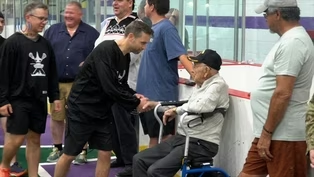
- Last June to commemorate Armed Forces Day players from Akwesasne and the Canadian Armed Forces came together for the second annual medicine game.
Players discovered what it means to learn about the spiritual roots of lacrosse, honoring the creator's game through connection, culture, and respect.
Take a look - Second time that we're doing this.
I believe Jimbo Barnes had had a lot to do with the first one and the kind of the creation of it.
So we're we're, you know, taking steps to make this kind of an annual, annual thing every year, which is good.
You know, the Canadian forces reached out to, to Jim Barnes and kind of one to pick his brain about the, the, you know, the creator's game and you know, what it kind of meant to us.
And, you know, how they could start playing.
'cause some of them, you know, haven't been playing very long or some people have, you know, just started picking up a stick.
So it's a, it's a good opportunity to learn and, and grow and just have fun.
Right?
- Mr.
Dwayne Thomas is a friend of our school.
Dwayne had suggested, I think somewhere along the way that, hey, maybe we should look at at doing something with the lacrosse.
Maybe let's, let's get a lacrosse game going.
Mr.
Jim Barnes came over and taught us about all of the cultures and traditions of the medicine game.
We realized then, and this was before the first annual game last year, we realized that, hey, it's not just a game.
There's, there's a long history of this game here in this, in this community.
So we, we, we, we ended up doing the first game.
It was great.
We've continued our relationship.
We talked to veterans, we have great relationship with lots of veterans in this community.
And we, we marched with the, with the Uncle, Sony veterans on Memorial Day.
And yeah, so now here we are at the second annual game.
So looking forward to it.
- Every time we come over, we come back with a renewed sense of just, of understanding.
I think, you know, we're we, we really come over, we try to listen and understand and, you know, Dwayne Thomas gave us a great speech at the end of last, last year's game about what reconciliation really is.
And I, I won't put words into, into Dwayne's mouth, but it gave all of us goosebumps sitting in the back.
So again, we know this is more than a game.
And, and for us it's just an opportunity to come over, laugh together with, with some of the members of the community and have a good time.
- It's, it's mostly just having fun, right?
We're just getting out here, you know, we're playing the creator's game, which is awesome, you know, and we're just here to play lacrosse and, you know, make some bonds with the, with the other team and, and ourselves, right?
So it's, it'll be a good day This year's Medicine Game takes place on Saturday, June 6th at 4:00 PM at the Turtle Dome on Cornwall Island in Canada.
Admission is free.
This year's special guest is Royal Canadian Air Force, Chief Warren Officer Renee Hanson, Senior Advisor to the Commander of the Royal Canadian Air Force.
And on June 13th, 2026, celebrate Armed Forces Day at Lamoureux Park in Cornwall, Ontario from 12 to 4:00 PM the day is filled with activities, displays, and ceremonies.
Visit cornwallarmedforcesday.org for more information.
Well, that does it for this Tuesday night.
If you have a story idea you'd like us to explore, we would love to learn more.
All you need to do is send us an email at wpbs weekly@wpbstv.org and let's share it with the region.
That's it for tonight.
Join us next time for a fresh look inside the stories.
Until then, stay safe and take care - Funding for WPBS weekly.
Inside the Stories is provided by the statewide Community Regrant Program, a REGRANT program of the New York State Council on the Arts, with the support of the Office of the Governor and the New York State legislature and administered by the St.
Lawrence County Arts Council.
- One thing that I like about this book, "live by example, connect with other people because of the love and the faith and the trust we have in each other."
And that's things that we live by.
Providing Support for PBS.org
Learn Moreabout PBS online sponsorship









Support for PBS provided by:
WPBS Weekly: Inside the Stories is a local public television program presented by WPBS