Look for the Helpers: Portraits in Community Service
Mark Knowles and Calvin Campany
Season 2 Episode 6 | 25m 35sVideo has Closed Captions
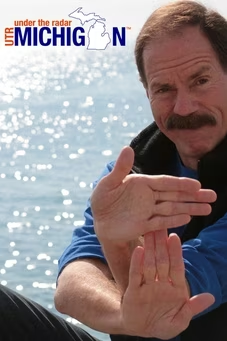
Meet local volunteers Mark Knowles and Calvin Campany.
Meet local volunteers Mark Knowles and Calvin Campany. Mark turned his experience with emergency medical support into a wider community service and now volunteers as a captain with Clayton’s Antique Boat Museum. Calvin decided to share his love of outdoor biking with people of all ages and abilities and now helms the Adirondack Foothill Cycling Club.
Problems playing video? | Closed Captioning Feedback
Problems playing video? | Closed Captioning Feedback
Look for the Helpers: Portraits in Community Service is a local public television program presented by WPBS
Look for the Helpers: Portraits in Community Service
Mark Knowles and Calvin Campany
Season 2 Episode 6 | 25m 35sVideo has Closed Captions
Meet local volunteers Mark Knowles and Calvin Campany. Mark turned his experience with emergency medical support into a wider community service and now volunteers as a captain with Clayton’s Antique Boat Museum. Calvin decided to share his love of outdoor biking with people of all ages and abilities and now helms the Adirondack Foothill Cycling Club.
Problems playing video? | Closed Captioning Feedback
How to Watch Look for the Helpers: Portraits in Community Service
Look for the Helpers: Portraits in Community Service is available to stream on pbs.org and the free PBS App, available on iPhone, Apple TV, Android TV, Android smartphones, Amazon Fire TV, Amazon Fire Tablet, Roku, Samsung Smart TV, and Vizio.
Providing Support for PBS.org
Learn Moreabout PBS online sponsorship- Hi neighbors.
Welcome to Look for the Helpers, portraits, and Community Service.
I'm Cynthia Tyler.
In every community there are those who step up to lend a helping hand, giving their time and putting in the energy to make life better for those around them.
They don't do it for the recognition, but because they care.
And it's what keeps our communities growing strong.
Tonight we sit down with two of our neighbors making a difference in the place that we all call home.
Mark Knowles turned his experience with emergency medical support into a wider community service, and now volunteers as a captain with Clayton's Antique Boat Museum and Calvin Campney decided to share his love of outdoor biking with people of all ages and abilities.
And now Helms, the Adirondack Foothill Cycling Club.
Please join me as we celebrate our local volunteers.
With me now is Mark Knowles.
He is a volunteer with the Antique Boat Museum in Clayton, New York.
Mark, thank you so much for being with us today.
- Thank you for having me.
- Now everybody knows that there's always the, the tours on the river, uncle Sam's and all of the big river boat tours, but the Antique Boat Museum is actually a little bit more special than that.
So what do you do there at the Antique Boat Museum?
- Well, I'm a captain, which means as far as, you know, driving the various boats that they have of, of their in water fleet.
And there's the variety.
I mean, anybody can come and go for a simple ride, 45 minute ride through some of the islands and here as far as some of the history of the river, some of the various aspects of the islands, and obviously about the antique boats themselves and all.
So it is very unique as far as from a tour aspect and people seem to really, really enjoy it in all from all walks of life, all ages.
I haven't had an unhappy person yet.
- Well, I mean of course 'cause you have an up close and personal view.
You said that on the Canadian side you get to be a little bit more intimate with all of the nooks and crannies of the islands and see some really beautiful sites.
- Oh, it is.
The river is gorgeous.
As I say, most people have no idea, you know, what we have up here.
- Right.
- And until they actually experience it and then it's kind of awe as far as afterwards.
- Right.
So as a captain for the, the Boat Museum here, that service started quite a bit in the past.
So you've, you've actually been a captain on the river and served on the river for many, many years.
I understand that you were E-M-T-E-M-S and a rescue diving instructor.
Trainer.
- Rescue diver.
- Rescue diver.
- And, but I was the head of it.
So bring on new ones, get them trained up.
- Okay.
- And work with other agencies.
- What sort of training is involved to become a boat captain?
- Well, it actually is kind of intense.
One, you've gotta have some boating experience.
I mean, personal, you know, that you, you know how to handle a boat and you got some documented time on, you know, on the water.
It doesn't have to be anything big or huge, you know, it can be a simple little runabout fishing boat, something of this nature and all just to be able to show the, the, the need as far as or the for it.
But then there's a class and all that is to get your total package for what the museum looks for is full two weeks as far as a Monday through Friday, eight hour days with various modules in testing as far as that all classroom just for that.
- Okay.
Wow.
- And so it is pretty intense.
And then even the application takes quite a bit in that it is licensed by the US Coast Guard and the requirements are that you've passed this courses and that you are drug tested, you have a intense physical, you've documented your sea time and all that gets sent in so long and short as far as if a person says, well, again, hopefully you've got a couple of few years of just regular fun boating.
- Right.
- But from the time you start taking the class until you actually get your license, it can take a few months - Again.
So it becomes a measure of are you passionate about this?
Is this, you know, something that you really wanna do.
If you're ready for it, time isn't gonna get in your way.
- Correct.
Correct.
- We had talked about you had, you've dived the lake, the river, the black river, which is exceptionally challenging.
Can you tell us a little bit about what it takes as a volunteer in those situations?
- I think as far as that, whether it's the diving fire or EMS, I think from a standpoint that people probably view that first off saying, wow, even looking at you, the excitement, the awe, the thrill.
And true enough, it is.
However, once you start getting into it, then you realize as far as, okay, the seriousness of it, not only as far as what it means to you, but what it means to others obviously in all these cases is you're going to help somebody that's in need.
And it's very, very rewarding to be able to have helped them in the situation, if not the individual, maybe the family and friends as far as with the outcome and awe.
So that's the biggest reward of, of it all, is knowing that you helped and maybe brought closure, you know, to the family and others.
- Yeah.
Now I understand that you are originally from Maryland and you began volunteering for EMS and fire down that way.
Was there somebody in your family or somebody in your life that just inspired you to, to want to start giving back?
- No, not really.
In fact, my mother thought I was crazy.
She said, this isn't gonna get you anywhere in life.
- Wow.
- So I think it literally was one of those, like probably any kid, you know, who looks out the window and sees a fire truck, an ambulance or a police car go racing by with red lights and sirens and you're just kind of like, Ooh, I think I may want to do that someday.
And I venture to say, if truth be known, most will pretty much say that.
But then as you get closer and start into it, you're again realizing what it's truly all about.
And not saying that there isn't a rush as far as that, but it's what keeps you in it is what's probably the big thing.
And to want to go on.
And as I say, volunteering, you know, some people may say as far as, well yeah, but I don't know if I can do that.
Well one, I, I'll put you this way, I didn't think I was gonna be a captain at the museum.
I had no clue that that was, you know, I mean I'd been on that river for years, know more about what's under the surface than I do, probably what's on top.
But you know, the museum, I knew it was there and I knew as far as that, I mean I had my captain's license, but they basically recruited me in awe.
And I kind of was like, I don't know anything.
I mean, I can drive a boat, but I don't know anything about these antique boats.
I don't know the history of the river or any of this stuff.
And I think as far as from a volunteer aspect, a person in general may say I'm interested in that, but I have no clue.
Well, that's where being a volunteer works because you don't have to - Know everything when when you start out everything or anything.
Yeah, - Exactly.
No, you just, Hey, I'm interested.
You know, as far as that, well like I say, the museum, they got tons of people there.
The mo, most of that place is probably two thirds.
Can't hold me to it, but I bet two thirds of that whole place is all volunteer.
- Wow.
- In awe.
And everything from, you know, working the information desk, the store to giving tours, to helping maintain boats, build boats to do the history so's a history.
So there's - Skillset for everybody there.
- Yeah.
Of all ages and all as far as that goes in that perspective.
Volunteer in other a, you know, areas.
I mean, if we didn't have volunteers in general, I think we'd be in a world of hurt.
- Oh, absolutely.
I absolutely that's the case.
- We'd be in a world of hurt.
Yeah.
Because, you know, you take any walk of life or need, there's probably some volunteers in that arena.
- Yeah.
- You know, whether it's even helping with social aspects, you know, - Because everybody needs a little bit of help now.
And then That's - Exactly, that's, that's just how it goes.
So there's always a, you know, if somebody says, Hey, well I don't know what I do.
Well yeah, you just, all you have to do is say, what do I think?
I would like to try and knock on that door and I bet you it'll be, come on in.
- Of course.
Yes.
'cause every, again, like I was saying, everybody needs some help.
And that's the organizations too.
They need help too.
- They definitely do.
- Oh, now, so in your extensive time for all the volunteering and everything you did, we've talked about, you know, diving and, and flight rescues and all of these things.
Is there a special memory that stands out to you that if you're having a low day and you need a little boost of energy, can you think of something that's that's a really special moment?
- In some ways?
I can't probably truly say there's a one situation, but I think where I get my warm and fuzzy, if you will, since I have been in a variety of fields, is in some ways just being a bystander at times.
I've been there, quote, been there, done that, taught it and let it, and if you will, whether it be the dive or the EMS or, you know, I even helped train some of the boat captains.
So I look at it from the standpoint of being able to say, see that ambulance go by, see that firetruck, and I recognize who's on there.
And I actually feel an warmth because I know those guys and I may have even helped train them.
And where I may not be doing it anymore, I know I influenced them to get into it, and I hope then they influence.
- Yeah, you planted the seeds and you're, you're watching it sprout and watching the new, the new crop of people go forward to, to - Help.
Exactly.
That's so I think it's more that's the probably on a, and that's at times on a regular basis, but to sit, there is a call a no, I can't come up with just one.
- And that's not necessarily a bad thing, it just means that you've had a lot of service and it all gives you that feeling, which means it's a life well lived as far as I'm concerned.
So Yeah.
That's fantastic.
What do you find in your, in your time, what have been some of the challenges to volunteers that you've seen?
- Well, training, you know, again, depending upon the walk of life that you, that you try to get involved in.
Again, fire, EMS, diving, medevac, boat captain, I mean, there's training involved and which case, like anything, trying to learn something, you know, you know, can be very trying at times and may not succeed the first time.
- Right.
- But like, like a job, you know, I think the biggest difference, you know, people say volunteer versus career and awe as, you know, what's really the difference.
The only difference really is a paycheck, you know, as far as that.
- Yeah.
- So the volunteer, in most cases, depending upon if it's the same field, has to do the exact same thing.
The paid person may have gotten themselves now into this position and say, but I really don't like what I'm doing anymore, but I need that paycheck.
Whereas the volunteer says, I'm doing it because I just love this.
- Very, very well said.
We thank you Mark, so much for being with us.
We really appreciate it and we hope to see you out on the St.
Lawrence River.
- Sounds good.
I appreciate it.
- Thank you.
With me now is Calvin Campy and Calvin, thank you so much for being on the show with us today.
How you doing?
- Good, good.
Thanks for - Having me.
Wonderful.
Now, you are a very big fan of bicycles.
I mean, you got him on the shirt, it's, you, we were talking about it now.
This is a huge deal of your life here.
You are a member of the Adirondack Foothill Cycling Club.
- That's right.
One of the founding members and member, yeah.
Founding members.
- Okay.
So tell us about that.
- So the Adirondack Foothill Cycling Club started about a couple years ago, three or four years ago, with, with the mission of just bringing bicycling to, to everyone of every ability, every level of cycling, just to make it more accessible for everyone in the north country.
- Gotcha.
All right.
I understand that you've partnered with Encompass recreation to, to bring this group to people that have disabilities and teaching them how to ride and the safety.
What inspired you to create this group?
- Well, we had a number of people in the north country who, who loved cycling, and everyone was kind of doing their own thing.
And we decided to start collaborating and putting on some events.
And then once we got some events going, we thought, wow, let's, let's bring cycling to more people, especially those who haven't even learned how to ride a bike yet.
- Oh, that's so fantastic.
Yeah.
And very exciting.
And, and this has translated, obviously the passion keeps ongoing because you're also a member of the New York Bike Coalition.
Yeah.
Now, people might not have heard about this because this is a different aspect of bicycling.
What do you do in that organization?
- So this is a statewide organization that's working for more bike safety advocacy, including the municipal level changing bike laws to make them more safe, changing if we can, traffic patterns, things like that just to make cycling more safe for folks.
- Okay, fantastic.
Now, has volunteering been a big part of your life?
Was there somebody that inspired you to, to do all this great volunteer work?
- Yeah, I, I think it was always part of my life.
I think my parents taught me that value that if you, you're given a lot, you should give a lot back.
And so it's always been part of my life.
- And you found that love in bicycling so yourself there.
Now do you, do you hold records?
Do you do this as a sport?
Do you, you must do this all the time?
It's a question of - Like, I love cycling, but I'm very slow, so I will never win any awards.
But I just love being on the roads, especially in the north country, - We, yes, we do have some beautiful trails, some beautiful roads and access.
Now the Foothill Cycling Club, that must, that sounds like you go out on adventures out into the Adirondacks.
So do you, how can people get involved with your organization - There?
There's a couple different ways.
So we have two main events every year we have a road cycling event called the Tour de Lewis, which is a, a road cycling event that goes throughout the, the county of Lewis County.
- Oh wow.
- And then we have a second event called the North Winds Gravel Classic, where we go on Tug Hill and hit the gravel roads with our gravel bikes.
- Oh wow.
Okay.
Now I understand that you are looking for some more volunteers for your organizations.
What kind of jobs can people look to be doing?
- If you have a talent?
We will, we will gladly accept the help for the events.
We're always looking for folks to help, even like being on course marshal or helping with an aid station, but for like our All Kids Bike program, which helps children learn how to ride bikes.
We're just looking for people with patience and kindness just to, to give us support, - Patience, and kindness.
I think that those are words that we hear over and again on this show.
Sure.
Because we just wanna reach out and help people learn and grow.
And on bicycles, that's gotta have some challenges here or there.
What, what kind of challenges do you find?
- I think helping, especially children have the confidence to ride the bike.
So our bikes are strider bikes, so what they do is they don't have pedals at first, so for the first couple sessions they just learn how to coast and they learn how to just kick and just just ride their bike.
And then we gradually put the pedals on and once they have the confidence with the, with balance, then it's amazing how all of a sudden it clicks and they can start pedaling.
- Oh, wow.
Yeah.
Now that's so exciting because not only are you helping them learn a new skill, but you're instilling a lifelong healthy habit and joy - And freedom.
- And freedom.
- Yes.
To have a bicycle means that you can get to other places easily.
That's just maybe just too far to walk.
Right.
It's, it's freedom and confidence.
- Yes.
And, and health and, and fun.
That's fantastic.
Now we were, we were talking earlier that this is actually an all year round kind of group.
The the Foothill Cycling Club.
So you guys actually do what, what's, what's the name of the bike that you take out into the snow?
- Fat tire bikes.
- Yeah.
Fat tire bikes.
Yeah.
Now that sounds grueling and challenging.
I, I enjoy being in the nice cozy part of the winter there.
We talked about that.
- Yep.
- But, so it's basically all year round.
- Correct.
- All kinds of help.
And, and even if people don't really, you know, have a specific, if they just love bike biking and, and cycling, they can come to you and find a place.
- Absolutely.
Our club has put together routes for folks.
So if you're not the spandex wearing type of, of cyclist - Me, - If you're just the slow roll type, there's also a place for you.
Okay.
There's cycling for everyone.
- Okay.
Where can they find more information about that?
- At our website, the Adirondack Foothill Cycling Club website.
- Okay.
- And then we have a pretty robust Facebook and Instagram page too.
- Okay, fantastic.
Now we touched on the New York Bike Coalition there.
Now you, you talked about changing laws and now it's a wonderful thing where a volunteer project can span everything from the passion of the, of the, of the idea that you're doing all the way up to changing it, to making it safer.
What are some of the, the things you're working on to try to change?
I know you've mentioned speed laws.
Is there something local that we're, - We're working on?
Not local.
Yeah.
I would love to bring some of this to the north country, but over the state we're working on just changing some speed limits in certain areas where there's more cyclists and pedestrians, but also just awareness, making drivers more aware of cycling, creating maybe a few more lanes to make it safer.
Creating more protected bike paths for folks in the north country would be great.
Again, we, we want people to be safe, we want them to enjoy it.
And some of that has to happen at a municipal or, or state level.
- Of course.
Yeah.
And not only are you helping to make people safer, but you're also helping promote a healthier environment.
- Yeah, of course - Bikes being out, it, it lets fewer cars, less emissions.
It's just better all health for, for everybody around.
Yeah.
So now in all of the work that you've done, can you tell us a story that's really touched your heart and kind of sticks with you whenever you need that little boost?
- Yeah.
When we launched the All Kids Bike program, there was a, a young lady who was nonverbal.
She, she never spoke.
She the first few times she got on her bike and she, she just walked a little bit on top of her bike and my first thought is she, she's not gonna learn how to ride a bike.
Not, not in the six, six programs that we do, but she stuck to it.
She was positive, she was quiet, but she seemed to be enjoying herself.
And by the fourth lesson she started pedaling and it was just a moment where you could just see it click and her whole demeanor changed and her confidence and she started biking around and I'll never forget that.
I'll never forget that moment.
- Wow, that's so exciting.
Yeah.
And it's what a wonderful thing to carry with you while you, while you go on about your work.
Yeah.
That's absolutely fantastic.
Now say you're out on a bicycle and you just happen to see people walking by and they look a little lost and they are wanting to help.
What do you say to them to inspire them to - Volunteer?
I would just, my advice to them would be to, to find your passion.
To find what, what makes you get up in the morning.
And if you have, like if you're given a lot, like my parents said it, it's our obligation to give back.
But it should be fun too.
It shouldn't be a chore.
Absolutely.
So find something that's fun, something that's meaningful to you, find your passion and then it doesn't even seem like work - Now.
Of course, finding all that passion and all of that.
When we talked about the jobs that volunteers can do, what kind of time commitment are we looking at?
Because you know, some people - Sure - They think that it's too much or it's too little or overwhelming.
What kind of time commitment are we looking at?
- Honestly, we will find room for anyone who has any kind of, of of time commitment.
People are busy.
We have jobs, we have families, you know, time is finite.
So if it's just an afternoon, if it's just a couple hours, we will accept that for sure.
If, if there's something you wanna do more long term and more ongoing, maybe a few hours a month for sure.
- Alright.
How has all of this work that you've done this fantastic volunteer work, how has that enriched and changed your life?
- Well, it certainly got me on the bike probably more than I would've without it for sure, which is good for my own personal health.
But I really start seeing the impact.
I think our bike club is happening.
I hope it's not magical thinking, but I start seeing more people on the road on their bikes and that makes me very happy.
I think the north country has a lot of folks, you know, there's some mental health issues, there's some physical health issues and I, anytime I see someone on a bike, I'm thinking, wow, maybe that, that life is a little bit better because they're on the bike.
- That's fantastic.
Yeah, absolutely.
So what motivates you to help?
We talked about, you know, your family had always given back, but there's that little spark inside of you.
What motivates you, gets you up every day and says, I want to help?
- Well, when we were researching our bike club and, and, and coming up with some, some reasons why we should even exist, we were surprised to learn that the north country has some of the highest suicide rates in the, in the, in the state and some of the highest obesity in the state.
And that's a problem.
We really need to do something to impact that and to make lives better.
And I think cycling is just an easy and fun way to do that.
- Wow, that's incredible.
Something that you never would've equated looking out there, but what a wonderful spark that you just decided to put those two together and create a way to help.
- Correct.
- Fantastic.
Wow.
Well, Calvin, thank you so much for being with us.
We really, really appreciate you being here and all the best of luck.
- Thank you.
And you can join us for a bike ride soon.
- Oh, absolutely.
I would love to.
Yes.
- That would be great.
I'd love that.
- Thank you.
Thanks for joining us today.
It's a reminder that bears repeating.
No one achieves anything alone.
The world needs a helping hand.
The world needs you go out and make a difference.













Support for PBS provided by:
Look for the Helpers: Portraits in Community Service is a local public television program presented by WPBS