WPBS Weekly: Inside the Stories
March 17, 2026
3/17/2026 | 26m 50sVideo has Closed Captions
A talk with women in aviation, Dr. Augusta Cecconi-Bates, and Watertown’s first female firefighter.
Take to the skies with the women reshaping aviation, where passion, perseverance, and mentorship are opening the runway to change. Then, we sit down with Dr. Augusta Cecconi-Bates to discuss her decades-long work in operatic composition rooted in anti-war and anti-discrimination themes. We also follow the journey of Olivia Simpson, Watertown’s first female firefighter.
Problems playing video? | Closed Captioning Feedback
Problems playing video? | Closed Captioning Feedback
WPBS Weekly: Inside the Stories is a local public television program presented by WPBS
WPBS Weekly: Inside the Stories
March 17, 2026
3/17/2026 | 26m 50sVideo has Closed Captions
Take to the skies with the women reshaping aviation, where passion, perseverance, and mentorship are opening the runway to change. Then, we sit down with Dr. Augusta Cecconi-Bates to discuss her decades-long work in operatic composition rooted in anti-war and anti-discrimination themes. We also follow the journey of Olivia Simpson, Watertown’s first female firefighter.
Problems playing video? | Closed Captioning Feedback
How to Watch WPBS Weekly: Inside the Stories
WPBS Weekly: Inside the Stories is available to stream on pbs.org and the free PBS App, available on iPhone, Apple TV, Android TV, Android smartphones, Amazon Fire TV, Amazon Fire Tablet, Roku, Samsung Smart TV, and Vizio.
Providing Support for PBS.org
Learn Moreabout PBS online sponsorship- Tonight on WPBS Weekly: Inside the Stories, take to the skies with the women reshaping aviation.
See how passion, perseverance, and mentorship are opening up the runway to change.
And we sit down with Dr.
Augusta Cecconi-Bates to talk about her decades long experiences in operatic composition, heavily rooted in anti-war and anti-discrimination.
Also get to know Watertown's first female firefighter, Olivia Simpson as she shares her journey from the academy to the force.
Your stories, your region.
Coming up right now on WPBS Weekly, Inside the Stories.
- WPBS Weekly, Inside the Stories is brought to you by: - When you're unable to see your primary care provider.
The Carthage Walk-in Clinic is here for you.
Located off Route 26 across from Carthage Middle School.
Comfort and Healing close to home when you need it most - North Country Orthopedic Group is there for your urgent ortho or sports related injuries.
With our onsite surgical center and same or next day appointments, we're ready to provide care for patients of all ages.
Your health matters to us North Country Orthopedic Group.
Keeping healthcare local.
- We are the north country where protecting one another like family is who we are and where our tomorrow will always be worth defending.
Find out how we keep the North country strong, at claxtonhepburn.org today.
- Select musical performances are made possible with funds from the statewide community Regrant program, a REGRANT program of the New York State Council on the Arts, with the support of the office of the Governor and the New York state legislator administered by the St.
Lawrence County Arts Council.
- Good Tuesday evening everyone, and welcome to this edition of WPBS Weekly: Inside the Stories, I'm Michael Riecke.
They soared past barriers and into the skies.
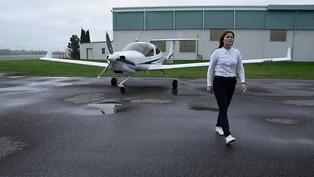
Meet the women reshaping aviation from trailblazers like Lola Reid Allin to new voices guiding the next generation from the captain's seat to the classroom.
See how passion, perseverance, and mentorship are opening the runway to change.
- For decades, the skies were dominated by men, but a growing number of women are defying gravity and stereotypes to claim their place on the flight deck.
It hasn't always been easy, but trailblazers like Lola Reid Allin helped clear the runway for our new generation of pilots.
- At the time.
I honestly, I loved it so much and it was so much fun.
And I was persistent in getting a job.
I wasn't, it wasn't easy in the sense of I could walk in anywhere and get a job, but I was very, I thought, very successful and I didn't, somehow didn't think I was doing anything that special.
I mean, it was, it was great.
I enjoyed what I was doing.
I loved what I was doing.
I think had I had other female colleagues, I might have felt differently.
Having input from others is always important.
But when I was flying up in Northern Ontario, up in British Columbia, number one, there were no other women around, generally speaking.
There was no one at the airports where I was based.
There was the closest one was say, in Winnipeg or Vancouver.
There were not very many women flying commercially.
- Today the landscape is changing and leading that shift is Cygnet Aviation Academy.
Since opening in 2023, president and Pilot Lynn McMullen has built a program that fast tracks graduates into Canadian airlines, bringing more women into the pilot seat than ever before.
- 20% of our students are women, which is fabulous.
And we all know the stat that roughly five or 6% of the women in aviation or in commercial professional aviation are women.
So I love seeing that greater number.
It wasn't that ratio when I was going to my flight training.
I think part of that is due to all of the organizations that are promoting women in aviation who are creating great role models of women in aviation.
We know through research that to feel like you can achieve something, it's important for you to see someone that looks like you achieving that goal.
And there are so many more role models through the Northern Knights Aero Foundation, my personal favorite.
Through Women in Aviation, the 99's, the Elevate programs, there's so much more awareness.
And the thing that is so beautiful about what's happening with this organization is it's not just the women that are promoting it.
We are getting amazing support throughout the industry.
- With initiatives like the Northern Lights Aero Foundation, where Lynn plays an active role, women in aviation are not just supported, they're celebrated, mentored, and inspired to lead.
- It is all about these incredible women who are blazing trails, doing incredibly inspiring things in the industry.
And our goal was to inspire others to want to do the same thing, to create role models for people to see it.
We have outreach and mentorship, amazing mentorship program where we connect mentors and mentees in the industry to support people's growth.
Often if you're new to the industry, you just don't know who to reach out to and who to talk with.
And there are so many amazing people that would love to share and, and give guidance and assistance 'cause they were there once, too.
- Thanks to organizations like the Northern Lights Aero Foundation, women in aviation are gaining visibility, encouragement, and real opportunities to rise.
And it's that kind of support that made it possible for pilots like Kaitlyn O'Gay to enter the industry with confidence.
I see - A lot of women in aviation, obviously less than men just because of the way it is we're building and we're growing.
But I went to school with a lot of girls.
For me, I think the people who, the women who came before me kind of built this foundation for us and they went through the hard work that I've never really faced.
I would say much adversity being a woman.
I mean, you get the typical jokes from some young men about women can't fly and all that kind of stuff.
Or there's a lot of kind of assumed, I've been out with some of my coworkers and I've been called a flight attendant, or I come up with one of my male students and they think that he's the instructor when we're together.
So you get that kind of just like biased off the what people, 'cause people think that pilots are men, right?
You get that.
But we had a lot of senior staff members at my school that were women.
So, it's just been ingrained in me that we are here, we have a space for us.
- Lola logged thousands of hours as a commercial pilot, navigating doubt, barriers, and the challenges of being one of the few women in the cockpit.
Lynn brought a bold vision to life with Cygnet Aviation Academy, opening doors for the next generation.
And Kaitlin now guiding others from the flight deck flies with confidence thanks to the women who came before her.
Each of these women has redefined what it means to fly.
And now, Lola has captured it all in a memoir.
Part love letter to the skies, part survival story.
- What I wrote about and what I experienced is a female pilot in aviation, but it also applies to any, the difficulties or the experiences, the joys, the triumphs.
It's about a woman who wanted something that society said wasn't appropriate for her, but she had the confidence and the determination to go ahead and do it.
So it relates to a lot of experiences.
- I would say that there's no, don't have, there's no barriers, don't have that kind of preconceived notion that you're at a disadvantage already.
I think little girls now will see people like me walking through the airport, getting on their plane, being their captain and flying them and I think that'll just become the norm.
So I think that's nice to know that again, we're just building on what's happening already, right?
We're putting it in motion - For WPBS Weekly.
I'm Gail Paquette.
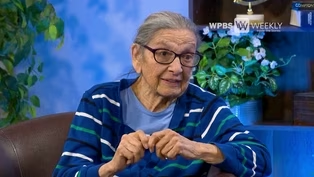
- For decades composer, Dr.
Augusta Cecconi-Bates has devoted her life to using music to tell stories about war, discrimination, and the world around us.
From operas and cantatas to musicals set in the prohibition era.
Her work blends strong social themes with music meant to be heard and understood.
Tonight she joins us inside the studio to talk about her career and the deeper meaning behind her work.
- Thank you, Michael.
Joining us in the studio tonight is Dr.
Augusta Cecconi-Bates, director of, as she puts it, serious music.
Dr.
Cecconi-Bates, thank you for joining us in the studio this evening.
It's a pleasure to have you here.
- Well, it's a pleasure to be here.
Thank you.
- And you have an extensive background in operatic production, musical production.
All, and all of your works are really influenced around anti-war and anti-discrimination.
I'm really curious, where did that journey begin for you?
- I think that began when I was commissioned in the early eighties by Oswego, SUNY Oswego, to write a piece for band.
And they, I picked the war is kind poem by Stephen Crane.
And I realized this is very important.
This is very important.
We were not at war then, but it was very important.
And that was commissioned, it was performed.
It was performed in Chicago several times by the Chicago Symphonic Wind Ensemble 'cause they thought it was important.
And in the eighties, Christopher Keen, who was then a conductor for the Syracuse Symphony, got wind of the cantata.
And he came up to me at a meeting one night and he said, if you orchestrate this, I'll perform it.
So I orchestrated it 'cause it was for band and I had to make it for orchestra.
So I orchestrated it, sent a copy to him, and it came directly back to me unopened because Christopher Keen had died.
- Oh.
So he was not able to do it.
And now I'm trying to find orchestras to touch it again.
And you're working on a bunch of works as we speak.
You have recently worked on pieces such as picking Elderberries with Craig Thornton.
You are working on, you did a opera, Molly of the Mohawks as we have here.
And you even referenced, I wanna go back a little bit 'cause you referenced Stephen Crane when you were talking about one of your cantatas, War is Kind.
Yeah.
What's the background behind that cantata?
- Well, the background behind that, Stephen Crane was a war correspondent during the Boar War in the 1899.
He died shortly thereafter, but he was the anti-war person.
He firmly believed that war was not good.
And he writes this poem and in them poem, it's, it's a description of how horrible war can be.
And obviously war is not kind.
- So when you make these, when you make these pieces of music, these cantatas, these operas, how do you get your message across of anti-war, anti-discrimination?
- Well, you have to have texts.
If you don't have words, you can't get the message across.
I mean, you can write all the beautiful music you want, it's just music.
All right.
It's sound.
But sound without the sense of the words isn't gonna tell you that it's anti-war.
You have to really make your point.
- And it sounds like you've definitely made that point.
'cause there was another, there was another cantata you mentioned that you are trying to get back played.
We have a dream.
And am I correct in assuming that that has relation to Martin Luther King's I have a dream speech?
- Oh yes it does.
- Ooh.
- Oh, in 1968 when he was assassinated, I was teaching in schools in Syracuse, New York.
And a lot of my kids were black students, eighth grades, and they were devastated.
And they came up to me and they said, wow, this is so terrible that this happened.
I said, why don't you write a bunch of essays and poems about Dr.
King?
So they did.
And we got it.
We put it all in a little booklet for them.
And then they came up to me and they said, Ms.
Bates, we know that you write music, can you make these words so that we can sing about Dr.
King?
And I said, sure.
So I put the little cantata together, we performed it with the kids maybe five, six times in Syracuse that in 1969, 1970.
And then the city asked me to orchestrate it.
And they said, if you get, if you orchestrate it, we'll get all city choir, all city orchestra.
'cause at that time they had orchestra in Syracuse schools.
They don't anymore, but they did.
And we'll get two good singers who are from the black community to sing the solos.
So we did, and it was performed in 1972.
It uses the, the text that the kids wrote, a lot of theirs.
But it also used, I have a dream that one day my four children, this is the speech by Dr.
King.
And we performed it and it was very, very successful.
And then it sat on the shelf for years.
And then suddenly orchestras were asking me about it.
So I submitted it and the first thing they hit was, you just broke a copyright law.
- Oh.
- You can't do it without permission from the king family because the 1963 speech I Have a Dream is copyrighted.
- Oh.
- So what I did was I changed the words and I essentially paraphrased what he said.
Still the same cantata, still seeking 27 different orchestras are looking at this.
Nobody has said yes, they're gonna do it.
But you never know.
You know, they just might.
- Now, I wanna mention another piece you're working on right now.
As a matter of fact, skaters, it's in production as we speak over in Toronto.
What can audiences expect for this upcoming opera?
- Well, they're gonna see a lot because number one, it is an opera.
Number two, it's gonna be a multimedia production because we're gonna show film from the 1940s during the war.
And we're also gonna show the film of when the two skaters, the sister and brother won a championship in 1962 in Prague.
That was on Wide World of Sports.
So we have that film of them, their skating champ, their championship skating of that.
So that'll be shown.
- How did you get access to that sort of media?
- It's in public.
That's public domain.
- Okay.
- Yeah.
That's public domain.
So we have a right to it.
- Okay.
I know Toronto has important significance as to why it's being put on there as opposed to anywhere else in the world.
What is that important significance?
- Well, specifically that family that left Czechoslovakia in 1948 and escaped, came to Canada and settled in just outside of Toronto at Oakville.
And they have a family business and they, they still maintain that business.
They're purveyors of cork products and they've been doing the seven generations of that.
But in any case, the two skaters were very happy in Canada.
They won the championship that they won in 1962 as Canadian citizens.
And Otto became the ambassador from Canada to the Czech Republic under Queen Elizabeth.
Wow.
So it's, it's very, very much connected to Toronto.
- So people are going to love this opera when they see it.
Oh, I think so.
It sounds like there was a lot of hard work and you referenced somebody who you worked with very closely.
Oh yeah.
Who passed away in the middle of this production.
Yeah, actually even my Molly of the Mohawks a lot, the conductor for that was Charles Schneider from the Utica Symphony.
And he and I had worked on something earlier together.
And when I did Molly of the Mohawks, he was the one that put it all together.
Got it.
You know, got it.
actually staged, et cetera, et cetera, and got the production done.
He is the one who worked with me then.
on Skaters and the two of us worked for 10 years creating the music, finding the performers, and talking about words, et cetera, et cetera.
And he did a lot to make sure that the orchestration actually was orchestration.
'cause he was an orchestra conductor.
We were all set to, for the two of us to be in Toronto to, you know, share the accolades.
But he passed away in, in 2022.
So as a result, when we do perform this, it'll always be done in Memoria for Chuck Schneider.
- I imagine he would absolutely love that.
- Yep.
- And you are carrying on his legacy through that, through that opera.
- So - When can audiences expect to see Skaters hit the Toronto theaters?
- Well, originally it was scheduled for October of 2025, but we just couldn't get enough people together for it.
Couldn't get enough money, is what it is.
This is a big production, so it's postponed now the possibility is May, 2026 and that's it probably will happen.
She's gonna use a student orchestra rather than a professional orchestra.
It'll cut the cost down a little bit.
But when you're talking opera, I don't know why I decided to write operas.
You know, I could write piano sonatatas and I can get 'em performed for five bucks.
But when you're talking opera, you're talking a hundred thousand dollars.
- Well, folks are certainly gonna look forward to this opera.
I can guarantee it.
As we start to wrap up, I'm getting the wrap up signal.
Now, as a matter of fact, there's one question I really need to ask you for.
Aspiring composers, aspiring artists who wanna do work similar to what you've done, what sort of advice do you have for them to get started?
- You just have to keep doing what you're doing and you have to believe in yourself and you have to do something musically every day.
And if you wanna write music, then you write something every day, even if it's only three or four notes.
But you do it every day because it's gotta be, it has to be the most important part of your life.
It's your whole mindset and okay, it's your mindset.
The last thing you're thinking about is money.
Well, that's the last thing I thought about.
And unfortunately I never got any money for any of the stuff I did.
So, but we were, we were lucky for Molly of the Mohawks.
We had a film producer from California called Honest Engines Films.
Imagine that.
And she came to NY and they filmed the, the production up there.
And she paid for all of that.
And this, it's online.
You can look it up online that the, the recording of it still available.
- Well, folks, you certainly need to check this out.
All of the, all the operas from Molly of the Mohawks to Skaters, Dr.
Augusta Cecconi-Bates, thank you so much for your time in stopping by our studio today.
We appreciate having you.
- Well thank you.
It's kind of nice for me to reminisce.
- Finally tonight we follow the inspiring journey of Olivia Simpson who made history as Watertown's first female firefighter.
She shares the challenges she's faced, the dedication she shows, and the path she continues to pursue.
Take a look.
- These fire trucks have a new firefighter at the helm.
Her name is Olivia Simpson, the first female firefighter to join the Watertown Fire Department.
- I chose to become a firefighter because my dad did it as I was growing up and I was just surrounded by it my entire life.
So it played a influential role in my career choice.
Being on the ladder truck, we respond to mainly fire alarms.
So we'll be on the engine shortly and then I will go on medical calls on that as well.
- Well, I've been here 29 years for my entire career.
We've never had a female firefighter with us, so that obviously is new to us.
But at the same time, it's not really that new or it's not really that different.
Olivia did a great job in our academy.
She was very tight with, with the rest of her team in the academy and did, did a fantastic job there.
Olivia had previously worked for Fort Drum fire department as a career firefighter within the Department of Defense system.
So she already had some credentials.
She had a fair amount of training beforehand and had experience as a career firefighter.
- We had to go through a 19 week academy that consisted of doing live fires.
We also sat through, I believe it was four weeks of EMT.
So that was definitely very mental.
We just learned the ropes, how the basic ways of being a firefighter go.
And we got certifications from the academy for firefighting.
- For Olivia, being a firefighter holds deep meaning, allowing hard to both draw inspiration and to inspire others.
- When I went to college for fire protection, I met a lot of great instructors that were actually females and they persuaded, they didn't really persuade me, but seeing them shine and do the job and succeed at doing the job definitely helped.
And I hope I can do that for other people.
I'm excited to be able to kind of influence, I guess you could say young girls and older women that they can do anything.
They put their minds to.
I think that they should follow their dreams.
They should just one foot forward, just start from the beginning and find someone that can help them get started.
- Disregard.
If she keeps her nose to the grindstone and works hard, she might be able to advance within the department.
And I think that would also help to, she'll gain additional, people will see more of her as that happens.
And, and that can go to, to let other people know that, hey, this, this isn't just a, something for that men do.
This is something that anybody can do.
She'll be just part of our team and I expect she'll do, she'll do great here.
And looking forward to seeing that - Being a part of the Watertown Fire department is like being a part of a whole other, whole other family.
It's a second - You don't feel like you're going to work when you come to work.
It's just, it's just one big family.
- It's a family that has embraced her with open arms and she's ready to begin this new chapter of her life with them.
- Life as a firefighter is rewarding.
Being able to help people on their worst days and just supporting the community in five to ten years.
I see myself still being in Watertown having five or ten years of experience under my belt.
I'll definitely continue to take classes and expand my career and my goals as a firefighter.
- You know, we're all built a little bit differently.
You can take a look at anybody out here who's working today, and you can see some that are bigger, taller, some that are smaller.
We've all got, we've all got different skill sets and abilities.
So she just fits right in as, as a, a unique person here at the department that's passed the same agility test requirements that everyone else has - In Watertown for WPBS Weekly.
I'm Subin Kim.
- That does it for this Tuesday night.
If you have a story idea you'd like us to explore, we would love to learn more.
All you need to do is send us an email at wpbsweekly@wpbstv.org and let's share it with the region.
That's it for tonight.
Everyone.
Stay safe.
We'll see you next time.
Until then, take care.
- WPBS weekly.
Inside the stories is brought to you by - When you're unable to see your primary care provider.
The Carthage Walk-in Clinic is here for you.
Located off Route 26 across from Carthage Middle School.
Comfort and Healing Close to home when you need it most - North Country Orthopedic Group is there for your urgent ortho or sports related injuries.
With our onsite surgical center and same or next day appointments, we're ready to provide care for patients of all ages.
Your health matters to us.
North Country Orthopedic Group, keeping healthcare local.
- We are the north country.
We're protecting one another like family is who we are and where our tomorrow will always be worth defending.
Find out how we keep the North Country strong, at claxtonhepburn.org today.
- Select musical performances are made possible with funds from the statewide Community Regrant program, a REGRANT program of the New York State Council on the Arts with the support of the office of the Governor and the New York State legislator administered by the St.
Lawrence County Arts Council.
- This is so terrible that this happened.
I said, why don't you write a bunch of essays and poems about Dr.
King?
So they did and we got it.
We put it all in a little booklet for them.
And then they came up to me and they said, Ms.
Bates, we know that you write music.
Can you make these words so that we can sing about Dr.
King?
And I said, sure.
 New
NewComposer Dr. Augusta Cecconi Bates
Video has Closed Captions
Dr. Augusta Cecconi Bates has devoted her life to using music to tell stories. (10m 51s)
Providing Support for PBS.org
Learn Moreabout PBS online sponsorship












Support for PBS provided by:
WPBS Weekly: Inside the Stories is a local public television program presented by WPBS