WPBS Weekly: Inside the Stories
July 14, 2026
7/14/2026 | 26m 59sVideo has Closed Captions
America at 250, young voices, and the G T Racing Experience at Shannonville Motorsport Park.
As we celebrate America's 250th anniversary, we look beyond the Founding Fathers to explore how everyday people helped shape the early days of the United States—and what it means to be an American through the eyes of several young voices in our community. Plus, the G T Racing Experience at Shannonville Motorsport Park gives drivers the chance to live out a dream.
Problems playing video? | Closed Captioning Feedback
Problems playing video? | Closed Captioning Feedback
WPBS Weekly: Inside the Stories is a local public television program presented by WPBS
WPBS Weekly: Inside the Stories
July 14, 2026
7/14/2026 | 26m 59sVideo has Closed Captions
As we celebrate America's 250th anniversary, we look beyond the Founding Fathers to explore how everyday people helped shape the early days of the United States—and what it means to be an American through the eyes of several young voices in our community. Plus, the G T Racing Experience at Shannonville Motorsport Park gives drivers the chance to live out a dream.
Problems playing video? | Closed Captioning Feedback
Where to Watch WPBS Weekly: Inside the Stories
WPBS Weekly: Inside the Stories is available to stream on pbs.org and the PBS app.
Providing Support for PBS.org
Learn Moreabout PBS online sponsorshipTonight on WPBS Weekly Inside the Stories.
As we celebrate America's 250th anniversary, we look beyond the founding fathers and explore how everyday people made their mark on the early days of the United States and what it means to be an American for several young voices in our community.
Also, the GT racing experience at the Shannonville Motor Sport Park gives drivers a chance to live out a dream.
Your story is your region coming up right now on WPBS Weekly Inside the Stories Funding for WPBS Weekly Inside the Stories is provided by the statewide Community Regrant Program, a REGRANT program of the New York State Council on the Arts, with the support of the office of the Governor and the New York State legislature.
And administered by the St.
Lawrence County Arts Council, Carthage Savings, founded in 1888, offering VA FHA seasonal and rural development mortgage products, providing financial services to Northern New York from offices in Carthage, Clayton Crohgan, and Watertown online at carthagesavings.com.
Good Tuesday evening everyone, and welcome to this edition of WPBS Weekly Inside the Stories.
I'm Michael Riecke.
In history class, we learn about the founding fathers, George Washington, Ben Franklin, Alexander Hamilton, just to name a few, rarely do we hear how ordinary people helped shape our republic.
Jefferson Community College Professor Josh Canale has spent his career researching names that don't show up in most history textbooks as part of our celebration of America.
At 250, I sat down with Dr.
Canale to hear some of his favorite stories of everyday people who made their mark on the revolution.
Dr.
Josh Canale, thank you so much for joining us.
- Thanks for having me.
Excited to be here.
- Great.
Well let's, let's start with this.
I always like to know what drew you into history.
- So that's a tough question, but I always loved history.
Like even as a little kid and I can remember and maybe like fourth grade or so mean, I was always interested in like the presidents and that kind of stuff.
I'd buy those like books on like trivia.
And I had a fourth grade teacher who every week she'd have like, you know, individual reading time and I always had one of these like president's books and I was always reading, it was like chapters about the presidents and their times, the presidents and their times, you know, major events, things that were going on.
And she would say to me all the time like, you gotta read something else.
Like you cannot just read that book.
You have to finish a book so that you can move on.
And I was like, but I really wanna read this.
Like, I wanna know more about the history.
So I mean, I just always had this passion to like understand the past.
And as I got older I realized kind of like almost by accident that history was a way to answer the questions that I had.
You know, why are we where we are?
How did we get here?
What's the path to move forward?
So history was always kinda like this beacon, even when I didn't know it was a beacon, I guess for me, you know, calling me to these kind of stories and learning about people.
And it's some of the stories we really want to dive into today.
I bet one of those presidents you read about was probably George Washington.
Yeah.
But you know, so often when we think of the American Revolution especially we, we think of those big names.
Yeah, we think of our founding fathers, but what do we miss by not considering some of the stories of just ordinary people?
Yeah.
I mean, don't get me wrong, the big names are super important.
You, you, you can't have a revolution to be successful without a Washington at the leadership.
You don't have the Declaration of Independence without Jefferson.
But if you overlook those common people, you lose really the diverse story of what the American Revolution is.
And you miss people like Crispus Attucks for example.
He is one of the first martyrs of the revolution.
He's this mixed race, African native American sailor who's considered one of the first martyrs of the revolution dying on the streets of Boston during the Boston Massacre.
I mean, you miss the Daughters of Liberty.
You miss these women who to boycott the British taxes.
They decide we're not gonna wear British-made goods anymore.
We're going to make our own in this sign of sacrifice and patriotism.
You Ms.
Joseph Plum Martin, the Connecticut farm boy, 14 years old, who wants to serve at 14 because of what happened at Lexington in Concord.
He can't serve at 14, but he serves at 15 and he lives throughout the entire war.
He's at Yorktown.
He is also famously writes about like the trials and the sufferings of being a, a soldier and an underpaid underfed, underappreciated, rebel army.
I mean, you miss all these things.
If you just focus on the political and the military leaders, you miss that this was a divisive civil war.
It's complex, it's complicated in history.
We like to think it's like this straight line, nice and neat, but it's not, it's complicated.
And if you overlook the common people, you miss the complexities and you really miss that.
This was an inclusive story about the nation's founding.
Right.
An inclusive and complicated story.
Interesting.
You, you've mentioned so many Oh yeah.
Examples there.
But if you could just, again, an an ordinary person, if we could hone in on someone whose experience really helps us understand the revolution different.
So one name that you're probably not gonna forget, and I'll quiz you on this if I see you ever again, right, is George Robert Twelves Hewes, I mean mouthful of a name.
And he is like the Forrest Gump of the early part of the revolution.
He is literally everywhere.
It's so interesting to follow this guy's life.
But before the revolution even begins 1763, he is a shoemaker in Boston and he talks about this in his memoirs later in life.
He's like in his eighties and he dictates his memoirs and he talks about being invited to the home of John Hancock.
You know, that same John Hancock, that big signature of that big name, right?
And he's invited to Hancock's house and he talks about, as an elderly man, I was super nervous.
I got washed up, I got scrubbed up, I put on my best clothes, super nervous.
He has to go around the kitchen door, not the front door.
And he has to wait on Hamilton.
Hamilton comes and you know, receives them.
And these aren't friends.
This is a ritual between haves and have nots or whatever you wanna call it, right?
Social elites and working class.
And Hancock goes through the rituals and Hughes goes through the rituals.
He, you know, invites him to have a drink.
You have a good new year, all that kind of stuff.
But the revolution comes and Hughes experiences, the Boston massacre, he's there at the famous ting of a loyalist.
He's there at the Boston Tea Party.
He's a privateer, he's a militia member.
Something changes with him so that when he's an elderly man dictating those memoirs, he talks about his experience in the Boston Tea Party.
And he says, while we were there, he says, you know, I did recognize a face as we're throwing tea into the harbor.
He goes, and it was, it was Hancock, he says, and we kind of, we saw each other, we recognize, but we both go back to what we're doing, throwing that tea in.
Was Hancock there?
Probably not.
So it's like, does that matter?
It definitely matters because something changed in Hughes.
He has this transformative moment of the American Revolution where he sees, it's not Hancock.
This guy I was nervous about seeing it is the revolutionist put these guys on the same playing field.
They're equals now in Hughes's mind, even if he wasn't there, that's what the transformation can do to from subjects to citizens of a new country.
- Wow.
Some of these events were, were risky for a variety of reasons.
What kinds of risks were those everyday people taking that we may not appreciate today?
- I mean It's a divisive civil war and I think, we don't generally like to think about this, but it was a civil war.
We like to think it's two militaries engaging each other.
And most people are probably somewhat familiar that there were loyalists, right?
But making decisions about loyalty, that's a risky decision every day.
And it doesn't change throughout the war and the loyalists, I mean, you got patriots, you got the loyalists.
Loyalists are like 20 to 25% of the population.
When you like to dismiss them, it's like, oh, there was probably this small group, but they were pretty sizable.
And there's actually even a bigger group that most probably people aren't familiar with.
And that's a term the Patriots would've been very familiar with.
And that's the disaffected, you're not affected to the the Patriot cause that encompasses loyalists.
But that group grows from that 20, 25% I mentioned to include neutrals.
People just wanna survive, religious pacifists.
There's probably, you know, thousands of those guys.
People who don't wanna accept continental currency 'cause it's probably not worth anything.
It's paper money by a rebel government.
People who don't put candles in their window to commemorate a major event.
All these individuals are disaffected in the Patriots.
You're not with us, you're against us.
And they have to form a new government with these people in the community.
So they're gonna immediately start asking people, take a side, take an oath, make a decision, so to speak.
It's these committees, they use a lot of coercive tactics.
They, they monitor movement, they open mail, they imprison without a trial.
So every decision is a risky decision during a civil war.
That's a revolution.
- Do you have any specific story that really captures that tension?
- Yeah, I mean, just in general about how you're gonna publicly make a statement on your loyalty.
Let's go back, you know, 1765.
So a lot of people think, you know, the revolution is the war.
Even Adams says the revolution begins before the war.
Like that's where the revolution is.
1765 stamped act, the beginning of the protests.
In a lot of ways the stamped act is a tax on paper.
So newspapers, wills, deeds, contracts, it is everywhere.
It impacts everyone.
So everybody hates it.
There's protests, there's boycotts, there's all sorts of things.
And anyone who's associated with this kind of dreaded tax, they're going to get some anger from their neighbors and community members, Albany, New York, we can get a kind of cool example.
Albany's a small town, which most of these towns where most people probably knew of each other.
And there's a rumor circulating this one guy, Henry Van Shaack, he solicited the role, he wants to be the stamp collector.
So he gets called down to local tavern, a lot of politics at local taverns at this time.
He gets called down to this local tavern and he comes in and they start applauding him, Hey, he's just a great guy.
Everyone knows him and they're, they're trying to ingratiate themselves.
We just wanna know, did you accept this role?
Did you ask for this role?
And he's like, no, great.
They're like, absolutely, that's great.
How about take an oath that you never will ask for that?
And he's like, no, I'm not gonna do that.
And he leaves, he gets invited a second time, come back to the tavern.
I mean, if you're Van Shaack, I mean your fear levels raising up by the moment again, they say the cheers, the claps, he's a great guy.
But a little bit of like the booze, the hisses, the jeers, the criticism.
And they say again, take the oath.
And again, he's like, no, I'm not gonna do this.
He leaves, he gets word that they're getting angrier.
I mean, they're at a tavern, so they're probably drinking, right?
And that violence could be an answer.
So I mean, what do you do if you're Henry Van Shaack?
I mean, who do you go to?
Magistrates, local police.
Basically.
He goes to these local police and he's like, Hey, you know, I got the situation on my hands here.
Can you help me?
Absolutely.
Just one thing, you gonna take that oath?
Even the magistrate, even the magistrates wanna know that.
So he ends up fleeing his house because that group at the tavern that is in a tavern at one point swells to about 400 people.
And they're coming down the street to his house to demand at his house that he take the oath, he gets word.
'cause I mean, apparently a 400 person crowd is not quiet.
He hides out in the snow overnight to avoid them as they're throwing furniture through his windows.
Next day he comes to town and is like, I'll take that oath, right?
I mean, that's the tensions of revolutions, right?
And making these types of decisions.
When a community knows who you are, What do these stories reveal about our founding that really still matter and resonate today?
So the stories that still resonate today, I mean, I think, you know, participation in politics like that, that's something that's so important.
Then you can look at any primary sources and there's people that are getting involved in politics.
I mean, they're in boycotts, they're in, you know, they're in discussions in taverns, they're in committees, they're all sorts of places.
They're volunteering, they're learning, they're participating.
And in a lot of ways, you know, it's kind of interesting, the continental Congress, those big names again, they form what's called the Continental Association.
And it's this ambitious plan in 1774 in response to the British laws passed, the punished Boston for the Boston Tea Party.
And their plan, these big names, the Adams, the Washingtons, the Patrick Henry is we're gonna have a continental wide boycott.
No importing British goods, no consuming British goods, no exporting until these laws are taken off.
The thing is, the continental Congress, we forget a lot of times is they're a recommending body, an illegal recommending body.
They have no power, they have no authority.
They're sending these guys back to their home colonies like, you know, hopefully we'll do these things.
So they don't just have no authority, they also have no mechanism.
And in this continental association they've got all these suggestions.
And the last one is they say every town, every county, every village form a committee to enact these policies, go out there and do it.
And in that moment, you have a democratization of this revolution where 7,000 plus Americans who previously had almost no involvement in politics, are now empowered to be political actors, to get involved.
And they do some coercive things, like I said, don't get me wrong, but that idea of overnight, that you can have a change in a society that can turn people that from subjects to citizens is pretty, it's pretty profound just because they're participating in politics.
Amazing.
Dr.
Canal, thank you so much for sharing your time and expertise with us.
We really appreciate it.
- I appreciate it.
Thank you for having me.
As we continue to celebrate America at 250, we ask, what does being an American mean to you?
It's a question that comes with many different responses.
As we learned when we asked high schoolers from across Northern New York, what it means to them, here were their responses.
To me, being an American means to live in this country with the rights that were guaranteed to you by our constitution.
To do whatever you want and means to be happy and successful in your life.
Spending time with family and overall just freedom and enjoyment of life.
Being an American to me means that you are free.
You have the choices of what to do, you go to school and learn.
Nobody can hold you back from doing what you want as long as you're not like killing people or harming someone in your way.
I just have a lot of freedoms that some countries in the world people don't have.
And it's just, I'm really blessed to be an American.
America is a very diverse place, and to me, being an American means that we should all accept each other's differences.
Because there's so many of us.
It really just means to continue to strive.
Being diverse, loved, and important.
We have the ability to rise up better and protect the people that come to our country for refuge or our residents already.
I still have the same opportunities as anybody else in the country to higher education, whatever career path I want.
Being an American means what you make of where you grow up and how that shapes your future and who you turn out to be.
Being an American means to me is being open-minded to different ideals, whether they be political beliefs, religious ideology, or simply a different opinion on breakfast cereals.
I can be who I want to be and do what I want to do without the judgment of other people.
Being able to speak your mind and say what you truly feel and not feel any pressure.
Having the ability to have different opinions from one another, being diverse from your neighbors, and being able to do things that you want to do.
Expressing myself who I am and knowing that I'm protected and I'm just celebrated for who I am and who I can be.
To me, being an American means having the rights and liberties that our founding fathers fought for and the privilege to live in the beautiful United States of America.
And it means that you value your freedom, you cherish it, but you understand that it's not a guarantee.
We've been trying to fight against tyranny and people who wanna take away people's rights.
And I think it's amazing how we've been a, sort of a shining beacon up to this point.
We've really done a lot for helping people and for helping our country grow.
Being an American means that you have a responsibility to uphold the legacy of your forefathers and their past military sacrifices.
Being American means to me, having opportunity, having fairness and opportunities to do things.
In America, you're allowed to be free and experience what most of what the world has to offer.
I get to have some great education and healthcare that's, and there's so many places I can travel just inside the country.
It means that you're able to celebrate that you're not being ruled by one person, that you're being able to live your life without restrictions or anything.
It is to want to help others.
It is to want to give to the community that has raised you.
To me, being an American means going to sleep at night, knowing I'm able to exercise my rights given to me in a free country.
Being able to be who you are and represent who you are without the fear of being discriminated against.
I can Choose my job, I can choose my education, I can choose where I wanna live.
I can choose how I want to live.
Having the freedom to do whatever you want to do in life to choose and participate in your government.
I feel like freedom is a huge part of this country and our nation.
And I think it's a very inclusive thing that we all need.
Each July we celebrate the birthdays of both the United States and Canada.
And this weekend the relationship of both countries is on full display at the Can-Am Festival.
This 54 year tradition returns to Sackets Harbor as it expands to Friday night from its West Main Street Parade, the Speedster Challenge.
Live music from regional artists and fireworks over the harbor.
The cross border celebration brings the community together each summer.
- I have people ask me all the time, you know, when is Can-Am because my family and friends are coming because it's just a fabulous time.
And they like to come up every year during that week or that weekend of Can-Am to celebrate.
'cause it's so much fun.
You know, celebrating Summer, celebrating our relationship with Canada and just kind of showing off our beautiful village.
The 54th annual Can-Am Festival starts this Friday at 5:00 PM and runs all weekend long.
For more information and the event schedule this year, just visit canamfestival.com at the Shannonville Motorsport Park In Ontario, the GT race experience gives those who love speed, a chance to step into the driver's seat of a race car and live out a dream.
Real cars real speed and real instruction from seasoned professionals.
It's more than just a thrill ride, it's a lesson that raw horsepower doesn't always mean true control.
Here's WPBS producer Gail Paquette with the story.
Shannonville Motorsport Park has long been a destination for racing enthusiasts with its wide corners and technical turns.
It's a track known for testing skill, it igniting passion.
One person who knows that passion firsthand is Chris Swinwood, owner of the GT Race Experience.
I was born in a racing family, so I, you know, basically my first year of life I was at a racetrack and as I got older, my dad got me into go-karts and I raced go-karts for years.
And then, you know, as racing gets expensive, you know, my dad got me more and more into the instruction side of things with the Motorsport Club of Ottawa.
And then as that further evolved, I got opportunities to do Motorsport experience programs in England, Australia.
And then when I finally came back to Canada, I'm like, I gotta run one of these in Canada, right?
So that's when I started to build the GT race experience.
The unique thing that GT Race experience does is we are able to take you out in our track prepared cars.
These are not cars that are street legal anymore.
These are cars purpose built for the racetrack.
So upgraded brakes, upgraded tires, upgrade suspensions, and it really maximize what you can do on track.
Then we take it to the next level after that.
So we give you in-car coaching with that coach in the passenger seat right next to you with a helmet, intercom and everything.
So clear communications is, is great.
This allows us to sit there and take you, push you harder than anyone else here can do.
And we can have a lot of fun doing it right and keep you safe at the same time.
And for those who have always dreamed of racing, this experience delivers with real cars, real speed and real instruction from seasoned professionals.
It's more than just a throw ride.
It's a chance to step into the driver's seat and live out a dream.
It was on my bucket list.
Indeed, this is a really good experience for people of all levels.
And hey, I don't know what I don't know, and I'm by no means am I a, a good driver.
And I got some instruction today and had a lot of fun and there's a lot of nice people here sharing their knowledge and helping each other out.
It was fun finding the edge of my comfort level and then going beyond it with new skills.
I learned about this much when there's this much to learn.
And that's exactly what the GT Race experience is designed to do.
Push boundaries, challenge assumptions, and teach real skill behind the wheel.
Because while some arrive with fast cars and big confidence instructors here know that raw horsepower doesn't always mean true control.
Every person who has a hopped up car that they've spent 20, $30,000 on and they go flying down the highway and they brag about how fast they can take an off ramp, they come here and they find out how humbling a racetrack is.
Not that there's danger involved, you're gonna hit a wall or something.
It's just that when you're traveling at a high rate of speed and a a tight left hander comes up, you're not ready for that.
So it's very intimidating for them to learn on the first lap that they're not as good as they were.
So we try to teach 'em not only car control, but directional control.
How can you drive fast on a racetrack that you've never been on?
It's like going to a foreign city and trying to drive at the ultimate speed in the downtown core.
It's not gonna happen.
So we just try to teach 'em the basics of learn where to go, then learn the line and then learn how to be fast From pedal to the metal adrenaline junkies to the wide-eyed first timer, clutching the steering wheel like it's a lifeline.
GT instructors have seen it all.
And no matter where someone falls on the spectrum, the team is ready to meet them.
With the right mix of patients precision and pedal power, We get all levels from the timid person to the overexcited person.
And you know, having that coach in the passenger seat next to you really kind of gives you a gauge of someone that knows, knows the car, knows the track, and knows where the limits are so they can communicate those to you.
And when you're sitting there being really timid and stuff, they can be like, no, go for it.
Full power.
Go, go, go, go, go.
And you know, if we get those overenthusiastic person, we're like, okay, we need to bring it back a little bit.
We're knocking on those doors, we can feel the back end sliding around.
Just tone it down just a smidge, right?
And we can get that communication and give that information needed so you can really maximize your experience.
And along with a variety of drivers comes a full tank of misconceptions.
Some think it's all about speed, others assume it's just like driving on the highway.
Only louder.
But the truth is, racing is far more technical, surprisingly mental, and yes, physically exhausting.
A lot of people, I guess think, you know, when they're sitting there watching racing on tv, they, it looks really, really simple.
And they're like, oh, I can go do that.
I drive on the 401 every day, I can do these things, right?
But in reality, when you get on the racetrack, there is a lot.
So even though we've gotten people in their thirties, they've been driving on the street for years.
Soon as we throw them on the racetrack, they're like, oh, this is a whole new level.
Right?
There's so much more to learn.
And they very, very quickly understand that.
And they're like, okay, I need to get some professional help and get that instruction, get that instructor sitting with them, and really take it to the next level.
'cause going out and driving, everyone can sit there and drive.
Everyone's done a drive of two, three hours, you know, from point A to point B. But in reality, on the racetrack, after 20 minutes, you're coming in, you're sweating, you're, you're exhausted, right?
And you're like, gimme water.
And it's only been 20 minutes.
But beyond the roar of the engines and the rush of the adrenaline, there's something else that keeps people coming back.
The camaraderie, whether you're a first timer or a seasoned track day regular, there's a sense of community here.
It's really nice too.
You know, I watched somebody get a flat tire and everybody else, okay, I got a jack, I got this, I got that.
Let me help you out.
And that was just really nice.
Everybody, there's no hesitation if somebody has something to offer and to share it up.
There's not a lot of professional racing going on here in Canada.
So there's the club racing weekends.
So you join a club, you come to the racetrack, you're with your buddies.
The camaraderie amongst the amongst people is great.
They'll help you fix your car.
They'll give you parts for your car.
You, it's not, there's not too many sports that in life someone's gonna willing to help you.
Try to beat them.
For WP BS Weekly, I'm Gail Paquette.
You can learn more about the GT Race experience at the Shannon Motorsport Park at GTrace.ca Well that does it for this Tuesday night.
If you have a story idea you'd like us to explore, we would love to learn more.
All you need to do is send us an email at WPBS weekly@wpbstv.org and let's share it with the region.
That's it for tonight.
Join us next time for a fresh look inside the stories.
Until then, have a safe evening.
We'll see you next time.
Take care.
Funding for WPBS weekly inside the stories is provided by the statewide Community Regrant Program, a REGRANT program of the New York State Council on the Arts, with the support of the office of the Governor and the New York State legislature.
And administered by the St.
Lawrence County Arts Council, Carthage Savings, founded in 1888, offering VA FHA seasonal and world development mortgage products, providing financial services to Northern New York from offices in Carthage, Clayton Crohgan, and Watertown online at carthridgesavings.com.
Well, and not feel any pressure Having the ability to have different opinions from one another, being diverse from your neighbors and being able to do things that you want to do.
Expressing myself who I am and knowing that I'm protected and I'm just celebrated for who I am and who I can be.

Video has Closed Captions
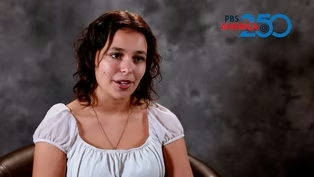
Northern New York students share what being an American means to them. (3m 59s)
Providing Support for PBS.org
Learn Moreabout PBS online sponsorship











Support for PBS provided by:
WPBS Weekly: Inside the Stories is a local public television program presented by WPBS