WPBS Weekly: Inside the Stories
Jefferson County Soil & Water
Clip: 8/25/2026 | 5m 45sVideo has Closed Captions
Learn what the Jefferson County Water & Soil Conservation District is doing to keep our waters safe.
Clean water doesn't just happen. It takes constant monitoring to protect the rivers, streams, and lakes we rely on every day. The Jefferson County Soil and Water Conservation District keeps a close eye on local watersheds, looking for problems like erosion, sediment, and pollution before they become bigger issues. Now, climate change is adding a new challenge.
Problems playing video? | Closed Captioning Feedback
Problems playing video? | Closed Captioning Feedback
WPBS Weekly: Inside the Stories is a local public television program presented by WPBS
WPBS Weekly: Inside the Stories
Jefferson County Soil & Water
Clip: 8/25/2026 | 5m 45sVideo has Closed Captions
Clean water doesn't just happen. It takes constant monitoring to protect the rivers, streams, and lakes we rely on every day. The Jefferson County Soil and Water Conservation District keeps a close eye on local watersheds, looking for problems like erosion, sediment, and pollution before they become bigger issues. Now, climate change is adding a new challenge.
Problems playing video? | Closed Captioning Feedback
Where to Watch WPBS Weekly: Inside the Stories
WPBS Weekly: Inside the Stories is available to stream on pbs.org and the PBS app.
Providing Support for PBS.org
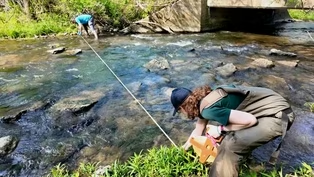
Learn Moreabout PBS online sponsorshipSo today we're sampling the Stony Creek Watershed, taking water samples.
This is our Mill Creek site, but there's eight total sites throughout the whole watershed.
And we'll be sampling twice a month, every month until November.
The Jefferson County Soil and Water Conservation District has a mission to conserve our natural resources and to keep our waters clean.
On any given day in the spring, summer, or fall, staff can often be found waiting through streams and waterways, collecting samples to monitor the health of local waters.
Jefferson County is home to more than 1800 miles of rivers and streams, along with 256 miles of shoreline along Lake Ontario and the St.
Lawrence River.
With such abundant water resources, maintaining healthy waterways is essential to the environment, local communities, and quality of life.
We're going to take both field samples and lab samples.
So our field samples we'll take with a probe.
It measures dissolved oxygen, pH turbidity.
But then our lab samples will be thing for things like total nitrogen, total phosphorus, and total dissolved phosphorus.
It'll give us an indication of our current water quality.
So if there is high levels of turbidity or total dissolved solids, we'll know there's probably an erosion concern upstream.
If there's elevated nutrient levels like phosphorus or nitrogen, we're going to know that that's a problem that needs to be addressed and that there's non-point sources contributing to that.
We're mainly looking for elevated nutrient levels.
That's what we suspect that if we found anything we would find.
But we'll also notice if there's low dissolved oxygen, which would be a problem for fish, or if there's high turbidity.
So there's probably erosion issues upstream if we find that.
The testing results are used to develop a nine-element plan or 9E plan.
Based on a framework created by the Environmental Protection Agency, the plan identifies a community's water quality concerns and outlines actions to address them.
A strong 9E plan can also improve a community's chances of securing grants to fund environmental projects.
That nine element plan, the direction we go on will be based on what we find.
So if there's high nutrient levels the best management practices, the plan suggests are going to target that.
If there's high sedimentation, it'll target that.
And if we don't find any problems, we'll shift as well.
One of our other 9E plans, they had great water quality, so we took it in the direction of climate change and what that will do to affect the watershed in the future.
One issue they're careful to look for is elevated phosphorus levels.
When excess amounts of phosphorus are present in water, it can cause severe ecological and water quality issues, including dead zones where aquatic life can't survive, and harmful alkal blooms that produce toxins dangerous to humans and pets.
Elevated phosphorus is going to lead to more nuisance algae growth in aquatic weeds.
So we want to keep that low but within the normal range so that there's still enough nutrients in the cycle, but not too much throwing things out of whack.
While human activities such as septic system wastewater and fertilizer use are primary sources of excess phosphorus, climate change can significantly worsen the problem.
Storm water is rainwater or snow melt that does not soak into the ground and instead flows over the land into nearby waterways.
As it travels, it can pick up soil, animal waste, road salt, pesticides, fertilizers, oil, debris, and other pollutants.
Climate change is increasing the frequency of intense rainstorms and rapid snow melt events, which produce greater stormwater runoff and flooding.
This fast moving water causes erosion of soil in stream banks, carrying accumulated phosphorus from agricultural and urban areas directly into rivers, streams, and lakes.
2090.
Back in my day when I was in elementary school, we started talking about it in terms of global warming.
But now we've shifted as scientists to using the word climate change because it's about more than just temperature.
But we're also seeing new weather patterns because climate is the average weather in a place.
So we're seeing more intense storm events.
We're seeing droughts in the summer along with those elevated temperatures.
When we get those more intense storm events from climate change, we're getting more runoff.
When we get those really intense storms, the water can't soak into the soil as much.
So we're getting more runoff, carrying nutrients and different pollutants into our streams, and that's why we would see that 10% increase in total phosphorus.
To protect waterways, the Jefferson County Soil and Water Conservation District helps municipalities implement best management practices that prevent, reduce, and reverse water quality issues.
Best management practices, we call them B&P for short.
There's a ton of them that we can do.
Farms can do things like cover cropping, using low till.
Manure injection is one because then you have less runoff if it rains.
Riparian forest buffers are great.
If you live along a lake or a stream, not mowing right up to the stream is great.
If you can leave a buffer of at least vegetation, but trees are even better, they're going to help absorb any nutrients or runoff before it gets in the stream.
We can all help protect our lakes, rivers, and streams.
Plant a rain garden to absorb runoff before it reaches local waterways, reduce or eliminate lawn fertilizer use, and have septic systems pumped out regularly.
Never dump motor oil, paint, grease, or other chemicals into storm grains.
You can also volunteer with organizations such as Save the River to participate in cleanups and habitat restoration projects.
To reduce the consequences of climate change, it's up to us to work together.
We need to work as a community.
We can't just put the blame onto any one sector.
It is coming from all of us.
We all live in a watershed.
Things we do every day are going to contribute nutrients and pollution to our waterways.
Providing Support for PBS.org
Learn Moreabout PBS online sponsorship













Support for PBS provided by:
WPBS Weekly: Inside the Stories is a local public television program presented by WPBS