WPBS Weekly: Inside the Stories
January 13, 2026
1/13/2026 | 25m 35sVideo has Closed Captions
A chat with mayor Justin Towndale, Clashing Swords, and traditional pipe making.
The mayor of Cornwall, Ontario, joins us in the studio, his take on the economy, the border, and life outside of politics. Then, we take you inside the Ironwood Sword School in Kingston, where the training manuals are older than all of us, and guiding a new generation of students plus, generations of indigenous tradition celebrating the art of pipe making. See firsthand how it's done.
Problems playing video? | Closed Captioning Feedback
Problems playing video? | Closed Captioning Feedback
WPBS Weekly: Inside the Stories is a local public television program presented by WPBS
WPBS Weekly: Inside the Stories
January 13, 2026
1/13/2026 | 25m 35sVideo has Closed Captions
The mayor of Cornwall, Ontario, joins us in the studio, his take on the economy, the border, and life outside of politics. Then, we take you inside the Ironwood Sword School in Kingston, where the training manuals are older than all of us, and guiding a new generation of students plus, generations of indigenous tradition celebrating the art of pipe making. See firsthand how it's done.
Problems playing video? | Closed Captioning Feedback
How to Watch WPBS Weekly: Inside the Stories
WPBS Weekly: Inside the Stories is available to stream on pbs.org and the free PBS App, available on iPhone, Apple TV, Android TV, Android smartphones, Amazon Fire TV, Amazon Fire Tablet, Roku, Samsung Smart TV, and Vizio.
Providing Support for PBS.org
Learn Moreabout PBS online sponsorship- Tonight on WPBS Weekly Inside the Stories, the mayor of Cornwall, Ontario joins us in the studio, his take on the economy, the border and life outside of politics.
And we take you inside the Ironwood Sword School in Kingston, where the training manuals are older than all of us, and guiding a new generation of students.
Plus generations of indigenous tradition, celebrating the art of pipe making.
See firsthand how it's done, your stories, your region coming up right now on WPBS Weekly, Inside the Stories.
- WPBS weekly inside the stories is brought to you by - When you're unable to see your primary care provider.
The Carthage Walk-in Clinic is here for you.
Located off Route 26 across from Carthage Middle School.
Comfort and Healing close to home when you need it most - North Country Orthopedic Group is there for your urgent ortho or sports related injuries.
With our onsite surgical center and same or next day appointments, we're ready to provide care for patients of all ages.
Your health matters to us North Country Orthopedic Group, keeping healthcare local.
- We are the north country where protecting one another like family is who we are and where our tomorrow will always be worth defending.
Find out how we keep the north country strong, at claxtonhepburn.org today.
- Select musical performances are made possible with funds from the statewide community Regrant program, a REGRANT program of the New York State Council on the Arts, with the support of the office of the Governor and the New York state legislator administered by the St.
Lawrence County Arts Council.
- Good Tuesday evening everyone, and welcome to this edition of WPBS Weekly Inside the Stories.
I'm Michael Riecke.
It's a smaller city with an important role along the US Canada border.
And at the helm navigating it all is Justin Towndale, the mayor of Cornwall.
I sat down with Mayor towndale to talk about the city he leads and his life outside of politics.
Mayor Towndale thank you so much for joining us for making the trip across the river and down the river to Watertown.
Welcome.
- Thank you.
Thank you for having me.
It's really a pleasure to be here and joining you.
- So I wanna get to the heart of your draw to public service.
What, what inspired you to serve your, your community?
- Yeah.
Politics has always been an interest of mine, even at a young age.
It, it's interesting, I just, there's no family history in it to be honest with you.
But I remember going back to the 92 federal election in Canada and there were a lot of hot topics going on at the time.
NAFTA was one of them.
You know, the 89 recession was kind of wrapping up a little bit.
And Canada had just introduced the GST, the goods and services tax at the federal level.
So that was the conservative party under Brian Mulrooney, prime Minister Mulrooney.
And the liberal party was campaigning against that tax saying they were gonna scrap it.
And they had their campaign document was called The Red Book.
And my dad doesn't get involved in politics anymore except for my own campaigns.
But at the time, you know, he felt strongly about it.
So I remember handing out red books with my dad and I don't know how old I was, probably about nine years old or something like that.
And I would say maybe that put a spark, buried a spark in me.
And I just remember always Cornwall being a smaller community, you know, knew who the, the elected officials were.
You knew who counselors were, who the mayor was, who the member parliament a member, provincial parliament were.
And just something that always seemed to be there, kind of around family, friends and whatnot.
And my parents used to host a lot of dinner parties and a lot of these individuals would come over and that spark persisted.
So when it was time for me to go to school, I went to University of Toronto.
I studied poli sci and Canadian studies and of course political science and university doesn't really train you to do this job by any means.
But things worked out well.
I, I was fortunate the timing of my graduation coincided with the provincial election.
I went home, I worked on a campaign for, at the time, our member of Provincial Parliament, Jim Brownell, who was very much a mentor to me.
And he was successful and the party was elected and I was offered a job at Queens Park.
And so began my official career in politics in 2007.
So I worked at Queens Park for about five years and then things changed a bit.
And I always thought, why don't I try my hand at municipal politics back home in Cornwall.
I always thought could try to do something, try to try to improve my community, try to contribute, especially with some experiences having lived away for a little while and new ideas, new ways of thinking.
And 2014, I put my name on the ballot I was elected.
The rest is history.
- So you, you grew up in Cornwall.
- Yes.
- How, was there anything from that experience growing up there that that shaped how you see your city today?
- Yeah, it's interesting 'cause there's been quite a drastic change in Cornwall over the years.
For me.
I think, you know, I I've been thinking about this more and more as we see the change that's coming, but also what's happening in other communities.
Our community's always been a quiet place generally, you know, let me, let me talk about crime for example, right?
Violent crime happens sometimes, but it's very rare.
So you don't see that as often.
But there's this heart, there's this big heart in the community and our community's very generous and I think we look out for each other.
So I can think of a couple things growing up.
Interestingly enough, they both involve the hydroelectric dam that's in Cornwall live around the corner from there.
And the recreational path that's along our waterfront.
One of the ways to get to it is right in front of the gate that leads to the, the, the dam itself.
When I was younger, much younger, I was riding my bike, my parents were walking, but I got ahead of them and there's a stop sign.
So the, the wreck path comes to a road and there's a stop sign.
I'm sitting there and then there's the guard booth for the, the hydro dam.
And there's a guard in there, right?
And as he, as a kid taught to respect authority and, you know, and someone's wearing a uniform, et cetera.
And he, he's doing this, he's like, you know, come here.
I'm like, uhoh, I'm in trouble.
I did something wrong.
He probably thinks I'm alone or whatever.
But, you know, at the same time, parents and still don't go off, especially with strangers.
So I waited for them to catch up.
And then finally he came over and it was funny because he handed me, I kid you not a toy balloon.
He had made a dog out of it, you know, a toy dog balloon.
And you know, like you see like clowns make, right?
Yeah.
And he did this, I don't even know where he got a balloon drum.
And he said he wanted to gimme that because I had stopped at the stop sign.
A lot of people just go right through it.
So he wanted to kind of reward good behavior and you know, that was like, oh, that's really nice.
But again, a few years later when they had one of the open houses at the hydro dam, they had some of the equipment out, like you could go on the scissor lifts and things like that.
And I'm like, oh I'll, we will do the tour and I'll come back after and I'll try out one of the lifts.
I wanna see what that's like.
But by the time the tour was done and we came out, they had put them all away and they were done.
And you know, as a kid, when you're disappointed why you cry, that happens, right?
So I started crying and a worker came over and said, oh, what happened?
You know, what's wrong?
And I talked about it and he's like, I'll take you up.
So he brought it back out and took me up and, you know, it was really kind of him.
He didn't have to do that and just making that effort.
So I think, you know, those are two very simple stories, but I think what it illustrates is that people step in, they're willing to help each other.
They're willing to, to, when they see something wrong or they see something they wanna recognize they do that.
So there there's like this friendliness even from people you don't know.
'cause those are two strangers trying to be nice.
And that persists today, I think, in a big way in Cornwall.
And certainly I think that's, that's part of the reason that I'm proud to be the mayor of Cornell and I'm proud of my community.
And more recently when we see fundraising efforts in our community, you know, we're about 48,000 people, but every time there's an ask, every time there's a need, our residents step up in such a big way that it's outstanding.
It's hard to believe how much money gets raised through these charity drives and everything else for all these different causes.
So that, that's part of it.
There's just this big heart in Cornwall.
Yeah.
- Community with a lot of heart.
So when you're, when you're not busy with policy discussions, daily operations of, of city business, how do you spend your free time when you find free time?
- Try to sleep?
No, yeah, - That's important too.
Yeah, yeah.
- You know, I, I, I find relaxing is, is a really good way to have done that.
Sometimes it's as simple as just catching up on TV shows that maybe don't have time to watch playing board games.
If there's a chance to go somewhere, maybe sitting by the water, relaxing with that, with family and friends.
Especially, I think one thing that's been challenging is unfortunately don't get a lot of free time with friends anymore and family.
So if there, there's the ability to, to spend time with them, even if it's just very quiet, not doing anything.
That's great.
I used to spend more time running and cycling.
I have to get back to that.
I have to be honest, I'm a little negligent in that regard.
But certainly anything that's quieter in general really appeals to me right now just because it, it's this kind of job, even smaller communities, it's very busy.
It's very go, go, go.
So when you can kind of tune out a little bit, it makes a big difference.
I, - I think for a lot of maybe Americans and probably Canadians, when they think of Cornwall, the hydro dam immediately comes to mind.
Obviously the city has a bit of an industrial past, like so many of the small communities up and down the river.
But how is Cornwall evolving, would you say?
- Yeah, I mean, thank you for that.
We, we certainly have a, an industrial pass.
One thing that may be of interest to people, especially here in the United States, I don't know how well known this is, but the first industrial application of the light bulb was in Cornwall.
And Thomas Edison himself came to Cornwall to oversee the installation of that.
And that was what was in the Weave shed area of town.
The weave shed, of course, being a large facility manufacturing textiles during World War ii.
They made a lot of the commonwealth uniforms in Cornwall for, for the military.
Now these days it's more turned into commercial and condominium.
But you know, at one time, and I say this and it's tongue in cheek, but it's more or less true, you name it, it was made in Cornwall.
You know, we've made everything from, like I mentioned, uniforms to paper.
Pfizer had a facility in Cornwall, Levi's jeans were made in Cornwall at one time.
Paint all kinds of things.
If you want to get even further down the rabbit hole, mustard gas, let's be honest.
So today we, we've seen a shift away from that.
I think a lot of, a lot of companies have turned offshore manufacturing and you know that, I know it's the same here in, in the us.
So what's come to fill that void is distribution and logistics in a big way.
Walmart is actually our major employer in Cornwall.
They have two large distribution centers, the superstore and a fleet for, for the transportation and goods.
All in all, they employ about 2,500 people in my community.
So it, we have a great relationship with Walmart, Canada, obviously subsidiary of Walmart, US We've also seen a shift into food production as well.
We have a couple companies that make food and actually do export to the United States in a big way, including some of the private label brands that are grocery stores down here.
So we've seen this interesting shift from more industrial where it's kind of a, if I, you know, be blunt, some of a dirty industrial to a more cleaner manufacturing or sustainable manufacturing in a sense.
Because when we look at production and, and requirements, you know, things like food.
So pork products and bacon are processed in Cornwall.
Demand for that is always high.
That's not going away.
Right.
And then that, that's all M Mel and then LeClaire Cookies, bisque LeClair, which is a company from Quebec, still family.
Really?
Yes.
Yeah.
They, they make some of their products in Cornwall.
And so those things aren't going away either.
And then there's a lot of other niche industries in Cornwall.
It's, it's been an interesting transition for us.
'cause we've also seen a lot of the industry that was in Cornwall was along the waterfront using the water for production manufacturing or generation of power or even a, you know, transportation shipping.
Right now we're seeing the St.
Lawrence cleaning itself.
It's, it's recovering and there have been investments recently.
We just, the province just announced an investment yesterday in Cornwall for more remediation of the St.
Lawrence.
But certainly we're seeing fishing recover and there are fishing derbies being hosting Cornwall and the water's clean enough that you can eat the fish you catch.
Whereas maybe go back even 50 years ago that may not have been the case.
So it's an interesting transition for us.
We're seeing that change and we are the, the hub in the area, you know, it's not just Cornwall and its own, the United Counties of STNG, Aqua Sony, and also Northern New York.
A lot of individuals from all these regions come into Cornell for their day-to-day needs.
So we've seen that transition into sustaining the local area as - Well here at town de we so appreciate your time and for making the trip down to Watertown to see us.
Thank you so much.
- Oh, thank you.
- When most people hear the words martial arts, they think of karate, judo or kung fu.
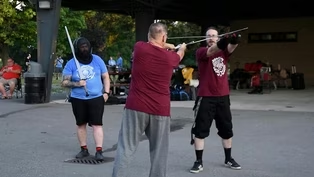
But in Kingston, Ontario, a very different kind of martial arts is making waves at the Ironwood Sword School students don't train with fists, they train with medieval long swords, guided by centuries old manuals.
They learn the moves once used on ancient battlefields.
It's physical, it's demanding, and it's a living link to history.
Take a look, - The clash of steel, the rhythm of footwork, the medieval long sword.
Once a weapon of war is now at the heart of a growing martial art in Kingston.
At Ironwood Sword School, students step back into history training with techniques pulled straight century old fight manuals bringing the past to life in every swing.
- It's a weapon art, but it's brings with it the trappings of the historical period, which I think is like when I started the school, I said, in the future, people are gonna want this and they're gonna need this for the way that society was going.
In the sense of there's, when two people meet in single combat with a steel weapon, there's an honesty that cannot be faked.
And the other thing is, I like, there's that idea of dao in eastern arts is, is the path to enlightenment.
So in this school it's ex explicit and implicit that, that we're doing this as a path to self understanding, self-learning and development, right?
So the code is there, but with the trappings of medieval, it's there chivalry, the shiva code, there's quotes from the manuscripts about, you know, be useful to your king and country.
Stuff like that.
So I think people are hungry for that in our current society where a lot of that honor, integrity stuff is lacking.
- The people who come to Ironwood Sword School are as varied as the skills they are mastering.
Some are history buffs, eager to step into the shoes of a medieval fighter.
Others are martial artists looking for a new challenge.
Many are simply curious, drawn by the romance of the sword and the chance to try something completely different.
- There are people that are interested in history and want to kind of do the relive it or experimental archeology.
Now there's many versions of different arts where people get fed in different ways for that.
There is also people that are interested in martial arts and they wanna learn the blade as a particular thing.
And then there is kind of a generic and geekiness is finally cool, right?
So I think that's one of the reasons we're growing is because there's always been that geek element.
And it's interesting 'cause some come and they kind of take the eight week course and then it's like a tick box.
Like, okay, I learned sword fighting.
And then others come and they get addicted and then like there are people kidding up before the eight weeks is already over and they're, they're hooked.
- Teaching authentic medieval swordsmanship isn't as simple as picking up a blade and copying a movie.
The source material, the fight manuals written by masters hundreds of years ago are rare and can be difficult to interpret.
- So HEMA is historical European martial arts.
So the H is historical.
The problem with historical is a, we start around our tradition about 1380 through to 1450.
And printing press isn't even developed till 1450.
So, and the Germans weren't writing as much down as the Italian.
So we have a few old manuscripts, but with all historical things, when you try to recreate it, there's, there's questions of accuracy.
The good thing for us in a fighting art is there's only one human body.
It hasn't changed.
So there's one set of joints, ligaments, our articulations haven't changed.
So it, it's great.
There's a manuscript from the 15th century with the big plu hose in, you know, the puffy pants and it's an arm bar straight out of modern jiujitsu.
Like the move is exactly the same.
So we do a thing we would call triangulation.
We read the manuscripts, but they're cryptic and language changes.
And then we have lots of people with lots of, in lots of other martial arts.
So then we do that and then we experimental archeology.
You work it, you try it, interpretations change.
If it works, then you figure you finally probably got the right kind of thing going.
- Long sword practice develops focus, discipline, and problem solving under pressure.
Iron wood isn't just preserving history.
They're giving students confidence and camaraderie that matter every bit as much.
In the 21st century as they did 500 years ago, - I was 20 something and I was working in an office.
I wanted something to do to get active, right?
I was looking for something easy to get into.
So I didn't look for team sports, I wanted something to do solo.
Yeah.
Like I had no idea that this existed.
I was looking for modern fencing and then I read, you can fence with a long sword.
I said, that sounds amazing.
I'm into Lord of the Rings and all that stuff.
I was that kind of person.
And then if I could learn to fight like that, whether I can do it competitively or not, I would still love to do that.
So I emailed Rob and emailed him on a Tuesday and I showed up on Sunday and I never left.
It's been seven years.
- Mastering Hema isn't just about swinging a sword.
It's about how you stand, how you move, and the footwork that keeps you balanced and in control.
Students quickly learn that in historical combat, where you put your feet can be just as important as where you place your blade.
- What we're doing is a combat sport.
So it is very physical, it is, it is rough.
Sometimes we practice safely, right?
Control is number one.
Well, safety's number one.
Control is part of safety.
We do lots of, lots of sword play.
Lots of footwork, lots of stance, right?
'cause your, your positioning is just as important as how you use the sword.
So we do a lot of footwork.
People underestimate how much footwork you need to do.
So starting from the ground up, like people do need a lot of training to just to move their feet.
After a while it becomes second nature.
- Students get a mix of physical challenge, mental focus, and hands-on history, all in a welcoming community.
That combination appeals to some people looking for fitness skill and connection in one place.
- It is, the first time I got to hold a sword is magical, right?
It feels awesome.
Words cannot describe it.
And then it's one thing to just hold it.
You know, it's another thing to actually learn how to use it to say, okay, you know, I, these are the historical texts and these are what these, you know, sword masters whose works had spanned centuries.
People would follow that and that was the golden standard.
And that's the standard that we still use today - For WPBS weekly.
I'm Gail Puckett.
- For more information, visit ironwoodswordschool.ca Our last story comes to us from Akwesasne at the St.
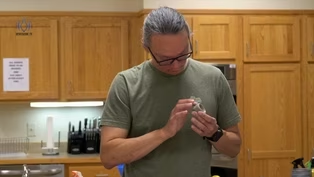
Regis Mohawk tribe's, Alcoholism and Chemical Dependency Program's Clubhouse, participants and staff come together to learn the traditional art of clay pipe making guided by an experienced instructor.
Participants have the opportunity to craft their own pipes while exploring their cultural history - On this side.
So I would say we could clean that up a little bit - It's a really good conversation starter with like, these are sacred pipes and so we're supposed to have that respect for our, our sacred tobacco.
And then, you know, being a youth, it, it's kind of, it, it's a good way to teach them how to live a good healthy, you know, clean life.
I, i think it's, it's a good way to transition into the, the cultural teachings and, you know, these different art forms that, that our people hold.
I find it's really important - I think it's when like, you see, not, not everyone takes to, to the pottery.
It can be very difficult.
But every once in a while you'll see like, you just see it.
They get really drawn to, they get lost in their work and they really enjoy it.
They love it.
And I, I like when I get a lot of questions and they're, they're really into the history and, and the culture surrounding, yeah, the, the pipes and the fights - Here at the Clubhouse, we believe that our culture is super important.
That's one of our, our program manager's biggest drives to, to work here is to make sure that our culture is reestablished into our youth, who are, is our future.
The class was really awesome.
Our instructor went very in depth about the history of clay with our people from pipes to pottery and then the transition from losing information about clay and then kind of reestablishing into our youth.
So it was really awesome.
- That does it for tonight's episode.
If you have a story idea you'd like us to explore, we would love to learn more.
All you need to do is send us an email at wpbsweekly@wbstv.org and let's share it with the region.
That's it for tonight.
Have a safe evening.
Everyone will see you next time.
Until then, take care.
- WPBS weekly.
Inside the stories is brought to you by - When you're unable to see your primary care provider.
The Carthage Walk-in Clinic is here for you.
Located off Route 26 across from Carthage Middle School.
Comfort and Healing close to home when you need it most - North Country Orthopedic Group is there for your urgent ortho or sports related injuries.
With our onsite surgical center and same or next day appointments, we're ready to provide care for patients of all ages.
Your health matters to us.
North Country Orthopedic Group, keeping healthcare local.
- We are the north country where protecting one another like family is who we are and where our tomorrow will always be worth defending.
country strong, at claxtonhepburn.org Today.
- Select musical performances made possible with funds from the statewide community Regrant program, a REGRANT program of the New York State Council on the Arts, with the support of the office of the Governor and the New York State legislator administered by the St.
Lawrence County Arts Council.
- There's that idea of dao in Eastern Arts is is the path to enlightenment.
So in this school, it's ex explicit and implicit that, that we're doing this as a path to self understanding, self-learning and development.
Video has Closed Captions
Learn the traditional art of clay pipe making with the Saint Regis Mohawk Tribe. (2m 47s)
Providing Support for PBS.org
Learn Moreabout PBS online sponsorship












Support for PBS provided by:
WPBS Weekly: Inside the Stories is a local public television program presented by WPBS