WPBS Weekly: Inside the Stories
February 24, 2026
2/24/2026 | 27m 14sVideo has Closed Captions
A walk-through history with Randy McIntyre and helping indigenous families navigate the end of life.
Historian Randy McIntyre stops into our studio to talk about Watertown’s rich history and his book documenting it all. Helping indigenous families navigate the end of life with traditions that guide the spirit's journey.
Problems playing video? | Closed Captioning Feedback
Problems playing video? | Closed Captioning Feedback
WPBS Weekly: Inside the Stories is a local public television program presented by WPBS
WPBS Weekly: Inside the Stories
February 24, 2026
2/24/2026 | 27m 14sVideo has Closed Captions
Historian Randy McIntyre stops into our studio to talk about Watertown’s rich history and his book documenting it all. Helping indigenous families navigate the end of life with traditions that guide the spirit's journey.
Problems playing video? | Closed Captioning Feedback
How to Watch WPBS Weekly: Inside the Stories
WPBS Weekly: Inside the Stories is available to stream on pbs.org and the free PBS App, available on iPhone, Apple TV, Android TV, Android smartphones, Amazon Fire TV, Amazon Fire Tablet, Roku, Samsung Smart TV, and Vizio.
Providing Support for PBS.org
Learn Moreabout PBS online sponsorship- Tonight on WPBS Weekly: Inside the Stories historian Randy McIntyre stops into our studio to talk about Watertown's rich history and his book documenting it all.
And helping indigenous families navigate the end of life with traditions that guide the spirit's journey.
Your stories, your region, coming up right now on WPBS Weekly, Inside the Stories - WPBS Weekly Inside the Stories is brought to you by: - When you're unable to see your primary care provider.
The Carthage Walk-in Clinic is here for you.
Located off Route 26 across from Carthage Middle School.
Comfort and Healing close to home when you need it most - North Country Orthopedic Group is there for your urgent ortho or sports related injuries.
With our onsite surgical center and same or next day appointments, we're ready to provide care for patients of all ages.
Your health matters to us North Country Orthopedic Group, keeping healthcare local.
- We are the north country.
We're protecting one another like family is who we are and where our tomorrow will always be worth defending.
Find out how we keep the North Country strong, at claxtonhepburn.org, today.
- Select musical performances are made possible with funds from the statewide community Regrant program, a REGRANT program of the New York State Council on the Arts, with the support of the office of the Governor and the New York State legislator administered by the St.
Lawrence County Arts Council.
- Good Tuesday evening everyone, and welcome to this edition of WPBS Weekly Inside the Stories.
I'm Michael Riecke.
The history of Watertown, New York is written into its streets, its buildings, and the stories passed down through generations.
For years local historian, Randy McIntyre has been collecting those stories and putting them into his book, A Walk Through History: A History of Watertown.
McIntyre stopped by our studios to share a bit of that history and the process it took to curate it all.
- Thank you Michael.
And with me now is local historian, Randy McIntyre.
Randy, welcome to the studio.
It's a pleasure to have you today.
- Thank you - For having me.
- And I think it's pretty safe to say, you know, a thing or two about the city of Watertown.
Am I right?
- Yes.
Over a long period of time.
I got to really know.
- I mean, it's clear you've got a very thick book here, A Walk Through Time: A History of Watertown.
Hundreds of pages of extensive history on this city.
And it made me immediately curious.
Where did your love for history really begin?
- Well, it began first with my, my father.
We used to go to the movies and then walk the public square and go down the tunnel of the Hotel Woodruff and into the Paddock Arcade and whatnot.
So I got interested there and then Alex Duffy gave a number of talks that I was able to hear, be at, and some of his writings.
It really made interesting.
And seventh grade they had the centennial and I was able to do a paper for that.
I didn't, you know, win the contest.
But I got interested in that by researching.
And then the other thing would've been Al Waltz on the radio, talking about the old buildings and what we used to have and various things like that.
So I started collecting postcards and I got over 400 postcards, probably of Watertown and I was able to, thinking about putting them together into a book.
- Those are the postcards right here on this cover, right?
- Yeah, some of them.
Yep.
- You said 400 postcards?
- Yeah, it was, I had 400 postcards, but, and some of them are in the book as well.
There's about 1400 pictures, 500 pages.
- Wow.
And I gotta note, do you have a personal favorite postcard?
It's probably like picking between your children.
It's hard, not, to pick - Just one.
Oh, it's, yeah, it's a tough one.
The Flower Library and probably some of the Thompson Park ones, because I remember the wading pool as a kid and whatnot.
- And those were two places that you were telling me were some of the big things you were, you had a really good time talking about in this book.
I wanna know, what did research for notable locations like that and others in Watertown look like?
I thought it was scarce for a while.
And then with the City Historian's office, I found a lot of information.
And with the Watertown Daily Times archives, fantastic.
Highly recommend anybody interested in researching, that would be a good place.
And then other people will let me into their collection of pictures, the Historical society, the park, the airport, various other places.
- So, when people are going through this book, it's almost textbook, this isn't in schools at all, is it?
- No.
- Are we gonna, are we aiming to get it into schools at all?
- I was hoping, I, I'm not sure what schools actually teach the local history, but it would make a great book because it's, it's broken down by chapter for articles.
The buildings that we have or have lost, fire department, police department, the libraries, park hospitals, theaters.
- It is literally a walk through time when you flip through these pages.
- Yeah.
And one of my pages actually has the, the footsteps showing out from the beginning of the founding of Watertown through all the different things that has happened through the years.
- Now this book is full of fascinating stories.
It's exactly what the title suggests.
It's a walk through time and you know, it all begins with some of the notable names you've mentioned earlier are in this book now.
And I wanna begin with the most notable one that I can think of off the top of my head.
Thompson Park.
What's the story of that park for those who don't know?
- Oh, John Thompson.
He was the president of the Air Break at the time and he bought a large track of land from where the park is now downwards.
And he set aside 190 acres for a park for the city, put a million dollars into it as far as lookouts and walls and wading pool.
I remember the wading pool was a kid, and so forth.
And he put a million dollars in and it gave it to the city anonymously.
And nobody knew about who it was until his death before they realized that it was John Thompson.
And they changed the name from City Park to Thompson Park.
- 'cause he was an anonymous benefactor.
- Yes.
- That's, see that's stuff like that that you can find in this book.
And you know, I think what else was fascinating is, I'd love to know about the history of Arsenal Street, mostly.
'cause that one's really, that was what caught my attention immediately.
- Yeah.
Arsenal Street, it, well down at the Sand Flats to probably Court Street Bridge was all residential.
There was no businesses there really, except for a couple of corner stores and whatnot.
Further up, it developed and county buildings were built and post office was built and whatnot.
And then Urban Renewal came in 68 and tore a lot of our old buildings down that we really, I wish I would still have 'em to tell you, too.
Because the old Armory and old city hall, there was some beautiful buildings.
- Because honestly today it looks like, it looks like a bunch of commercial now.
Yes.
Like it doesn't look like what it looked like in those photos.
No.
And I am especially curious about, you know, this used to be a big millionaires town, like once upon a time, this was a, there were more millionaires per capita in this area.
Yes, it was.
- than aything else - You could tell even by some of the buildings, some of the homes that are just huge.
That is, - Is there any of those that are, those stories that really stand out to you that you'd like to share?
- One would be, of course the Flower, Governor Flower.
The only governor from Watertown.
And they, her, his daughter built the Flower Memorial Library in honor of him and gave money for the books and gave money for outside and the fountains and after it was done.
There was one story where Henry Keep father died and they lost their home and whatnot and they ended up in the poor house.
And he was given to a farmer who was supposed to take care of him and didn't.
So he ran off with a burrow coat and I forgot, a dollar or whatever, I can't remember the exact amount.
And he invested, he worked and took his money, invested it, and he became a millionaire himself.
And that's how the Henry Keep Home was, was found when his wife, when he died, his wife built that in his memory.
- And earlier in this interview, you even mentioned Alex Duffy.
He's referenced in your foreword and he's also, you also named him as Mr.
Watertown.
Tell me a little bit about him.
Yes, Mr.
Watertown, he knew Watertown back of his hand.
He knew the, so-called "Red Light District" 'cause he delivered papers to the madams.
He gave a talk.
I read one article that took you around Public square and told you what used to be there.
And it was just an amazing story.
And he gave talks.
I was president, the General Brown Historical Society and he gave a talk there and, and other places that I just, it was an amazing, the, the knowledge he had.
I wish she would've wrote a book 'cause it was fantastic.
- Yeah.
Like he probably helped, he probably was a big help when it was coming to putting this whole book together.
- Yes.
- And I just, you know, this, it's gotta like, growing up here, you're from this area - Obviously.
- Yes.
So making this book must have been incredibly nostalgic.
- Yes.
Do you, have you brought back a lot of memories of the old buildings, like I said, the Armory and the old City Hall and the old Woolworth building.
- Tell me about the Woolworth building.
- The Woolworth building was a hotel at one time and whatnot.
And what happened there is Woolworth ended up leasing the land because it was owned Henry Cape.
So it was a 99 year lease and he built that store and it had to ended up taking half of the Paddock Arcade as well.
So the Paddock Arcade is a lot smaller than it used to be.
- I was gonna say in those photos that looked, the Paddock looked a lot longer than normal.
- And the Woodruff Hotel, they even had a hard time tearing it down.
It was built so well, the, the wrecking ball hit the wall, bounced off and did some damage to the Empsall building.
That's how strong it was built.
- Yeah, it is crazy to see the photos in there and see how much Watertown has changed over time.
I think the biggest thing I'm wondering is what really inspired you to make this history book?
- I think it was my postcards.
I, I really thought that people should see that.
And as I put it together, I said, well I gotta get more description for these buildings and I gotta do this.
And by the time I got done, I got, I said I got 500 page, a little over 500 pages and say I can't cut any of it out to reduce it.
I said I gotta go with it.
So I went with the 500 pages and I said 1400 pictures.
And there it's just, I'm so pleased with it.
- It almost sounds like if you weren't careful it would've turned to a thousand page book.
- Oh, it could have easily probably.
It does take you from the founding through today.
The only thing I haven't really covered a lot of is the government itself.
And can I ask why that is?
- I had to stop someplace.
Pretty much it.
Yeah.
- It was too much at a certain point.
'cause you do, you do cover a lot of ground from the hospitals, the schools, the media outlets.
I saw little shout out to WPBS or well, not really a shout out.
You mentioned WPBS.
- Yeah, - I just was blown away by the amount of research that went into a book.
- Four years.
- Four years it took.
And you've sold over 750 copies of that.
That's gotta be - So far.
- feel rewarding.
Yes.
It's very reward, rewarding.
- So I guess, I guess when you think about it, and you're probably not thinking about what's next, but what is next after a book like this?
- I don't know.
I've got a deal, but it's more of a personal type story than actual history.
I also worked on some on the history of Brownville at one time and I've got some written about that.
So I'm not sure if I, so it just depends.
It's just, I just enjoy history.
- It's really, it's really, you wanna see where things take you.
- Yeah.
- Now something else we touched on a little bit earlier in this interview was, you know, we mentioned the airport and it's just fascinating to see that strip of land that was once nothing and now is like what it looks like today.
It's gotta be cool to see photos like that.
But also Watertown was originally an industrial town.
Correct?
- It became an industrial town.
A a big, big industrial town.
The sewing machines, worldwide distribution.
You got the air car, air freshener, which is worldwide, Stephens engineering worldwide.
The air brake was worldwide.
There was a Babcock.
He started off with windmills and, and wooden wood piping.
And he went to carriages in, in as many as a thousand a year of carriages and wagons.
And then he went to automobiles and built automobiles and then he built body parts for automobiles.
He also did all the ambulances for World War II and he built stretchers for the World War II as well.
So it was a combination of all kinds of various products.
Wow.
Coming in and going out.
- So, and there's another one I think of, 'cause you mentioned, we mentioned Paper Mills, the Knowlton's, another one that looks like it changed in the photos.
Knowlton's another one was paper mill.
The first, a lot of the paper mills were textile industry first, and then they became paper.
And then there was places that actually built paper making machines for the paper mills and things like that.
- And there's one name that immediately popped to mind before, before we run outta time.
The name Massey came up a lot in there.
- Massey, he was one of the founders of, of Brownville.
Matter of fact he's buried at the Arsonal Street Cemetery near, near the sidewalk.
And he Massey Street's named after him.
Matter of fact, he had a little Massey Square at one time off of Massey Street.
- And now one of his long descendants is here, one of the big Massey names, Sean Massey.
So, I'm starting to get the wrap up signal, but I gotta ask you real quick, for people who are curious about water town's history, where can they go to find this book?
- This book is located at amazon.
Amazon.com and it's been selling pretty good.
- And for people who want to, who wanna start looking into Watertown history, where would be like the perfect place you would recommend them to start?
- Probably the Watertown Daily Times Archives.
The archives, it's full.
There's like, there's stuff I couldn't, I had but couldn't use.
I had probably four or five boxes of research material that I copied and, and was using.
Wow.
So yeah, there's a lot - Well, Randy, thank you so much for taking the time to talk with us today.
It was a pleasure having you in here.
And we look forward to hearing more about the history of Watertown from you.
Thank you.
Thank you for having me.
- A death doula provides non-medical, holistic support.
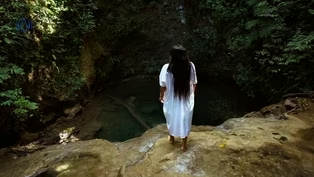
Emotional, spiritual, and practical to individuals and their families facing the end of life by focusing on the quality of life they respect the dying process as a natural part of living at Akwesasne, death doula Diane Boots helps families navigate the end of life with grace, compassion, and dignity.
Honoring Haudenosaunee traditions that guide the spirit's journey.
- Let's say you're in a car accident, would you want to go on machines?
- We do a lot of education.
We have to prepare the family and, and the patient.
Making sure their will is done.
Making sure they understand what the medical proxy is.
What's a power of attorney?
Why should you have a will?
All of those things have to be put in place before.
Do they wanna live at home?
If they wanna have a home birth, what is the room gonna look like where they're gonna be?
Our number one is that we're non-judgment.
And that goes with if I'm traditional and if they start the rosary and they can't finish it, well I'm gonna stand there in honor of the family and the patient and I'm gonna do the rosary.
So my belief systems and my judgment is totally out the door.
It's their power.
It's given them their power.
And I think that that's very important.
- I really believe in our condolence.
It's a very important protocol to guide, not only the spirit, but the family member.
That's part of the things that I work with the family, is acknowledging when a person is passing that they become more in the spirit world than the physical world.
So that transition is very important.
And also in the condolence, like the 10 day feast, they're the faith keeper is always telling the family, you know, they're not gonna be here physically, they're spiritual and they're talking to the spirit and training them, too.
So I just think that the condolence is an amazing way to look at death and to do your healing around.
- How I do that is I go in and I introduce myself.
I sit with the family and with the patient.
I'll go over and I'll say, you know what?
I said, I think it's really a awful that when you're born, people are teaching you, teaching you teaching you supporting you, and then you reach this part of your life and everybody shuts up.
And I said, you know what?
I'm your person.
You wanna talk about anything.
I really push the confidentiality at that point with the patient.
If they share something with me that's between him and I or, you know, and the wall.
They open up to me more and I become, that's what I like about it, is I kind of start becoming part of the family.
And if they need a emotional release, I'll help them do a emotional release.
And I even tell the kids, there's no question that's not on the table.
You need to ask.
- Anything is open.
One of my patients was like, can we have a girls' night?
And I says, well, what does a girls' night look like?
She goes, oh, I want a taste of a beer.
He says, Hey, how about a Budweiser?
They go, yeah, might as well have the full thing.
You know, why go light at this point?
But she just wanted to have fun.
And so what we did is we cranked up the jigging music and my worker and I jigged for her, and we laughed and told stories and everything.
And that was our girl's night out.
And it's kind of like, let's go back a little bit to normal - Don't be afraid of death.
Get to know the people's energy and you won't miss your loved one as much.
Yes, we're gonna miss them physically.
You gotta believe in your experiences.
When you have dreams or you see something, you see a bird or you, you an insect or a butterfly keeps bugging you, you know, don't swat it away.
You know, it's, it's a message.
And you know, we get to share things like that during my training.
People just open right up and they go, oh my God.
What I, you mean what I had was a actual spiritual experience?
Well, yes.
Wow.
Doesn't that feel good?
Yeah.
It gives you the shimmers.
Almost.
Yeah.
Whoo... - That does it for us this Tuesday night.
If you have a story idea you'd like us to explore, we would love to learn more.
Just send us an email at wpbsweekly@wpbstv.org and let's share it with the region.
That's it for tonight.
Everyone join us next time for a fresh look inside the stories have a safe night.
We'll see you soon.
Take care.
- WPBS weekly.
Inside the stories is brought to you by - When you're unable to see your primary care provider.
The Carthage Walk-in Clinic is here for you.
Located off Route 26 across from Carthage Middle School.
Comfort and Healing close to home when you need it most - North Country Orthopedic Group is there for your urgent ortho or sports related injuries.
With our onsite surgical center and same or next day appointments, we're ready to provide care for patients of all ages.
Your health matters to us.
North Country Orthopedic Group, keeping healthcare local.
- We are the north country where protecting one another like family is who we are and where our tomorrow will always be worth defending.
Find out how we keep the north country strong, at claxtonhepburn.org, today.
- Select musical performances are made possible with funds from the statewide community Regrant program, a REGRANT program of the New York State Council on the Arts with the support of the office of the Governor and the New York state legislator administered by the St.
Lawrence County Arts Council.
- Our number one is that we're non-judgment.
And that goes with if I'm traditional and if they start the rosary and they can't finish it, well, I'm gonna stand there in honor of the family and the patient and I'm gonna do the rosary.
So my belief systems and my judgment is totally out the door.
It's their power, it's giving them their power.
And I think that that's very important.
Providing Support for PBS.org
Learn Moreabout PBS online sponsorship












Support for PBS provided by:
WPBS Weekly: Inside the Stories is a local public television program presented by WPBS