WPBS Weekly: Inside the Stories
August 27, 2024
8/27/2024 | 28m 9sVideo has Closed Captions
Johnny on Fire, Kingston's Military Communications and Electronics Museum & more!
World renowned golf instructor and former PGA pro, Peter Beames, joins Johnny Spezzano in the kitchen. Learn how to make a traditional Irish breakfast skillet from the professor himself. And we visit Kingston's Military Communications and Electronics Museum, where they honor the troops, the times, and the technology that helped win wars.
Problems playing video? | Closed Captioning Feedback
Problems playing video? | Closed Captioning Feedback
WPBS Weekly: Inside the Stories is a local public television program presented by WPBS
WPBS Weekly: Inside the Stories
August 27, 2024
8/27/2024 | 28m 9sVideo has Closed Captions
World renowned golf instructor and former PGA pro, Peter Beames, joins Johnny Spezzano in the kitchen. Learn how to make a traditional Irish breakfast skillet from the professor himself. And we visit Kingston's Military Communications and Electronics Museum, where they honor the troops, the times, and the technology that helped win wars.
Problems playing video? | Closed Captioning Feedback
Where to Watch WPBS Weekly: Inside the Stories
WPBS Weekly: Inside the Stories is available to stream on pbs.org and the PBS app.
Providing Support for PBS.org
Learn Moreabout PBS online sponsorship- [Michael] Tonight, on "WPBS Weekly: Inside The Stories", world renowned golf instructor and former PGA pro, Peter Beames, joins Johnny Spezzano in the kitchen for a regional dish from Peter's hometown, learn how to make a traditional Irish breakfast skillet from the professor himself.
And we visit Kingston's Military Communications and Electronics Museum, where they honor the troops, the times, and the technology that helped win wars.
Your stories, your region, coming up right now on "WPBS Weekly: Inside The Stories".
(bright music) (transition whooshing) (bright music) (transition whooshing) (bright music) (transition whooshing) (bright music) (transition whooshing) (bright music) (transition whooshing) (bright music) - [Narrator] "WPBS Weekly: Inside The Stories" is brought to you by.
(bright upbeat music) - [Narrator 2] When you're unable to see your primary care provider, the Carthage walk-in clinic is here for you, located off Route 26 across from Carthage Middle School.
Comfort and healing close to home when you need it most.
(bright music) - [Narrator 3] North Country Orthopedic Group is there for your urgent ortho or sports related injuries.
With our onsite surgical center, and same or next day appointments, we're ready to provide care for patients of all ages.
Your health matters to us.
North Country Orthopedic Group, keeping healthcare local.
- [Narrator 4] We are the north country, where protecting one another like family is who we are, and where our tomorrow will always be worth defending.
Find out how we keep the north country strong, at claxtonhepburn.org, today.
- [Narrator] Additional support is provided by the estate of Evelyn Peckham.
- Good Tuesday evening everyone, and welcome to this edition of "WPBS Weekly: Inside the Stories", I'm Michael Riecke.
We kick things off in the kitchen of Johnny Spezzano, tonight, he teams up with author, golf instructor, former PGA pro, and professor, Peter Beames, to make a regional dish from Peter's hometown, a late night breakfast skillet with an Irish twist.
Take a look.
(transition whooshing) (bright music) (transition whooshing) (upbeat rock music) - Hey, come on!
(upbeat rock music) Hello, my friends, welcome to another "Johnny on Fire", I'm Johnny Spezzano, welcome to my kitchen, and welcome to Professor Peter Beames, he's my guest.
- Thank you.
- And he is about to show us an Irish breakfast.
- [Peter] Yes.
- All right, so, here's what our ingredients consist of.
You tell 'em, Pete, what do we got?
- Well, we've got bacon.
- Mhm.
- Baked beans.
- Yep.
- Ham.
- Yeah.
- Bologna, from- - Croghan Meat Market, we're using it, yeah.
- Croghan Meat Market, yeah.
- Love it.
- Eggs, potatoes, mushrooms.
- Okay.
- Tomatoes, and onions.
- And it's all going in this pan?
- Yes, it is.
- All together.
- And also, we've got Alteri's toast.
- Oh, we'll throw some toast- - Which has to be fried.
- All right, so, here's what we did, we actually cooked the potatoes, you can boil them at home.
- Okay.
- Or, you can, actually, I like to throw 'em in the microwave.
- Yeah.
- Okay, so what I'm gonna do is, before we cut this stuff up, I'm gonna throw our pan in the wood-fired oven to get it heated up, so that way when we crack the egg, it sizzles, so it's gonna be good.
So, all right, so did you tell me there's another name for this breakfast?
- [Peter] Well, it originally was called an English breakfast.
- Okay.
- And it was in the 17th century, and it was for the aristocracy of Britain, and they used to have gun shoots, and so that everybody had enough energy, like you found out today about your energy.
- [Johnny] Yeah.
- They had a big breakfast.
- Oh, okay.
- But, they had to take it to Ireland to get the real fry up.
(Johnny laughing) So, it's a, you know, so that was, it was the 17th century.
- Okay.
- And then the Irish took it over, and they had different meats, they had like black pudding, white pudding.
- What is black pudding?
Is that like blood pudding?
- Yes, it's kind of a blood pudding, yeah.
- Okay.
- But very, very tasty.
- All right, did you tell me you want me to cut the tomato a certain way?
- The tomato has to be cut that way, I'll show you why.
Yeah, so, yeah- - Okay.
- The long ways, yes.
- Like this, right down the middle?
- Yes, right, right down the middle.
- Okay.
- [Peter] And then you slice a couple of, you just wait, that's it, exactly, we just need two slices.
- Okay, all right.
- Yep.
- [Johnny] You know what you're doing on this, I don't.
- Yeah, yeah.
- All right, so we're cutting that up, how 'bout onion?
Any special way you want that?
- Oh, it doesn't matter, no.
- All right, so we'll make a couple of slices of onion.
- [Peter] Yep, yep.
And they need to be kinda diced a little bit.
- Yeah.
Okay, all right, we'll leave that like that, our mushroom?
- Any way you want.
- Okay.
- Yep, yeah, that's great, yeah.
- Okay.
This is all gonna cook in the pan together.
- [Peter] Right.
- So, you wanna keep in mind that you want it to all kinda be done at around the same time.
- Yeah.
- So, I did precook some bacon.
- Okay.
- Okay, all right, so we're getting our veggies done, we don't need this tomato?
- No, we don't.
- Okay, we don't need that tomato.
- You're gonna do a couple of thin slices, too, of that.
- Oh, okay.
- Yeah.
- [Johnny] All right, our Croghan bologna, a north country favorite, which I did not peel, I probably should have.
- Yeah.
- We'll do that quick.
- It's pretty good, it's pretty good.
- Okay.
- [Peter] Croghan bologna.
- I honestly eat it all the time with the skin on it, but, there we go.
- All right.
- We'll peel that right off, and we'll cut that for us nice.
- And the interesting thing, we were talking about, you know, the derivation, where it all came from.
- Mhm.
- Is that this was kind of the breakfast that kept the working class people going in the '60s, so you'd be on the freeways, and you'd get off a freeway, and for maybe two and six pence, or five shillings, you've got a good breakfast.
Now today, this breakfast in Britain costs about $10.
- Okay.
- Which is still a pretty good price.
- Mhm.
Now, what's up with the beans?
Baked beans for breakfast?
- Oh, yeah, yeah.
- Some of the people watching at home go, "I couldn't do that."
- No, no, they're kind of a staple diet for the working class, if you didn't have any money, that was the place to go.
- Get some beans.
- It's all about finance.
- All right, so we got everything cut up here, Professor Peter Beames.
- Yeah.
- Now, let's go see how hot our pan is.
- Right.
- Okay.
(pan scraping) - All right, I threw a little butter, that's now brown butter.
- Great, great.
- In there, it looks good, okay.
All right.
(pan sizzling) Getting a little sizzle and everything.
All right, crack our egg.
(egg thudding) (pan sizzling) Okay.
You're gonna help me by- - Yeah, yeah- - Cutting up the tomato?
- I'm just gonna get this a slice.
Yep.
- [Johnny] How many eggs?
- As many as you want.
- We'll do three.
- Yeah.
- [Johnny] Okay.
And mushroom.
- Yeah.
So that would be the slice which goes on the fried bread.
- [Johnny] Okay.
(pan sizzling) - Boy, this brings back memories.
(Johnny laughing) - It smells good.
- Of dark days over the Pennines, breaking down in Aldershot.
Oh my goodness, yeah.
- Trying to make that fit, Pete.
Beans?
- Yep.
- Okay.
- Beautiful.
- What did I forget?
Croghan bologna?
- Yep.
- [Johnny] Okay.
All right, this is all gonna go in the wood fire oven, and then we'll be able to eat it all at once.
- Yep.
- Okay.
- [Peter] Looks fantastic.
- And I don't think we have any room for the ham.
- Nope, well, that's all right.
- Is that okay?
- We'll have a ham sandwich with mustard when we go out fishing.
- All right.
Little pepper and salt.
- Yep.
- Gotta have that on the eggs, a little sea salt.
Okay, we're gonna throw it in the wood-fired oven.
Looks good already.
(upbeat music) So, Pete.
- Yeah.
- We forgot to put the bread- - Oh!
- In the pan.
- We didn't fry the bread.
- But we're gonna do it right now, we got a loaf right here.
- Yep, yep.
- Okay, should we do the end?
- No, no.
- No?
- No.
- No, thin?
- Thin.
Yep, that's it, you got it.
- Okay.
- [Peter] Yep.
- All right, I gotta do- - Just two pieces.
- I'll do four.
- Oh, okay.
Wow.
Beautiful.
Beautiful.
- All right.
We'll just throw that- - Oh yeah.
- We'll just throw that on there.
- All right, oh.
- Okay, we'll let that roast up along with our eggs, move over, eggs.
- Yeah.
- Okay, so, you, my friend, we've known each other since 2008.
- Yes.
- And, at that time, you were a local golf pro here.
- That's right.
- At a local golf course.
- Yeah.
- But you've had an amazing life, when you were a young man, you were on the Pro Golf Tour.
- All over the world, yeah.
- Yeah.
- There was no money.
- No money in it.
- No, no.
- So you've told me stories about hitchhiking across South Africa.
- Yes.
- With no money- - No money.
- No water.
- And ending up in the middle of nowhere, 400 miles from anywhere, with no water.
- Like in a desert kinda- - Desert, yeah.
- Bush scenario?
- Yep.
- And what ended up happening?
- Two Malawi truck drivers stopped, they picked me up, and they were determined they were gonna kill me, and they took me off the road, to Kimberly.
- Yeah.
- And I prayed that the sun wouldn't set, but it did, so I got my four iron out- - Your golf club.
- Yes, was ready.
- You were using that as a defense?
- I heard, and one popped up one side, one popped up the other, one said, "You want a Coca-Cola, boss?"
And the other one said, "You want a hamburger?"
- Aw.
- So I was saved.
- And they delivered you- - They delivered me right to the door of the tournament, and up to that point, I was the holiday maker.
People laughed at me because I never made the cut- - Okay.
- Never made any money.
That week, something happened- - What?
- And I finished fourth.
- Okay, outstanding stuff.
- Yeah, yeah, yeah.
- And then you ended up golfing with some of the greats.
- Arnold Palmer and Gary Player in Australia, I led the Australian Masters, which all the greatest golfers in the world were there, except Jack Nicklaus.
- Okay.
- And, just had the most incredible life that any human could have, because I followed my dreams, and I came to America, which was a land of dreams.
And here I am- - And here you are.
- Next to "Johnny on Fire".
- Now, something cool, the professor here, you do have a book, it's available on Amazon.
- Yeah.
- What's it called?
- It's called "The Order of Procedure".
- Okay.
- It's done very well.
- Yeah, you might wanna check it out, some golf tips, and- - Yeah, golf tips.
- Facts from your life- - Yeah, just from all over the world- - And it's on Amazon.
- It is.
- Okay.
- And hopefully our movie, which they're gonna make, is on Amazon, too.
- All right, so what he's talking about is he's been approached about a movie, based on his life.
- Mhm.
- From the producers of a film called "Soul Surfer".
- Very big hit.
- Which was about a young woman who had her arm bit off by a shark.
- Yeah, that's right.
- So you're in the process of making this movie with these guys?
- Yes, yeah.
- Okay, exciting stuff.
- It is exciting.
- So we'll be watching and see how that- - Sign the paper.
Sign my life away.
- See how that goes, but you, the reason they wanna do that is because you've had such an interesting life.
You never gave up, you didn't have money, while some of the big golfers were, you know, getting on their- - Helicopters, yeah, jets, G5.
- Getting on their private planes.
- Yeah, yeah, yeah.
- You were hitchhiking.
- I was hitchhiking.
- To get to the next- - Yeah.
- Tournament, and to play.
- Yeah.
- So, it really was quite a time, and this was in what year?
Around?
- Well, when it started was '67.
- Okay.
- And it went on 'til I finished in 1981, or 1980.
- Mhm.
- And I played the greatest golf of my life in the New Zealand Open with Jack Newton, who unfortunately had an airplane propeller nearly cut his body in two.
- I read about that.
- Yeah, and he was my enemy, but we fell in love, because we both played incredible, and I had a beer with him, which was the greatest honor.
- Well, you're an Irishman.
- Yeah, that anybody could have.
(Peter and Johnny laughing) - All right, well I appreciate you showing us your Irish breakfast.
- Right.
- I think we need to check it out and see how it's doing.
- Yeah, we do.
- Okay, so- - Absolutely.
- Let's do just that.
(upbeat rock music) All right, first, (pan scraping) we toasted up some bread.
(pan clanging) - Wow.
- And, here comes our Irish breakfast, shouldn't you be singing "Oh, Danny Boy" or something?
- If I could sing, I certainly would.
- [Johnny] Oh, look at this.
- Oh my gosh.
- Woo!
- [Peter] Oh my gosh.
- Fit enough for a king.
- Yes.
- Hand me that spatula, right over there.
- Yep.
- Now what's the deal with the bread?
You wanna show me how this works?
- Yeah, so you get a plate, and you would take the bread, and you put the piece there, and then you would take the, hopefully we can, yeah, they're perfect.
- The tomato.
- We put that on top.
- Okay.
- Like that.
- Mhm.
- Right?
- Yeah.
- And then you would take an egg, I dunno whether I can do that- - Yeah.
- But I'll try.
Oh, yeah.
- Yeah, you got your bacon with it.
- Yeah.
So that would go on top of there, so it's kind of making a little sandwich, and then- - Okay.
- You get a little bit of bacon.
- Put your bacon on there- - Yeah.
- Go ahead.
- Yeah.
- [Johnny] Do it up.
- [Peter] And then you get some beans.
- [Johnny] You put those on it?
- Oh yeah.
- Oh, that's your side meal.
- Yeah, and then you get some potatoes, and, man, I'm making a good meal here.
- Good breakfast.
- And a little bit of there.
- Mhm.
- And that's it.
- What about your Croghan meat?
- Oh, did I not get that?
- [Johnny] Yeah, get a little sausage there- - [Peter] Right there, and a little bit of onion, which goes- - [Johnny] Got a little room on the plate over- - Yeah.
- Oh.
- Oh, there we go.
- Okay, now what?
- That's it.
- Where's mine?
- You can go for it.
- All right, I'll try.
- 'Cause you don't like tomatoes.
- [Johnny] I'll do what you do.
- All right?
- Okay.
- You don't like tomatoes.
- Okay.
(spatula scraping) - [Peter] Yeah, on top, that's it.
- Little egg.
- Yep.
- Okay, and onion?
- Yeah.
(spatula scraping) - And, you took- - I mean- - You took it all.
- Probably, yes I did, and probably the, (Johnny laughing) the toast would've been a bit more soaked in butter.
- And do you close it up, or no?
- No, oh no- - You just- - Oh, no, no, no.
- Oh, you eat it, oh, 'cause it's very English and British and- - Yeah, yeah.
- Irish, and- - Yeah.
- All right.
- I think you can have that one, and I'll have that- - No.
- You sure?
- Please.
- All right.
Okay.
- Please.
- Let's try a bit, and see what it's like.
- Okay.
- Yeah, all right, just a little bit there.
Wow.
- This is enough to keep you- - Tasty.
- Full all day.
- Yeah, this is tasty.
- Mm!
Real good, Pete.
So good, everything's great in cast iron.
- Mm.
- Thank you so much for coming on the cooking show.
- You're welcome, awesome.
- And much success to you.
Again, go find the professor's book.
- Mhm.
- What's it called again?
- "The Order of Procedure".
- Okay, you can get it on Amazon, you can listen to my podcast, you can watch all the "Johnny on Fire" episodes at wpbs.org, I love ya, have a great day, and let's eat.
Mm!
- I love it, I love it.
- [Johnny] It came out really good.
- [Peter] Did you get some mushrooms?
- [Johnny] Yeah, I got a mushroom, yeah.
- [Peter] Mm.
(upbeat rock music) - Good?
- Mm!
- [Johnny] I'm gonna start wearing this hat all the time now.
- Mhm.
(transition whooshing) - If you're looking for more fire-grilled recipes from Johnny, visit wpbstv.org, and scroll through our library.
Also, if you'd like to be a guest on the segment, drop us an email at wpbsweekly@wpbstv.org, make sure you include your name, and your fire-grilled recipe idea.
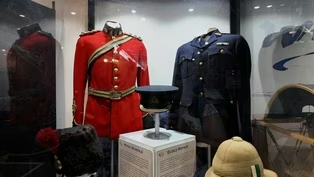
Kingston's Military Communications and Electronics Museum's collection highlights the role that military communications and electronics have played in Canada's military for more than a century.
Over 20,000 square feet of gallery space is dedicated to telling the story of groundbreaking and lifesaving technology, both past and present, here's producer, Guy Carlo, with more.
(transition whooshing) (bright music) (transition whooshing) - [Guy] Kingston, Ontario is home to the Military Communications and Electronics Museum.
We spoke with its Curator and its Executive Director to learn how they preserve Canadian history.
- After the Second World War, the school here, the Canadian Forces School of Communications and Electronics, they started to accumulate a large assortment of Second World War and First World War equipment, and they decided in 1961 to establish the Royal Canadian Corp Signals Museum, in their headquarters building located here at CFB Kingston.
And by the time we hit the 1980s, they had such a huge collection that the museum they had in the basement was no longer able to accommodate the collection, and they started a fundraising process, in order to build the facility you're visiting here today.
So, in 1995, we were able to put in the cornerstone, and May of 1996, we were able to open this facility.
At the time, it had about 10,000 square feet of gallery space, and then we outgrew that, rather rapidly as well, and in 2014, we added another 10,000 square feet, in order to accommodate the ever-changing collection here at the museum.
The Boer War is actually the impetus for our founder, Major Bruce Carruthers, when he participated in the Boer War, he actually went over twice, once as an NCO and once as an officer.
And in the heat of the battle, he saw how vital communications were, and at that time, we were fighting under the British, and there was nothing like a Signal Corps during that period of time.
So, upon his return to Canada, he actually petitioned for Canada to form the Canadian Signal Corps, and as a result, Canada has the earliest Signal Corps within the British Empire.
The museum is about the troops, the times, and the technology, and we've started to be able to incorporate the stories of those individuals that make it matter, for instance, Major Wolfe, during the Dieppe Raid, a lot of people don't like to talk about negative history, we didn't win the Dieppe Battle, we in fact had to evacuate.
But the Major came onto the beach in his CO car, which was practically destroyed, but his radio was still operational, and he continued communication until he saw all hope was lost, saving countless lives.
And right before he was captured by the Germans, he was able to destroy his comm book and his radio, but he kept that message getting through, right up 'til the very end.
And being able to highlight heroes like that is one of the main parts of this job, and it's why it's so important.
Because these heroes, they're not the type that will tell people what they did, but thanks to war diaries and others, we're able to pass on their story to the public, and they're just so important to why we're here today.
(bright gentle music) - [Guy] The museum tells the tales of Canadian soldiers, and how communications abilities have evolved from their earliest conflicts, right up to the present day.
- The museum here, we actually talk about the troops, the times, and the technology, and we really go over a whole lot of things in the gallery.
So, for the troops, we talk about some of the main individuals that have been associated with the communications and the electronics branch, we call it the C and E branch, and some of the technology that we've dealt with over time.
Our history is called semaphore to satellite, so we deal with everything from semaphore flags, to heliographs, all the way up to satellites, so, modern technology and everything in between.
And then we deal with the chronology of what we have developed, what Canada developed over time, in terms of those technologies, and the ways to use them as well.
We take everything from late 19th century, on up to the present day.
So, the gallery covers everything up to Afghanistan, and we talk about some of the very earliest ways in which we communicated orders within the military.
There's, some of the earliest objects in the collection are from the First World War, but we do deal with some items that are before that as well.
There's actually two museums under one roof, currently we have the Military Communications and Electronics Museum, which takes up the bulk of the museum, but we also have co-located the Royal Canadian Electrical and Mechanical Engineers Museum here.
They're the guys that maintain the vehicles, and a lot of the other military equipment in the Canadian military, so they're showcasing some of the things that they do in their roles as well.
Both of them are well worth taking a look at.
- [Guy] With thousands of items spanning more than 100 years of military history, stories unfold through the lens of technological advancement.
- For more information on the museum, probably the best resource is our website, candemuseum.org.
Definitely check out our hours and our admission prices before you come, we're generally open from 10:00 to 3:30, five days a week, but in the summer, we're actually open seven days a week as well.
Things that you might wanna do while you're here, we actually have two escape games, so improbable escapes, we've done Camp X and Spymaster.
So, for families, it's a great thing to do, not just looking at the exhibits, but you're also interacting with them in a unique way, so you can get more information on those on the website as well.
There's a lot of technology here, a lot of unique objects to come and take a look at.
- [Guy] From the Military Communications and Electronics Museum in Kingston, Ontario, for WPBS Weekly, I'm Guy Carlo.
- Check out our- - For more information, visit candemuseum.org.
Well, mark your calendars for a new series premiering on WPBS, "Moon Flower Murders" is coming to Masterpiece this fall, it picks up where the very popular "Magpie Murders" riveting finale left off, but you don't need to be a fan of "Magpie Murders" to watch.
Then, catch the premiere of season four of "Van der Valk", the team is back and ready to tackle more of Amsterdam's criminal underworld.
It all happens on September 15th.
Take a look.
(transition whooshing) (bright music) (transition whooshing) (dramatic music) - It's about our daughter.
She's gone missing.
We think it may be because of one of your books, "Atticus Pund Takes The Case".
- He was killed in a hotel at a wedding.
- That would be a good setting for a book.
(cleaner gasping) - Blood stains on the bridal down.
- Oh, I like that.
(dramatic music) - [Writer] Chapter one, it was a picturesque village in the county of Devonshire, its most famous resident was the British actress, Melissa James.
- Sometime between 6:28 and 6:38 in the evening, somebody broke into her house and strangled her.
- So who do you think may have been responsible?
- [Detective] That's Maureen Gardner, at the hotel.
- We have information that could help you.
- [Detective] And there's a film producer, called Oscar Berlin.
- I've changed my mind, you'll just have to find somebody else.
- [Detective] There's her financial advisor, man by the name of Algernon Marsh.
- You'd know a thing or two about lying.
- I don't know what you're talking about.
- I don't trust him an inch.
- Mm.
(bell dinging) - [Speaker] Ms. Ryeland.
Don't tell me you're involved in another murder.
- I started all this, and now I'm gonna finish it.
- If I see you again, I will arrest you.
- You were the key witness, what did you see?
- You need, I think, to be careful, it might have been better if you did not all come.
(engine revving) (dramatic music) - [Narrator 5] "Moonflower Murders", on Masterpiece Mystery.
(engine rumbling) (dramatic music) (dramatic music) ♪ Rain fall down in by the water ♪ - And I take it you're not here for a swim.
(dramatic music) - She's dead.
- Yeah.
Yeah, I noticed that.
(dramatic music) - [Speaker 2] Like the day could get any worse.
- No wonder the killer got him.
- Love you too, sweet cheeks.
(dramatic music) Still a charmer, then.
- Oh, this is him mellowed.
- Wow, you got my sympathy.
- So our prime suspect is someone who's been missing, presumed dead, for two years.
♪ What doesn't kill you ♪ - [Speaker 3] You heard from Eddie?
♪ Makes you stronger ♪ - Eddie, where are you?
♪ There's a garden ♪ ♪ Inside ♪ - It's none of your business.
- You made it my business.
(speaker groaning) - Let's consider this your first and last warning.
(explosion booming) - [Speaker 4] I know what we missed.
(dramatic music) - Kill a police officer, you're in a whole lot more trouble than you are already.
Drop the gun.
(dramatic music) (transition whooshing) - Before we wrap things up tonight, here's a look at what's happening in your community, on both sides of the border, for the month of September.
(transition whooshing) (bright music) (transition whooshing) (bright upbeat music) (bright upbeat music continues) (bright upbeat music continues) That does it for this Tuesday night, join us next time for a fresh look inside the stories.
Getting locally grown fruits and vegetables onto school lunch trays isn't as easy as it seems, discover how one program is overcoming the obstacles.
And, we're on a mission to learn more about who our elected leaders are beyond politics.
We take a trip to the Watertown Sportsmen's Club for a chat with Congresswoman, Claudia Tenney.
In the meantime, if you have a story idea you'd like us to explore, we'd love to learn more, drop us an email at wwpbsweekly@wpbstv.org, and let's share it with the region.
That's it for now, everyone, we'll see you soon.
On behalf of everyone working hard behind the scenes here at WPBS Weekly, I'm Michael Riecke, have a great night.
(bright music) - [Narrator] "WPBS Weekly: Inside The Stories" is brought to you by.
(bright music) - [Narrator 2] When you're unable to see your primary care provider, the Carthage walk-in clinic is here for you, located off Route 26 across from Carthage Middle School.
Comfort and healing close to home when you need it most.
(bright music) - [Narrator 3] North Country Orthopedic Group is there for your urgent ortho or sports related injuries, with our onsite surgical center, and same or next day appointments, we're ready to provide care for patients of all ages.
Your health matters to us.
North Country Orthopedic Group, keeping healthcare local.
(bright music) - [Narrator 4] We are the north country, where protecting one another like family is who we are, and where our tomorrow will always be worth defending.
Find out how we keep the north country strong, at claxtonhepburn.org, today.
- [Narrator] Additional support is provided by the estate of Evelyn Peckham.
- And, here comes our Irish breakfast, shouldn't you be singing "Oh, Danny Boy" or something?
- If I could sing, I certainly would.
- [Johnny] Oh, look at this.
- Oh my gosh.
- Woo!
- [Peter] Oh my gosh.
- Fit enough for a king.
(bright music)
Providing Support for PBS.org
Learn Moreabout PBS online sponsorship











Support for PBS provided by:
WPBS Weekly: Inside the Stories is a local public television program presented by WPBS