WPBS Weekly: Inside the Stories
April 28, 2026
4/28/2026 | 25m 14sVideo has Closed Captions
Emmanuel Church's Meals Program, a Fresh Look at Ostrich Farms and The North Country Adventure Team.
We go inside the Emmanuel Church Community Meals Program. Our Fresh Look at Farming Series continues with an ostrich farm. Plus, the North Country Adventure Team lets kids be kids.
Problems playing video? | Closed Captioning Feedback
Problems playing video? | Closed Captioning Feedback
WPBS Weekly: Inside the Stories is a local public television program presented by WPBS
WPBS Weekly: Inside the Stories
April 28, 2026
4/28/2026 | 25m 14sVideo has Closed Captions
We go inside the Emmanuel Church Community Meals Program. Our Fresh Look at Farming Series continues with an ostrich farm. Plus, the North Country Adventure Team lets kids be kids.
Problems playing video? | Closed Captioning Feedback
Where to Watch WPBS Weekly: Inside the Stories
WPBS Weekly: Inside the Stories is available to stream on pbs.org and the PBS app.
Providing Support for PBS.org
Learn Moreabout PBS online sponsorship- Tonight on WPBS Weekly Inside the Stories, serving the community one meal at a time.
We stop by the Emmanuel Congregational Church to learn about their community meals program and how they're feeding the neighborhood.
And a Canadian couple is bringing something different to the table.
Their ostrich farm is part of a bold vision for the future of sustainable farming.
Also, the North Country Adventure Team is providing a safe, supportive space where children can explore, learn life skills, and simply enjoy being kids.
Your stories, your region.
Coming up right now on WPBS Weekly: Inside the Stories.
- Funding for WPBS Weekly inside the stories is provided by the statewide Community Regrant Program, a REGRANT program of the New York State Council on the Arts, with the support of the office of the Governor and the New York State legislature and administered by the St.
Lawrence County Arts Council.
- Good Tuesday evening everyone, and welcome to this edition of WPBS Weekly: Inside the Stories.
I'm Michael Riecke.
Everyone deserves a good home cooked meal.
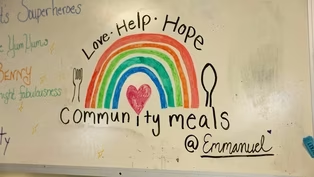
At least that's what Steph Russell believed when she helped create the Community Meals Soup Kitchen at a Emmanuel Congregational Church.
Since then, they have served thousands of meals to neighbors across the community, offering not just food, but a place to gather, connect, and feel at home For more, we go to WPBS producer, Luke Smith.
- Behind Every meal served in this church basement is a smiling face, making it possible.
It's a goal.
Steph Russell had when she was approached by Jefferson County on making a new meal service for the community.
- The county had gone to churches the first year of Code Blue.
They went to churches and said, Hey, would you guys mind making a meal for everybody before they go to Salvation Army to spend the night?
So it wasn't set in one church.
When I sat down with the county, I was like, this needs to be for everybody.
- That idea laid the foundation for community meals at Emmanuel Church serving up hot meals for anyone who stops by.
- The goal is to make people feel not only welcome, but that we're thankful that they came to hang out with us.
There's always a protein, a starch, typically a warm vegetable.
And then we have bread.
We always have a green salad.
We always have fruit and then dessert.
- Hot meals aren't the only thing guaranteed to visitors of community meals, they're also able to get their groceries from their pantry service, providing everything from food to essential care products.
- We constantly have rotating items.
We do like a soup of the day, a snack of the day, fruit, vegetable of the day that we rotate out different products each night that we do the pantry.
We weren't sure really how it was gonna go, but the numbers that we got really started increasing last spring and summer.
So when I started volunteering here throughout the spring, it was basically just a bunch of boxes of donations that had accrued over time and we started organizing those boxes, getting them up on shelves.
So this has really become more of like a mini grocery store in here.
This is the first place that serves community meals, free meals to the community and and runs a food pantry unlike no other that I've seen before.
- But what makes Community Meals shine is the people who make it possible.
From the moment someone walks through the door to the moment they leave, that sense of care and positive energy is something Steph and her team work hard to carry through each interaction.
- I have an incredible staff who also believes in this.
Staff, who they themselves have had their own trials and tribulations.
Blake graduated drug court and spoke about us and I'm proud of that.
Benny, my cook, one of my very first diners.
Now Benny's like, "you know what I was thinking maybe I'm gonna write a cookbook and I'm gonna write a cookbook in like mass quantity.
So it wouldn't just be like for a family, it would be for situations like this."
- We always have a good time here.
You know, we're always laughing trying to, you know, wear a smile on our face.
Life isn't easy all the time.
So I think maintaining a positive attitude is a big reason why a lot of our volunteers continue to come back.
- In 2025 community meals served over 24,000 meals in its dining room and provided over 3,500 visits from its pantry.
But beyond the numbers is the mission to make sure everyone who stops by a manual for a meal leaves well fed with a smile on their face.
- People usually don't come to a soup kitchen 'cause they're having the best day of their life, but I want them to know we're happy to see 'em anyways.
- I think Steph is really the embodiment of everything that we do here and of generosity and care and compassion.
Steph is definitely the best boss that I've ever had.
- I can't believe that not only do I have this opportunity, but that people, honestly, that people believe in me.
I think that is why it's so important to me that the people that visit us have that feeling.
'cause I wouldn't be here without that feeling.
There wouldn't be a community meals without that feeling.
- In Watertown for WPBS Weekly, I'm Luke Smith.
- To learn more, you can find them at communitymealsatemmanuel .weebley.com.
Well, they are big, bold, and surprisingly well suited to life in Canada.
At Struisvogel Farm, Brittany and Caleb DenOuden are raising ostriches not as a novelty, but as part of a bold vision for sustainable farming.
From their lean meat to their luxurious hides, these birds are part of a zero-waste model that's turning heads across the provinc.
In an industry still finding its footing in North America, they're not just farming, they're leading a quiet revolution.
Here's producer Gail Paquette with the second installment of our Fresh Look at Farming series.
- Brittany and Caleb never planned on becoming ostrich farmers, but their journey took flight thousands of miles from home on a volunteer trip to Africa where they were first introduced to these curious towering birds.
- So once we finished our university studies, we decided let's spend another year volunteering before we kind of settled down.
And we ended up going to South Africa and spending a year there.
And while we were there, we visited some our ostrich farms and they had the largest ostrich farms in the world there.
So we toured some of them and then we were just fascinated by it.
From then on, we ate a lot of ostrich meat while we were there, and then we also were fascinated by the bird themselves.
When we came back to Canada after that year, it just kept coming back to our minds of our experience there and we couldn't - Let it go.
They began researching everything they could, looking for anyone who had experience with these fascinating birds on Canadian soil.
Their search eventually led them to Need O'troche, a pioneering ostrich farm in Quebec.
It was there among a flock of long legged giants that the dream started to feel tangible.
They asked questions, observed the day-to-day operations and soaked up everything they could from Farmer Nicholas.
What they saw wasn't just novelty, it was viability.
Ostrich farming could work here.
- And so we bought 10 little baby chicks that were about two to three months old and then started with that, made sure we could keep them alive.
Everything went all right and then everything went great.
And we decided, okay, let's jump in a little bit farther.
And we bought some adult breeders also from him.
And then when that went fine as well, then we needed to mix up the genetics a bit to have a better breeding group.
And so we bought some ostriches from the states at a couple different farms there.
And then we kind of had our crew of breeders and then it just explodes after that.
And then we have a hundred birds in no time.
- It turns out ostriches are surprisingly easy to farm.
They're hardy, low maintenance animals adaptable to the Canadian climate, but it's not just about the birds, it's about building a sustainable future.
And nothing goes to waste.
The hides become leather, feathers turn into art, eggshells into crafts, and the meat lean, tender and rich in iron.
It's a hearty, healthy red meat that tastes like beef, both far less fat.
- Yeah, I think we like to think outside of the box using first principles.
Why, you know, why beef, why that red meat?
And when we looked at ostrich in South Africa, we realized, here's a meat that's healthier for you.
It's better for the environment, it's easier to raise less water, less food per pound of meat.
And I would say easier to farm.
And so it's a new novel idea, but it seems like it has all the right ingredient ingredients to be a mainstream meat for For Canada.
- Yeah, the meat's the number one for sure, but since we're processing processing them for the meat, then we won't use all parts of the bird.
So yeah, then we'll use the feathers and we now make our own feather dusters and then the oil, we render the fat down and we send that to Quebec and she oxidizes it, does all the lab work for it for us, and then gives it it back to us and then we bottle it for skincare.
- Ostrich farms are still few and far between in North America, so Brittany and Caleb have had to blaze their own trail from the start.
Their learning curve has stretched beyond their own backyard, reaching out to connect with farmers across the continent, trading knowledge and building community in an emerging industry.
Their willingness to share what they've learned and keep learning along the way isn't just helping their farm grow.
It's helping lay the foundation for a wider network of sustainable ostrich farming in Canada and beyond.
- So we are registered as a farm in Ontario, but in terms of the be like the benefits of an association, learning about your animal, there are, there's nothing else.
So we actually had to join the American Ostrich Association so that we could kind of jointly benefit from research and discussions on ostrich.
So we, we've gone to Carolina for the last association and we met some people there, went and visited another farm.
There's a very large one in the states and then a lot similar size to us, all just trying to figure it out.
And it seems like they're all spread out kind of doing the same thing.
They're finding their own abattoir, they're trying to figure out how to, what to do with feathers if there's someone they can find to do that.
The, the leather, the oil.
Some are stockpiling, some are doing it themselves, some are shipping it around.
Everyone's basically on their own trying to do this.
So the association has been really good to kind of talk about best practices - In an industry that's still finding its footing in North America.
Brittany and Caleb are at the forefront, dreaming big and paving the way for others who just might follow their lead.
They're not keeping their journey behind closed gates either their farm is open to the public, inviting visitors to meet the birds, learn about sustainable farming and get a firsthand look at what it takes to raise ostriches in Ontario.
Inspiring a new wave of curiosity and possibility in Canadian agriculture.
- We, yeah, we kind of hope there's, I guess like we're first generation, so we hope that ostrich farming continues to grow and so we can only do so much in our lifetime.
So we hope it just like we we're kind of introducing it, being like the marketers to it in Ontario.
So hoping people try the meat and hoping people learn about the bird and realize you can farm ostrich in Canada and then maybe after us more farms will pop up and it'll start picking up.
But as one farmer, you can't do much.
And yeah, really marketing and just like educating people is like kind of our goal.
And then growing as much as we can though, if we can get up to 2, 3, 400 birds, like we hope that the demand increases and continues and we can keep going.
- For WPBS Weekly, I'm Gail Paquette.
- For more information, visit Struisvogel.ca.
The North Country Adventure Team Summer Biking Program is about much more than biking.
It's about building confidence, resilience, and teamwork.
Coaches celebrate individual progress and encourage children to challenge themselves and support one another.
Most importantly, it's about providing a safe, supportive space where kids can explore, form friendships, learn life skills, and simply enjoy being kids.
- I love their energy and their spirit.
They really, you know, it's six to eight at night and it seems late, especially after all the summer commitments and the family engagements that they have.
And they still come and they're excited for nothing more than friendship, opportunity to explore and some free pops.
So I love that about these kids and, and their eagerness to go.
- The North Country Adventure Team is an alternative kids bicycling recreation program held mainly at the Indian River Intermediate School throughout the summer, founded in 2024 by Alan Cooper with the firm relief that kids need adventure teams.
The program's purpose is simply to let kids be kids.
- The kids explore, they get more summer social time, they grow bonds.
It's kinda like a team, but it's more of a support network.
It's not about competition.
It's the kids growing together, challenging themselves in different ways.
They might hit take a really steep hill and one kid may be able to do it five times and one might be only able to do it one.
But we celebrate the victories.
We celebrate the one kid who struggled and struggled and overcame it.
And the kids who have been understanding how to do it, they're there more as a support system.
So it's kids kind of learning more social skills and leadership skills.
- It was the idea that there is such a group out there that is looking to explore this area, to learn more about it, to exercise, to engage, and to give kids a non-competitive option within the region of having fun learning and building together as a team and learning these awesome skills that we take for granted.
And really just watching that progression from my group, the little guys all the way up to the older kids, it's really amazing to watch 'em all go together.
- Groups who approximately eight children, ages five to 18 are led by two to three adult coaches on a two hour adventure ride.
All adult volunteers have passed a background check and have completed ambulance and in-house training sessions.
Each session is freestyle by design.
No two nights feature exactly the same activities or scenery.
- We don't have a fully structured program for the simple fact that it allows our coaches to see where the kids are and adjust to that.
A lot of structured programs kind of will bore a kid or will not make a kid feel a challenged.
With ours, our coaches adapt on a weekly basis of how many times they take breaks, where they go.
They always try to make every week different.
And I think in a lot of ways that's good because it allows the coaches to naturally have their own way.
And I think a lot of our coaches really enjoy the fact that they can tailor it to what they want and how they feel and the different activities they do.
We have suggestions, but the coaches are allowed to do what they want ultimately.
I'm just here for support.
- Kids explore school grounds, trails, creeks, playgrounds, even the bus garage, all while gaining hands on experience riding a bike and building balance and coordination.
- We teach a lot of the basics just quickly.
We have some fun, put 'em in some games.
We were playing red light, green light to work on braking.
We did some balance pushes and then we really see how the kids are feeling.
We let them explore.
We go into the nature trails and the cross country trails that are available here at Indian River for the cross country teams.
So we do a lot of fun stuff to get 'em engaged, get 'em excited, and honestly, two hours goes by really fast.
- The kids learn that it's okay to do hard things.
I think that's the biggest thing that they learn.
It's not about, well it is bike skills in a sense, but it's also, it's the hard things.
And it's sometimes seeing deer.
There's a lot of deer back on the trail, a lot of discovery.
A lot of our kids are not from Indian River too, which is pretty cool that we have 26% of our kids are from surrounding towns.
So in some ways it's natural exploration, it's discovering new communities, but it's also in some ways just finding a better version of themselves.
Go, - Come on, you can do it.
The North Country Adventure Teams, weekly bike rides give kids a sense of belonging, provides challenges, and develops perseverance and independence.
But really it's not about the bikes, it's about providing kids a safe space and the time to discover a version of themselves that they didn't know existed.
It's about creating a sense of identity, community and self-esteem.
Most of all, it's about the smiles, the laughter, and kids simply being kids.
- The kids benefit from just being themselves.
I think that's the biggest thing.
Riding for icy pops, riding for breaks, playing on the playground, learning bike skills, but also learning life skills.
There's a lot of friendships made.
- Go.
One minute!
I enjoy running the North Country Adventure Team because it's just, it's really cool to just see families, communities, and kids moving.
Yeah, it's in the heart of it.
That's really it.
- For more information on the North Country Adventure Team, visit ncadventureteam.wixsite .com/community or on Facebook.
- Rounding the corner to Ottawa.
Now we take a peek inside a musical event that's been going on there for well over a decade.
We first brought you this story in 2021.
Gil's Hootenanny is an entertaining and engaging Mayday singalong concert that's been a much anticipated event for more than 16 years.
Gil's Hootenanny recently announced that this year's May 1st concert will be its last in this format.
The team is looking to reshape Gil's Hootenanny with more events held in smaller venues.
Details will be announced in the fall of 2026.
Here's a look back at Gil's Hootenanny.
- A lot of people don't know what a Hootenanny is anymore, especially of the younger generation.
But a Hootenanny is a place where people get together to sing.
Not so much to hear performers, although that can be part of it too, but really to sing along.
Been selling out for the last number of years with 300+ participants attending and singing along and leaving with their hearts and spirits full of music and community.
- So where do you do this?
But the bigger question is why.
Why do you do this?
- We do this in part to remember my dad, whose name was Gil Levine and who died in 2009 at age 85 because Gil loved Hootenannies.
And in his obituary there were three important words about this, which were plan a Hootenanny.
He had Hootenannies every year at my parents' home and invited people to come and to bring a song and to share their song and to sing together.
And my dad was a strong trade unionist, social activist, and really believed that singing together could create a kind of solidarity of spirit.
But it grew and grew over time.
It changed over time.
One of the things that changed was we moved away from singer songwriters simply performing to having more and more singing along.
And people asked for that.
Participants said, we wanna sing more.
And so we would have more and more and more in the evening sing along songs.
We even had a songwriting contest that ran for a number of years, and the idea was to generate new songs that were on the theme of protest and hope, but also were highly sing alongable, in other words, had great choruses, easy lyrics.
They stick in your head, they're easy and they stick in your head.
Catchy melodies.
- All we need - Is right here.
themes, relevant themes.
And and so our, our sing alongability scale, I would say we've gone way up with more and more and more singing along.
- So we are expecting this in just a few days.
May 1st it's gonna be different this year.
Where can folks go or what can they expect and how do you want them to show up?
Are you imagining everyone singing along online even when they were able to in person?
- Yeah.
Obviously it's different in COVID times.
And last year of course was our first year doing a virtual Hootenanny.
One of the hard things about the virtual part is that we can't hear each other's voices.
So it's singing along.
But we, we only hear whoever is singing on screen and myself, - Right.
- As long as, as long as we sing, there is life, there is hope and there's solidarity.
Thank you.
- Thank you Tamara very much.
We appreciate it.
- Gil's Hootenanny 2026 will take place at 7:00 PM on Friday, May 1st at the campus of the first Unitarian congregation in Ottawa.
More information at gilshootenanny.ca.
Well that does it for this Tuesday night.
If you have a story idea you'd like us to explore, we would love to learn more.
All you need to do is send us an email at wpbs weekly@wpbstv.org and let's share it with the region.
That's it for tonight, everyone.
Until next time, take care.
- Funding for WPBS weekly inside the stories is provided by the statewide Community Regrant Program, a REGRANT program of the New York State Council on the Arts, with the support of the office of the Governor and the New York State legislature and administered by the St.
Lawrence County Arts Council.
- People usually don't come to a soup kitchen 'cause they're having the best day of their life, but I want them to know we're happy to see him anyways.
- I think Steph is really the embodiment of everything that we do here and of generosity and care and compassion.
Steph is definitely the best boss that I've ever had.
Providing Support for PBS.org
Learn Moreabout PBS online sponsorship












Support for PBS provided by:
WPBS Weekly: Inside the Stories is a local public television program presented by WPBS