
250 Years of Americana
Season 30 Episode 22 | 52m 29sVideo has Closed Captions
ROADSHOW discoveries reflect 250 years of American art, artifacts, crafts & collectibles.
ROADSHOW discoveries reflecting 250 years of American art, artifacts, crafts and collectibles. One valuable treasure reaches $300K!
Problems playing video? | Closed Captioning Feedback
Problems playing video? | Closed Captioning Feedback
Funding for ANTIQUES ROADSHOW is provided by American Cruise Lines and Ancestry. Additional funding is provided by public television viewers.
Support provided by:


250 Years of Americana
Season 30 Episode 22 | 52m 29sVideo has Closed Captions
ROADSHOW discoveries reflecting 250 years of American art, artifacts, crafts and collectibles. One valuable treasure reaches $300K!
Problems playing video? | Closed Captioning Feedback
Where to Watch Antiques Roadshow
Antiques Roadshow is available to stream on pbs.org and the PBS app.
Buy Now

ANTIQUES ROADSHOW's 2026 Production Tour
Enter now for a chance to win a pair of free tickets to one of the three stops on ANTIQUES ROADSHOW's 2026 Tour. Sweepstakes entry deadline is April 6.Providing Support for PBS.org
Learn Moreabout PBS online sponsorship♪ ♪ CORAL PEÑA: Happy birthday, America.
It's such an incredible piece of American history.
(chuckling): You're kidding.
This piece combines a great folk design with great history.
PEÑA: It's "Antiques Roadshow: 250 Years of Americana."
♪ ♪ PEÑA: American ingenuity has long been a hallmark of our national character, as well as a point of pride.
To celebrate the United States' 250th anniversary, "Roadshow" compiled some of the best pieces of Americana we've ever seen.
Outstanding items that showcase the experiences... Oh, my gosh.
So this is of a real historical significance.
It's-it's a really neat piece.
PEÑA: ...innovations... I guess it's not a secret to anyone that this is a light bulb.
Yes.
But it's a, it's a very special kind of light bulb.
PEÑA: ...and artistic expressions that make up our storied history.
APPRAISER: In many ways, they're very symbolic, I think, of his passion for the environment and making people aware of the American landscape.
PEÑA: July 4, 1776, is the U.S.A.
's birth date, but we're starting off with a treasure created in a city under siege several months before the 13 colonies declared independence.
Take a look.
GUEST: The powder horn came through my mother's family.
The stories vary-- it was, uh, perhaps a wedding gift to my grandmother and grandfather, or may have come later, possibly from an auction or sale.
Okay.
But it's been in the family, that we know of, for about 70 years.
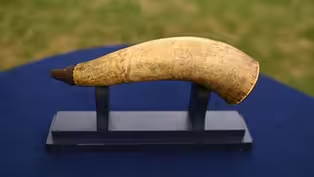
Hm, well, it's a really nice example of a powder horn that was made in the Boston area in 1775.
And it was made during the siege of Boston.
After the events of Lexington and Concord in, on April 19, 1775, there was a massive influx of troops from across New England that descended on Boston.
They, they built a series of fortifications around the, the town to blockade the British army in the towns so that they couldn't get back out into the countryside to try to capture more supplies or disrupt military activities.
One of the major fortifications in the town was Roxbury.
Mm-hmm.
And we actually see the term "Roxbury Camps."
And then there's this really simple but interesting outline of a fortification.
Now, on... this side, we have something very interesting.
An inscription that says "by Abimeleck Uncus."
Abimeleck Uncus was a soldier who was serving in Colonel Timothy Danielson's regiment in 1775.
Oh, wow.
I actually found a muster roll from October of 1775... Uh-huh.
...where Abimeleck Uncus appears on that roll.
(chuckling) And he appears on the roll as being from the town of Norwich in Connecticut.
Oh, my gosh, oh.
Yeah.
In addition to that, I can tell you that he was Native American.
He was a Mohegan, in fact.
In 1777, he enlisted for three years in the 1st Connecticut Regiment.
Significantly, he's mentioned as being sometimes on Indian duty, or working with Indians.
I can only think of a, a small handful of other horns that were likely decorated by Native Americans, and most of those are of a generation earlier.
Mm-hmm.
I think it's a really interesting, I think, important piece of, of American history.
Have you ever had it appraised?
Uh, my mother's estate was appraised about six years ago.
Okay.
And, um, it was appraised for $5,000.
Okay.
Well, I think that in today's market, uh, siege of Boston powder horns are fairly popular right now.
Mm-hmm.
This powder horn at auction could easily sell in the $8,000 to $12,000 range.
Mm, right.
And I think it has a really good potential of bringing more because of the history.
Mm-hmm.
Because of Abimeleck's association.
Well, that's, that's wonderful.
That's amazing.
Well, it-it... My grandmother would be so pleased.
(chuckles) Well, uh, being native of San Diego, and I worked for the local utility, and I was in a department called the Art and Display department.
And we built displays, uh, for the fairs and home shows, and it was appliances and things like this here.
And during the '70s, they decided to get rid of this department and-and... And you brought it home with you.
Yeah, right.
(laughs) So, my, uh, old boss at that time, I asked him if I could please have that, and he said, yeah, go ahead and take it, so.
Well, it was, it was a nice gift of him to give to you.
Oh, yeah.
Now I'm realizing that today, so.
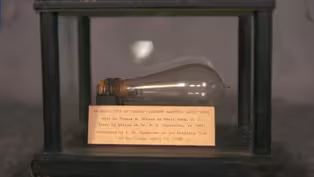
Well, I guess it's not a secret to anyone that this is a light bulb.
Yes.
But it's a, it's a very special kind of light bulb.
And it has a presentation plaque, which is interesting.
We don't know... the truth or not behind the plaque, and it says it was presented by Thomas Edison to a Mr.
Raymerton, and then later given to a, a club in the, in the late '30s.
But we know it's an Edison bulb for, for a number of reasons, uh, mostly by the construction, and also because it has the original Edison patent label, which is actually applied as a paper label... Uh-huh.
...to the base of the bulb.
It has a-- the brass and ceramic collar at the base.
Uh, it's in incredible condition.
Been protected in this case.
And the carbon filament, what were you-- you to use as a filament, in order to, to last for a long time and he ultimately settled on the carbon filament.
The reason that things like this are so interesting and so popular is because a person like Edison is so key to the history of technology in this-- in the country and in the world.
And he's such a fascinating character.
The more we learn about him, the more interesting he is.
So, the num-number of collectors surrounding Edison and all his inventions and all his patents, has grown dramatically.
And of course, he's most known for the light bulb, something that really changed the face of the world for everyone.
Right.
Now, a light bulb like this, from the late 19th century, is pretty scarce, and they don't come up at auction very often.
One from a little bit earlier than this recently sold in London... Mm-hmm.
...for around $5,000.
Wow.
This one quite dates a little bit later than that, and I'd put it at $3,000 to $5,000 easily.
Yeah.
If you could find out a little bit more about Mr.
Raymerton... Mm-hmm.
...maybe he was something-- somebody very interesting that had an interesting association with Edison.
Mm-hmm.
That might boost the value a little bit.
Mm-hmm.
But what you've got here is a fantastic piece that has great potential, easily in the-- in the $3,000 to $5,000 range.
Wow.
And I-- I'm really, really glad you brought it on the show.
Yeah, well, I'll have to thank my wife for that.
She's the one who got-- told me, "get it out of the garage and get in the house."
(laughing): "Get it out of the garage."
Yeah, here it is and... Geez, that's really nice to know.
GUEST: It was a gift from my ex-husband.
Right before he left me, uh, he gave me a birthday present, and this was it.
Best thing he ever gave me, actually.
I know that it was probably purchased in Philadelphia and it probably cost around $1,800.
I received it in 2005.
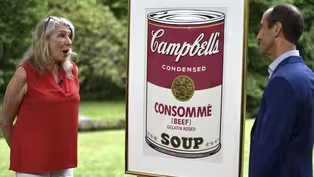
APPRAISER: It's actually a color screen print by Warhol... Mm-hmm.
...from the first Campbell's Soup series that he did in 1968... What?
...which is a set of ten different soup cans; all Campbell's soup cans.
Okay.
And these are based on a 1962 painted series that he had done and first exhibited at Ferus Gallery in Los Angeles.
Okay.
Just as he was shifting from his career as an advertising artist in New York to more of a fine artist.
Mm-hmm.
And Warhol got on the map and became a famous artist through his appropriation of everyday images.
Right.
And he said that one of the reasons he chose Campbell's soup early on is because as a kid growing up in Pittsburgh... (chuckling): Right.
...he was fed Campbell's soup and ate Campbell's soup all the time.
Makes sense.
So he made a, a set of ten different subjects, ten different soups, in the first Campbell's Soup series, number one, in 1968.
These were done in an edition of 250 each of the prints, and each of them are signed in ballpoint pen and ink and numbered with a rubber ink stamp.
Right.
Now, he was very well-known when these were made.
And the reason why he made them in the late '60s based on a painted series from the early '60s is that he could make multiple images of them, and using screen print... run off a lot, and ten times 250, you have 2,500 prints to be sold from this series.
Not bad, yeah.
So, cashing in on his growing popularity.
These were printed in New York and published through Warhol's publishing outfit called Factory Additions.
Mm.
Even though he was well-known at the time, a lot of people viewed these as prints and sort of common images, not of great value.
What did he sell them for originally?
Originally, a couple hundred dollars.
Couple hundred dollars?
Yeah, wow.
Yeah.
Or the whole set for maybe $1,000.
Yours is in great shape.
Really?
Yes.
Great.
On a scale of one to ten, ten being the best... Right.
...you're-you're at about an eight and a half, maybe nine with this one.
Well, and it's been on a wall.
But you've kept it out... It was on the right wall.
You've kept it out of the sunlight.
Right, yeah.
I did, I did.
(chuckles) So, what would you guess?
What-what would you say is a, is a value?
(exhales) I... I am clueless, because, I mean... a-and part of it is what you were explaining, like, they're original paintings, and then there's this series of prints and that series of prints.
So I don't know where this fits in, I'm really clueless.
Well.
I've never heard of divorce gifts either.
Is that a... (laughing): I don't know.
(laughing): That's a-- that's a new thing for me.
It was a birthday gift right before the... right before he left.
Okay.
I don't know.
I think maybe we call it a guilt gift or something?
I don't know.
Guilt gift, I like that one.
Go with that.
Yeah.
In this condition, great shape, I would put a replacement value of $50,000.
What?!
Come on... that's crazy.
Oh my goodness.
I don't know-- I... I'm speechless.
Ooh, I don't know what to say.
The more common the soup-- take tomato soup?
Right.
That's a $75,000, $80,000 print.
Isn't that interesting?
Because it's tomato soup.
That's the iconic soup.
That's the iconic soup, right.
Right.
APPRAISER: It's a nice set.
It's not the first edition, but... GUEST: Oh.
...in the generation of, condition is everything in a big way, and they're in very nice condition.
I would put $100 to $150 as a, as an auction estimate.
This came from, uh... Western Virginia.
I bought it in 1968.
For two bucks apiece.
GUEST: It's a photograph of Sportsman's Park with two teams from the Negro Baseball League playing.
And Satchel Paige is on the Monarch team.
APPRAISER: My understanding is this was sitting in kind of a prominent spot in, in an old house.
Where, where was that?
(chuckling): Um, well, my family home that my dad purchased in like 1960, which probably was built around the late 1800s-- in the basement, on the old furnace, there was this photograph sitting there for many, many, many years, apparently.
I didn't notice it for a really long time, until the furnace broke down and I had to have it repaired, so.
And I think we see some of that with a lot of the dust and some of the dirt.
Yeah.
As a result of some fortuitous scheduling, Kansas City Monarchs and Satchel Paige came to town-- St.
Louis, Sportsman's Park-- to play the Chicago American Giants.
Satchel Paige wiped the floor with them, with the Monarchs.
Okay.
They won 11 to two that day on a, on a beautiful Fourth of July.
Okay.
Uh, here-here's what's very interesting about that day in St.
Louis history.
The Jim Crow laws required that African Americans sit separately, and the right side bleacher was reserved under the local, uh, Jim Crow rules.
Mm-hmm.
On this day, African Americans could sit wherever their pocketbooks would take 'em, whatever they could afford.
They would sit throughout the park.
Mm-hmm.
Just this day.
Wow.
Because Satchel Paige wanted that to be the case.
Satchel Paige, prolific baseball pitcher... Pitcher.
Athlete, but he was more than that.
He was a Jackie Robinson in many ways, in that he had fans of any race and creed.
which is why we see that the Jim Crow laws were put to bed, uh, for th-- for his coming into town.
A Hall of Famer.
He was a guy that really broke a barrier in many ways for fans of the sport.
Sportsman's Park here in St.
Louis, it was prominent in that it housed sporting events.
Baseball was really the mainstay.
Closed in 1966.
We've got the park captured beautifully in a, a pretty wide panorama.
Right.
Uh, black and white.
Now, of course, there are some condition issues.
Of course.
And again, sitting on top of the furnace, uh, that would tend to happen.
Yes.
With a bit of restoration... Mm-hmm.
Not only would it present well, but I think what you see is a really clear, beautiful image.
Have you had it valued?
No.
Okay.
As is, it's worth about $3,000.
Okay.
It would probably cost between $400 to $600 to restore.
Okay.
But I think the return, what you'd see at auction, is a range of $5,000 to $7,000.
I know you're waiting for this response-- you're kidding.
(chuckles) Oh, my gosh.
No.
I think, I think it's a-- it's a beautiful image, again, of a really important day in St.
Louis history... Absolutely, absolutely.
...in baseball history, and American history.
The Jim Crow laws, I mean, that was put to bed with the Civil Rights Act of 1964.
But on this day, it was put to bed for baseball.
Exactly.
Oh, my gosh.
So this is of... of real historical significance.
Yeah, absolutely.
Great, wonderful.
Oh, my gosh.
Makes me happy.
Yeah.
Very happy.
Same here.
Thank you so much.
This is seriously giving me chills right now.
It's, it's a great piece.
Absolutely.
They belonged to my great-grandmother.
Um, she worked for the Department of War and, uh, Department of Labor, and that she was a pack rat.
And, I mean, she just, she loved to collect things.
How many of them are there?
I'm... guessing about 50.
I pulled out a couple of very specific and interesting pieces to talk to you about.
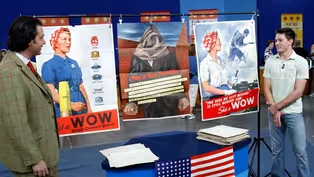
The ones on either end are a very famous figure in American World War II history.
It's Rosie the Riveter.
And one of the reasons why I love these posters so much... Uh-huh.
is that she is such a popular character... Mm-hmm.
...and her image is so well-known, but you actually very seldomly see the posters.
Uh-huh.
Now, these are advertising the Women Ordinance Worker... Okay.
... program where women were making shells in factories while the men were away.
And in fact, the one that's closest to you says, "'The girl he left behind' is still behind him."
Very, very popular and surprisingly, really rare in the world of World War II posters.
Okay.
Now, very differently is the poster that's in the middle here.
Now, this poster is by a very famous artist whose name is Ben Shahn, and his name appears on the poster.
And the story behind this poster is a page right out of your history class.
Okay.
In 1942, the Czechoslovakian resistance assassinated... Mm-hmm.
...uh, Heydrich, who was one of the high commandants in the Nazi army, uh, in Czechoslovakia.
Okay.
And in retaliation, the Germans liquidated an entire village in Czechoslovakia.
They killed all of the men and deported all of the women and children to concentration camps.
Okay.
The town was called Lidice, and this poster is so somber and so grim, of a-- of a shackled man with his head in a bag up against a brick wall.
And it's meant to look sort of like a radio dispatch saying what happened.
Now, another image is this image up front, and it seems like a very simple poster.
It says, "give it your best."
It was meant to increase production in factories.
Okay.
The poster is not signed, but we know that it's by a very famous artist named Charles Coiner.
And this poster, because of its clear and obvious patriotism, is actually also very desirable on the market.
Finally, I want to show you something that I've never seen before.
And this is a group of posters for something called the O.P.A.
And the O.P.A.
is the Office of Price Administration... Okay.
...which existed during the war specifically to keep people from profiting on, uh, gasoline, on rent.
And these are a very creative, very modern series.
They really-- they don't seem like they're from 1945.
Uh, they seem much more recent.
I've never, never seen them before.
And in fact, only just today when I went online to do some research, learned what the O.P.A.
was.
I'd never heard of the Office of Price Administration.
Okay.
So I think these are very exceptional.
If I had these posters at auction, I would appraise them in the following way.
The two posters of Rosie the Riveter, uh, each by Adolph Treidler, by the way, a very famous artist.
Right.
I would estimate each one at $1,500 to $2,000.
Okay.
The Ben Shahn poster, I would estimate at $800 to $1,200.
Okay.
The Charles Coiner-- "Give it your best," the American flag-- I would estimate at $700 to $1,000.
Okay.
And all of these posters for the Office of Price Administration, as a group, I would estimate this group alone at $1,500 to $2,000.
Oh, cool.
Okay.
So, together now, we're looking at between $6,000 and $8,200.
And that's just for the ones we're looking at, not for the other ones that are in the pile.
Okay.
Great.
How does that sound for a piece of history?
That sounds great.
I had no idea.
GUEST: I bought this 14 years ago from the original owner's son.
He kept the original bill of sale, and the one where he paid it off a year later.
APPRAISER: And that was in...?
July 28, 1956, on the bill of sale.
1956.
And that was, uh, right here in Mobile?
Right in Mobile.
Right in Mobile.
Okay.
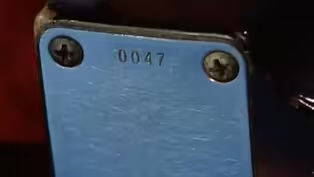
Well, this is literally the 47th one made, excluding prototypes, that would actually place it in the year 1954.
Any idea of the value?
I paid $3,000 for it.
$3,000?
I paid a lot of money for it.
14 years ago.
Mm-hmm.
Well... today, a 1954 Stratocaster would be valued at auction between $50,000 and $70,000.
Unbelievable.
Great piece, thanks for bringing it in today.
Oh, thank you very, very, very much.
Yeah, my pleasure.
My grandfather was from Galveston and went to college in Connecticut.
Met and married my grandmother, whose family still had the royal charter on her home.
When she returned to Texas, she brought ancestors with her.
Her great, great, great-aunt and uncle.
His name was Frederick Seymour, and his wife was Prudence Miner.
Her picture was done in 1799.
His was done three years earlier, and they've descended in the family ever since.
And where did they live, Peter?
He was a sea captain and merchant in Hartford, Connecticut.
She was from New London, Connecticut.
And you know a little bit about the artist.
And can you tell us?
Well, I'd not known anything until an article in the magazine "Antiques" found a woman name of Mary Way from New London.
And I wrote a letter to the author of the article.
He felt it was an easy attribution to Ms.
Way.
That's about as far as I can go with it.
Well, this is an example of, of wonderful things coming in a small package.
Mary Way was a very, uh, versatile American artist, specializing in portrait miniatures.
And what is so marvelous about her work is she's the only American miniaturist that we know of that worked in a three-dimensional manner... Hmm.
...called dressed miniatures.
She managed to create a three-dimensional effect by painting in watercolor, and then actually picking out the clothing with scraps of fabric that she would cut and fold and then touch up with paint on top of that.
Neither of these are in their original frames, but the detail and the wonderfulness of Mary's technique certainly shines.
In her portrait, we have this incredible ability to pick out detail.
The hat, its many layers, its see-through quality.
And down on the arm, her dress actually has sleeves of a very light gauze material, and you can just make out little details of flowers which are embroidered into that gauzing.
This is an incredibly difficult thing to do effectively.
She certainly deserves her newfound fame as one of the great women artists, as well as American, uh, miniaturists... Hmm.
...of the late 18th, early 19th century.
She was born in 1769 in New London, and died there in the early 19th century.
They are superlative examples and I would conservatively estimate that these would be in the $20,000 to $30,000 range.
Yikes.
(chuckling): Heavens.
Nice to know.
Yes, I had no idea.
Well, you've started off well by having them properly, professionally conserved and I know you'll treasure them.
I certainly will.
Thank you so very much.
GUEST: Captain William A. McClellan is my second-great-grandfather.
He served in the Union army in the Civil War.
He started out as a second lieutenant in Company D, the 84th Indiana Volunteers.
Throughout the course of the war, he elevated in rank to-- when he mustered out, he was a captain.
The quilt has come down through my family.
We believe that it was actually made for the period of time when he... was attending the reunions of the Grand Army of the Republic.
I looked him up in the census and recognized that he was a farmer.
Mm-hmm.
And, that struck me as interesting, because most officers, when they mustered in as a lieutenant or a captain, they had some above average education.
McClellan was 25.
Yes.
I don't know if you knew that when he mustered in, which was relatively old.
Mm-hmm.
And that may be why he mustered in as a second lieutenant, in a position of authority.
The 84th was a Western theater group.
Your feeling about the quilt, that it is a post-war quilt, I think is probably correct.
I think that you're right, that it probably has something to do with the G.A.R., or the Grand Army of the Republic... Mm-hmm.
...which of course is the Union soldiers' veterans organization that... Organization.
...that started up not long after the war ended.
Yeah.
So it may have been made for his participation in G.A.R.
encampments.
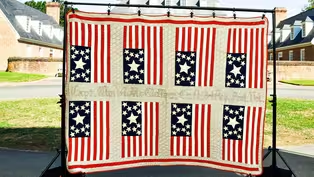
The flags make this quilt.
Flags in... in themselves are, are often incorporated into quilts.
Mm-hmm.
But this particular example is really, really striking.
Have you ever thought about, "Gee, I wonder what this thing could be worth?"
Maybe $1,000.
In the right kind of auction, with historical items... Mm-hmm.
...that related to the Civil War or American history, this quilt would probably sell for $10,000 to $15,000.
Now, that's to someone potentially who is an Indiana Civil War collector.
Civil War, yeah.
It might even sell for more in an auction of folk art and Americana to someone who is a quilt collector.
Collector.
I would probably feel pretty comfortable telling you an insurance value of this would be $20,000.
Wow.
When my mother gave it to me, it was like, "Wow.
(laughing): Why did you keep this hidden all these years?"
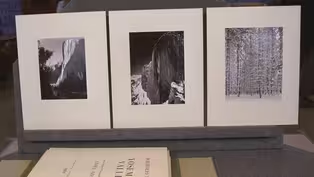
Well, this is a, uh, portfolio that I purchased from, uh, Ansel Adams in 1964.
Uh-huh.
Um, I went to my first museum job, And I thought, "This would be a great opportunity just to have a small exhibition of Ansel Adams' work."
And so I wrote him and we bought the portfolio.
These are three representative images from a portfolio of 16 photographs that Adams did of the Yosemite Valley.
These photographs were done over a period of almost 40 years.
In 1926, Adams took his first trip to Yosemite, made some photographs at that point, and continued to go back.
Now, what's important is that they're signed by Adams.
They're also archivally mounted.
Adams was very concerned with the proper presentation of his photographs.
He developed the craft of very fine photographic printing.
And these prints were done around 1960.
So they're referred to as modern prints that Adams crafted from the original negatives.
And as he made these later prints, he reinterpreted them.
And in many ways, they're very symbolic, I think, of his passion for the environment and making people aware of the American landscape.
What did you pay for these images when you acquired them?
The, uh, portfolio was $100.
$100.
In 1964.
At auction, I would estimate the 16 photographs in the portfolio at $30,000 to $50,000.
(laughing) Oh!
A bit different from it's, uh, 1964 price.
It's a Norman Rockwell artist print, and it's signed.
I bought it at an auction.
I paid $3,250 for it.
I think the original hung in, uh, the White House for a period of time during the Obama administration.
And this young lady now is grown, and she was there for the installation in the White House.
So I thought it was pretty interesting.
I've never seen this grouping of early NFL football memorabilia before.
Oh my gosh.
You're looking here at the contract that your husband's grandfather had from George Halas signed by George Halas... Right.
...for the first year of the NFL in 1922.
This is the first year.
You look at these charms, though, these charms were from championships, but this is the Western Championship from 1923, because those two years, they came in second to the Canton Bulldogs, which were led by Jim Thorpe.
So this is amazing treasure trove of memorabilia.
And if I were going to put an estimate on it at auction, for the whole group, $8,000 to $12,000.
Oh, my.
(laughs) You know, it's from Chicago, but it belongs in Canton.
GUEST: I went to answer an ad in a penny saver for a mattress set, and I was a starving student in college.
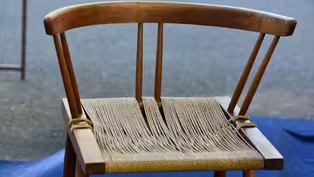
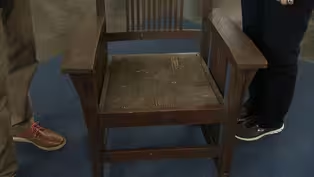
I went to go buy the mattress set, and I saw the chair, and I just fell in love with its design.
And she allowed me to sit in the chair, the owner, but she told me it's not for sale.
And so I said, "Oh, my goodness, I love this chair."
She said, "I'd only sell it to the right person."
I left her my name and my number.
A couple weeks later, she called me and she said, "You're the person."
And she said, "How much could you afford?"
And I said, "Maybe $25."
And she said, "Okay, um, how about $23?"
(chuckling): And so that's what I bought the chair for.
And then a couple years later, I was in a bookstore, and I was looking at a book about Nelson Rockefeller's house.
And there is the chair.
I found this name, George Nakashima.
I just love this chair.
I love the design, and I've used this chair.
It's not something precious.
It's something a part of my life, and it's in my living room.
It is very early in his career, in the late '40s, after he was interned during World War II in a Japanese camp, he was exposed to Japanese traditional woodworking techniques there.
His first designs, of which this is one of the first designs, had a very strong Japanese traditional feel to it.
Hundreds and even thousands of years of Japanese woodworking had really remained unchanged.
And George was taking those techniques, honoring them, but then shaping that tradition gently towards modernism.
And what this chair is, is it's a very elegant, sophisticated, modern version of a traditional Japanese crafted chair.
By the time he died in 1990, he had been making them continuously for over 40 years.
And his daughter, Mira, is continuing that tradition and making them today.
So there's quite a lot of them that, that are out there.
There are also quite a lot of people who wanted to make chairs that looked like George's.
So how do we know that this is by George?
I don't know.
A couple of little small details.
The grass seat is original.
This is seagrass that's tightly woven, which is a traditional Japanese technique.
It's completely put together with wood pegs.
There's no metal screws or any, uh, kind of nails.
This is all crafted by hand.
You can see that these, uh, side rail spindles here are pegged right here on the side.
That's a traditional woodworking technique, but George had a very specific way of creating those and attaching them to the rest of the structure.
Also, these side rail spindles are shaped by hand, the legs, which are also hand-turned.
Some chairs by other makers never have those types of subtle details.
So this chair is by George Nakashima.
That's great.
Uh, and it's known as the grass seat chair.
And it's very hard to date it, except by looking at the patina.
The original oiled finish is a little worn, but it has a really wonderful, warm patina.
And what year did you buy it?
1986.
1986, so George was still alive, uh, at that time.
Yes.
They were made exactly the same between the late '40s and the time you purchased it in 1986.
But I would think that this chair is probably from the mid-1960s.
The wood is American black walnut.
These were made in New Hope, Pennsylvania.
You paid $23 in 1986-- what do you think it's worth today?
(sighs) Okay, I'm going to just go for it, I'll say... $2,300?
That's a pretty good guess.
This chair, at auction, typically sells for between $2,000 and $2,500.
Okay!
Uh... Thank you so much.
Yeah.
They're rarely marked.
I've probably sold 100 of these chairs.
Really?
Over 30 years and I have never seen one that was marked.
GUEST: This piece was given to me by my dad.
I was told that great-grandma was the one that did the beadwork.
APPRAISER: Your father's great-grandmother?
Yeah.
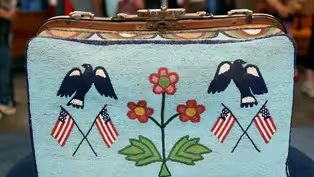
This bag, uh, is really from the golden age of pictoral beadworks in the Dakota area, which is really 1890 to about 1910.
It comes from the Standing Rock area.
Now what we see are these fantastic pictoral elements with the eagle and the flag.
And this is diagnostic for one of the families that beaded up in there.
And there were two real important families.
One was Claymore.
And the other was Nellie Gates.
This was made by the Claymore family.
And they're very collectible.
Now I'm going to turn this slowly so that our audience can see what fantastic elements.
We have this sort of beaded rainbow element here, which is also typical of this, of this period.
And then again on this side we see more floral.
Which is just beautifully executed.
And we see that it's just fully beaded.
Now we have some condition problems up here on the top.
That should be fixed and it should be cleaned, but only cleaned by a professional.
Would you be depressed at all if I told you that this bag was worth $40,000 to $60,000 at auction or at a good gallery?
Wow.
Would you smile?
I guess!
(both laugh) GUEST: I brought you a series of letters that were signed by abolitionists.
They were invited to the 100 year anniversary of the Free Will Baptist Church.
And the letters in the back are those that could not attend the ceremony in Weare, New Hampshire.
I inherited it from my father who inherited it from an elderly gentleman he befriended.
The title of this book is the "Centennial Record of Free Will Baptists, 1780 to 1880."
It was published in 1881 and it's a record of the convention or the celebration that the Free Will Baptist Church held in 1880 to celebrate 100 years from their founding.
This copy seems to belong to a gentleman named William Foss who may have been an attendee or an organizer.
He collected all of these things and put them together, like a scrapbook.
The Free Will Baptists are a denomination within the Baptist church was an important abolitionist organization.
Not only did they agitate to end slavery in America, they also provided important assistance to enslaved people after they escaped from the south and moved upwards through New England.
And in the back are bound-in photographs.
I love this photograph of the building of the Free Will Baptist Church that was built in 1819.
And then as you said, several letters, from really prominent abolitionists are bound-in.
People who were invited to this ceremony but for one reason or another, were not able to attend.
The first one is from Frederick Douglass, who is one of the most prominent abolitionists.
A former slave who became one of the most prominent writers and speakers of the abolitionist movement, and he was invited and not able to make it.
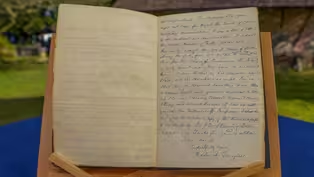
But he wrote this incredible letter in which he specifically said, "When I escaped from slavery "42 years ago and sought liberty in New England, "the Free Will Baptist churches were about the only churches "open as a rule for the advocacy of the cause of the slave.
"You were not ashamed of the negro's cause "when it was hated and despised, when he was persecuted and mobbed from city to city."
It's a two-page letter, and you can see his signature down here.
Right behind Frederick Douglass is a letter from Harriet Beecher Stowe, who is the author of "Uncle Tom's Cabin."
She was also invited, could not make it.
She talks about having used the records of the Free Will Baptist Church to write "The Key to Uncle Tom's Cabin," which was the follow up book.
There was a lot of criticism of "Uncle Tom's Cabin" that it was fictionalized and romanticized and therefore not something we should take seriously.
And so she wrote another book to say, no, here is the evidence that supports the drama that I included in my book, and there's also a letter from James Garfield.
His letter is not as exciting because he basically says, "I'm, I can't attend, I'm too busy."
But he was too busy because he was running for president.
(chuckles) This is really a terrific memento of the abolitionist movement.
The Frederick Douglass letter, even though this letter is a little bit later in his career, the fact that he mentions his escape from slavery puts this letter in a much higher tier.
It's not hard to find something signed by Frederick Douglass.
There are all of these government documents are signed by him.
It is hard to find a letter in which he talks so eloquently about his struggle and about the people who helped him along the way, which this does.
At auction, I would put the Frederick Douglass letter, if-if you just had it by itself, the Frederick Douglass letter would be $50,000 to $70,000.
(chuckling): Right?
The Harriet Beecher Stowe, also very popular, would be $3,000 to $5,000.
And the rest of the materials would probably be another $2,000 to $3,000.
So at auction, the entire book, I would say $55,000 to $75,000.
If you wanted to insure it, you should put it at a minimum... ...of $110,000.
Deep breath.
(chuckles) Deep breath!
Thank you.
Thank you very much.
You're welcome.
A lot more than I thought.
It's a big deal.
It's a really big deal.
It's such an incredible piece of American history.
I love it.
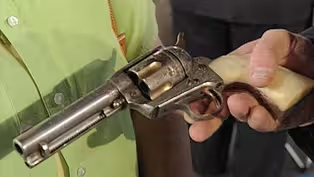
APPRAISER: It is a Colt Single Action Army revolver, also known as the Peacemaker-- this gun, um, from the serial number, uh, appears to be somewhere around the 1880s.
All of these would have been extras.
The engraving, the gold wash, the mother of pearl grips.
GUEST: It was simply listed as an Ub Iwerks drawing from "Steamboat Willie."
This was $40.
Wasn't sure if it was authentic.
I took a chance.
It is certainly authentic.
"Steamboat Willie"" is one of the most iconic Disney cartoons.
It was done in 1928.
Mickey is playing, like, a xylophone on the cow's teeth.
Right.
Right.
Value-wise... Mm-hmm.
...we would put a pre-sale estimate at auction of $2,000 to $2,500.
Wow.
(laughs) It's a wonderful, charming drawing.
Thank you for bringing it in.
Thank you.
Appreciate it.
GUEST: My mother gave me these, but she got them from her mother, my great grandmother's sister married George Ohr.
APPRAISER: Wow.
And so these were made by...?
George Ohr.
Did you ever meet any of his family?
Did you ever go there?
Yes.
I met what I believe was his daughter.
They lived out in the country and I went with my mother and my aunt.
And I remember, like, a, a house and a barn.
Uh-huh.
Maybe a barn setting.
It was a rural setting.
Sure.
And I saw, like, shelves of pottery and I went inside their house for a little while.
It wasn't any mansion, that's for sure, it was just regular people.
Right.
The pottery, was there a lot of it?
Did you see it?
Did you re-- have any memories of that?
Yeah, and from what I can remember, it was, like, on tables, and it was on shelves.
It was everywhere.
And just stacked everywhere.
Yes, sir.
And the family just didn't think much about it?
No.
(chuckles) They did not.
No.
Isn't that interesting?
Tell me about these pieces here.
Well, as far as I know, I have a rabbit ear puzzle mug.
Then that particular puzzle mug, it's got a strange kind of etching on the handle.
Uh-huh.
And then the little house over there is an inkwell.
Yes, that's correct.
And then a pitcher.
Okay-- George Ohr made lots of puzzle mugs.
A puzzle mug has little holes in the handles and in the rim, but there's a hole at the bottom of the handle.
And so to drink out of it, you tilt the mug, and then you have to put your fingers over certain holes.
Ah.
And then you can... ...usually suck one of the holes and get the liquid out-- but you have to know the puzzle, and I don't know what it is.
(laughs) Okay.
But there is a trick to drinking out of it without spilling it.
So that's, that's why it's called a puzzle mug.
Okay.
And then the pitcher is a little unusual for George Ohr in that it's really utilitarian.
Most of his stuff was decorative.
What I really love about the inkwell is it's, is the shape of a house, exactly what was like in his community.
With even doors and windows, the roof line.
And I think it was a really interesting design that he made it like that.
Now, there's a number of different marks that he used.
And one of the examples of the marks is actually on the house.
He just scratched in hand.
He put Biloxi.
He also sometimes signed by hand.
Right.
So this one has his name, George Ohr, which he signed in script, and the other two have the same mark.
The impressed mark there was like a little die stamp that he pressed into the clay with his name and Biloxi.
Now, the date of all these pieces, they were made by George Ohr between about 1895, about 1900.
What year were you there?
'59, '60, possibly.
Okay, yeah.
In about 1969, a man came down from the Northeast and bought most of that pottery and hauled it off.
So you saw it before he hauled it all off-- the mugs, you could look online and see some kind of high prices.
And the prices on Ohr has fallen a little bit; in some cases more than others.
But since those are relatively common, actually, these days, they only sell for normally around $500 to $750 apiece.
The pitcher has a few little damages, which is not that unusual for Ohr.
A lot of it does have a little damage, but it would still be worth between $1,250 and $1,750.
And then the inkwell is the best piece, and that one would probably sell for at least $2,500 to $3,500.
And so the collective total would be somewhere between $4,750 and $6,750.
Okay.
However, if it went to auction, the family connection, the provenance might bump the price up a little bit more.
I see.
How much do you think all that pottery is worth now that you were looking at?
That I was looking at then?
Millions.
You got it.
Millions.
We talked about it.
I talked about it with some of the other appraisers, and we estimate all that pottery is now worth somewhere between $50 and $100 million.
Wow.
That's a lot of money.
As a little girl, if you had known that.
(laughing): Yeah!
GUEST: My mother said this was a scarf worn at George Washington's inauguration.
He did not wear it.
The men got these, and the women got the earrings.
You have some distinguished ancestry, I should put it, right?
I do.
Entirely possible that you would have, uh, some family member that went to that ball, right?
Yes.
But you don't know whi-- exactly which one, right?
No.
Okay, we are looking at this now framed and-and folded, a silk banner that probably was seven feet long if you extend it.
And it's all folded under itself right here, it's really long.
I did not realize that.
When this showed up, I was so excited, because, first of all, I love American folk art.
Uh-huh.
I also love American history.
Right.
This piece combines a great folk design... Right.
...with great history.
So, as you know, President Washington was inaugurated on April 30, 1789.
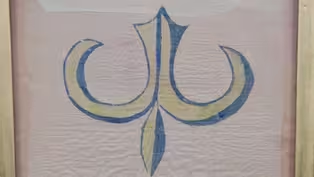
A week later, they held a big ball down near Wall Street in New York, for the president-- we have this American eagle, painted eagle on the silk.
And it's a classic stance with the laurel branch in one claw symbolizing the peace, and the other claw, the arrows symbolizing strength.
And the eagle's banner here says "E Pluribus" written out in gold.
There are 13 stars above that in yellow with blue outline.
And up here, it looks like an abstract design.
Somebody else actually pointed out, I can't take credit, this is "G," and this is a "W."
Oh, my heart.
For George Washington.
That's fabulous.
Isn't that great?
You never, you never... No, it's better than fabulous.
And it's better than fabulous because the "G."
If you look sideways.
I see the "G."
And then the-the "W" for George Washington.
They're probably silver little spangles with glass beads.
Right.
Each one is carefully sewn over the star... Oh... ...for "G.W."
and the 13.
That's... that is so exciting.
Isn't that neat?
And above it, Oh, yeah.
the French, like, like a fleur-de-lis.
A fleur-de-lis!
Now, a week after the major ball... Yeah.
...Count de Moustier had another ball, the French count... De Moustier!
...for Washington-- De Moustier!
Now, we don't know, we certainly can't prove it because these relics are so rare.
And to my knowledge, no other of these banners exist.
But it's very possible that a banner like this would have been at that ball a week later.
And I've checked with several experts here, The silk, the fine silk is of the period.
The spangles.
It's all right.
I've got good news and bad news-- which one?
Which one do you want first?
(chuckling): I, I think I'll take the good news today.
You want the good news first?
Okay, I think that's a good way to do it.
The value, on a, on a bad day, would be $3,000 to $6,000, and this is the kind of object that, in the right situation... Right.
...could bring $10,000, $15,000 at an auction setting.
Now, I'm going to give you the bad news.
These are costume jewelry from after 1900.
So they aren't...?
They, they didn't... Mother lied to me.
They didn't make clips like this... Okay.
...uh, th-this ear clip until after 1900.
So, you know, and al-- Okay, oh, that's interesting.
Yeah, and also, the metal's not gold, and it's not even enamel, so they're nice decorative ear clips.
But, so these weren't made for... So I can wear them without feeling like I'm... ...all right.
You can wear them without worrying about losing them as much, you know, but this, you want to... Yeah.
Yeah, yeah, yeah.
Yeah.
...you want to really preserve as you've always done.
I'm excited, really.
I just love it.
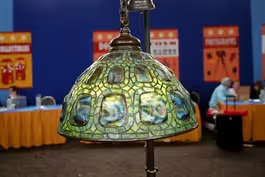
Well, I more or less inherited it when my grandfather passed away in 1964.
It was purchased directly from Tiffany.
Actually, my grandfather purchased four lamps on February 11, 1915.
Which lamp is this lamp?
Uh, the one valued at $90 at the time.
He picked the cost.
And $90, and so that was the dining room lamp.
That was the dining room lamp.
I also noticed that you brought a photograph of it hanging in the dining room-- what, what year would you say this was?
Uh, that is 1967, and that was Christmas Day.
And that's my mother, my father and a cousin of mine.
Oh, that's great.
Well, I want to tell you, Tom, that this lamp is the stuff that Tiffany dreams are made of.
It has everything going for it.
It's had two owners.
Your grandfather and then you.
Yes.
And it came directly from Tiffany Studios.
It has the original patina.
It has something also very special, which is the original hardware.
Oh.
Many times when people removed hanging Tiffany shades from homes, they took the shade and they left the hardware behind.
And probably 90% of the hanging shades out there today do not have their original hardware.
But you have that, and that actually adds value to the lamp.
Oh.
This is called a Turtle Back glass lamp.
Okay, I've heard that term.
There are green Turtle Backs, red Turtle Backs and yellow Turtle Backs.
This is probably one of the nicest green Turtle Back lamps I've ever seen.
And it is signed, but I'm not even going to show you the signature, mainly because this lamp is a signature in itself, it's just 100% right.
Do you have any idea what it's worth?
I was told about 25 years ago that, uh, somewhere between $12,000 and $15,000 at that time.
Okay.
If this were for sale in a retail shop, I could see it selling easily for $150,000.
(chuckling): You're kidding.
No, I'm not!
(laughs) Alls I can do is say thank you.
I appreciate it.
Thank you.
So, thank you.
Thanks for bringing it, it's gorgeous.
Thank you very much.
Wow.
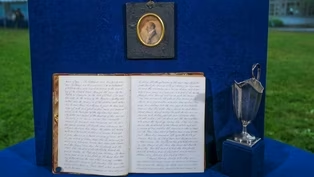
Today I brought a cream pot forged by Paul Revere and a diary belonging to Thaddeus Harris and his portrait.
And he was the son of the person who actually, of the man who owned this cream pitcher.
Yes, William Harris.
So the diary's depicting the night that they left Charlestown because they got intel that the Regulars were coming.
When you say the Regulars, that means the British, British Army.
The British, yeah, the British Army.
So they grabbed a bundle of important papers, and some linens, some silver plate, this cream pot, and some spoons and fled to Lexington.
They didn't stay there long because the Battle of Concord and Lexington had just happened... Mm-hmm.
...on April 19, 1775.
And so they left Lexington and went out to Sterling, Mass.
where they felt that they were safer.
Okay.
Paul Revere, of course, is the one maker of colonial silver that any collector would really want to have.
By colonial silver, I mean silver made before America became the United States, when it was still the 13 colonies and owned by England.
Mm-hmm.
Paul Revere was a silversmith in Boston.
His father had also been a silversmith.
This pitcher was probably relatively new at the time that this, uh, incident occurred.
It's, uh, neoclassical in style.
It's a helmet form pitcher, and it's got some very lovely engraving on outside of it with some initials uh, showing who it belonged to in the family, and then the mark of Paul Revere Jr.
on, on the back of the foot.
Mm-hmm.
A similar creamer sold this year, 2025, for a little over $25,000.
I think with the archival material that you have, the story of it relating to having been something that was saved from being stolen by the British army makes it a very interesting story and adds some value to it.
I would say that if this were to come up at a public auction of American silver, the pitcher, combined with the archival material and the miniature portrait would bring in the neighborhood of $25,000 to $30,000.
And as it's property of your family and has historical importance to your family, I'm sure you're not going to sell it.
So I would put an insurance value of $40,000 to $60,000 on it.
Wow.
It's amazing.
PEÑA: Thanks for watching this special episode of "Antiques Roadshow."
Follow at @RoadshowPBS on social, stream full episodes, and sign up for our newsletter at pbs.org/antiques.
See you next time on "Antiques Roadshow."
Preview: 250 Years of Americana
Video has Closed Captions
Preview: S30 Ep22 | 30s | Preview: 250 Years of Americana (30s)
Appraisal: Paul Revere Jr. Silver Pitcher with Diary, ca. 1775
Video has Closed Captions
Clip: S30 Ep22 | 2m 46s | Appraisal: Paul Revere Jr. Silver Pitcher with Diary, ca. 1775 (2m 46s)
Appraisal: F. Douglass Letter & Free Will Baptist Archive
Video has Closed Captions
Clip: S30 Ep22 | 4m 49s | Appraisal: F. Douglass Letter & Free Will Baptist Church Archive (4m 49s)
Appraisal: Flag Quilt, ca. 1880
Video has Closed Captions
Clip: S30 Ep22 | 2m 43s | Appraisal: Flag Quilt, ca. 1880 (2m 43s)
Appraisal: Tiffany Studios Turtle Back Glass Shade
Video has Closed Captions
Clip: S30 Ep22 | 2m 22s | Appraisal: Tiffany Studios Turtle Back Glass Shade, ca. 1915 (2m 22s)
Appraisal: WWII Propaganda Posters
Video has Closed Captions
Clip: S30 Ep22 | 3m 50s | Appraisal: WWII Propaganda Posters (3m 50s)
Appraisal: 1775 Abilmeleck Uncus-carved Powder Horn
Video has Closed Captions
Clip: S30 Ep22 | 3m 10s | Appraisal: 1775 Abilmeleck Uncus-carved Powder Horn (3m 10s)
Appraisal: Washington's Inaugural Ball Sash, ca. 1789
Video has Closed Captions
Clip: S30 Ep22 | 3m 33s | Appraisal: Washington's Inaugural Ball Sash, ca. 1789 (3m 33s)
Appraisal: 1954 Fender Stratocaster
Video has Closed Captions
Clip: S30 Ep22 | 51s | Appraisal: 1954 Fender Stratocaster (51s)
Appraisal: George Nakashima Grass Seat Chair, ca. 1965
Video has Closed Captions
Clip: S30 Ep22 | 4m 2s | Appraisal: George Nakashima Grass Seat Chair, ca. 1965 (4m 2s)
Appraisal: 1968 Warhol Campbell's Soup Can Screenprint
Video has Closed Captions
Clip: S30 Ep22 | 3m 18s | Appraisal: 1968 Warhol Campbell's Soup Can Screenprint (3m 18s)
Appraisal: Colt Single-action Army Revolver, ca. 1880
Video has Closed Captions
Clip: S30 Ep22 | 21s | Appraisal: Colt Single-action Army Revolver, ca. 1880 (21s)
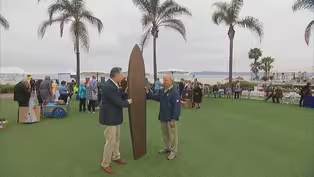
Appraisal: Women's Carved Surfboard, ca. 1925
Video has Closed Captions
Clip: S30 Ep22 | 1m 4s | Appraisal: Women's Carved Surfboard, ca. 1925 (1m 4s)
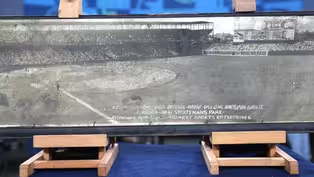
Appraisal: 1941 Sportsman's Park Panorama
Video has Closed Captions
Clip: S30 Ep22 | 3m 11s | Appraisal: 1941 Sportsman's Park Panorama (3m 11s)
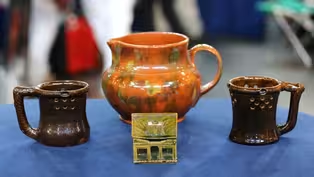
Appraisal: George Ohr Pottery, ca. 1900
Video has Closed Captions
Clip: S30 Ep22 | 4m 37s | Appraisal: George Ohr Pottery, ca. 1900, in New Orleans Hour 2. (4m 37s)
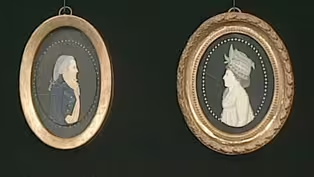
Appraisal: 1796 & 1799 Mary Way Dressed Miniatures
Video has Closed Captions
Clip: S30 Ep22 | 3m 11s | Appraisal: 1796 & 1799 Mary Way Dressed Miniatures (3m 11s)
Appraisal: 1960 Ansel Adams Portfolio III
Video has Closed Captions
Clip: S30 Ep22 | 2m 16s | Appraisal: 1960 Ansel Adams Portfolio III (2m 16s)
Appraisal: Gustav Stickley Armchair, ca. 1905
Video has Closed Captions
Clip: S30 Ep22 | 34s | Appraisal: Gustav Stickley Armchair, ca. 1905 (34s)
Appraisal: 1884 Edison Light Bulb & Plaque
Video has Closed Captions
Clip: S30 Ep22 | 2m 36s | Appraisal: 1884 Edison Light Bulb & Plaque (2m 36s)
Appraisal: Claymore Beaded Bag, ca. 1895
Video has Closed Captions
Clip: S30 Ep22 | 1m 55s | Appraisal: Claymore Beaded Bag, ca. 1895 (1m 55s)
Providing Support for PBS.org
Learn Moreabout PBS online sponsorship New Episode
- Home and How To

Hit the road in a classic car for a tour through Great Britain with two antiques experts.

 New Episode


 New Episode






Support for PBS provided by:
Funding for ANTIQUES ROADSHOW is provided by American Cruise Lines and Ancestry. Additional funding is provided by public television viewers.